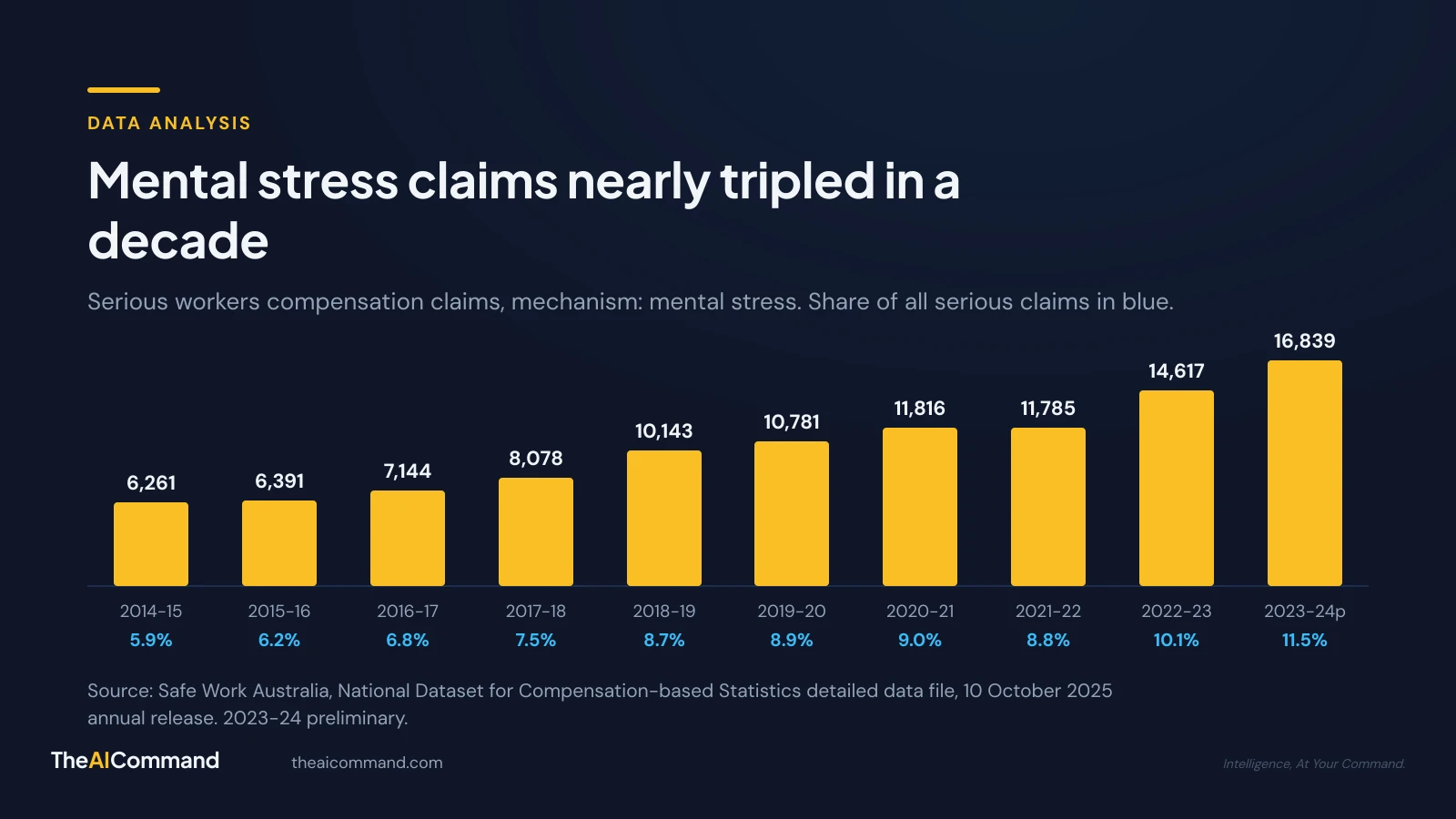
Australia's national workers' compensation data now shows mental stress producing 16,839 serious claims a year. A decade earlier the same series recorded 6,261. That is a rise of 169 per cent over ten years in which all serious claims grew 37.8 per cent, and it lifts mental stress from 5.9 per cent of the serious claims pool to 11.5 per cent: from roughly one serious claim in seventeen to roughly one in nine.
Those numbers come from the Safe Work Australia National Dataset for Compensation-based Statistics detailed data file, the 10 October 2025 annual release. They are not on any dashboard in this form. We computed them from the published spreadsheet, twice, by two independent code paths that had to agree exactly before anything entered this article. The full method, including the breaks in series and the caveats, is published below so the finding can be checked rather than taken on trust.
The ten-year series
The table below is the complete computed series. The 2023-24 year is preliminary, marked "p" by Safe Work Australia, and will be revised in later releases as open claims develop.
Two features of the series are worth naming. First, the growth is not a single spike. The count rises in nine of the ten years, and the share rises in eight of them. Second, the one visible dip in share, 2021-22 at 8.8 per cent, is largely a denominator effect: that year the biological factors mechanism recorded 10,440 serious claims, most of them COVID-19 related, which inflated the total pool. Mental stress counts barely moved that year; the pool around them swelled.
What is inside the mental stress group in the latest year? The two largest categories in 2023-24p are work-related harassment and workplace bullying at 5,596 claims and work pressure at 4,075. Exposure to violence and harassment adds 2,636, exposure to a traumatic event 1,902, and sexual harassment 281. These composition figures are a snapshot of the latest year only. They are deliberately not presented as trends, because the sub-category coding changed over the decade in ways that make decade-long comparisons unsafe. The method section explains why.
Why does each of these claims cost so much more?
The count is only half the finding. On the latest non-preliminary year, 2022-23, the median mental stress serious claim involved 36.8 weeks of time lost. The median across all serious claims was 7.4 weeks. That is a ratio of 5.0. Median compensation paid tells the same story: $69,927 for mental stress against $16,304 across all serious claims, a ratio of 4.3.
So the claims pool is not just tilting toward psychological injury in volume. It is tilting toward the single most expensive mechanism in the dataset, measured either in working weeks or in dollars. A hazard category that is roughly one claim in nine by count is a far larger share of total scheme cost and total lost working time.
Medians for the preliminary year are not published by Safe Work Australia at all, because recent claims are still open and will accrue more time and compensation. That discipline is worth copying: this analysis uses 2022-23 for all cost and duration figures rather than quoting an artificially low preliminary number.
What does a claims series from 2014 have to do with AI?
Nothing causal, and this needs to be said plainly: the series predates broad AI deployment, does not measure AI exposure, and supports no claim in either direction about what AI has done to psychological injury rates. If you see this data quoted as evidence that AI is harming workers, or protecting them, the person quoting it has gone beyond what the file contains.
The relevance is practical, and it runs through work design. Every organisation currently redesigning work around AI tools, reallocating tasks, changing monitoring arrangements or compressing role scopes, is intervening directly in the hazard categories this series tracks: job demands, job control, support, role clarity and workplace interactions. Australian WHS regulators already treat psychosocial hazards as hazards requiring identification and control like any other, and an AI-driven change to how work is allocated or supervised is exactly the kind of change that should trigger a fresh psychosocial risk assessment. New South Wales has gone further still, legislating a dedicated duty around digital work systems that algorithmically manage work.
The ten-year series is the baseline for all of that. It says the psychosocial cost curve was already steep before agentic AI reached most workplaces, that the biggest single categories are harassment dynamics and work pressure, and that each claim in this category costs around five times the median. For anyone building the business case for prevention-first AI rollout design, those are the three numbers to carry into the room. The same logic drove our read of Canberra's employment data: measure the baseline honestly before attributing anything to the technology.
How we did it
Source. Safe Work Australia, National Dataset for Compensation-based Statistics (NDS) detailed data file, 10 October 2025 annual release, downloaded 15 August 2026 from the dataset page. The file covers ten years to 2023-24, with 2023-24 preliminary. Safe Work Australia publishes the data under a Creative Commons Attribution 4.0 licence. The dataset updates annually, which is what makes this an annual series.
Versioning and revisions. The dataset page records two minor revisions since the annual release: a February 2026 update from adopting version 3.2 of the NDS specification, and a June 2026 update from data improvement work. Safe Work Australia applied both to its interactive dashboards but not to the downloadable file, and gives the 2020-21 total serious claims count as a worked example: 131,639 in the file, revised to 131,759 on the dashboards. All figures here are computed from the downloadable file as published, so they cite a stable artefact; the revision scale is well under 0.1 per cent.
Definitions. A serious claim is, in Safe Work Australia's words, "an accepted workers' compensation claim that involves one or more weeks of working time lost" and excludes all fatalities and journey claims. Mental stress is mechanism of incident group 8 under the Type of Occurrence Classification System (TOOCS). Medians for time lost are in working weeks; medians for compensation are in dollars, computed on non-zero amounts.
Extraction. Counts come from Table 4.1 of the detailed data file (claims by mechanism), medians from Tables 4.2 and 4.3. We extracted the "8 Mental stress" group row and the "Total" row for each of the ten years, plus the two-digit rows for the latest-year composition snapshot. Cells marked NP (not published) were treated as missing, never as zero.
Recomputation. Every figure in this article was produced by two independently written code paths, one in Python using openpyxl and one in Node.js using SheetJS, run against the same file with a shared output specification. The two outputs matched exactly, checksum-identical, before any figure was used. Percentages and ratios are rounded half-up to one decimal place.
Breaks in series and exclusions. Three matter. First, sub-category coding: Victoria coded mental stress claims to a single digit until it began two-digit reporting in 2022-23, and the sexual harassment code was added to TOOCS in 2021 with uptake varying by jurisdiction. Safe Work Australia's explanatory notes advise caution on two-digit mental stress trends, so all trend claims here use the group 8 total, which is unaffected; two-digit figures appear only as a 2023-24p snapshot. Second, COVID-19: the 2021-22 total is inflated by around ten thousand biological factors claims, which depresses the mental stress share for that year. Third, the preliminary year: 2023-24 counts will be revised upward as late claims are accepted, and medians for that year are not published.
What this data cannot tell you. Claims are not incidence. Safe Work Australia's own limitation note records that the dataset excludes workers not covered by workers' compensation schemes, withdrawn claims and out-of-scope claims, and not every eligible worker claims. A rising mental stress series is consistent with rising injury, but also with reduced stigma, better awareness of entitlements, broader jurisdictional acceptance of psychological injury claims, and improved coding. This analysis reports what the claims data shows and attributes no cause.
Do this Monday
- Pull your own mechanism split. Ask your insurer or claims team for your organisation's serious claims by TOOCS mechanism for the last five years. If mental stress is growing faster than your total, you are living the national trend.
- Baseline before you redesign. If an AI rollout will change task allocation, monitoring or role scope this year, record the psychosocial claim and complaint baseline now. Without it you will never know what the change did.
- Put the cost asymmetry in the paper. A five-times median time lost figure belongs in any business case that weighs prevention spend against claim cost. Use the national numbers until you have your own.
- Treat AI work redesign as a psychosocial change. Route it through the same hazard identification and consultation you would apply to any significant change to systems of work.
- Recompute us. The source file is public and the method above is complete. If your numbers disagree with ours, one of us is wrong, and we want to know.
Bottom line
Safe Work Australia's own published file shows mental stress serious claims rising from 6,261 to 16,839 across ten years, from one serious claim in seventeen to roughly one in nine, with each claim costing around five times the all-claims median in time lost. The series says nothing about AI. It says a great deal about the baseline any AI-era work redesign inherits, and about the price of getting the psychosocial dimension of that redesign wrong.
This article is general information and education only. It is not legal, compliance, financial or professional advice. Obligations vary by organisation and circumstance. Verify current requirements against the primary sources cited and seek advice specific to your situation.
References
- Safe Work Australia, Workers' Compensation data (dataset page, release history and licence): https://data.safeworkaustralia.gov.au/our-datasets/workers-compensation-data
- Safe Work Australia, National Dataset for Compensation Based Statistics detailed data file, 10 October 2025 annual release: https://data.safeworkaustralia.gov.au/sites/default/files/2025-10/National%20Dataset%20for%20Compensation%20Based%20Statistics%20detailed%20data%20file.xlsx
- Safe Work Australia, National Data Set for Compensation-based Statistics Edition 3.2, Explanatory Notes: https://data.safeworkaustralia.gov.au/sites/default/files/2025-10/National%20Dataset%20for%20Compensation-based%20Statistics%203.2%20-%20Explanatory%20Notes.pdf
TheAICommand. Intelligence, At Your Command.