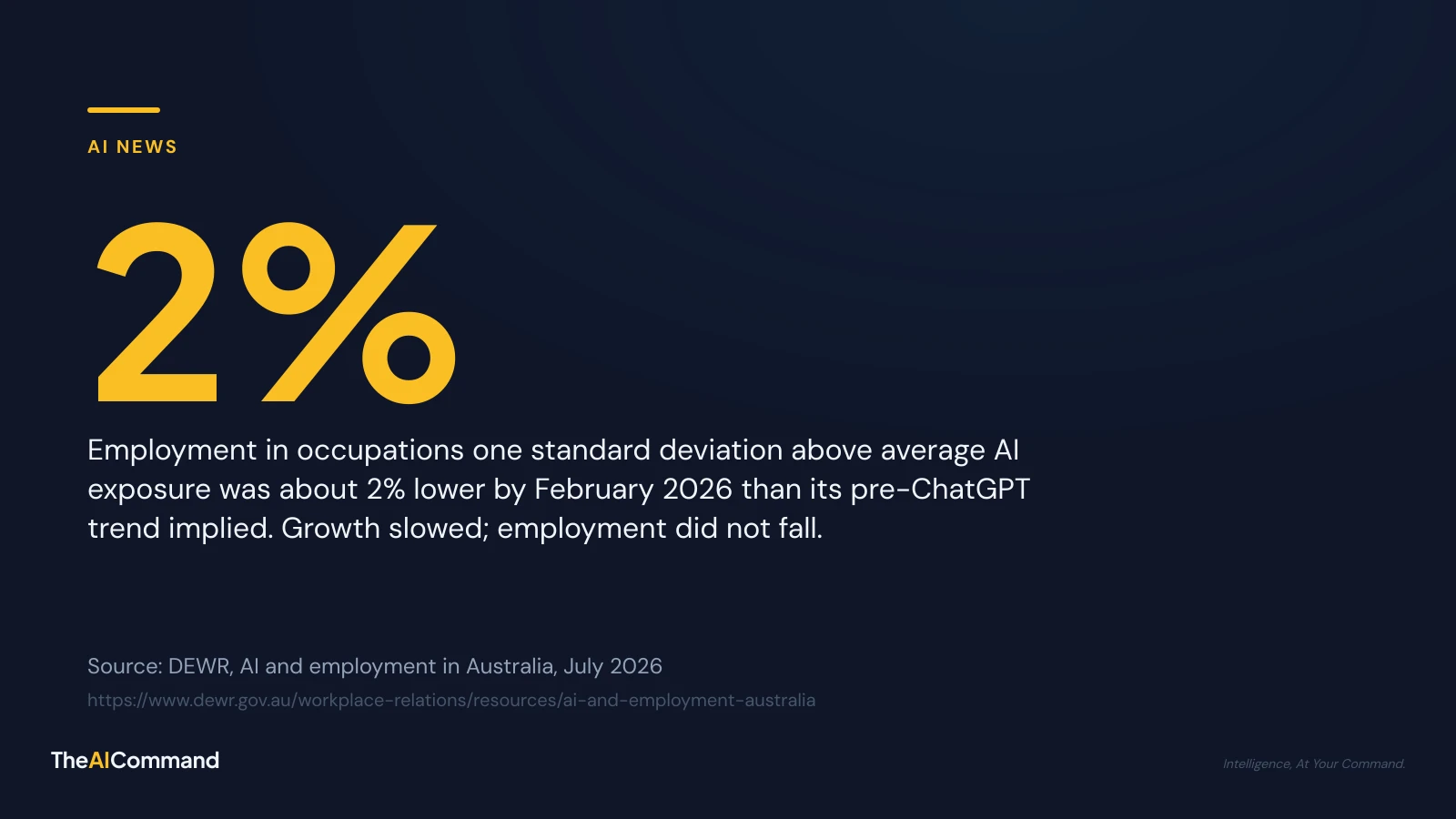
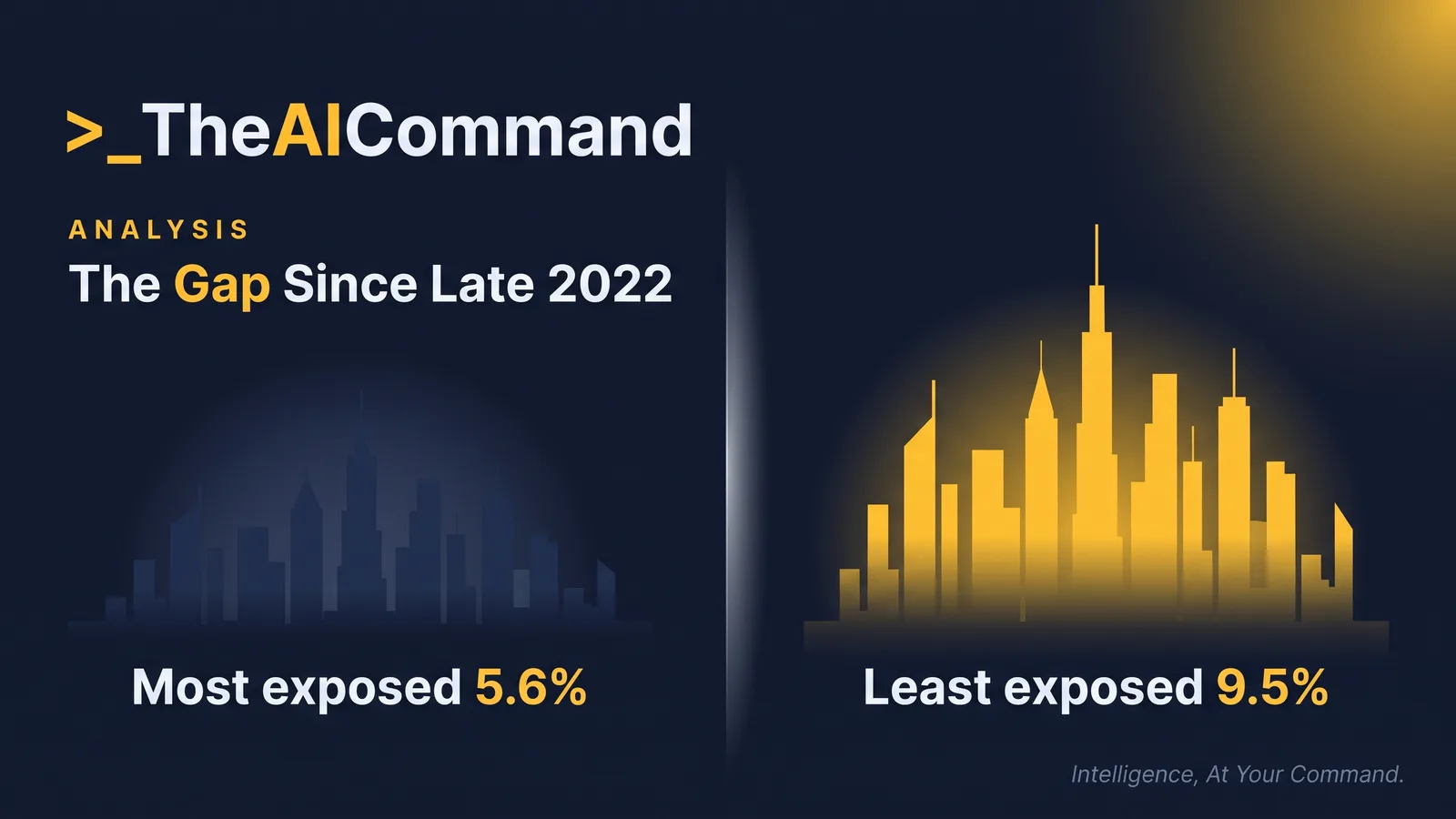
Australia's first official measurement of AI's effect on jobs has landed, and the number is small: the most AI-exposed occupations grew 5.6 per cent since ChatGPT arrived in November 2022, against 9.5 per cent for the least exposed, about 2 per cent below trend. The loudest voices in the AI and jobs debate have never had to show their working. This month, the Australian Government did.
In July 2026 the Department of Employment and Workplace Relations published AI and employment in Australia: Monitoring framework and evidence to date, the first systematic attempt by an Australian government agency to measure what generative AI has done to employment since ChatGPT arrived in November 2022. Not a forecast, not a sentiment survey, but a statistical model run over 355 occupations across 45 quarters of ABS Labour Force data, paired with a dashboard of descriptive indicators and a robustness chapter that stress-tests its own headline result.
The finding: a small, recent, strengthening negative relationship between an occupation's AI exposure and its employment growth. Just as important is the posture: a government agency building the infrastructure to detect AI-driven labour market change as it happens. For anyone managing people, risk, claims or safety, this is the evidence base your board packs have been missing.
What did the DEWR report find?
The headline contrast is clean. Between November 2022 and February 2026, employment in the most AI-exposed fifth of occupations grew by 5.6 per cent. The least exposed fifth grew by 9.5 per cent. Exposure is measured by Jobs and Skills Australia's generative AI automation exposure scores, which rate how automatable each occupation's tasks are by a large language model. Routine cognitive work scores highest; manual and care work lowest.
DEWR's core model turns that contrast into an estimate. For an occupation with AI exposure one standard deviation above average, employment by February 2026 was about 2 per cent lower than under its pre-ChatGPT trend, significant at p equals 0.018. Critically, the model finds no relationship between exposure and growth before ChatGPT, which is what you want to see before blaming something that happened in late 2022.
Around that estimate, the descriptive picture is mostly reassuring. Unemployment sits at 4.2 per cent, lower than at any point in the decade before COVID. The one soft headline indicator is the hiring rate, at 4.2 per cent versus 5.5 in November 2022, and the report gives six reasons not to read that as an AI effect, including that transitions from non-employment into work remain above pre-pandemic levels.
Two findings cut directly against the doom narrative. Software and Applications Programmers, the occupation the AI-is-killing-coding story is about, employed 199,000 people in February 2026, up 25 per cent and 40,000 people since the quarter before ChatGPT launched. And young Australians are not showing the US pattern of struggling AI-era graduates: employment for 20 to 24 year olds grew slightly faster than for those 25 and over, young graduate unemployment is 5.4 per cent, the lowest since well before COVID, and the share of young graduates in degree-level occupations rose from 51.1 per cent to 52.2 per cent.
The shape of the effect: recent, and strengthening
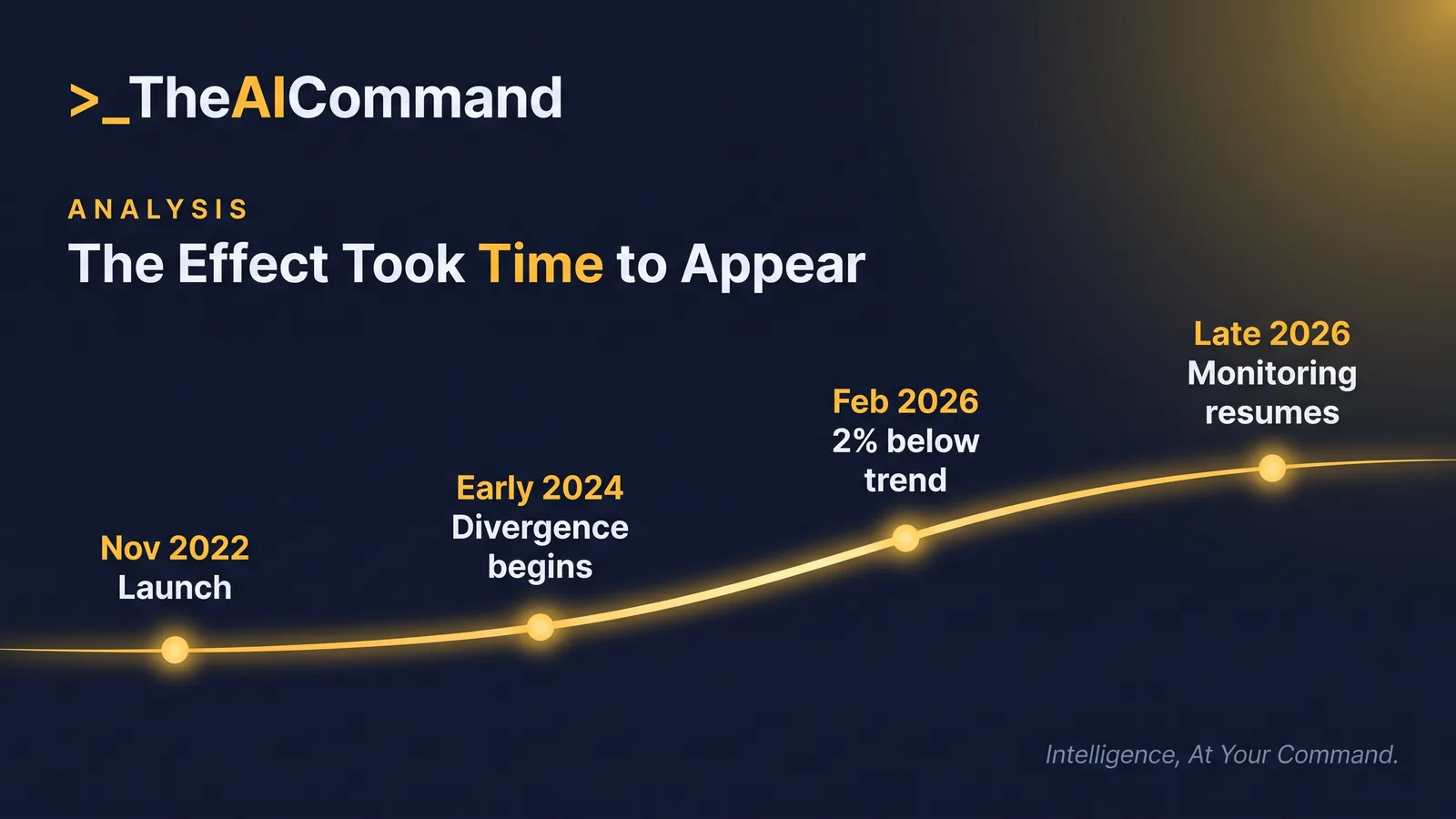
The timing matters as much as the size. All of the sluggishness in the most exposed occupations has occurred since the beginning of 2024. Employment in that quintile is still above its pre-ChatGPT level, but now sits slightly below its February 2024 level while every other group kept growing. There was no step-change when ChatGPT launched.
The event study, which estimates the relationship quarter by quarter, tells the same story. Of 31 pre-ChatGPT quarters, only one is statistically significant. Of the 13 since, six are significantly negative, and the most recent, February 2026, is the sharpest reading yet: employment about 1.7 per cent below the model's counterfactual per standard deviation of exposure, significant at the 5 per cent level. A variant that assumes the effect only began in November 2023 fits better than the core model, at p equals 0.0046. That pattern is consistent with an adoption lag: firms experiment, then deploy, then adjust staffing.
Then the report does something unusual. It spends a chapter trying to break its own finding.
The caveats are the story
Read the robustness chapter before quoting the 2 per cent, because DEWR itself treats the core result as "suggestive rather than settled causal evidence of AI-driven job loss" (p. 55), and the reasons are specific.
The result depends materially on how exposure is measured. Under the JSA automation scores, the negative relationship is significant. Swap in the US-derived Felten AIOE measure and the coefficient shrinks and loses significance at p equals 0.25. Swap in Anthropic's observed-usage exposure scores, built from how people actually use Claude, and it is near zero at p equals 0.95. Only one of the three measures produces the finding. DEWR argues the JSA scores, built on the Australian occupation structure, are the best fit, but concedes this is the strongest reason for caution.
The result is also sensitive to timing and method. Exclude the COVID years from the pre-treatment sample and it stays negative but loses significance at p equals 0.14. Estimate with OLS instead of the Poisson approach and the relationship vanishes at p equals 0.996, although the report shows why it prefers Poisson for this data. On the other side of the ledger, the finding is not driven by a handful of occupations: in over 95 per cent of 1,000 bootstrap draws the coefficient stays negative, and weighting occupations by size makes the estimate about 50 per cent larger. Hours worked show a similar but not quite significant pattern, and job advertisements do not corroborate the employment signal at all.
And then there is the blackout. The ABS has retired occupation-level employment data under the ANZSCO classification, and publication resumes under the new OSCA classification in late 2026, so February 2026 was the final measurable quarter. This report is a frozen snapshot, taken at exactly the moment the signal turned most clearly negative. For the rest of 2026, nobody has newer occupation-level evidence than this.
Which occupations are actually exposed to AI?
For financial-sector organisations, the exposure list is uncomfortably familiar. The largest occupations in the most exposed fifth include General Clerks, Accountants, Accounting Clerks, Finance Managers, Receptionists, Solicitors, and Purchasing and Supply Logistics Clerks. That fifth accounts for more than a quarter of total Australian employment, and its share has been declining since well before ChatGPT, from 28.7 per cent in 2015 to 27.0 per cent in 2026.
The demographics shift the risk conversation. Workers in the most exposed occupations are majority female, at 56.3 per cent against 30.5 per cent in the least exposed, and far more likely to hold a degree, at 43.7 per cent against 14.9. Exposure is compositional: women are more exposed because they are disproportionately employed in exposed occupations. The dashboard's most concerning indicator sits here too: the unemployment rate for workers previously in the most exposed occupations has risen since late 2022, and the gap between the most and least exposed groups has almost closed, a level not seen in at least 20 years.
What it means, domain by domain
A 2 per cent shortfall against trend is not a restructure trigger. It is a planning input, and it lands differently in each function.
WHS: insecurity is a hazard, not just a mood
The safety implication is not that AI takes jobs. It is that the fear of it is now evidence-backed enough to be foreseeable. Job insecurity and poorly managed organisational change are recognised psychosocial hazards, and a worker in an exposed clerical role reading AI headlines does not experience a p-value; they experience uncertainty. NSW has gone further, legislating in 2026 to treat digital work systems, the way software allocates, monitors and manages work, as a WHS matter. A government report confirming softening in exposed occupations makes it hard to argue AI-driven change was unforeseeable if the risk assessment never mentioned it. The opportunity runs the other way: consulting early and managing workload through transitions is the control the hazard demands.
If your psychosocial risk register covers restructure risk but not AI-driven role change, this report closes that gap. The hazard is now foreseeable in the plainest sense: a Commonwealth department has published the evidence.
Workers compensation: watch the claims mix
For Comcare-scheme and state-scheme practitioners, the report describes the claimant population of the next few years. The most exposed occupations skew female, tertiary-qualified and office-based: clerks, accountants, finance and administrative professionals. If the softening continues, the plausible pressure point is psychological injury claims connected to job insecurity and restructuring, in cohorts that historically claim less often for physical injury. None of this changes how any individual claim is assessed. But claims teams plan on cohorts, and this is the first Australian dataset that says which cohorts to watch. The benefit side is real too: AI is already helping claims teams draft and summarise faster, provided de-identification and human review are non-negotiable.
General commentary only: scheme-level exposure data informs workforce and claims planning. It has no bearing on the determination of any individual claim, which turns on its own evidence and the legislation.
GRC: put the workforce on the risk register
Boards have been asking what AI means for the workforce and getting vibes in response. This report is the citable answer. For APRA-regulated entities, workforce capability sits naturally inside the risk management framework CPS 220 expects, and CPS 230's operational resilience lens reaches critical operations staffed by exactly the occupations on the exposure list: clerical processing, finance operations, compliance support. The GRC move is to treat AI workforce impact as a named risk with an owner, an occupation-level exposure map as its first artefact, and the DEWR dashboard indicators as its monitoring metrics.
The strongest governance signal is not the 2 per cent. It is that the measuring has started, and boards should expect the same standard of evidence internally: every workforce claim with its source and its sensitivity attached.
HR: redeployment before redundancy
The exposure list reads like an HR headcount report: General Clerks, Accountants, Finance Managers, Receptionists, Accounting Clerks. The trap is letting the report justify pre-emptive redundancy programs it does not support. Employment in exposed occupations has grown since 2022, just more slowly, and the report explicitly declines to attribute causation. What the evidence does support is workforce planning that starts now: mapping which roles sit in exposed occupations, building redeployment and reskilling pathways toward the augmentation-heavy work JSA's research points to, and taking consultation obligations seriously, since award consultation clauses and the redeployment element of genuine redundancy under the Fair Work Act both bite hardest on employers who moved straight to termination. Slower growth also means slower backfill: attrition in exposed roles is the cheapest restructuring tool, if planning starts before the vacancy does.
HR gets a defensible middle path: no evidence for panic, no excuse for pretending the exposure list excludes your back office. Build redeployment routes while unemployment is still 4.2 per cent.
Leadership: the honest message
Leaders currently choose between two imported scripts. The report quotes both poles: Dario Amodei's prediction that AI could eliminate half of entry-level white-collar jobs and push unemployment to 10 or 20 per cent within one to five years, and Daron Acemoglu's estimate that only around 5 per cent of jobs will be heavily affected within ten. Australia's measured answer, so far, is 2 per cent below trend in exposed occupations, no youth crisis, no acceleration in occupational churn, and a software workforce up 25 per cent. The leadership job is to say exactly that to the team: real, small so far, concentrated in routine cognitive work, and strengthening, which is why the organisation is investing in capability and redeployment now rather than waiting. Denial burns credibility the first time a role changes; doom burns it every day in between. The measured version is also the true one.
Teams do not need leaders to predict the future. They need leaders who can say what the evidence shows and what the organisation is doing about it.
What can financial-sector teams do now?
The report names Accountants, Finance Managers, General Clerks and Accounting Clerks among the largest most-exposed occupations, which puts banks, insurers and super funds closer to this evidence than almost anyone. Concrete moves, by function.
WHS
- Add AI-driven role change and job insecurity to the psychosocial hazard register, citing the DEWR report as foreseeability evidence.
- Fold AI and automation questions into your next psychosocial risk survey, so you measure the anxiety rather than guess.
- Build a consultation-first protocol for any AI deployment that changes how work is allocated, monitored or assessed.
- Train managers to spot and escalate change-related distress in exposed teams early.
Workers Compensation
- Brief claims and injury management teams on the exposure profile: female-skewed, tertiary-qualified, office-based cohorts.
- Track claims mix by occupation group against the exposure quintiles, so a shift shows in your data before your costs.
- Review early-intervention pathways for psychological injury in administrative and finance roles, where the softening is concentrated.
- Keep aggregate data out of individual matters: no exposure score belongs near a liability decision.
GRC
- Table the report at the next risk committee with a one-page map of your workforce against the most exposed occupations.
- Add AI workforce impact to the risk register with a named owner and a review date aligned to the late-2026 data resumption.
- Test whether capability loss in exposed critical operations is covered in your CPS 230 tolerance settings and scenarios.
- Require every workforce claim in internal AI reporting to carry its source and its sensitivity.
- Watch the two indicators DEWR flags as most concerning, the employment share gap and the unemployment gap, and set an escalation trigger.
HR
- Map every role family to the exposure quintiles and share the honest result with the executive, back office included.
- Build redeployment pathways from exposed clerical and finance roles toward augmentation-heavy work before headcount decisions force it.
- Use attrition deliberately: pause automatic backfill in the most exposed role families and route the budget to reskilling.
- Audit consultation clauses in your awards and agreements now, so AI-related change follows the process.
- Set graduate intake on the Australian evidence, not imported US headlines.
Leadership
- Deliver the measured message before the next headline cycle does: real, small so far, concentrated, strengthening, and being managed.
- Ban unattributed AI job-loss claims from internal decks; no source, no decision.
- Pair every AI efficiency initiative with a stated people plan, so redeployment is visibly part of the deployment.
- Put the late-2026 monitoring resumption in the calendar and revisit workforce strategy when the next data lands.
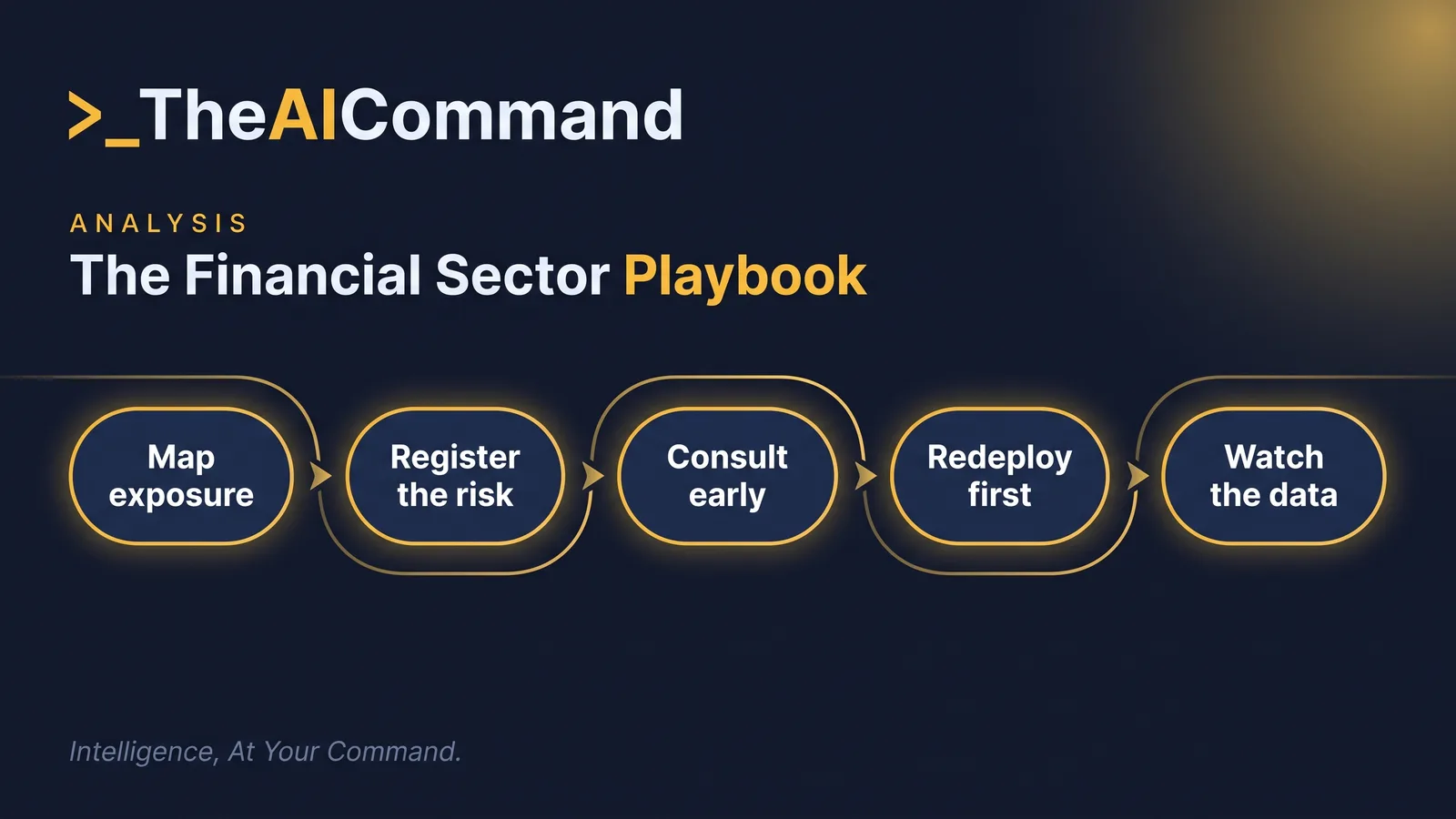
The bottom line
DEWR's conclusion is carefully balanced: no broad AI-driven upheaval, genuine softening in exposed occupations, a modest negative signal much smaller than public claims of large-scale job loss, and enough sensitivity in the modelling that none of it should be treated as causal proof. The evidence justifies neither complacency nor panic. It justifies exactly what the department is doing: watching, carefully, with published methods.
The useful part is that Australia now has a baseline. When the data resumes in late 2026, the question is whether the recent negative quarters were the start of a trend or noise. Until then, this is the best evidence in the country, and the organisations that fold it into their hazard registers, risk committees and workforce plans this quarter will look prepared either way.
Do this Monday
- Read the robustness chapter before anyone quotes the headline. The shortfall against trend holds under one exposure measure and one estimation method, and the report says so itself. Whoever repeats the finding internally should be able to name what it depends on.
- Overlay your own role families onto the exposure list. General Clerks, Accountants, Accounting Clerks, Finance Managers and Receptionists sit in the most exposed fifth. Build the one-page map of your workforce against that list before an executive asks for it.
- Add AI-driven role change to the psychosocial hazard register. A Commonwealth department has now published the evidence, which moves job insecurity from AI change out of the speculative column and into the foreseeable one.
- Give AI workforce impact a named owner on the risk register. Set the review date against the resumption of occupation-level data and nominate the dashboard indicators that will be monitored, including the employment share gap and the unemployment gap the report flags as most concerning.
- Brief claims and injury management teams on the exposure profile. Female-skewed, tertiary-qualified, office-based cohorts are where psychological claims pressure is most plausible, and none of that aggregate data belongs anywhere near an individual liability decision.
- Pull the consultation clauses in your awards and agreements. AI-related change has to follow the process that is already written, and checking the wording is cheaper before a rollout than after one.
- Build the redeployment route before the next vacancy. Pausing automatic backfill in exposed role families is only a strategy if the reskilling pathway exists to absorb the people.
- Draft the measured message for the team. Real, small so far, concentrated in routine cognitive work, strengthening, and being managed. Deliver it before the next headline cycle does.
References
- DEWR 2026, AI and employment in Australia: Monitoring framework and evidence to date, Department of Employment and Workplace Relations, Canberra. July 2026. Licensed CC BY 4.0. https://www.dewr.gov.au
- Jobs and Skills Australia 2025, Our Gen AI Transition, the source of the generative AI automation exposure scores. https://www.jobsandskills.gov.au
- Australian Bureau of Statistics, Labour Force, Australia, Detailed. Quarterly employment by occupation to February 2026. https://www.abs.gov.au
- Brynjolfsson, E., et al. 2025, Canaries in the Coal Mine?, as cited in the DEWR report for the US early-career findings and the treatment-date convention.
- Amodei, D., prediction on entry-level white-collar employment as reported by Axios (VandeHei and Allen 2025), quoted in the DEWR report as the pessimist pole.
TheAICommand. Intelligence, At Your Command.