
Section 66 decides admissibility on dates, twenty-eight days out. The Safety, Rehabilitation and Compensation Act 1988 (SRC Act) provides that where a claimant has instituted proceedings and "the claimant had not disclosed that matter to the Tribunal at least 28 days before the day fixed for the hearing of those proceedings", "that matter is not admissible in evidence in those proceedings without the leave of the Tribunal". The text checked is Compilation No. 82, compilation date 1 July 2026, as at 26 September 2026.
Leave is decided on dated facts, and the determining authority is best placed to evidence them. Where those facts sit in email threads and an index assembled at the end, the file holds a record of a record and no evidence of service. The control is a per-matter disclosure register, opened at determination and complete before any assistant is pointed at the bundle.
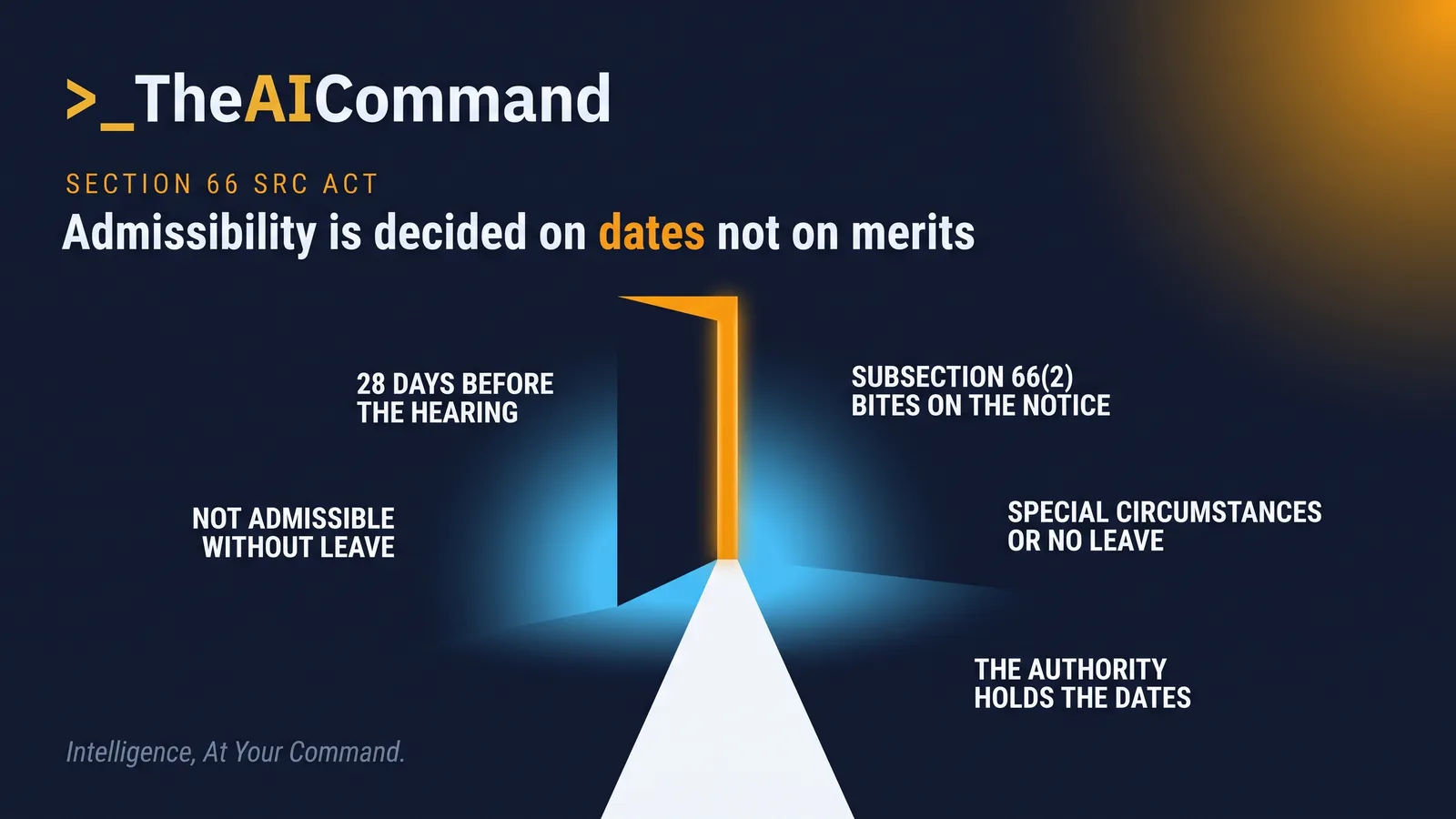
What section 66 bars, and whom it binds
Subsection 66(1) attaches to a claimant who has instituted proceedings and to a matter not disclosed to the Tribunal at least 28 days before the hearing day. The consequence is inadmissibility without leave.
Subsection 66(2) runs on a different trigger, and on three cumulative conditions: a section 58 notice given before the determination, a failure to comply, and material the claimant had or could have obtained without unreasonable expense or inconvenience before the determination. Where all three are met, "the information, document or copy shall not, without leave of the Administrative Review Tribunal, be admissible in proceedings instituted under this Part in relation to the determination". That bar is independent of the 28 day count, and it catches material the claimant could have obtained as readily as material the claimant held.
Subsection 66(3) conditions leave under subsection 66(2). The Tribunal shall not give leave under that subsection unless the claimant provides a statement of reasons for the failure to comply and the Tribunal is satisfied there are "special circumstances justifying the admission of the information, document or copy in evidence". Subsection 66(1) sets no statutory criteria for leave, although in Abdul the Tribunal applied a special circumstances test to a subsection (1) application.
Two limits are easy to overstate. Section 66 binds the claimant on its terms, so it is no bar on the determining authority tendering late material, whose own duty sits in sections 25 and 26 of the Administrative Review Tribunal Act 2024 (ART Act), Compilation No. 5, compilation date 18 May 2026. And subsection 66(2) is described here from the statute alone, because no decided application of it was located in the sources checked.
Why does leave turn on the authority's records?
Because special circumstances is assessed against a record of dates, and the authority evidences dates with documents rather than recollection.
A leave application asks what was served and when, what the notice required and by when, and what was in the joint bundle. The claimant can assert those facts. The determining authority can produce the notices, the service records, the index and the lodgement dates. Section 56 of the ART Act puts a duty on the decision-maker to "use their best endeavours to assist the Tribunal", and that assistance is given in dated records.
Time is the other reason. A matter that runs from the determination through reconsideration to a listed hearing outlasts the memory of the officer who made the determination. Anything not written down on the day is gone.
Two refusals of leave, in the Tribunal's words
In [Abdul and FedEx Express Australia Pty Limited (Compensation) [2025] ARTA 1605](https://www.austlii.edu.au/cgi-bin/viewdoc/au/cases/cth/ARTA/2025/1605.html), decided on 1 September 2025 by General Member F Eylward, the Tribunal set out the rule: "Section 66 of the SRC Act prohibits a claimant who has instituted proceedings from adducing any matter into evidence not previously disclosed at least 28 days before a Hearing without leave of the Tribunal." Leave to adduce extended video footage part way through the hearing was refused: no special circumstances beyond what appeared to be an oversight, against prejudice to the respondent and the need to recall two medical experts.
In [Ofori and Australian Capital Territory (Compensation) [2025] ARTA 2062](https://www.austlii.edu.au/cgi-bin/viewdoc/au/cases/cth/ARTA/2025/2062.html), decided on 10 October 2025 by the same member, leave was refused for new oral evidence from a lay witness going beyond her filed statement, the Tribunal recording it as "being of little assistance to the Tribunal and there being no special circumstances to justify its admission, leave was not granted". Section 66 reaches oral evidence as well as documents.
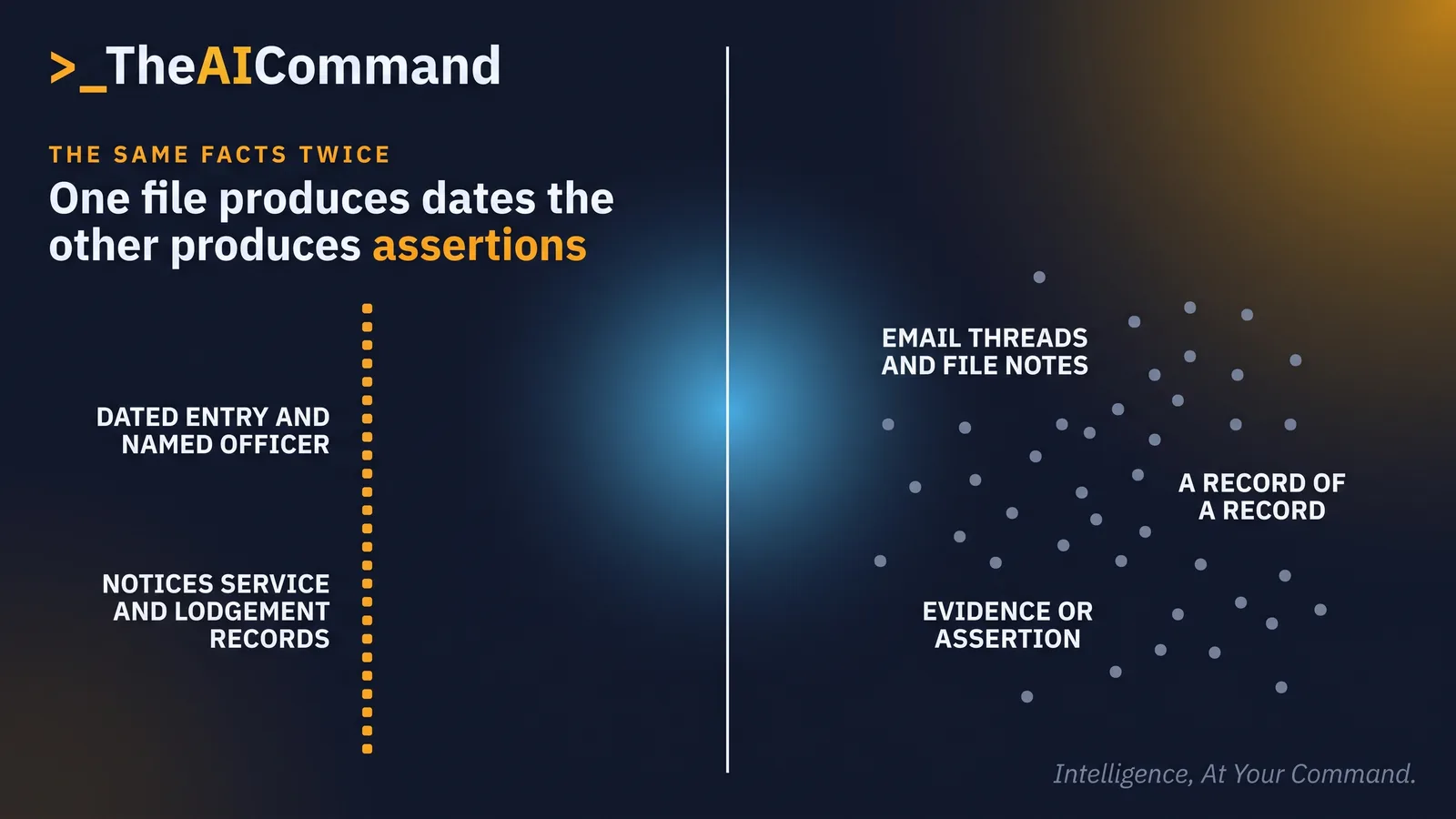
Neither decision supports a proposition that leave is never granted: the test is special circumstances applied to two sets of facts. What transfers is the mechanism of the first failure. One version of the footage was served, a longer version was tendered, and the bundle index carried only the first. An index built from a dated register exposes that gap on either side in time to raise it before the hearing.
The clocks that fill the register
Every row exists because a statutory clock runs against it. Naming the clock beside the column stops the register drifting into a general file index.
Those periods are read from the SRC Act, Compilation No. 82, compilation date 1 July 2026, and the ART Act, Compilation No. 5, compilation date 18 May 2026, as at 26 September 2026.
Section 64 of the SRC Act allows an application for review of a reviewable decision, and the section 23 duty then runs 28 days from the Tribunal's notification. Twenty-eight days will not reconstruct a file built over the life of the claim, so the register is opened at determination.
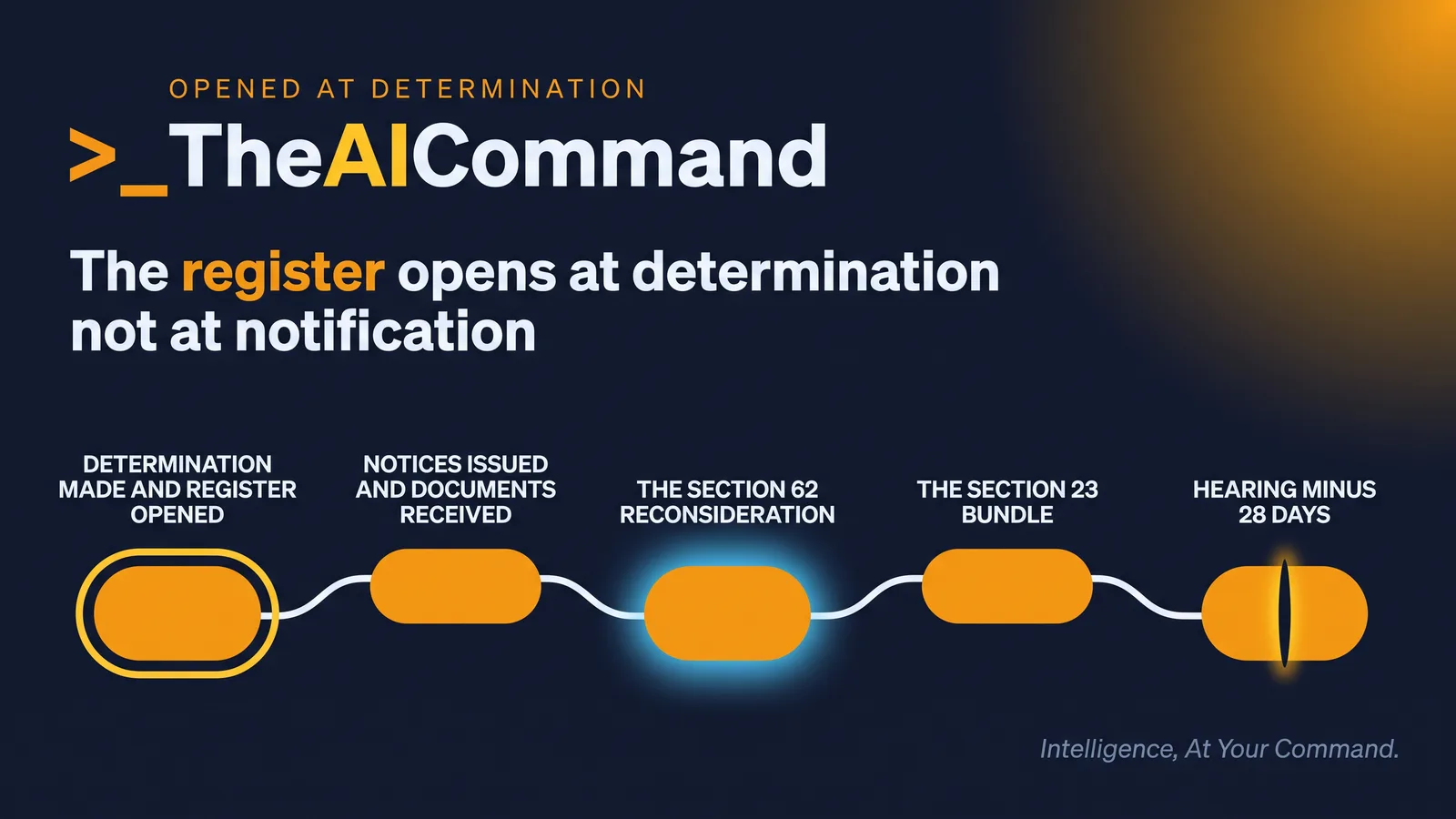
The disclosure control register, in full
One register per matter, headed with the claim placeholder and the determination date, because subsection 66(2) turns on whether the notice preceded it. One row per document, and one row per item a section 58 notice specified, whether or not it arrived. Thirteen columns: ten trace to a statutory or practice direction obligation, three to the record's own evidentiary weight.
Column 1 is not cosmetic. The Administrative Review Tribunal's Common Procedures Practice Direction, compilation date 20 August 2026, as at 26 September 2026, sets five form requirements for the documents a decision-maker gives the Tribunal on commencement of a review, among them pagination and an index. A register that numbers documents before the bundle is built produces that index as a by-product.
A worked shape, placeholders and illustrative dates only. Comcare scheme guidance SRC330, last updated March 2025, uses a notice seeking payslips from concurrent employment. It records that the notice must allow a minimum 28 days to respond and must clearly outline what is required, and should also state the due date and the likely consequences of a refusal or failure without reasonable excuse. It lists reasonable excuses, so the register carries what the claimant said as well as what arrived, and it limits use: a notice is not to compel an employee to sign an authority to release, to consent to a third party collection, or to produce privileged documents.
Read against the determination date in the header, that row carries the authority's record of the first two conditions in subsection 66(2) for that item, and it exists whether or not the payslips from [EMPLOYER] arrived.
Who owns each row?
Ownership splits at the determination, because that is where the file changes hands and where the evidence of handover is usually lost.
- Owner, part one: the determining delegate owns every row up to and including the determination.
- Owner, part two: the review officer owns every row after it, including the section 62 reconsideration and the section 23 bundle.
- Trigger: a notice issued, a document received, served or lodged, and a stated due date passing with no responsive document. Five events, no discretion about writing the row.
- Evidence: the dated entry and the officer name, made on the day of the event.
- Review: at the section 62 reconsideration and again when the section 23 bundle is settled, checking each time whether the claimant has given a statement of reasons for non-compliance.
A register reviewed twice is a control. A register written once and never re-read is a document.
What does the Generative AI Practice Direction require of a user?
On 20 August 2026, President Justice Emilios Kyrou AO signed a new practice direction on the use of generative artificial intelligence, as the Tribunal recorded in its news item of 24 August 2026. The position stated here is as at 26 September 2026.
Three provisions of the Generative AI Practice Direction shape the register's tool column. Paragraph 2.4(e) requires a person to be able to explain, if the Tribunal asks, how Generative AI was used and what was done to check the output. Paragraph 2.4(f) forbids relying only on the tool to verify its own output. Paragraph 3.13 says a disclosure should sit prominently at or near the beginning of the document and should state what tool was used, where in the document it was used, and how the output was checked.
Paragraph 3.20 decides what may be entered into a publicly available tool: "A person must not enter confidential, private, privileged or otherwise protected information into a publicly available Generative AI tool unless satisfied that doing so is lawful, authorised, and consistent with every obligation that applies to the information." Paragraph 3.21 sets the parallel rule for a privately available tool, the case that reaches an authority running an assistant over its own bundle: the person must be satisfied the information will remain confidential and that appropriate safeguards are in place to ensure it cannot be shared. The note to paragraph 3.18 gives "documents produced under sections 23 and 25 of the Act" as an example of material subject to the implied obligation.
Note 1 to paragraph 1.4 records that the Direction does not apply to Generative AI used in the internal administration of the Tribunal. The obligations attach once material is prepared for the Tribunal, which is where the register's tool and checker column earns its place.
TheAICommand works to the Verified Draft Method: de-identify the inputs, ground the model in your own source material, keep a person at the decision point, verify against the primary source, and log what happened.
Two prompts that read the register
Both prompts take a de-identified register extract and the de-identified source documents it is read against. Neither asks for judgement: reconciliation and chronology are the only jobs, and a wrong answer in either is visible on inspection.
What to check: open Table B first and confirm, against the paginated bundle itself, that every item listed there genuinely has no register row, because a false entry there sends an officer hunting for a document that was always accounted for. Then take five rows at random from Table A and read the date off the source document, since a run against a mistyped register reproduces the mistake. Then take every row in Table C and read both dates off the two source documents, because a reported date conflict becomes evidence only once a person confirms which date is on the face of the document. The Tribunal's Checklist for using Generative AI in Tribunal proceedings asks whether facts, calculations, citations, quotations and sources have been checked, and notes that it "is a guide only."
What to check: read the due date in each output row against the face of the notice and against any further period allowed, because Comcare guidance SRC330 records a minimum of 28 days to respond, and a notice allowing less is a problem with the notice rather than with the response. Re-compute two of the day counts by hand from the two dates in the same row, because a wrong count is invisible once it sits in a chronology. Confirm that nothing in the second list has been characterised as a failure or a refusal. Record which tool produced the chronology and who checked it, in column 10.
Do this Monday
The artefact is the Disclosure Control Register, one workbook per matter, thirteen columns as above. The owner is the review officer, with the determining delegate owning rows up to the determination.
The first step fits in under an hour.
- Take one live matter where a reviewable decision has been made.
- Create the thirteen columns.
- Back-fill every item each section 58 notice specified, quoting each date from the face of the notice rather than from a file note.
- Leave every unknown as NOT FOUND rather than filling it from memory.
The check that proves it worked: count the items those notices specified. Every one has a register row, every row carries either a date quoted from a document or the word NOT FOUND, and every row names the officer who made the entry. If any specified item has no row, the back-fill is not finished. If any row carries a date not on the face of a document, correct it.
The bottom line
Dates are evidenced by records made on the day, not by recollection assembled later. The determining authority holds the notices, the service records and the index, so its register is what a leave argument runs on. Build the register at determination, put one owner on each row, and record any Generative AI tool used alongside the person who checked its output. Run an assistant across it for reconciliation and chronology, never for judgement. This is general information and education, not legal or professional advice.
TheAICommand. Intelligence, At Your Command.