
A reviewable decision notice has three mandatory parts.
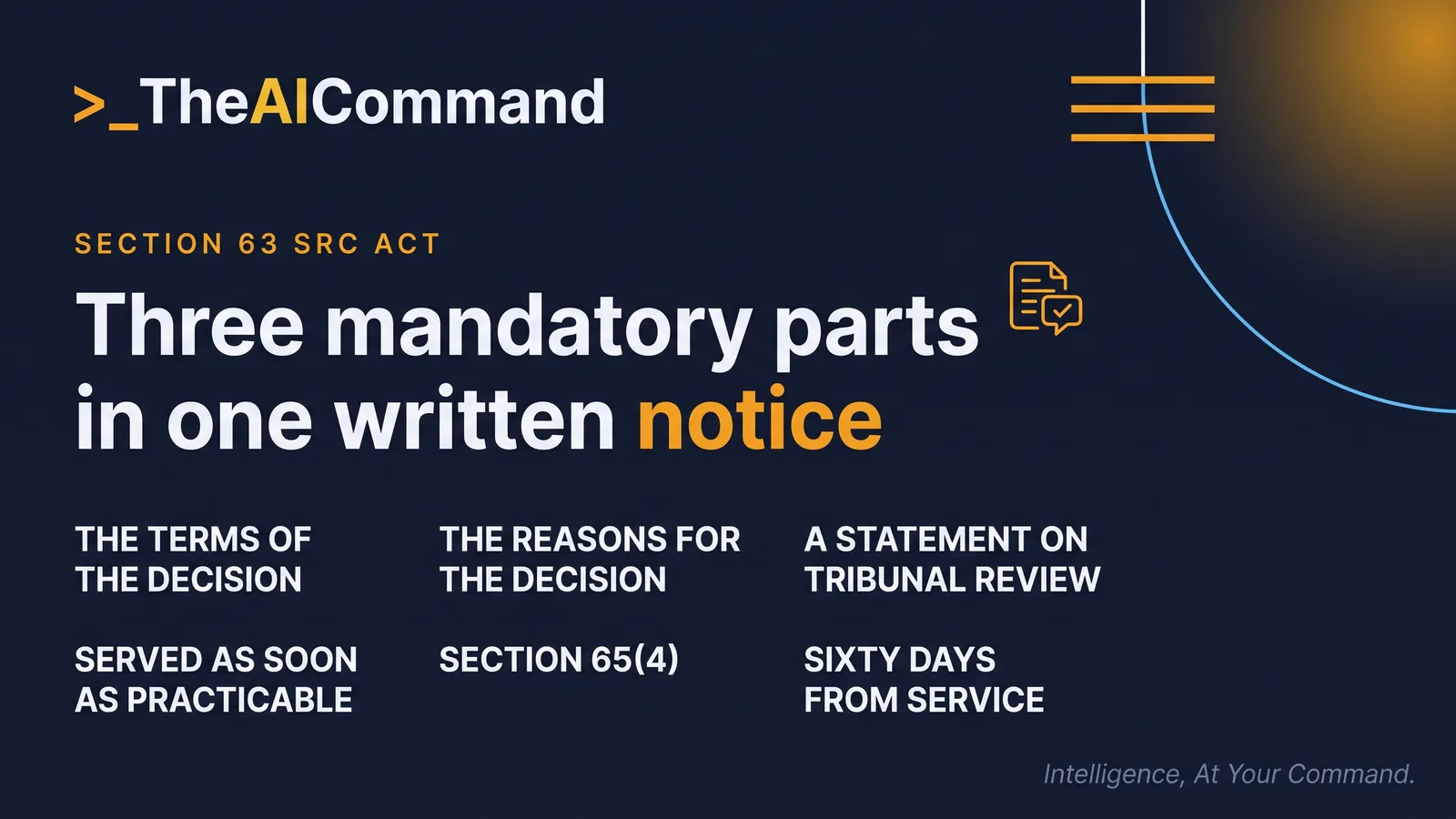
Section 63 of the Safety, Rehabilitation and Compensation Act 1988 (SRC Act), at Compilation No. 82 on the Federal Register of Legislation, states that as soon as practicable after a person makes a reviewable decision, the person shall cause to be served on the claimant "a notice in writing setting out:" the terms of the decision, the reasons for the decision, and a statement about applying to the Administrative Review Tribunal. Three parts, one document, no prescribed form and no word count.
The practitioner consequence sits one section away. Under s 65(4), an application to the Tribunal must be made within 60 days after the applicant is served with notice of the decision, so service of the s 63 notice starts that clock. A notice served late, silent on review rights or thin on reasons does not stay a drafting problem in the claims team.
What follows runs one de-identified file from the reconsideration decision through assembly, checking, signature and service, and names the point where the assistant stops. The positions cited are as at 26 September 2026.
What s 63 actually requires
The text is short and the obligations are exact.
The chapeau carries two conditions that are easy to read past. The first is timing: "As soon as practicable after a person makes a reviewable decision". That is not a fixed number of days, and it is measured against what was practicable on this file rather than against a batch cycle. The second is service: the notice is caused "to be served on the claimant", an event with a date and a delivery record behind it.
Then the three parts: "the terms of the decision;", "the reasons for the decision; and", and "a statement to the effect that, subject to the Administrative Review Tribunal Act 2024, application may be made to the Administrative Review Tribunal for review of the decision to which the notice relates."
Note what paragraph (c) does not say. It does not require the notice to explain how to apply, name the registry, or set out the sixty days. Comcare's guidance on applying for a reconsideration of a determination describes the registry details as sitting inside the reviewable decision itself, which is convention rather than requirement. A notice carrying the deadline and those details does more than s 63 compels, and removes the argument that the claimant was not told.
Where does a reviewable decision come from?
Not every decision on a claim is reviewable.
Section 60 defines the term: "reviewable decision means a decision made under subsection38(4) or section62." The common path is s 62. A determination is notified under s 61, the claimant is dissatisfied, and under s 62(3)(b) the request must "be given to the determining authority within 30 days after the day on which the determination first came to the notice of the person making the request", or within such further period as the determining authority allows, before or after that period expires. Section 62(4) then requires the determining authority to reconsider the determination, or to cause it to be reconsidered by a person holding its delegation who did not make, and was not involved in making, the determination. Independence is statutory, and Comcare's reconsideration page confirms it: reconsiderations are "carried out by a reconsiderations officer who was not involved in making the primary determination."
Under s 62(5), "the person may make a decision affirming or revoking the determination or varying the determination in such manner as the person thinks fit."
Section 62(6) requires the request to be decided within the period prescribed by the regulations, and regulation 11A(2) of the Safety, Rehabilitation and Compensation Regulations 2019 sets it: the determining authority must decide a claimant request to reconsider a decision "within the period of 30 calendar days, starting on the day the determining authority receives the request." Comcare's scheme guidance on statutory timeframes for decision-making under the SRC Act, last updated April 2025, confirms the day of receipt is day one and that the timeframes reach Comcare and self-insured licensees alike. That period commenced 1 April 2024, on Compilation No. 2 as at 26 September 2026.
The sequence on the s 62 path therefore runs in one order: a determination, a request inside 30 days, a decision inside 30 calendar days, then a notice served as soon as practicable. A reviewable decision made under s 38(4) reaches the same notice by another route. The notice is the last act, and the act the claimant's rights run from.
How do you assemble the three parts from the file?
Work in the order the file was built, not the order the notice reads.
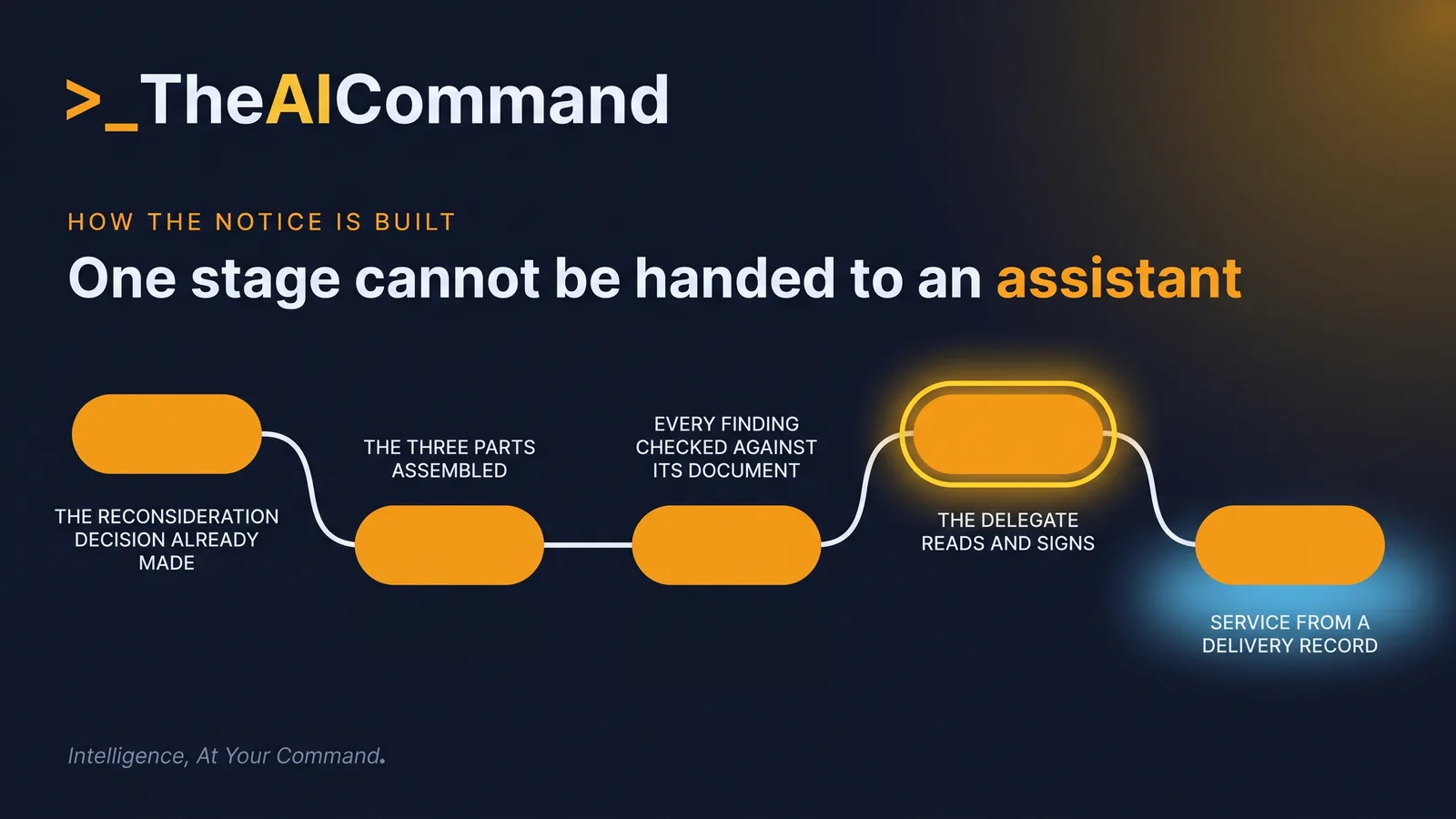
Take one de-identified matter, counted in days rather than dates. The determination came to the notice of [CLAIMANT_NAME] on day 0, the reconsideration request reached the determining authority on day 12, and the decision was made on day 41, the thirtieth calendar day counting receipt as day one. The notice was served on day 42, and the 60 days in s 65(4) runs from that service.
Stage one is the decision itself, already made under s 62(5). The notice does not create it, it reports it.
Stage two is the terms, the shortest part and the one most often blurred by narrative. The terms are the operative words, written deterministically: "The determination of [DATE] in respect of [CLAIM_NUMBER] is affirmed.", or revoked, or "varied to the following effect" with the varied terms set out in full. A reader who stops there still knows what has happened to the determination.
Stage three is the reasons, the subject of the next section. On this file they carry two findings: that [CLAIMANT_NAME] reported the injury on the day it occurred, from page 2 of the incident report, and that [TREATING_PRACTITIONER] certified a capacity for suitable duties from a stated date, from page 1 of the certificate.
Stage four is the review rights paragraph. On this file it runs: "Subject to the Administrative Review Tribunal Act 2024, application may be made to the Administrative Review Tribunal for review of this decision. An application must be made within 60 days after this notice is served on you. The registry details are set out below." That is s 63(c) first, then the period, its start point, and the registry line. The Administrative Review Tribunal's workers compensation review page records no fee for such a review, as fetched 26 September 2026.
Stage five is service, recorded from a delivery record. [DELEGATE] reads the assembled notice and signs it before that, the one point no assistant reaches.
An assistant is useful at stages two and four and dangerous at stage three if asked to write rather than check. The first prompt reads the de-identified draft and reports which of the three parts is present, quoting the sentence carrying it.
What to check: confirm Table A quotes a sentence rather than paraphrasing one, because a paraphrase is the model describing the notice it expected instead of the one in front of it, and read each quoted sentence back in the draft. Table B is the real output: no rows against the reasons means either that the draft carries no findings of fact or that the model missed them, and both are defects.
The reasons element is where notices fail
Paragraph (b) is one line long and carries the whole weight.
Section 63(b) requires "the reasons for the decision; and". It sets no standard; the standard arrives from the forum that reads the notice. The Administrative Review Tribunal Act 2024, at Compilation No. 5 dated 18 May 2026, defines a statement of reasons by three components: it "sets out the findings on material questions of fact; and (b)refers to the evidence or other material on which the findings are based; and (c)explains the reasons for the decision." That is the shape a reasons section is measured against once a matter is on foot.
Build the reasons section against those components in order. List the material questions of fact as findings in deterministic language, one to a line, each followed by the document and page it rests on. Then evaluate them against the provision applied, and close on an outcome sentence matching the terms word for word. One finding from the file above reads: "[TREATING_PRACTITIONER] certified a capacity for suitable duties from [DATE], at page 1 of the certificate of capacity." A reasons section that recites the chronology and then asserts an outcome is missing component two, the component a claimant needs in order to know what to contest.
TheAICommand works to the Verified Draft Method: de-identify the inputs, ground the model in your own source material, keep a person at the decision point, verify against the primary source, and log what happened.
The second prompt runs the traceability check. It maps assertions to documents and names the assertions with nothing behind them.
What to check: open every row marked MATCHED and confirm the quoted line exists in the document named, at the page or heading given, because a quotation the model composed reads exactly like one it found. Every NO SOURCE row is a finding to remove or to source before service. A source document no assertion relies on is either irrelevant or evidence the reasons have not dealt with.
When does the sixty day clock actually start?
On service of the notice, and not on the date printed on it.
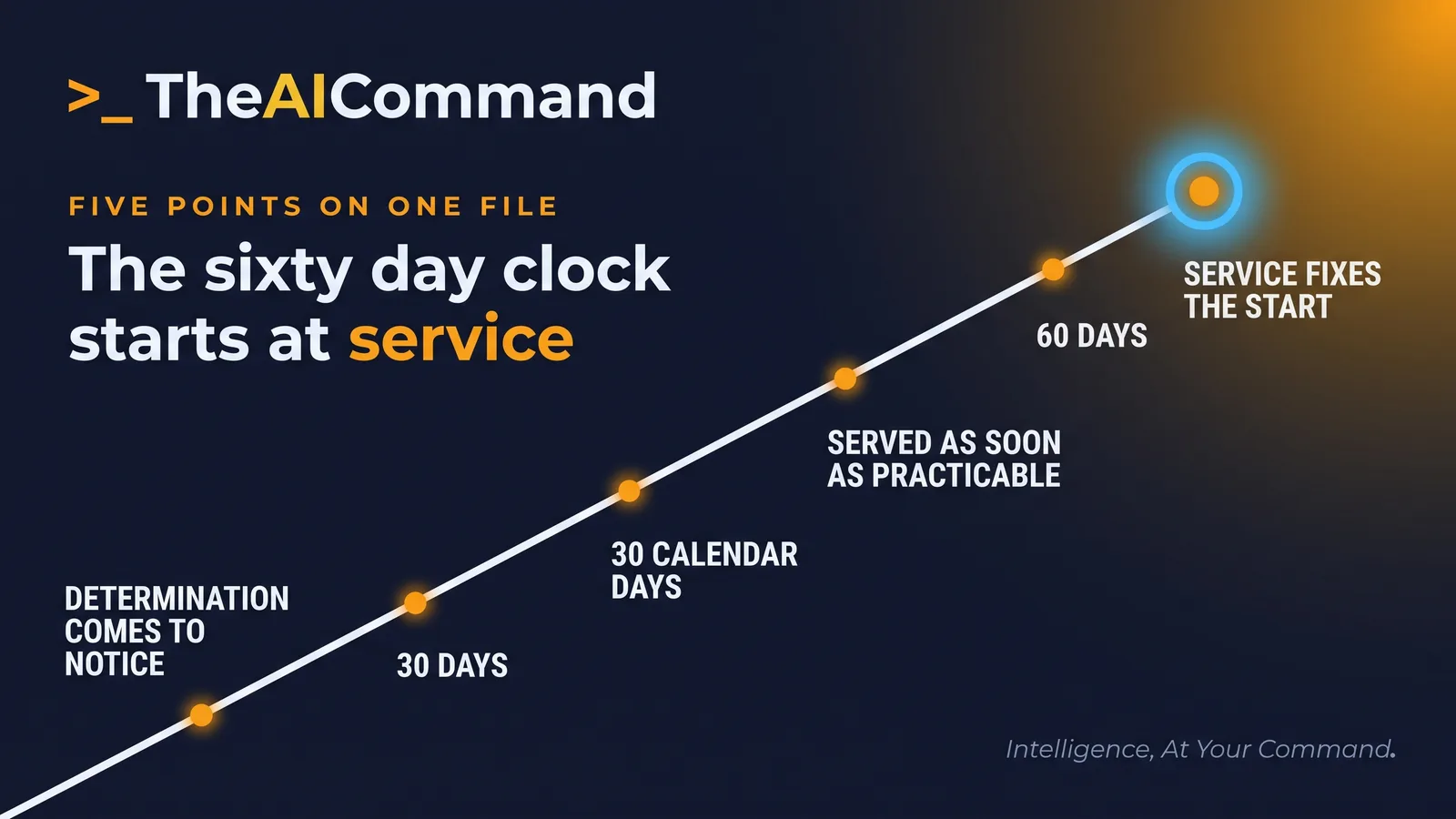
Section 65(4) requires an application to the Tribunal for review of a reviewable decision to be "made within 60 days after the person making the application is served with notice of the decision". The Tribunal's page puts it from the claimant side: "Usually, you must apply for a review of a decision within 60 days from the day the reviewable decision is received."
Both formulations tie the clock to an event in the world. A notice dated the fourteenth and posted on the twenty first has a service date of neither, and the file needs the delivery record that fixes it. Where service and receipt fall on different days, the file records both, and counts the 60 days from service, which is what s 65(4) requires.
What follows an expired period is not the determining authority's discretion. The 60 days is fixed by s 65(4) of the SRC Act, which applies despite the general rule in s 18 of the Administrative Review Tribunal Act 2024, and the relief is s 19(2) of that Act, at Compilation No. 5 dated 18 May 2026 and as at 26 September 2026: "The Tribunal may, by order, extend the period if the Tribunal considers that it is reasonable in all the circumstances to do so." Section 19(4) bars an extension where reinstatement under s 102 is available or has been refused. Section 19(6) of that Act gives a notified party 14 days to oppose an extension application, as at 26 September 2026, and the Tribunal's page stated the same period as fetched 26 September 2026.
That relief is discretionary, and the notice is where the question starts. Section 63(c) requires the notice to state that application may be made to the Tribunal, so a compliant notice and a delivery record together show what the claimant was told and when. Where service is in dispute, the delivery record is what fixes the day.
What the assistant never does
It never holds the power, and it never verifies its own work.
Comcare's guidance on best-practice decision making under the SRC Act, last updated April 2025, is direct on the first: "If the legislation assigns a power to a designated person, the power can only be exercised by that person, unless the statute expressly authorises further delegation of the power." Section 62(4) assigns the reconsideration to the determining authority or a person holding its delegation. A model is neither, and the delegate reads the file, makes the decision, authors the reasons and signs.
The second constraint follows the material into the Tribunal. The Administrative Review Tribunal (Use of Generative AI) Practice Direction 2026, signed 20 August 2026 and applying to applications lodged before, on or after that date, states that "A person who uses Generative AI must verify Generative AI-assisted material and remains responsible for it, whether or not Generative AI was used to prepare it". It bars relying only on a generative AI tool to verify that same tool's output. It restricts entering confidential, private, privileged or otherwise protected information into a publicly available tool, and sets a parallel restriction for privately available tools. It requires a person to explain, if the Tribunal asks, how the tool was used and what was checked, which is why a one line log beats a policy: model, date, document, person. The direction governs material provided to the Tribunal and does not reach its own internal administration.
The third prompt carries the least legal risk, because comprehension is where a review rights paragraph usually fails.
What to check: read list two before the rewrite, because the changes are the output and the paragraph is only the demonstration. Confirm the 60 days, the start point and every registry detail survived character by character against the original. Anything returned as MISSING FROM ORIGINAL is a drafting instruction for the delegate, not a model output to paste.
A missed timeframe does not create a decision
An overdue file is still a file awaiting a decision.
Comcare's scheme guidance on statutory timeframes states the limit plainly: "Importantly, the Regulations do not prescribe a deemed determination or reviewable decision if a determining authority fails to meet the statutory timeframes." Thirty calendar days passing without a decision does not hand the claimant a reviewable decision, and does not relieve the determining authority of the obligation to decide and serve a notice under s 63.
The remedy for lateness is a decision and a compliant notice, not a faster notice with a thinner reasons section. A notice assembled at speed to clear a queue omits the evidence references.
It also bounds what an assistant does on a backlog: it compresses the checking, not the deciding.
Do this Monday
Build the three part check sheet and put a role against it.
The artefact is one page, run against every draft reviewable decision notice before service.
The owner is the claims and compliance team leader, not the delegate who signs, because the sheet is a second pair of eyes and the delegate who authored the reasons cannot confirm they are traceable. Where there is no such role, a reconsiderations officer other than the one who decided holds it.
The first step fits in an hour. Take one recently served notice and de-identify it in full, to [CLAIMANT_NAME], [CLAIM_NUMBER], [DATE_OF_BIRTH], [EMPLOYER], [DELEGATE] and [TREATING_PRACTITIONER], stripping dates of birth, addresses and reference numbers from headers and footers as well as the body. Run it in a tool the organisation has approved for claim material, not a publicly available one. Transfer the first prompt's results into the sheet by hand, taking the registry details and the service date from the file and the delivery record, which the prompt never sees.
The check has two parts. The artefact worked if every block is marked present or absent, and block two carries a row for every finding of fact in the notice. The notice passed if all three blocks are present and every row in block two carries a document reference. A row reading "no evidence reference in the draft" is a gap, and a gap on a served notice goes back to the delegate who signed it. The sheet runs on every draft from there. Testing each reference against the file is the second prompt, on a second sitting.
The bottom line
Section 63 of the SRC Act requires three parts in the notice following a reviewable decision: the terms, the reasons, and a statement that application may be made to the Administrative Review Tribunal. Service of that notice starts the 60 day period in s 65(4), measured from service and not from the date printed on the letter, with the Tribunal describing the same period to claimants as 60 days from the day the decision is received. The relief afterwards is the discretion in s 19(2) of the Administrative Review Tribunal Act 2024. An assistant can check the three parts, trace every finding back to its document and make the review rights paragraph readable, but it cannot hold the delegation, author the reasons or verify its own output. Build the three part check sheet first, then put the assistant to work on the drafts.
This article is general information and education only. It is not legal, compliance, financial or professional advice.
TheAICommand. Intelligence, At Your Command.