
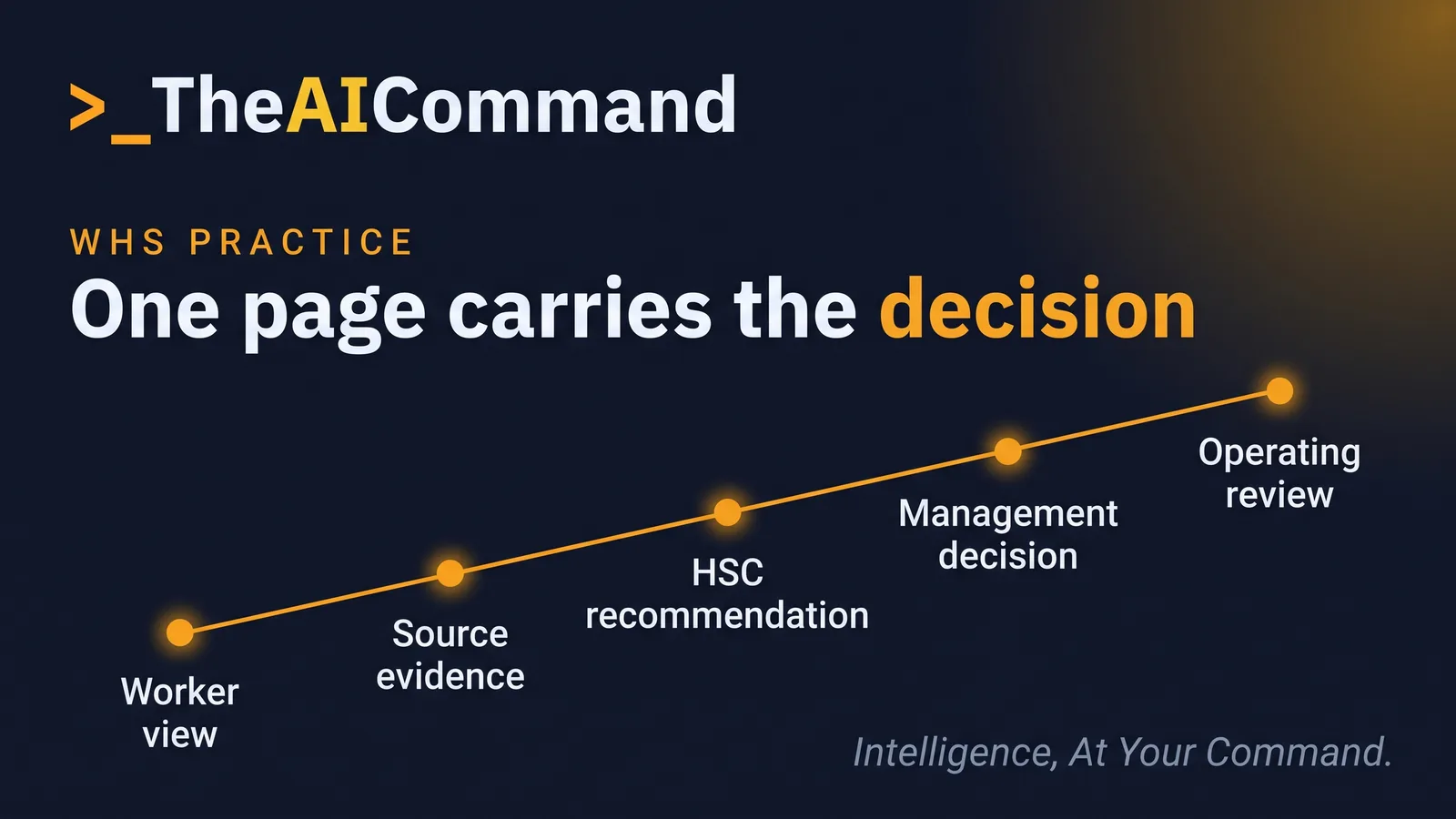
A committee pack earns its pages only when it helps workers and management confront a risk. Use a one-page, role-coded packet that carries worker views, source evidence, control choices, the decision required, an owner and a review trigger into the room.
A WHS committee pack should make the next human action unavoidable. Put the risk question, worker view, evidence provenance, control options, required decision, owner and review date together on one page.
That page does not turn the health and safety committee into the duty holder. It lets the committee perform its consultative and co-operative role, then shows which recommendation belongs to the committee and which decision remains with the PCBU or authorised management.
AI can assemble the packet from approved records, find gaps and test whether the ask is clear. It cannot decide the control, speak for workers, resolve disagreement or declare consultation complete.
Why does a thick committee pack produce thin decisions?
A recurring pack can become an archive of charts and updates. A material risk may appear on four pages without a request to recommend, investigate, consult or review.
The committee does not own WHS. Safe Work Australia's current model WHS Act is dated 5 December 2025, but it has effect only when implemented in a jurisdiction. Its sections 75 to 79 address HSC establishment, constitution, functions, meetings and related PCBU duties.
Section 77 gives an HSC functions that facilitate co-operation between the PCBU and workers in instigating, developing and carrying out health and safety measures, and assist with workplace standards, rules and procedures. Section 76 requires at least half the members to be workers not nominated by the PCBU. Section 79 gives the committee access to relevant hazard and worker health and safety information, subject to limits on personal or medical information.
The Work Health and Safety Act 2011, current compilation dated 1 July 2024, uses the same core architecture. Section 14 says a duty cannot be transferred, section 19 places the primary duty on the PCBU, and section 77 states the committee functions. A recommendation can inform a control decision. It does not move the duty. These are the same model WHS law provisions most Australian jurisdictions mirror.
Do not collapse an HSC and an HSR into the same box. Under section 68 of the Commonwealth Act, an HSR represents a work group, monitors measures, investigates complaints and inquires into apparent risks. Those functions remain with the HSR. An HSR may sit on the committee, but ordinary committee members do not acquire HSR powers. The questions an HSR should be asking about deployed AI tools are a separate exercise from the committee's decision packet.
Consultation reaches beyond placing a paper on an agenda. Commonwealth sections 47 to 49 require relevant information, a reasonable opportunity for directly affected workers to contribute, consideration of their views, and timely advice about the outcome. Where an HSR represents them, consultation must involve that representative.
This makes a common pack label dangerous: Decision: HSC approval. Approval of what, by whom, under which internal authority, and with what legal effect? Replace it with a role-coded decision line:
RECOMMEND: the HSC's collective position within its agreed functions.AGREE COMMITTEE PROCEDURE: an internal meeting or working rule allowed by the constitution and applicable law, not approval of a control.RECORD WORKER OR HSR VIEW: the view, disagreement and consultation still open. Recording a view is not consultation by itself.AUTHORISED MANAGER DECISION: the person or forum authorised internally to decide and resource action. Internal authority does not transfer the duty.SEPARATE HSR PATHWAY: any representation, inquiry or statutory step that remains available to the HSR.
Victoria's Occupational Health and Safety Act 2004, version 45, has been in force since 6 August 2025 and uses an employer and employee regime. Section 72 requires an HSC within three months after an HSR request or if regulations require. It has no model-law request trigger for five workers. At least half the members must be employees and, so far as practicable, HSRs or deputies. Subject to the Act and Regulations, the HSC may determine its procedures.
WorkSafe Victoria's HSC guidance says responsibility for dealing with health and safety issues rests with the employer and the HSC has a major consultative role on an ongoing basis. It rejects dispute resolution as an HSC function and recommends papers before meetings and notes that identify decisions, responsibility and timing.
Information items can remain information items. Stop presenting a material choice as an update when a person must act.
What belongs on a one-page decision packet?
The packet is a decision interface. It lets worker representatives test evidence and management see the control choice.
Use this one-page decision packet checklist:
- Risk question: one sentence naming the hazard, affected work group and choice now required. Write a question that can be answered, not a topic such as
psychosocial risks. - Worker view: what affected workers and the relevant HSR have said, how the view was obtained, material disagreement and what consultation is still open. Do not let an AI summary replace direct worker input.
- Evidence provenance: source, owner, period, cut-off date and limitations. Distinguish verified facts, worker reports, management assumptions and AI synthesis.
- Control options: realistic options, expected benefit, implementation dependency, possible new risk and missing evidence. Include an interim measure if delay leaves people exposed.
- Role-coded ask: use
RECOMMEND,AGREE COMMITTEE PROCEDURE,RECORD WORKER OR HSR VIEW,AUTHORISED MANAGER DECISIONorSEPARATE HSR PATHWAY. Never useapprovewithout the role and authority. - Action and review: accountable action owner, due date, resources required, operating check, review date and earlier trigger. A calendar date alone is weaker than a trigger such as a software release, worker report or failed control test. A risk register wired to those triggers keeps the review honest.
- Privacy boundary: under Commonwealth section 79, personal and medical information must stay out unless the worker consents or it is de-identified and could not reasonably identify them.
Safe Work Australia's official HSC templates are optional starting points, not prescribed forms. They describe a consultative committee, provide agenda and minutes examples, and include responsible person, priority and date fields. Add the decision packet as a front sheet.
Use this prompt to assemble a first draft from approved, de-identified records. The HSC secretariat and WHS manager must verify every source, role label and open consultation step before circulation.
AI is useful here because provenance work is tedious and omission-prone. It can match a figure to a controlled report, expose a missing cut-off date and compare control options already proposed by people. Safe Work Australia's current AI and digital-technologies risk guidance says decisions about how to control risks must be informed by consultation with workers and identifies human oversight and audits as possible controls. That is the boundary for the drafting workflow too.
Fictional worked example: [INSURER_NAME] has introduced AI-generated call summaries in a customer complaints team. Workers report that checking summaries after abusive calls adds cognitive load and delays recovery breaks. Management data shows longer after-call work, but the reporting period includes a separate product incident. The pattern is a familiar one: AI pace changes can intensify work before anyone has decided that they should.
The old pack spreads those facts across a technology update, a workload chart and an incident appendix. The one-page packet asks: Which interim and longer-term controls should management select for summary review after aggressive calls, following HSC consideration and further consultation with [WORK_GROUP]?
The source ledger exposes the confounding product incident. The worker-view box records the HSR's request for shift-level consultation. Control options include pausing summaries after flagged calls, changing review requirements, adding recovery capacity and testing a revised interface. The HSC is asked to recommend principles and identify gaps. [DECISION_OWNER_ROLE] is asked to select and resource controls after consultation. Nobody asks AI to choose.
Use this prompt to test decision readiness. The relevant HSR or worker representatives, WHS practitioner and named management decision owner must review the critique and decide whether the packet is ready.
The strongest packet may still be not ready. Obtain the missing worker view, validate the data or apply an interim measure. AI should expose uncertainty, not fill it with confident prose. Officer due diligence is easier to evidence when the packet trail shows who was asked to decide what, and when.
Do this Monday
- Choose one live item. Pick a material risk that has appeared in two packs without a recorded recommendation or management decision. Confirm the jurisdiction, HSC constitution and affected work group.
- Write the risk question. Name the hazard, people affected and choice required in one sentence. If the sentence contains three decisions, split the packet.
- Build the provenance strip. Put the source, owner, period, cut-off and limitation beside every material fact. Remove personal or medical details the committee should not receive.
- Add the role-coded ask. Separate the HSC recommendation, management decision, HSR pathway and consultation outcome. Confirm the management representative has a route to the necessary authority and resources.
- Circulate and close. Give members enough time to consult their work groups, then record the recommendation, human decision, reasons, action owner, due date, operating check and review trigger. Tell affected workers the outcome in a timely way.
Do not redesign the whole pack first. Prove the format on one item where delay or ambiguity matters. The useful measure is not pages removed. It is whether the next accountable action can be traced from worker input to evidence, recommendation, decision and review.
Bottom line
A WHS committee pack should reveal the decision, not hide it among updates. Give the HSC a clear recommendation to consider, preserve the HSR's separate role and name the human management authority that must decide and resource action. Use AI to assemble and challenge approved evidence, never to select the control or manufacture agreement. One role-coded page can turn a reporting cycle into a traceable consultation and action cycle.
This article is general information and education only. It is not legal, compliance, financial or professional advice. Obligations vary by organisation and circumstance. Verify current requirements against the primary sources cited and seek advice specific to your situation.
References
- Safe Work Australia, Model Work Health and Safety Act, current version dated 5 December 2025: https://www.safeworkaustralia.gov.au/doc/model-work-health-and-safety-act
- Safe Work Australia, Model Work Health and Safety Bill, current 5 December 2025 text: https://www.safeworkaustralia.gov.au/sites/default/files/2025-12/model-whs-bill-5_december_2025.pdf
- Federal Register of Legislation, Work Health and Safety Act 2011, current text: https://www.legislation.gov.au/C2011A00137/latest/text
- WorkSafe Victoria, Health and safety committees: https://www.worksafe.vic.gov.au/health-and-safety-committees
- Safe Work Australia, Health and safety committee templates: https://www.safeworkaustralia.gov.au/sites/default/files/2022-07/health-and-safety-committee-templates_july2022.docx
- Safe Work Australia, Artificial intelligence and digital technologies: Managing risks: https://www.safeworkaustralia.gov.au/safety-topic/hazards/digital-technologies-ai/managing-risks
- Victorian legislation, Occupational Health and Safety Act 2004, in-force version 45: https://www.legislation.vic.gov.au/in-force/acts/occupational-health-and-safety-act-2004/045
TheAICommand. Intelligence, At Your Command.