
A rollout-by-rollout view misses what workers actually carry. Map concurrent implementations, supplier-pushed updates, transition work, retraining, role ambiguity and recovery capacity by work group. The point is not a new risk score. It is a human decision about collisions before the calendar becomes the control.
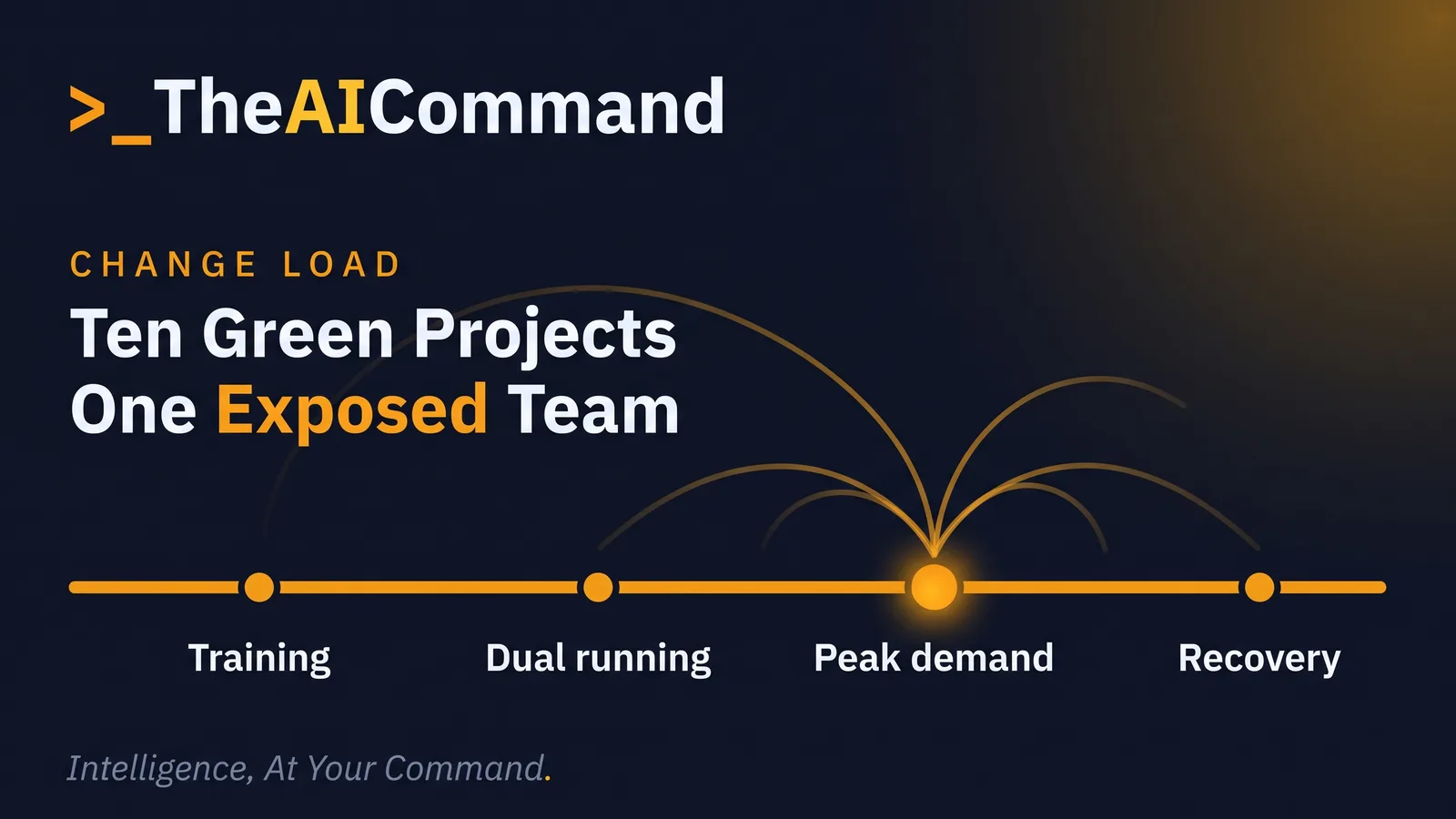
Ten individually reasonable AI changes can create one unreasonable period of work. If each project reports only its own training plan and launch date, nobody sees the same contact-centre team learning three interfaces while targets, scripts and escalation roles also move.
Cumulative change load is not a new statutory hazard category. It is a practical way to identify the duration, frequency and interaction of recognised psychosocial hazards such as poor organisational change management, high job demands, low role clarity, low job control and poor support.
Build a work-group change-load map across the portfolio. Use AI to assemble controlled project data and expose collisions, then require affected workers, HSRs, WHS practitioners and operational leaders to test the picture and decide whether to sequence, pause, resource or redesign each change.
What does ten-change exposure look like?
A programme register usually answers a delivery question: which projects are on schedule? A change-load map answers a different question: what is landing on this work group, at what frequency, for how long, and alongside what other demands?
Safe Work Australia's current poor organisational change management guidance says poor change management becomes a hazard when severe, prolonged or frequent. Its examples include weak consultation, poor planning, unclear communication and inadequate support or training. Separate project assurances can therefore miss repeated exposure.
The legal route is through existing duties. The current Commonwealth Work Health and Safety Regulations 2011, compilation 28 from 25 March 2025, define a psychosocial hazard as one arising from or relating to the design or management of work, a work environment, plant at a workplace, or workplace interactions or behaviours, that may cause psychological harm. Regulation 55D requires a PCBU, in determining which control measures to implement, to have regard to all relevant matters, including exposure duration, frequency and severity, how hazards may interact or combine, job demands, systems of work including how work is managed and supported, and the information, training, instruction and supervision provided.
There is no regulation 55E called cumulative AI change load. Do not invent one. The portfolio view is an evidence method for applying regulations 55A to 55D to the work as experienced, not a replacement legal category or an automatic compliance result.
The Commonwealth Managing Psychosocial Hazards at Work Code of Practice 2024 is current and in force. It covers poor organisational change management, role clarity and interacting hazards, and gives examples such as adjusting targets during transition, planning duties, providing support and ensuring adequate training.
The Safe Work Australia model psychosocial Code says to consider psychosocial hazards collectively rather than in isolation, because workers may be exposed to more than one at a time and hazards can interact or combine. It has legal effect only where approved in a jurisdiction, so verify the local instrument.
AI updates belong on the map even when nobody calls them a rollout. Safe Work Australia's July 2026 AI overview says implementing new digital technologies or changing existing ones, including routine changes to IT systems and updates pushed or initiated by software providers, may introduce or change WHS risks. Its examples identify workloads increasing to get across new system updates, particularly where updates are unnecessary, too frequent, or have little safety or long-term efficiency benefit.
Use the affected work group as the unit of analysis. Four owners may report green while a branch team experiences one combined window of new tools, verification, scripts and learning.
Use this change-load map checklist:
- Work boundary: affected group, changed tasks and differences across locations or work modes.
- Change unit: rollout, feature activation, supplier release, procedure revision, target change or system retirement.
- Exposure window: preparation, dual-running, learning, stabilisation and the expected end of transition work.
- Human load: checking, repair, meetings, workarounds, task switching and lost recovery.
- Role movement: new or unclear responsibility, escalation, expectation or authority.
- Capacity: learning time, staffing, supervisor availability, task relief and competent help.
- Consultation lane: workers and HSRs, open choices, views, response owner and next discussion.
- Collision action: proceed, resequence, resource, reduce scope, redesign or pause.
Use this prompt to assemble the first portfolio view from approved records. The WHS practitioner and portfolio owner must verify dates and scope, while affected workers and HSRs must test whether the map describes the work actually experienced.
Do not ask the model for a single red, amber or green score. A bright colour can conceal why the exposure exists and who must act. Keep the collision visible so a person can decide what to change.
How should the portfolio map change decisions?
The map earns its place only when it changes sequencing, resources or work design. A collision count without a decision route is just another report.
During active implementation, run a weekly collision review with portfolio, operations, WHS and workforce planning. The forum can identify a collision and assign an owner. It cannot consult for affected workers or their HSRs.
Under the current Commonwealth Work Health and Safety Act 2011, compilation 16 from 1 July 2024, sections 47 to 49 require consultation, so far as is reasonably practicable, with workers directly affected or likely to be directly affected. Share relevant information, enable workers to contribute, consider their views and advise the outcome. Where the workers are represented by a health and safety representative, the consultation must involve that representative.
Section 49 covers hazard identification, risk assessment, control choices and proposed changes affecting health or safety. Use the portfolio map to route consultation, not compress it into an enterprise survey or steering group.
Safe Work Australia's AI risk guidance, announced on 23 July 2026, applies the ordinary risk process and worker consultation. It says a review is required before a change, such as a software update, that is likely to have new or different WHS risks that the control measure may not effectively control.
Regulation 38(2)(b) of the Commonwealth Regulations carries the same qualified trigger, and regulation 38(3)(b) confirms that a change to a system of work, a process or a procedure counts as a change at the workplace. A supplier's minor release label does not answer the WHS question.
Comcare's current change-management guidance identifies weak consultation, risk consideration, support, training and communication. It says to consider your work health and safety management systems and integrate these into the change process to monitor and prevent risks to workers. Test what workers must absorb, not whether a project uploaded training.
Fictional worked example: [BANK_NAME] plans a complaint-classification assistant, an identity-check update and a knowledge-search replacement for [CONTACT_CENTRE_TEAM] during [CHANGE_WINDOW]. A supplier also announces a user-interface update. Each project has training, a support mailbox and a local risk entry.
The map shows three learning sessions, two dual-running periods, AI-output checks and revised escalation language during a complaint peak. Team leaders also have separate training, reducing floor support. No project record contains that combined picture.
People move the knowledge-search replacement, protect learning and verification time, retain the old escalation aid during stabilisation, and consult [HSR_WORK_GROUP]. Each project keeps its risk assessment, consultation record, owner and review trigger.
Keep two records. The portfolio map shows the shared exposure window and sends a collision to the right forum. The change-level decision record then captures the verified evidence, affected workers, HSR involvement, options considered, worker views, human decision, reasons, control owner and review trigger. The first prevents fragmentation. The second prevents aggregation from erasing accountability.
Use this prompt to challenge a proposed sequence. The operational decision owner, WHS practitioner, workforce planner, affected workers and HSRs must review the output and make the sequencing and control decisions.
Victoria requires its own analysis. The Psychological Health Regulations 2025 have been in force since 1 December 2025. Regulations 14 to 16 require employers to identify hazards, control risks and review controls. The definition covers factors in the work design, the systems of work, the management of work, the carrying out of the work or personal or work-related interactions, with poor organisational change management, high job demands and low role clarity among the listed examples.
Under section 35 of Victoria's current Occupational Health and Safety Act 2004, version 45, consultation applies to directly affected or likely directly affected employees when identifying or assessing hazards and risks, choosing controls and proposing changes that may affect employees' health or safety to the workplace, to the plant, substances or other things used there, or to the conduct of the work. Involve the HSR where employees are represented.
WorkSafe Victoria's compliance code includes poorly managed, supported or communicated change and inadequate consultation. Use Victorian employer and employee terminology, not Commonwealth provisions.
This also differs from a steady-state pace review. The map covers temporary but repeatable implementation, relearning, dual-running and role changes before several systems settle.
Do this Monday
- Choose one exposed work group. Start with a team receiving at least two changes in the next eight weeks. Set the task boundary and include supplier releases already announced.
- Draw the real windows. Add preparation, training, dual-running and stabilisation, not only go-live dates. Ask workers where transition work starts and when it actually stops.
- Add human load and recovery. Record new checking, workarounds, changed expectations, task relief, protected learning time, supervisor capacity and access to breaks. Mark assumptions.
- Run the collision review. Put portfolio, operations, workforce planning and WHS owners in the room. Route each affected group and HSR into the consultation required for the specific change.
- Record the human decision. For every material collision, name who chose to proceed, resequence, resource, redesign or pause, the reasons, worker views considered and the trigger for review.
Do not begin by scoring the whole enterprise. Prove that one team-level map can expose a collision that separate project registers missed and lead to a traceable decision.
Bottom line
Cumulative AI change load is not a new statutory category, but overlapping changes can increase the duration, frequency and interaction of recognised psychosocial hazards. A portfolio map should reveal where implementations, supplier updates, retraining, role ambiguity, workload and weak recovery capacity collide for a work group. Use AI to assemble and challenge controlled evidence, never to approve the sequence or pronounce consultation complete. Keep each change's consultation and control decision human, local and traceable.
This article is general information and education only. It is not legal, compliance, financial or professional advice. Obligations vary by organisation and circumstance. Verify current requirements against the primary sources cited and seek advice specific to your situation.
References
- Federal Register of Legislation, Work Health and Safety Act 2011, current text: https://www.legislation.gov.au/C2011A00137/latest/text
- Federal Register of Legislation, Work Health and Safety Regulations 2011, current text: https://www.legislation.gov.au/F2011L02664/latest/text
- Federal Register of Legislation, Work Health and Safety (Managing Psychosocial Hazards at Work) Code of Practice 2024, current text: https://www.legislation.gov.au/F2024L01380/latest/text
- Safe Work Australia, Model Code of Practice: Managing psychosocial hazards at work: https://www.safeworkaustralia.gov.au/doc/model-code-practice-managing-psychosocial-hazards-work
- Safe Work Australia, Poor organisational change management: https://www.safeworkaustralia.gov.au/safety-topic/managing-health-and-safety/mental-health/psychosocial-hazards/poor-organisational-change-management
- Safe Work Australia, Artificial intelligence (AI) and digital technologies: https://www.safeworkaustralia.gov.au/safety-topic/hazards/digital-technologies-ai
- Safe Work Australia, Artificial intelligence (AI) and digital technologies - Example opportunities and risks: https://www.safeworkaustralia.gov.au/safety-topic/hazards/digital-technologies-ai/example-opportunities-and-risks
- Safe Work Australia, Artificial intelligence (AI) and digital technologies - Managing risks: https://www.safeworkaustralia.gov.au/safety-topic/hazards/digital-technologies-ai/managing-risks
- Safe Work Australia, New AI and digital technologies guidance now available, 23 July 2026: https://www.safeworkaustralia.gov.au/media-centre/news/new-ai-and-digital-technologies-guidance-now-available
- Comcare, Poor organisational change management: https://www.comcare.gov.au/safe-healthy-work/prevent-harm/psychosocial-hazards/change-management
- Victorian legislation, Occupational Health and Safety (Psychological Health) Regulations 2025, in-force version 001: https://www.legislation.vic.gov.au/in-force/statutory-rules/occupational-health-and-safety-psychological-health-regulations-2025
- Victorian legislation, Occupational Health and Safety Act 2004, in-force version 45: https://www.legislation.vic.gov.au/in-force/acts/occupational-health-and-safety-act-2004/045
- WorkSafe Victoria, Compliance code: Psychological health - Appendix C - Examples of psychosocial hazards and risk controls: https://www.worksafe.vic.gov.au/compliance-code-psychological-health-appendix-c-examples-psychosocial-hazards-and-risk-controls
TheAICommand. Intelligence, At Your Command.