
AI can remove routine steps while concentrating difficult judgement, corrections and customer emotion into every remaining task. Measure that changed exposure before celebrating throughput. The WHS question is not simply how much work moved. It is what sustained effort the new pace demands from people.
Faster throughput is not evidence that work became safer or easier. An AI tool can shorten each transaction while leaving workers with a denser queue of exceptions, more output to verify and less time to reset between demanding decisions.
Australian WHS law does not create a standalone hazard called AI pace. The relevant question is whether the technology introduces or contributes to recognised hazards and risks through job demands, work design, systems of work, low control, inadequate support or interacting exposures. The psychosocial hazards framework already covers the exposure; the AI queue just changes where it concentrates.
Use a five-signal pace test: queue velocity, sustained cognitive effort, task switching, review burden and recovery time. It gives you a work-design view that a productivity dashboard cannot provide, while keeping decisions with workers, WHS practitioners and operational leaders.
What changed when the queue became faster?
Start with the work that remains after automation. Safe Work Australia's AI opportunities and risks guidance says automating routine tasks can improve efficiency and reduce demands, but can also leave workers with a greater proportion of tasks requiring extensive thought and focus. It describes that result as work intensification.
That pattern is easy to miss in financial services. A contact centre tool drafts the call summary, so the next interaction arrives sooner. A fraud system filters obvious alerts, leaving more ambiguous ones. A complaint assistant drafts a response, but a worker must still verify it.
The automation may be valuable. The mistake is treating saved keystrokes as saved human capacity. Verification, correction, challenging a confident error and moving between unresolved exceptions all require effort.
Safe Work Australia's job-demands guidance defines high job demands by the physical, mental or emotional effort needed. It says high demands become a hazard when severe, prolonged or frequent, and directs workplaces to consider duration, frequency and severity, consult workers, observe work and review available information. No universal transactions-per-hour number can answer that local risk question.
The current Commonwealth Work Health and Safety Regulations 2011 are in force in compilation 28 from 25 March 2025. Regulations 55A to 55D address psychosocial hazards and risks. Regulation 55D requires a PCBU selecting controls to have regard to all relevant matters, including exposure duration, frequency and severity, interacting hazards, work design including job demands and tasks, and systems of work including how work is managed, organised and supported.
That is an enacted Commonwealth example. Other model-law jurisdictions may vary, so check the current local instrument.
Victoria needs a separate analysis. Its Occupational Health and Safety (Psychological Health) Regulations 2025 have been in force since 1 December 2025. WorkSafe Victoria's regulatory guidance gives emotionally or cognitively demanding work tasks and high workloads as examples of high job demands, and excessive monitoring or little control over how work is done as examples of low job control. Do not paste Commonwealth regulation numbers into a Victorian assessment.
The five-signal pace test converts those principles into an operational inquiry:
- Queue velocity: How quickly does another item arrive after completion or escalation? Can a worker pause the flow when a case requires more thought?
- Sustained cognitive effort: Which routine tasks disappeared, and how much remaining work now requires ambiguity resolution, emotional regulation or high-consequence judgement?
- Task switching: How often must a worker change customer, product, channel, system or decision frame before finishing a meaningful unit?
- Review burden: What must a person check before relying on AI output, and is that time recognised in staffing, targets and service expectations?
- Recovery time: Can workers take planned breaks and brief recovery after intense work, or does the faster queue consume the time automation created?
This is not a score that AI should turn green. Keep the signals separate because one favourable result can hide a harmful one. Faster queue movement does not cancel increased effort or lost recovery.
Use this prompt to structure a de-identified pace map. A WHS practitioner must verify the source evidence, affected workers and their HSR must test the description of work, and the operational owner must decide what action follows.
How do you test pace without turning WHS into productivity analytics?
Measure the work group and the system, not an individual's supposed tolerance. The purpose is to understand exposure and control design, the same lens as allocating work with psychosocial controls in mind. It is not to rank workers, infer health status or create another performance feed.
Begin with process evidence already generated for legitimate operational purposes, subject to privacy, access and retention controls. Useful fields may include queue patterns, task types, hand-offs, corrections, escalations and break access. Pair records with observation and consultation because system data cannot reveal the effort required to resolve a case.
Safe Work Australia's AI risk-management guidance directly identifies systems that set or track pace without enough task time, routine automation that leaves more cognitively demanding work, computer-set pace and low job control as possible risks. Its suggested controls include enabling workers to alter pace, change tasks or pause for breaks, alongside human oversight, training and supervision, and IT and WHS expertise. Those are examples, not an automatic control prescription for every workplace.
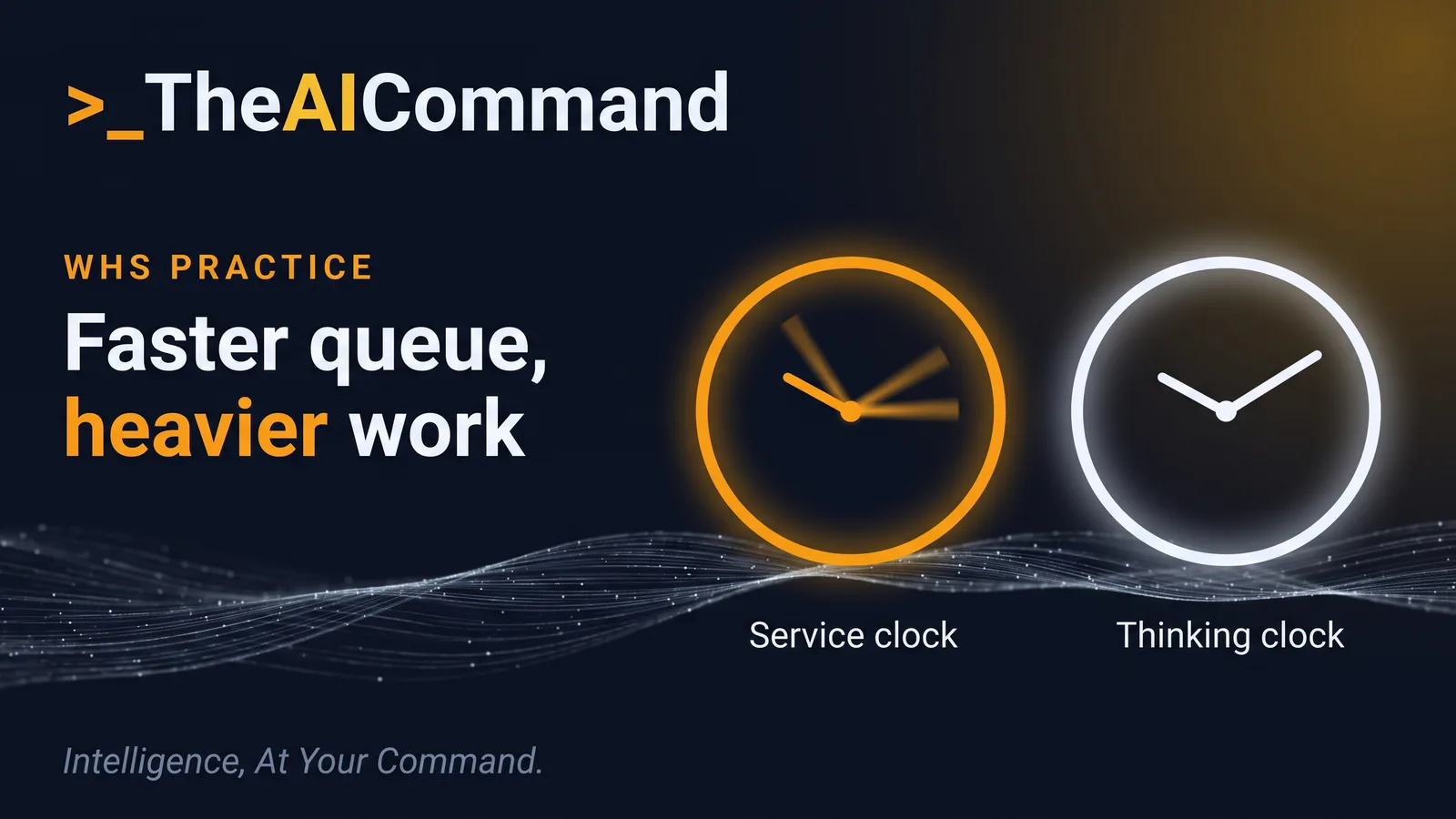
Separate two clocks:
If the first accelerates while the second is treated as waste, the system is borrowing capacity from the worker.
Fictional worked example: [CONTACT_CENTRE] introduces [AI_SUMMARY_TOOL] for calls handled by [WORK_GROUP]. During [BASELINE_PERIOD], workers entered notes manually and had a natural gap before the next interaction. During [REVIEW_PERIOD], the draft summary is produced quickly and the queue advances immediately.
The productivity report shows higher throughput. The five-signal test shows less note-taking, but sustained checking, subtle corrections, more unresolved digital-service complaints and an immediate switch to the next customer. Workers say the pause function is unclear and affects visible queue status. The fictional result does not establish harm. It calls for competent assessment, consultation and control review.
A sensible trial might change queue settings, protect verification time, make pause authority explicit, rotate demanding work, insert recovery after defined interaction types, reduce duplicated system hand-offs or adjust staffing assumptions. The right combination depends on the actual exposure, the workers' experience and what is reasonably practicable. Do not default to resilience training while leaving the work design untouched.
Victoria's Psychological health compliance code covers identification, assessment, control and review. The current authorised Victorian Regulations require employers to eliminate the risk so far as reasonably practicable and, if elimination is not reasonably practicable, reduce it using work-management, plant, systems, work-design or environmental measures. Information, instruction or training may only be used on its own where none of those measures is reasonably practicable, and in any combination it must not be the predominant control measure.
Use this prompt to challenge a proposed control set. The accountable operational manager and a competent WHS practitioner must review feasibility and legal fit, while affected workers and HSRs must be consulted before people decide what to implement.
Review the control after implementation. The model psychosocial hazards Code emphasises consulting workers, considering how hazards interact, controlling risks and checking whether controls remain effective. Approved-code status and legal effect depend on the jurisdiction, so verify local adoption before describing it as legally operative. What the officer layer needs from this exercise is a separate question, covered in officer due diligence for AI work systems.
The review question is not whether output stayed high. Ask whether workers can verify properly, use agreed pause and escalation routes, recover, maintain quality and avoid sustained rushing. A control that shifts hidden work into unpaid time, skipped breaks or superficial checking has not solved the problem.
Do this Monday
- Choose one stable AI-assisted queue. Define the work group, system version, operating period and task boundary so the review tests steady-state work rather than transition friction.
- Test the five signals with workers. Bring queue evidence, task samples and current targets. Ask workers and HSRs where effort moved, what the system data misses and when demands combine.
- Separate the two clocks. Record the service expectation beside the human time needed to understand, verify, decide, document and recover. Mark every place where that thinking time is assumed rather than designed.
- Trial one work-design control. Select a bounded change such as protected verification time, worker-controlled pause, task rotation, fewer hand-offs or adjusted queue release. Name the human owner and any operational safeguard.
- Set a review signal. Combine an operational measure with worker evidence. Review when the system version, queue settings, staffing model, task mix, error pattern or worker reports indicate the exposure may have changed.
Keep the exercise separate from individual performance management. If workers believe that reporting effort or using a pause will count against them, the evidence will be distorted before the assessment begins.
Bottom line
AI pace is not a new statutory hazard category, but AI can intensify recognised psychosocial hazards through job demands, work design and systems of work. Safe Work Australia's current guidance expressly recognises that routine automation can leave people with more cognitively demanding work. Test queue velocity, sustained cognitive effort, task switching, review burden and recovery time together, then redesign the work rather than asking people to absorb the gain. Keep the evidence collective, the consultation genuine and the control decision human.
This article is general information and education only. It is not legal, compliance, financial or professional advice. Obligations vary by organisation and circumstance. Verify current requirements against the primary sources cited and seek advice specific to your situation.
References
- Federal Register of Legislation, Work Health and Safety Regulations 2011, current text: https://www.legislation.gov.au/F2011L02664/latest/text
- Safe Work Australia, Job demands: https://www.safeworkaustralia.gov.au/safety-topic/managing-health-and-safety/mental-health/psychosocial-hazards/job-demands
- Safe Work Australia, Artificial intelligence (AI) and digital technologies - Example opportunities and risks: https://www.safeworkaustralia.gov.au/safety-topic/hazards/digital-technologies-ai/example-opportunities-and-risks
- Safe Work Australia, Artificial intelligence (AI) and digital technologies - Managing risks: https://www.safeworkaustralia.gov.au/safety-topic/hazards/digital-technologies-ai/managing-risks
- Safe Work Australia, Model Code of Practice: Managing psychosocial hazards at work: https://www.safeworkaustralia.gov.au/doc/model-code-practice-managing-psychosocial-hazards-work
- Victorian legislation, Occupational Health and Safety (Psychological Health) Regulations 2025: https://www.legislation.vic.gov.au/in-force/statutory-rules/occupational-health-and-safety-psychological-health-regulations-2025
- WorkSafe Victoria, Psychological health regulations - Frequently asked questions: https://www.worksafe.vic.gov.au/psychological-health-regulations-frequently-asked-questions
- WorkSafe Victoria, Compliance code: Psychological health: https://www.worksafe.vic.gov.au/compliance-code-psychological-health
- Victorian legislation, Occupational Health and Safety (Psychological Health) Regulations 2025, authorised version 001: https://content.legislation.vic.gov.au/sites/default/files/2025-12/25-103sra001-authorised.PDF
TheAICommand. Intelligence, At Your Command.