
Median mental health claims take almost five times as long.
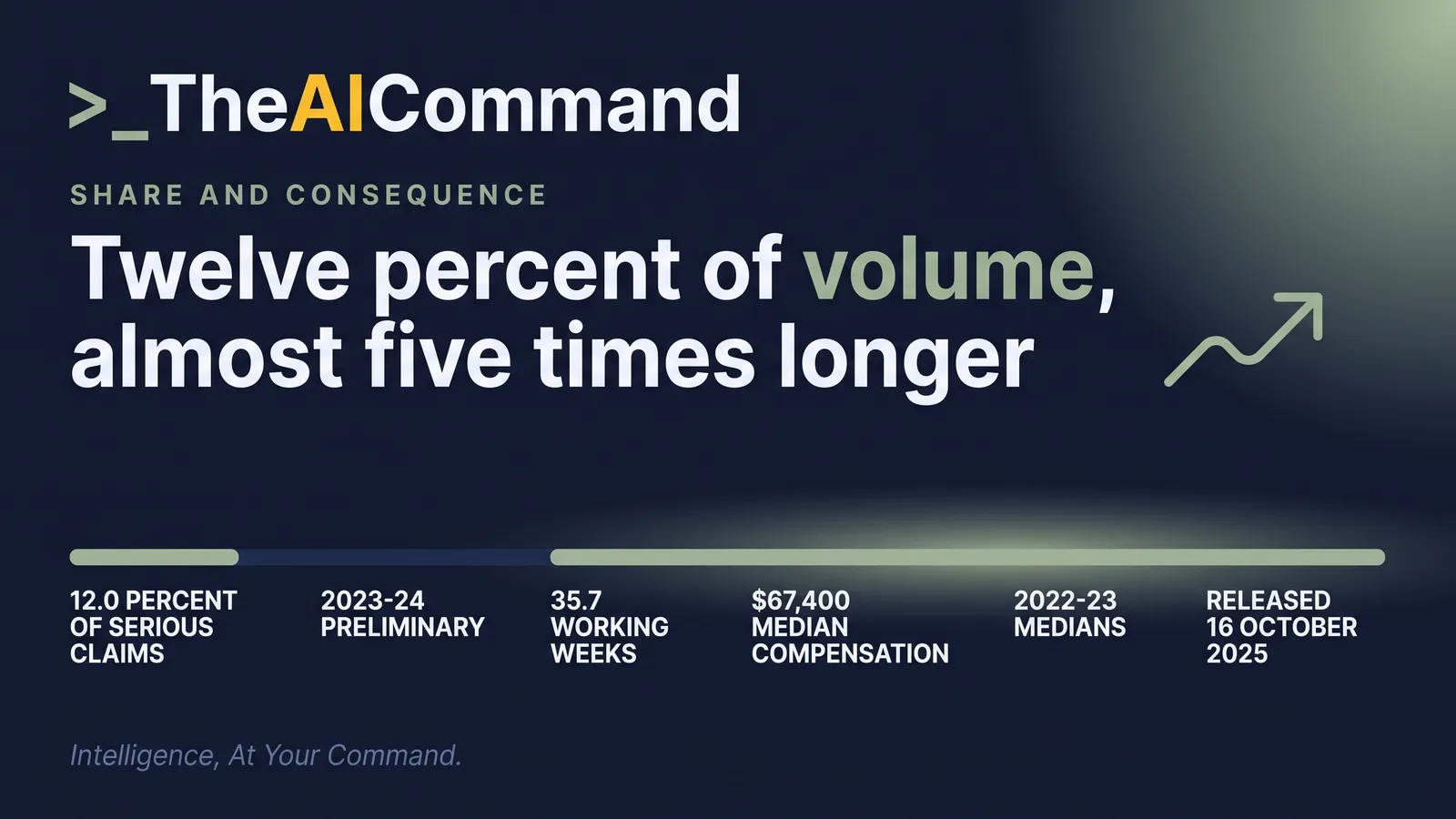
That is the most useful number in the national workers compensation dataset for anyone deciding how an artificial intelligence (AI) work system gets deployed, and it is published, dated and free to read. Safe Work Australia's Key Work Health and Safety Statistics Australia 2025, released on 16 October 2025, records 17,600 serious claims for mental health conditions in 2023-24 preliminary data, or 12.0 percent of all serious claims. The consequence for a practitioner is narrow. A deployment that sets the pace of work, removes job control or changes how work is managed without consultation is a change to one named hazard category. In that edition, the category's 2022-23 median claim runs almost five times the lost time and more than four times the compensation of the all-claims median. Regulation 55C of the Work Health and Safety Regulations 2011 (Cth) requires the psychosocial risks that change carries to be managed in accordance with Part 3.1.
What the 2025 edition actually reports
Start with the shape of the category rather than the headline. The 2025 edition puts all serious claims at 146,700 for 2023-24 preliminary, of which mental health conditions account for 17,600, or 12.0 percent, an increase of 2,300 serious claims, or 14.7 percent, over the year.
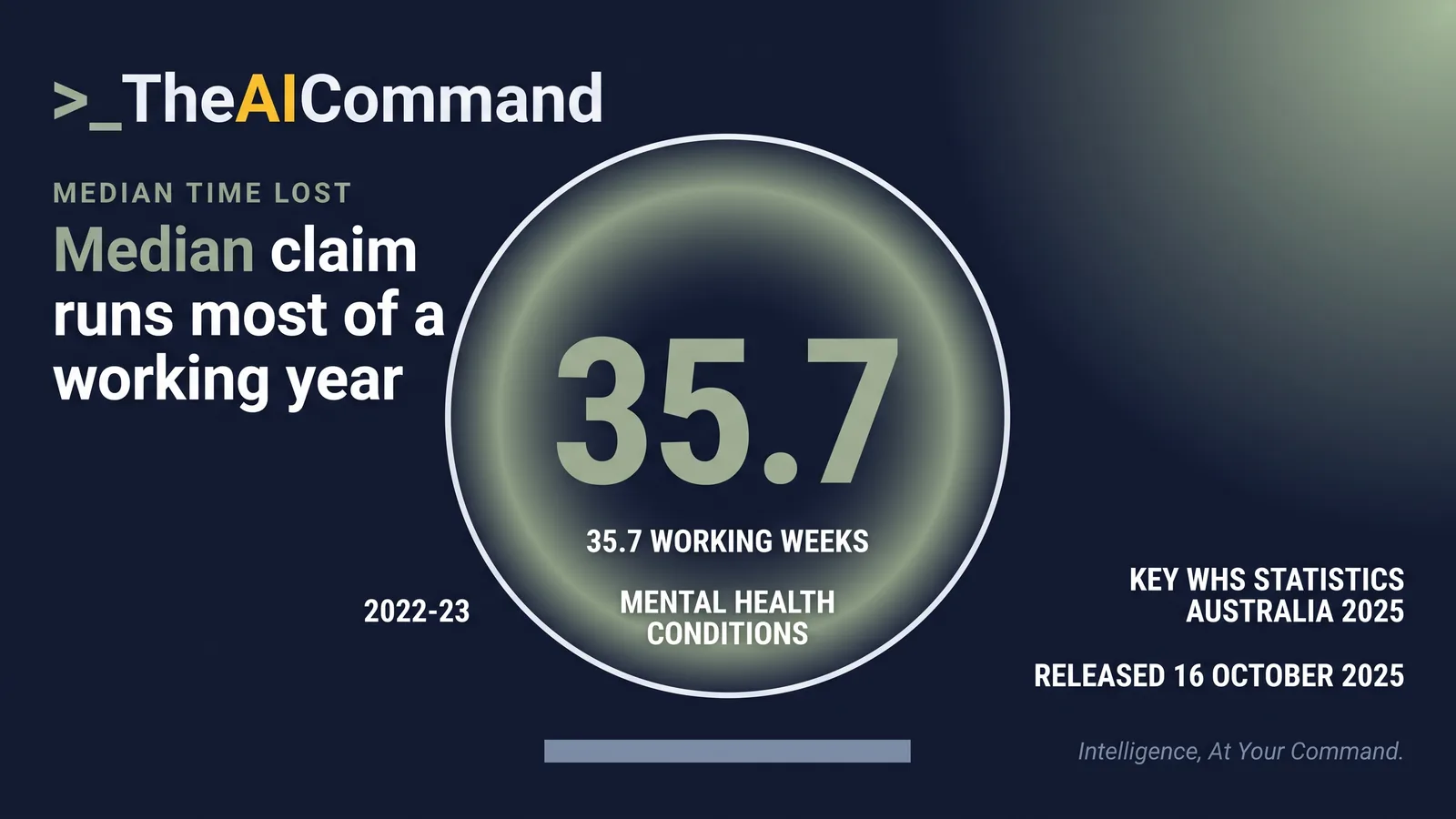
Then read the same edition on time and money. Safe Work Australia's data portal latest release page states that "The median time lost from Mental health condition serious claims in 2022-23 (35.7 working weeks) was almost 5 times the median time lost across all serious claims (7.4)." The median compensation paid for 2022-23 follows the same shape, and Safe Work Australia describes it as more than 4 times. Those are the source's own ratios and they are reproduced here rather than recomputed.
Every figure in that table sits in Key Work Health and Safety Statistics Australia 2025, released 16 October 2025, and the two reference periods are not interchangeable.
Definitions travel with every one of those figures. Endnote 5 of the 2025 edition defines a serious claim as one involving one working week of time off work or more, and endnote 9 records that median compensation paid excludes claims where there was zero compensation paid. Safe Work Australia's data glossary adds two exclusions the endnotes do not: claims involving a fatality, and claims with a duty status of "Commuting/journey" or "Away from work during recess period". Together they decide whether an internal claim tally is comparable at all.
The category is also distributed unevenly by sex. In Key Work Health and Safety Statistics Australia 2025, released 16 October 2025, mental health conditions accounted for 17.2 percent of serious claims made by women and 8.2 percent of those made by men in 2023-24 preliminary data. A deployment concentrated in a business unit with a particular workforce profile is not touching the national average.
Why does 12.0 percent of 2023-24 preliminary volume carry almost five times the 2022-23 lost time?
The published data does not say. A median of 35.7 working weeks is not a statistical curiosity. It is most of a working year, for the median claim, in a category that is 12.0 percent of serious claim volume in 2023-24 preliminary data. Half the claims in that category sit at or above 35.7 weeks.
Hold the money figure at the same distance. The $67,400 is the median compensation paid across the category in 2022-23, as reported in the 2025 edition. It is not the cost of a single claim to a single employer, it is not a premium impact, and it excludes claims where nothing was paid. Presented as any of those things it will be challenged, correctly, by the first finance reader in the room.
What the two medians justify together is a sequencing argument rather than a cost argument. If the median psychosocial claim removes a worker for most of a year, the controls that matter are the ones applied before the exposure, not the ones applied after a claim is lodged.
What do the numbers not say?
Four limits, stated before a reader finds them.
First, the 2023-24 data are preliminary. Revision is expected, so the counts and shares are a snapshot of an open reporting period rather than a settled result.
Second, the medians are not 2023-24 figures. Safe Work Australia does not report median time lost for a preliminary reference period because some claims remain open, and the endnotes record that data for the most recent non-preliminary period is used in such instances. The 35.7 weeks and the $67,400 are 2022-23 values carried into a 2023-24 preliminary table. They sit in that table beside the 2023-24 counts, one careless step from being relabelled, and a relabelled median is wrong.
Third, nothing in this dataset attributes any claim to an AI deployment. No Australian collection does. The connection drawn in this article runs the other way: the guidance names psychosocial hazards, and Safe Work Australia separately names AI and digital technologies as things that can introduce or contribute to those same hazards. Any stronger claim is unsupported.
Fourth, the figures quoted here are medians. A median locates the middle of the category and says nothing about how long the longest claims run, so nothing on this page supports a statement about the tail.
On currency, the 2025 edition was released on 16 October 2025 and remains the current edition as at 24 September 2026. A 2026 edition, when it lands, moves every figure and every edition line together.
Ten years pointing the same way
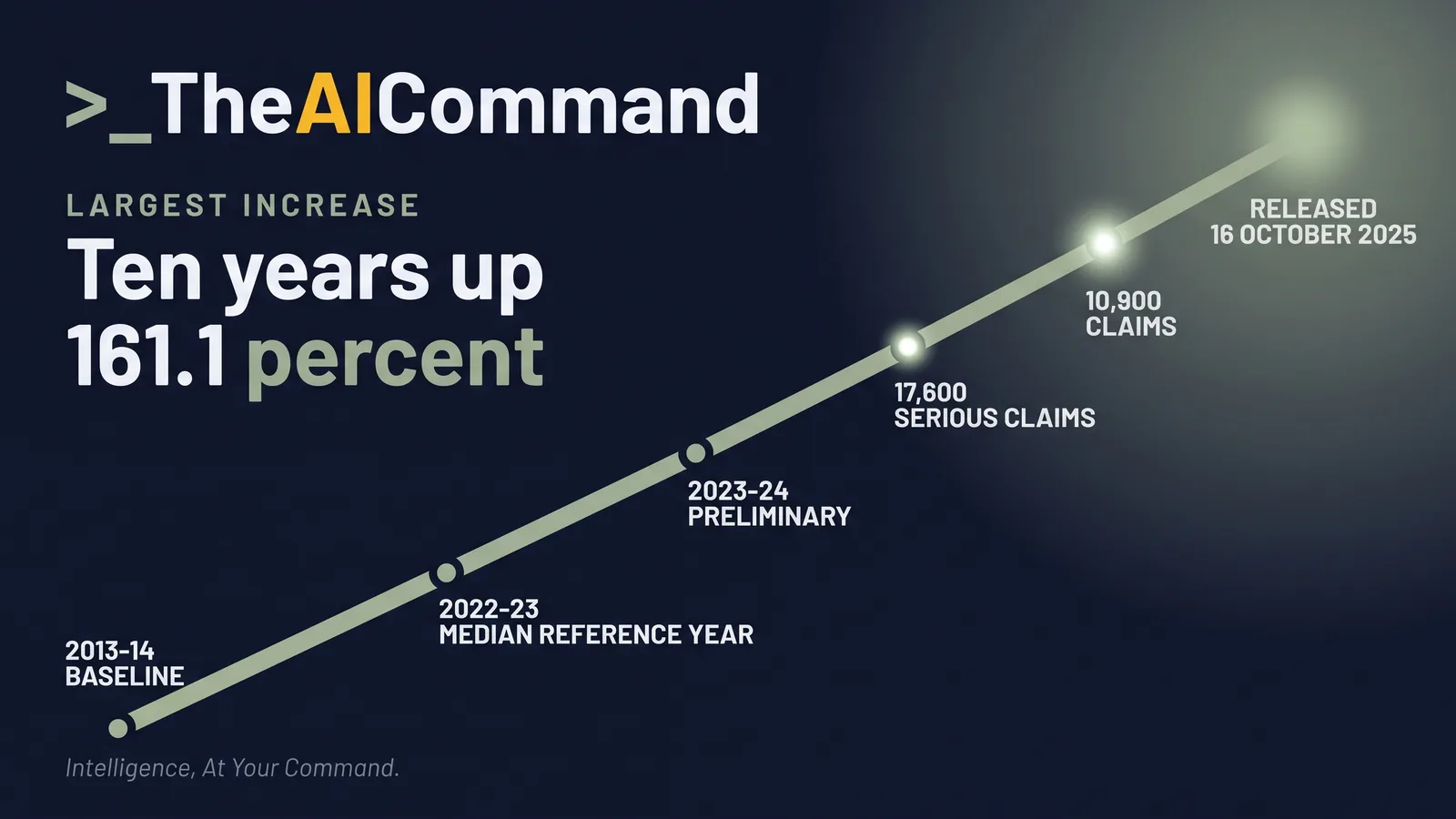
Over the decade to 2023-24 preliminary, mental health condition serious claims rose by 10,900 claims, or 161.1 percent, the largest increase of any nature of injury major group in the 2025 edition. That is the number that makes this a design question rather than a reporting question. The published data does not say what is driving it.
It also sets the opening line of an officer pack, stated before anything is said about a deployment.
Where does an AI work system touch psychosocial risk?
Safe Work Australia answers this in its own words. The Safe Work Australia page on artificial intelligence (AI) and digital technologies, managing risks states that these technologies can introduce or contribute to physical and psychosocial hazards, then names them one at a time, in a list it records as not exhaustive. Among the psychosocial hazards it names:
- High job demands, where systems set or track the pace of work.
- Low job demands, where complex tasks are automated and more of the remaining work is reviewing the output of AI.
- Low job control, where the pace of work is set by computers.
- Poor support, lack of role clarity and poor organisational change management.
- Poor organisational justice, where automated decision-making processes result in unfair, biased, faulty, or discriminatory decisions.
The page also records the condition that turns a design choice into an exposure: systems that "closely monitor or set work tasks, particularly if there is little or no input from workers". That is a description of a rollout method, not of a product.
Safe Work Australia announced this guidance on 23 July 2026, and the wording quoted here is the wording on the page as at 24 September 2026. Its news item states that under the model work health and safety laws, employers have a duty to manage the risks arising from AI and digital technologies to ensure that workers and others remain healthy and safe at work. The risk management process is the same one used for any other workplace hazard. There is no separate AI process to build.
Hazards also stack. Comcare's page on psychosocial hazards, as at 24 September 2026, notes that in most cases hazards work in combination and together increase the risk of harm, and gives high job demands combined with low support and low job control as likely to be very hazardous. An unconsulted rollout produces exactly that triple by construction: more monitored output, less say over pace, and no clear route to raise a problem.
The duty spine, and what it requires of a deployment
Above the psychosocial regulations sits section 19 of the Work Health and Safety Act 2011 (Cth), at Compilation No. 16, compilation date 1 July 2024, as at 24 September 2026, which requires a person conducting a business or undertaking to ensure, so far as is reasonably practicable, the health and safety of workers, and which names at section 19(3)(c) "the provision and maintenance of safe systems of work". An AI work system is a system of work. That is the hook, and it predates any guidance.
Division 11 of Part 3.2 of the Work Health and Safety Regulations 2011 (Cth) supplies the detail, at Compilation No. 28, compilation date 25 March 2025, as at 24 September 2026. Regulation 55A defines a psychosocial hazard as one arising from or relating to matters including "the design or management of work". Regulation 55B defines the corresponding risk. Regulation 55C requires psychosocial risks to be managed in accordance with Part 3.1 and the control measures required by regulation 55D to be implemented. Division 11 was inserted by F2023L00012, so it is settled law rather than a proposal.
Regulation 55D(2) is the one to read line by line before a deployment. It requires that in determining control measures the person "must have regard to all relevant matters, including: (a) the duration, frequency and severity of the exposure of workers and other persons to the psychosocial hazards", and it goes on to name "(c) the design of work, including job demands and tasks" and "(d) the systems of work, including how work is managed, organised and supported". A tool that allocates tasks and monitors completion engages paragraphs (c) and (d) directly.
The order of controls is in the instrument, not only in guidance. Regulation 55C sends psychosocial risks to Part 3.1, where risks are eliminated so far as is reasonably practicable and regulation 36 then requires substitution, isolation and engineering controls, administrative controls only if a risk remains, and personal protective equipment last. Safe Work Australia's Model Code of Practice: Managing psychosocial hazards at work of July 2022 applies that order to psychosocial risk, as a model code adopted separately in each jurisdiction. Administrative controls and personal protective equipment are the least reliable controls and provide the lowest level of health and safety protection. The model code also sets out reviewing control measures to confirm they are working as planned.
For the assessment workflow these numbers justify, see the companion piece on AI-assisted psychosocial risk assessment.
Victoria runs a separate instrument
Victoria is not a model work health and safety jurisdiction and its psychosocial duties sit in their own instrument. The WorkSafe Victoria Compliance code: Psychological health, Edition 1 of September 2025, records that the Occupational Health and Safety (Psychological Health) Regulations 2025 (Vic) and the code are in effect from 1 December 2025, a date now passed as at 24 September 2026.
A control set built on the Commonwealth regulations carries no Victorian authority of its own, so a national rollout needs a Victorian overlay before it reaches a Victorian workforce.
Three prompts that keep the numbers honest
TheAICommand works to the Verified Draft Method: de-identify the inputs, ground the model in your own source material, keep a person at the decision point, verify against the primary source, and log what happened.
The first prompt maps a system against the Safe Work Australia hazard list without letting the model invent hazards.
What to check: every hazard named in the output has to appear, in those words, in the attached Safe Work Australia page. If a hazard appears that is not on the page, the model has reached outside the attachment and the whole output is re-run rather than corrected. Check also that no status reads as a conclusion about adequacy, because that decision belongs to the reviewer, and that the output names no location for any piece of evidence, which the reviewer fills in.
The second prompt builds the officer-pack comparison, which is where the two reference periods meet.
What to check: read every figure in the draft back against this message before the page leaves the desk, and check the reference period on each one. The 2022-23 medians and the 2023-24 counts sit in one published table, so a relabelled period is the failure to look for first. Confirm the preliminary line survived, and confirm the gap sentence is about the median time lost row rather than the claim counts and states a difference rather than a cause. Confirm the basis line survived, because without it the two columns count different populations. Confirm too that any measure with no organisation value reads not reported internally rather than sitting blank.
The third prompt tests a draft control set against the regulation instead of against a habit.
What to check: open the regulation and confirm the matters quoted back are the matters the instrument lists, in order, with nothing added. Then confirm the model has not proposed a control that is absent from the draft, which turns a gap analysis into a fabricated compliance record.
Do this Monday
The artefact is a one-page psychosocial claims comparison for the next officer pack. The owner is the work health and safety manager, [WHS_MANAGER]. The first step fits inside an hour.
- Pull the accepted claim count for [REPORTING_PERIOD] from the claims system for the mental health conditions nature of injury major group, which is the group the national figure counts, and record on the page which codes were included.
- Filter that count to claims carrying one working week or more of time lost, then exclude fatality claims and claims coded "Commuting/journey" or "Away from work during recess period", which is the basis the glossary sets. Take the median time lost across those claims.
- Convert that internal median from the unit the claims system records to working weeks, using the organisation's own standard working week, and record the divisor on the page. The 2025 edition does not publish the conversion it uses, so note that the two medians sit on comparable but not identical bases.
- If the claims system reports compensation paid on those claims, take the median across the claims that were paid something, because the national figure excludes claims paid nothing. If it does not, write not reported internally in that cell.
- Put the organisation figures in the table below, beside the national figures, each national figure carrying its reference period, with the edition line under the table.
- Add the line recording that the 2023-24 figures are preliminary, then a second line recording that [REPORTING_PERIOD] and the national reference periods are different years, so the page is a benchmark and not a year on year comparison. Then name the difference between [ORG_MEDIAN_WEEKS] and the national 35.7 working weeks for 2022-23, and stop.
Source for every national figure in that table: Key Work Health and Safety Statistics Australia 2025, Safe Work Australia, released 16 October 2025.
The check that proves it worked is specific. The officer pack that goes to [OFFICER] carries a dated comparison and one named gap, not a trend line, and every national figure on the page can be traced to a row in the 2025 edition with its reference period intact. If the page cannot survive someone opening the edition beside it, it is not ready.
The second artefact, for the next deployment rather than the next pack, is the regulation 55D(2) checklist produced by the third prompt, held as a versioned file. The owner is [WHS_MANAGER], the trigger is any change to the system that alters pace, task allocation or monitoring, and the check is that every matter in regulation 55D(2) carries either a control or a recorded reason it does not apply.
The bottom line
Mental health conditions were 12.0 percent of serious claims in 2023-24 preliminary data but carried a median 35.7 working weeks of lost time and $67,400 in median compensation paid, both 2022-23 figures carried into the Safe Work Australia 2025 edition, released 16 October 2025. Safe Work Australia separately names the psychosocial hazards that AI and digital technologies can introduce or contribute to, including systems that set the pace of work and automated decisions that land as unfair. Nothing attributes a single claim to an AI deployment, and nothing needs to: regulation 55C requires psychosocial risks to be managed whatever loads them. Put the published medians beside the organisation's own psychosocial claim tally, dated to the reference period, and the deployment argument stops being about the technology. It becomes an argument about the design of work, which is where the regulations put it in the first place.
TheAICommand. Intelligence, At Your Command.