
The Commission now asks whose words a statement carries.
As at 25 September 2026, the Fair Work Commission generative artificial intelligence (GenAI) requirements apply in every Commission matter from 20 October 2026, and the obligation they create attaches to a named individual rather than to a function. The manager who made the dismissal decision signs a checking declaration on the employer response, whether or not any tool was used. If that manager also gives a witness statement, the final Guidance Note adds a test the March exposure draft did not carry: the statement must reflect the witness's own words.
The practical consequence is narrow. A manager can still use a model on a statement. What the note asks a model to do has shifted from drafting the account to transcribing and ordering an account the manager already gave.
What the requirements say, and who they reach
The Commission page Using AI to help you with your case states, as at 25 September 2026, that "These requirements apply to all Commission matters from 20 October 2026." Not unfair dismissal alone. Every matter type, on both sides of the file.
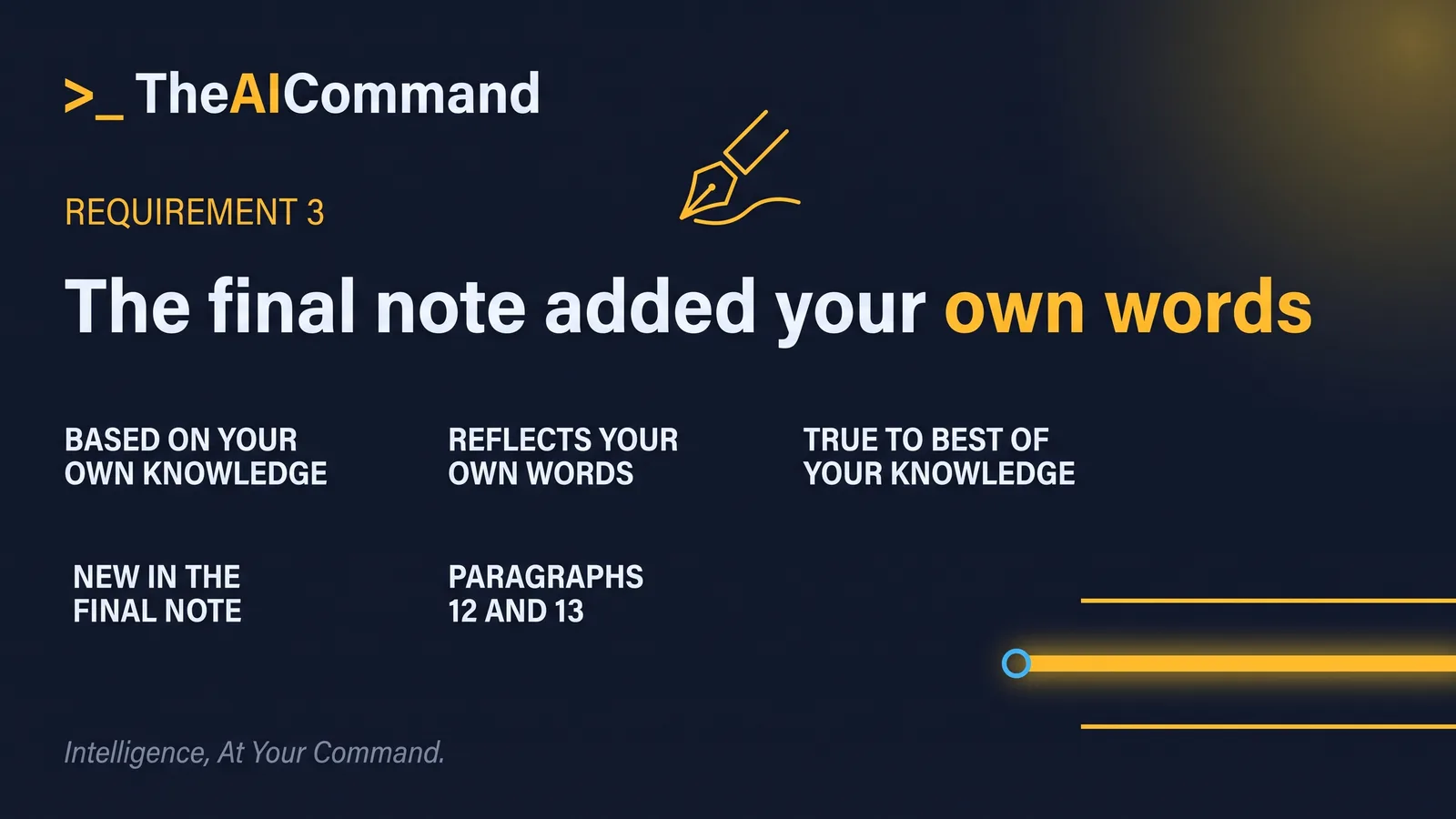
The instrument itself is the Guidance note: Use of generative artificial intelligence in Commission cases, published 24 August 2026, which records at paragraph 5 that it commences on 20 October 2026. It carries three requirements. Requirement 1, at paragraph 8, is disclosure of the use and of how the tool was used. Requirement 2, at paragraphs 9 and 10, is checking, and at paragraph 31 the note is explicit that "the checking must be done by a person". Requirement 3, at paragraphs 12 and 13, is the witness and declarant obligation: check that the document is based on your own knowledge, reflects your own words and is true to the best of your knowledge, then state that in the document.
The note names the sources it treats as known to be correct: the Commission's Benchbooks and legal textbooks, the Find decisions and orders service, AustLII and Jade, and the Federal Register of Legislation. Paragraph 7 carves out use limited to spelling, grammar or formatting.
Requirement 3 carries the change that reaches the manager personally, and this article follows it.
What changed between the exposure draft and the final note?
The exposure draft published 24 March 2026 asked a witness for two things, at draft paragraph 9. The phrase "own words" does not appear in it.
The final note asks for three. Paragraphs 12 and 13 add that the document must reflect the witness's own words, and paragraph 38 carries the same element.
The scope of paragraph 35 narrowed to factual content while the language firmed, and paragraph 36 is the whole operational answer for a manager. Converting the manager's words into a document is contemplated. Supplying words the manager never had is not. The narrowed definition also puts any AI-generated summary of a search result inside scope.
The March draft was covered here in three rules for AI in a Commission case on 10 July 2026. Its framing of the third requirement as a ban is firmer than the draft, which recommended against GenAI for witness statement content, and firmer than the final note, which is a check and declare obligation. The professional representative reclassification is covered at the in-house adviser AI duty.
Why the obligation lands on a person, not a function
AI policy is usually written for a function: legal owns citations, employee relations owns the response. The Commission requirements do not work that way, for a mechanical reason. A declaration is signed by a human being with a name on it.
The President's statement of 24 August 2026, issued by Justice Hatcher, records at paragraph 8 that regardless of whether AI was used to prepare the form, all users will be required to complete a section on the use of AI and complete a declaration confirming they have done the checking. Two consequences follow for an employer: the disclosure section is filled in even where no tool was touched, and the checking declaration is a positive statement by whoever signs.
The forms on both sides change. The Commission's news item of 24 August 2026 states that "Our application and response forms will also be updated by 20 October to help parties comply with the new requirements", so the employer's response form changes, not only the applicant's originating form. The President's speech of 8 September 2026, Maintaining focus in an age of disruption, commits the Commission to having modified its forms in individual rights matters by the start date.
None of this creates a new offence. Section 678 of the Fair Work Act 2009, Compilation No. 73, compilation date 7 July 2026, already provides that a witness commits an offence where sworn or affirmed evidence is false or misleading, with a maximum penalty of imprisonment for 12 months. Section 137.1 of the Criminal Code, Compilation No. 174, compilation date 30 June 2026, already covers knowingly giving false or misleading information to a Commonwealth entity, also carrying a maximum penalty of imprisonment for 12 months. Both pre-date the Guidance Note.
What changes is evidentiary rather than criminal. From 20 October 2026 the file carries a dated statement, signed by a named individual, that the checking was done. That is a different object in a hearing from a general organisational assurance.
What does a compliant statement routine look like?
TheAICommand works to the Verified Draft Method: de-identify the inputs, ground the model in your own source material, keep a person at the decision point, verify against the primary source, and log what happened.
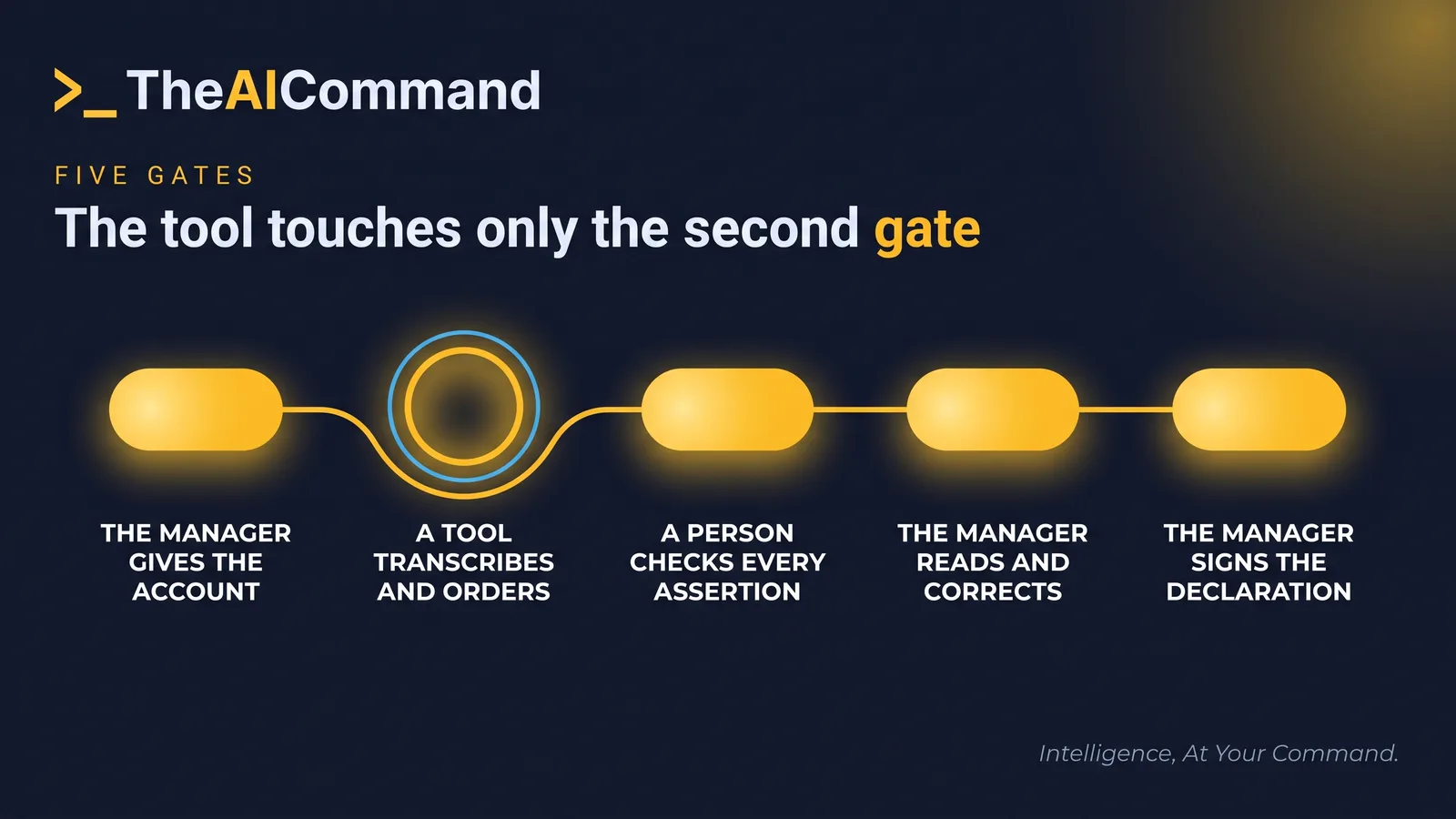
Applied to a witness statement, the method produces a sequence with a named person at every gate. The manager gives the account first, in their own words, dictated or typed, before any model sees the file. A tool transcribes and orders that account under paragraph 36 and adds nothing. A person, not a model, checks every factual assertion and authority against the sources paragraph 31 names. The manager reads the result, corrects the phrasing that is not theirs, and signs. The disclosure line records which of those steps involved a tool.
A constructed, de-identified example shows the difference. The manager's own account, given before any model saw the file, records telling [EMPLOYEE_NAME] on [DATE_2] that the till count was short again and asking what happened, [EMPLOYEE_NAME] answering that they did not know, and the manager noting it was the third time. Handed to a model with an instruction to draft the statement, the same file comes back as: "On [DATE_2] a meeting was convened with [EMPLOYEE_NAME] to address a recurring reconciliation discrepancy, at which [EMPLOYEE_NAME] was afforded an opportunity to respond and provided no explanation." The second version reads better, converts a conversation into a convened meeting, and characterises the exchange in words the manager never used. The transcribed version keeps the till count, the third time and the flat answer.
The Commission already supplies the starting artefact. Its Templates page describes its witness statement template as a document in which you "Present the facts in your own words and in a logical order." The "own words" standard is not new to the Commission. What is new on 20 October 2026 is that the witness declares having met it.
One constraint governs every step. The Commission page is direct: "Do not enter personal information about yourself or other people, or confidential case information, into public GenAI tools." Paragraphs 40 and 43 of the note carry the same point. Before pasting anything, replace every name, position title, employer and matter number with a placeholder, and number the dates in the order the events occurred.
What to check: read the returned statement against the account you gave and mark every phrase you would not have used. If the output reads better than you speak, it has been rewritten rather than ordered, and requirement 3 is not satisfied. Then check that the questions list is genuinely a list of questions, because a model that answers its own questions has supplied content. Confirm no date or document name appears that was not in your account.
The second prompt builds the checking list without letting the model do the checking. Run the placeholder replacement over the draft before attaching it.
What to check: count the rows against the draft yourself on a sample of three paragraphs, because an incomplete list is worse than no list. Every row then needs a person to open the underlying document or the authority on the sources paragraph 31 names. Any row that cannot be matched to a document you hold is removed from the draft, not softened.
Who signs the disclosure, and what does it have to say?
The person who lodges the document signs it. Paragraph 8 of the President's statement puts the AI section and the checking declaration on all users, so for an employer it is whoever signs the response, not an adviser further down the file. Where a professional representative lodges instead, footnote 1 of that statement brings a human resources adviser employed by a party inside that definition.
Requirement 1 asks for the use and the "how". Attachment A to the President's statement of 24 August 2026 is an example of the disclosure rather than final form text, because the modified forms are not in force as at 25 September 2026. Its use question names six categories, with an Other uses field for anything outside them:
- researching or getting advice about the law, eligibility, outcomes or Commission processes
- organising facts, evidence, the timeline or documents
- transcribing a person's voice into written words
- translating another language into English
- writing or creating content used in the application
- modifying or editing written content the person created
Its declaration carries four tick boxes: that references to facts and evidence are correct and the evidence exists, that cases, legislation, textbooks and articles referred to exist and support the positions claimed, that extracts and quotes come from the sources named, and that all other details are correct and relevant. Paragraph 27 of the note gives the same functions in prose, joining transcription and translation. A disclosure that says only "assistance" does not answer the question requirement 1 asks.
The consequences of getting it wrong are set out at paragraph 15 of the note. The Commission may give the material less weight, may disregard it, may make a costs order, or may dismiss an application. The first two leave no visible trace on the file, so a party may never learn that the material was discounted.
What to check: the sentence has to name one of the six Attachment A categories above or use the Other uses field, and it has to survive being read back against what actually happened. If the record of use was written from memory a week later, fix the record rather than the sentence. Check that the person named as having done the checking is the person who did it.
How did the Commission arrive at this?
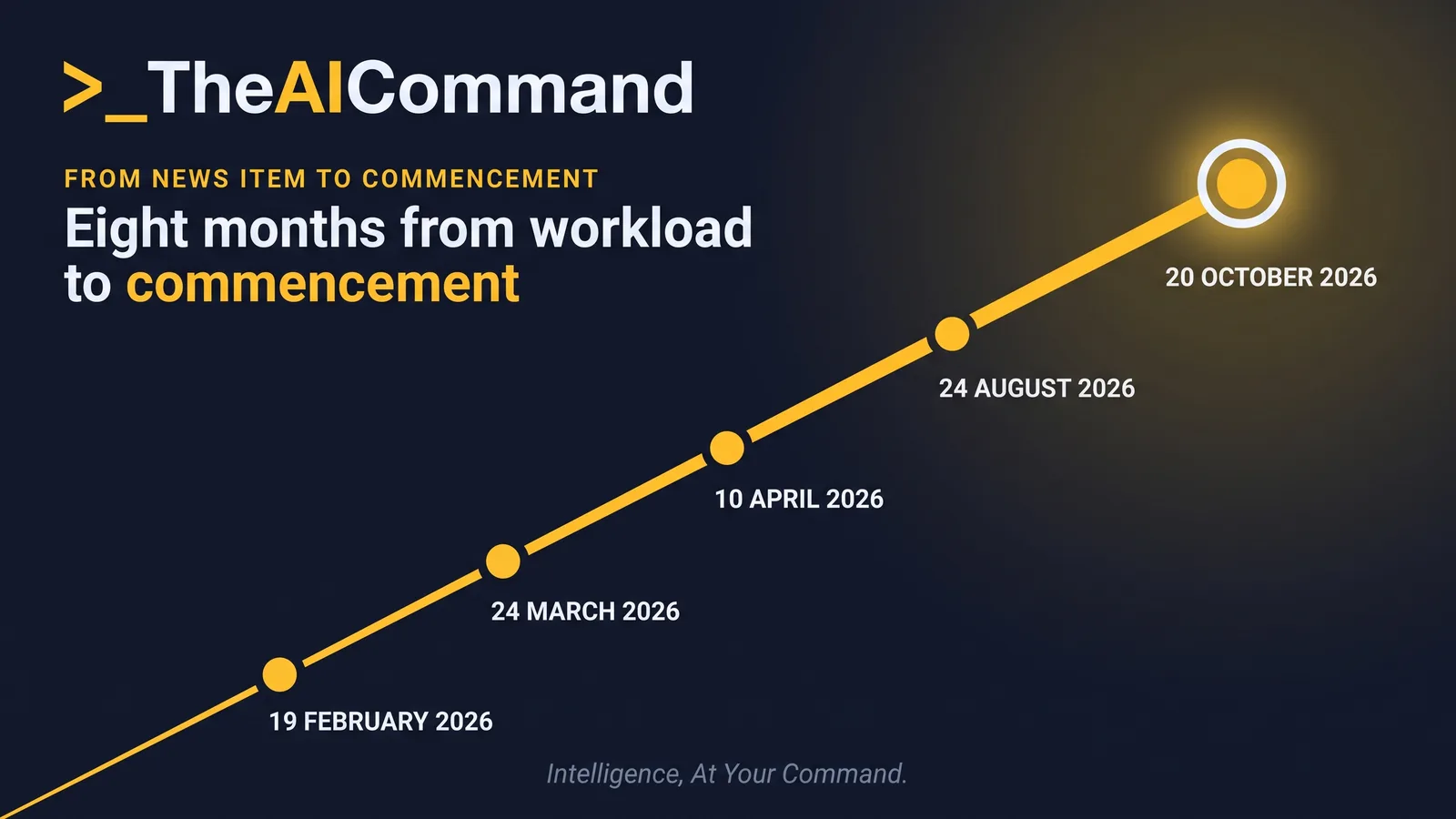
A Commission news item dated 19 February 2026, AI and increased workload at the Commission, records a presentation in which the President discussed AI as a driver of increased lodgments. The exposure draft followed on 24 March 2026, with the accompanying President's statement on the exposure draft recording that comments closed at 4 pm on Friday 10 April 2026. The final note and the President's statement followed on 24 August 2026, for commencement on 20 October 2026.
The scale behind it is set out in the President's statement of 24 August 2026, which records that by the end of financial year 2025-26 the total Commission workload had increased by over 70 percent in the space of three years, that 28 submissions were received on the draft, and that approximately 40 percent of surveyed applicants reported using AI to prepare or manage their case. The causal link stays hedged: the Commission says it has been led to infer the cause, which is not the same as establishing it.
The employer-side picture comes from the Fair Work Commission GenAI user research final report, final version 18 August 2026, prepared by Pivot Management Consulting from 18 interviews and an online survey run February to April 2026 with about 400 applicants and about 200 respondents. Of surveyed respondents, 57 percent felt the applicant had been using GenAI for their case at the Commission. An internal Commission survey cited in the same report found that in the six months to March 2026, Members identified GenAI use, by one or both parties, in 50 percent to 75 percent of cases.
The report names a pattern: "GenAI tends to fixate on procedural fairness arguments, generating detailed procedural objections regardless of the substantive merits of the dismissal." That is an argument about process, answered by evidence about process, which is exactly what a manager's statement carries.
The respondent evidence base is thinner than the applicant one, resting on six interviews, and the report describes employer use as largely confined to organising responses, drafting submissions and supplementing professional advice rather than replacing it.
What the note does not do
Four limits follow, because each one is a claim somebody will make in a briefing next week.
- Not a legislative instrument. Compilation No. 1 of the Fair Work Commission Rules 2024, compilation date 31 July 2026, returns no occurrence of artificial intelligence or GenAI. The requirements sit in a guidance note and in forms.
- Not a ban on AI in witness statements. Paragraph 35 is expressed as guidance against creating factual content, and requirement 3 is a check and declare obligation.
- The forms are not live yet. As at 25 September 2026 the modified forms are a dated commitment made in the President's statement of 24 August 2026 and restated in the speech of 8 September 2026, not an observed fact.
- Not final. Paragraph 3 of the note records that it will be amended from time to time, and the speech of 8 September 2026 acknowledges that the note is likely to require ongoing modification. Check the published version before citing a paragraph number.
Do this Monday
The artefact is a one page pack headed "Your own words", holding the Commission's witness statement template and a cover note of four labelled lines. It goes to any manager who may be asked for a statement. The owner is the employee relations lead, or the human resources manager where there is no separate function.
The first step fits inside an hour, and on 11 October 2026 commencement is nine days away.
- Download the witness statement template from the Commission's Templates page.
- Label the four cover lines: who gave the account, what tool touched the document, who checked it against the source material, and who signs the declaration. The first three stay blank until a matter arrives; the fourth names a role.
- Send the pack to the next manager asked for a statement, before they open a chat window.
- Confirm, before lodgement of any employer response from 20 October 2026, that the named signatory has read the sources the checking ran against.
The check runs the same day the pack is built: a colleague reading it cold can name by role who signs the declaration and which line records the tool. Three further checks apply at first use: each filled line carries a name, the returned statement carries the manager's own phrasing rather than the model's, and the disclosure line names one of the Attachment A categories rather than the word "assistance".
The bottom line
The final Guidance Note asks a witness for something the March exposure draft did not: that the statement reflect the witness's own words. On 11 October 2026 the requirements commence in nine days, they reach every matter, and the checking declaration is signed by a person. Paragraph 36 draws the line a manager can work to, permitting transcription and translation provided the statement still reflects those words, while paragraph 35 says the factual content should not be created by a model. Build the routine around the account the manager gives first, and the tool becomes a transcriber rather than an author. Get the sequence right before the forms change, not after a Member asks how a paragraph came to be written.
TheAICommand. Intelligence, At Your Command.