
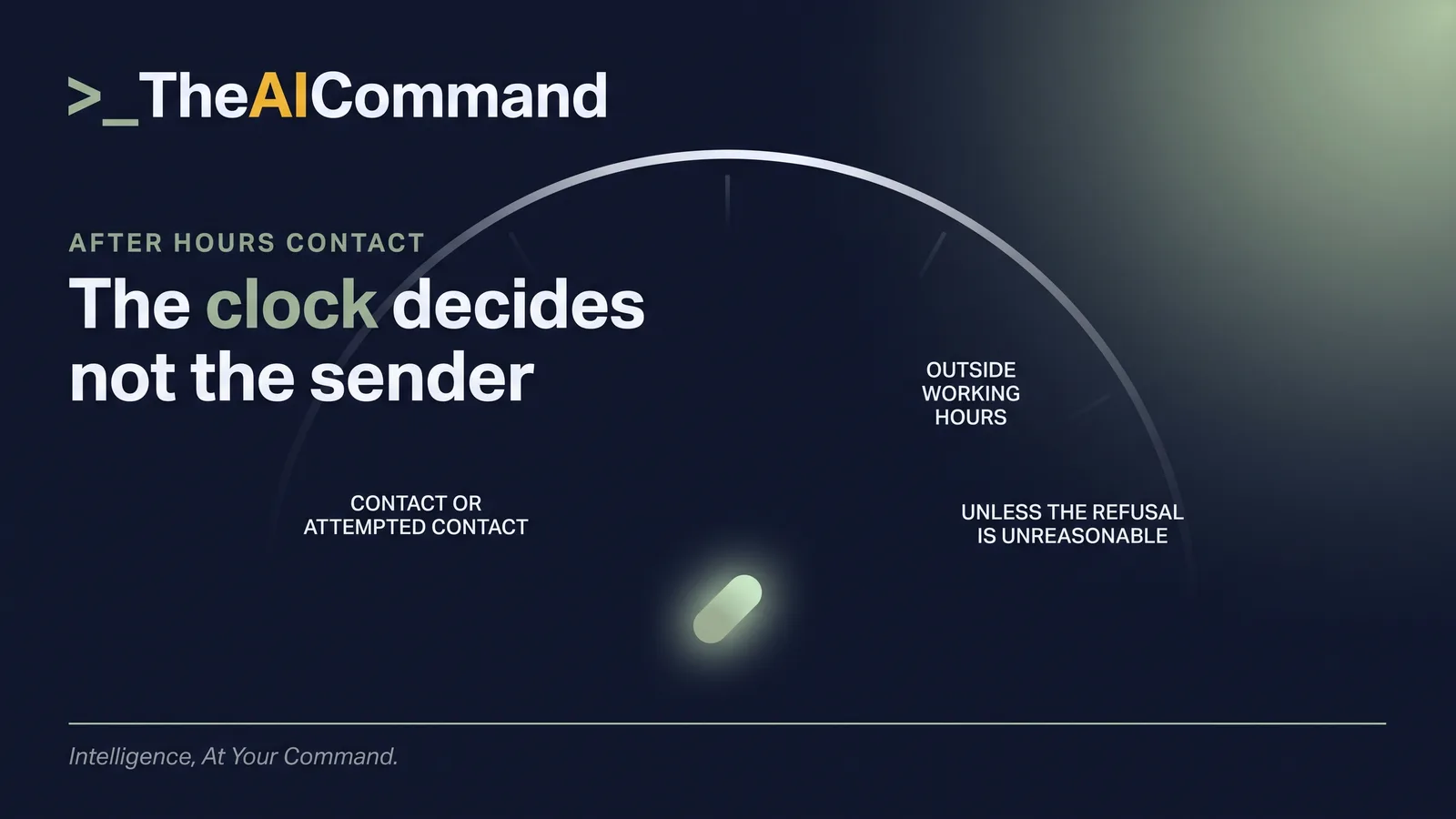
The section names the hour, not who pressed send.
The Fair Work Act 2009 attaches an employee right to refuse to the contact itself and to the hours the contact lands in. The section says nothing about whether a person was awake, present or deliberate when the message went out. For a human resources function running scheduled sends, rostering notifications and assistants that dispatch on a timer, that is the whole of the problem. The stack produces after-hours messages, and as at the Commission's own statement of 21 November 2025 the section had not been tested on a send that a system timed. Whether such a send is contact within the meaning of the section is what this article examines against the section text, and as at that statement no authority had decided it.
The practitioner move is evidentiary. Pull a week, or one roster cycle, of after-hours outbound from the human resources information system, the rostering tool and the messaging stack. Sort every send into three buckets: a person chose this delivery moment, a system chose it, or the log cannot tell. The third bucket is the finding.
What changed, and what a practitioner does differently
Three things moved, and one thing stopped moving.
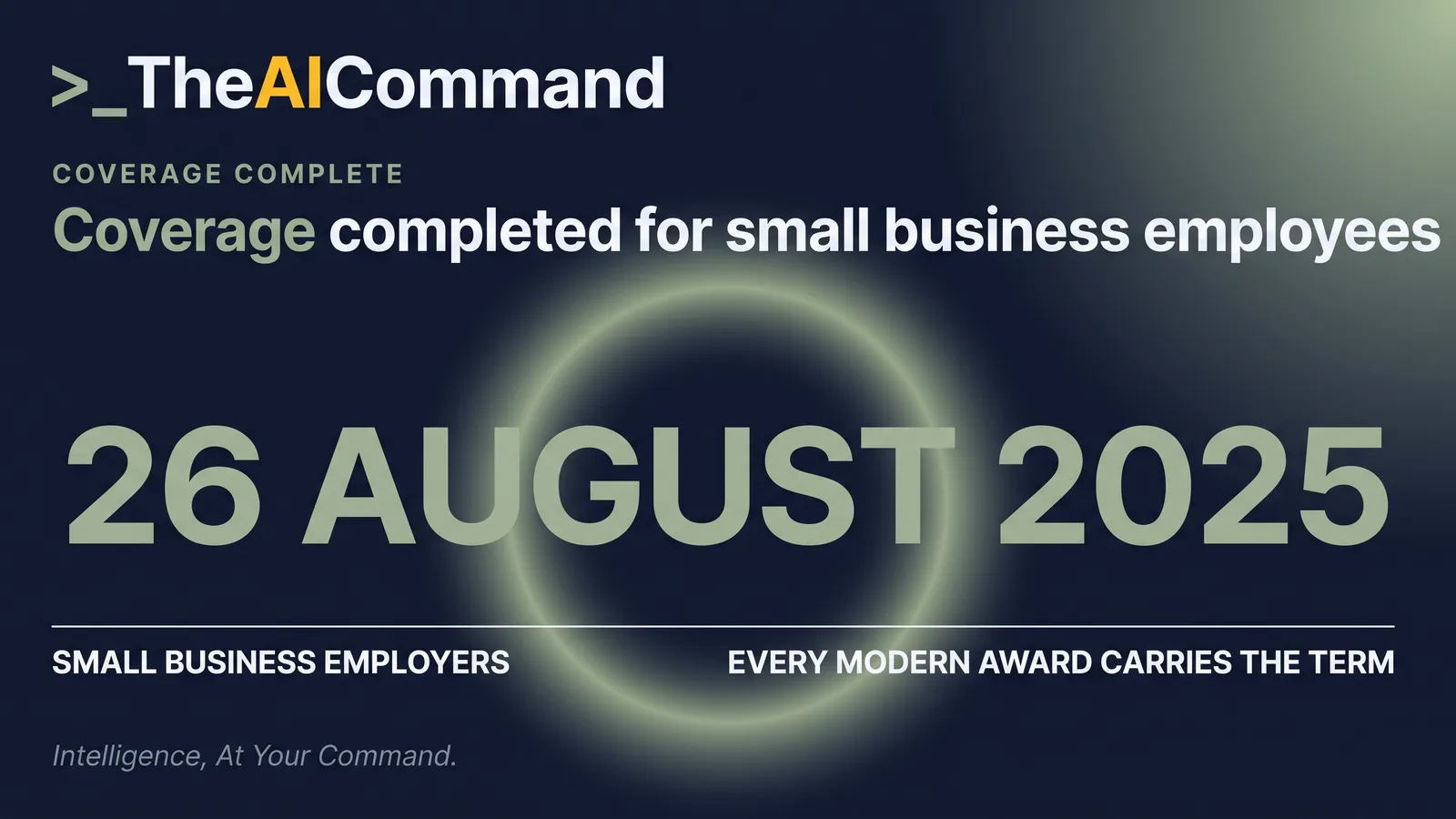
Coverage completed. The Fair Work Commission page What is the right to disconnect, last updated 26 August 2025, states that "If an employer was a small business employer on 26 August 2024, the right to disconnect applies to its employees from 26 August 2025." The staged start is finished. As at 24 September 2026, employer size decides nothing.
Award coverage completed. The Commission major case page for Variation of modern awards to include a right to disconnect (AM2024/14), last updated 13 February 2026, records in the Commission's own words that "We added a right to disconnect term into all modern awards by 26 August 2024." There is no award-by-award question left to answer as at 24 September 2026.
Regulator guidance refreshed. The Fair Work Ombudsman page Right to disconnect, content last updated 18 June 2026, describes the reach of contact by channel: "Contact can include using a range of communication channels such as calls, emails, texts, social media and messaging services." The regulator frames the question around the channel and the hour, and says nothing about whether a human was at the keyboard.
The thing that stopped moving is the guidance the Act itself requires, and that is the change with the most operational weight. The previous position was defensible: wait for the written guidelines, then write the policy against them. That wait now runs at least until the Commission revisits the question, which it put at about 12 months from 21 November 2025. The reasoning has to be done in house, against the section, and it has to be evidenced.
What does section 333M say?
The operative words are short. Read at Compilation No. 73, compilation date 7 July 2026, on the Federal Register of Legislation text of the Fair Work Act 2009, and current as at 24 September 2026, section 333M(1) provides that an employee may "refuse to monitor, read or respond to contact, or attempted contact, from an employer outside of the employee's working hours unless the refusal is unreasonable".
Four features of that sentence matter for an automated stack.
The section reaches attempted contact, and it does not say the contact has to land. Neither term is defined.
It reaches beyond the employer. Section 333M(2) extends the same right to contact "from a third party if the contact or attempted contact relates to their work and is outside of the employee's working hours unless the refusal is unreasonable". The same wording appears on the AustLII consolidated text of section 333M, checked word for word against the register compilation. A labour hire client or a contracted payroll provider messaging an employee about work is not outside the frame because it is not the employer.
Section 333M(4) provides that "each of the rights in subsections (1) and (2) is a workplace right within the meaning of Part 3-1". What follows from that characterisation is outside what this article verifies against a primary source, so take advice on it.
Reasonableness is the test. Section 333M(3) sets out five matters that must be taken into account in deciding whether a refusal is unreasonable, and it opens "Without limiting the matters that may be taken into account", so the five are mandatory and not a closed list. The compilation linked above carries all five, and that text is what the second prompt below needs. One of them, section 333M(3)(b), is "how the contact or attempted contact is made and the level of disruption the contact or attempted contact causes the employee". That factor is about the mechanism of the send. An automated dispatch at 22:40 to every person on a roster is a mechanism an organisation chose. Section 333M(5) runs the other way: a refusal "will be unreasonable if the contact or attempted contact is required under a law of the Commonwealth, a State or a Territory".
Two procedural sections complete the picture. Section 333N(2) requires that "the parties to the dispute must attempt to resolve the dispute at the workplace level by discussions between the parties". Section 333P(2) provides that the Commission "may make any order it considers appropriate (other than an order requiring the payment of a pecuniary amount)". The remedy is an order about conduct, and the first forum is a conversation at the workplace. Both favour the organisation that can produce a record.
Who the right reaches, and since when
As at 24 September 2026, coverage is universal by employer size and by award. The Commission page, last updated 26 August 2025, records that a right to disconnect term was added to all 155 modern awards, a count that held as at 24 September 2026. The same page states that the right applies to national system employees and that it does not apply to independent contractors, a boundary worth writing into any policy covering a mixed workforce.
The award term adds an obligation the section does not spell out. Clause 13A.3 of the Clerks Private Sector Award 2020 (MA000002), read on the Fair Work Ombudsman award library on 24 September 2026, provides that "An employer must not directly or indirectly prevent an employee from exercising their right to disconnect under the Act."
Indirect prevention is the phrase to sit with. A contact pattern that is automated, constant and unacknowledged is not a direction to answer, and it can still be the environment in which nobody feels able to refuse. That is the clause an automated pattern would be tested against. Clause 13A.4 qualifies it immediately: the award records that clause 13A.3 does not prevent an employer from contacting, or attempting to contact, an employee outside working hours in stated circumstances, including to notify a recall to work. The obligation is on prevention of the right, not on contact itself.
Why no guidelines are coming any time soon
Section 333W(1) provides that "The FWC must make written guidelines in relation to the operation of this Division." They do not exist. In its Statement of 21 November 2025 in AM2024/14, the Full Bench recorded that "the Commission has not yet considered any test cases nor resolved any significant disputes regarding the substantive right to disconnect provisions in the FW Act". It deferred both the model award term review and the guidelines, and indicated it would return in about 12 months. No guidelines had been made as at 24 September 2026.
That statement cuts both ways. As at that statement, no authority had said an automated send is contact, and none had said it is not. An organisation that has automated a large share of its employee communications is carrying an untested position, and the way to carry one is with a record, not an opinion.
Is an automated send contact under the section?
Neither the section, the regulator guidance nor the Commission's own statement answers that question. The Act uses the words "contact, or attempted contact" and defines neither. The Fair Work Ombudsman describes contact by channel. The Full Bench recorded on 21 November 2025 that it had resolved no significant dispute on the substantive provisions. So the honest statement of the position is textual: the section names a sender, a recipient, a work relationship and a set of hours, and not a human choosing the moment of delivery.
Write that into the policy in exactly those terms. An organisation that records "an automated send is not contact" has adopted a legal conclusion no source supports. An organisation that records "the section does not distinguish by who chose the delivery time, so the following automated patterns are being reviewed against section 333M(3)" has adopted a defensible position and left itself somewhere to move when the first decision lands.
This is general information for practitioners, not legal advice, and an organisation takes its own advice on its own facts.
Where after-hours sends come from in a human resources stack
Four mechanics produce after-hours sends in a human resources stack, and only one of them has a person choosing the hour the message lands.
The first is ordinary scheduled send. Microsoft support documentation for delaying or scheduling messages in Outlook describes it plainly: "After you select Send, the message remains in the Draft folder until the delivery time." A person picked the hour in advance, which is the easy bucket.
The second is assisted timing, where the product proposes the hour. Microsoft support documentation for the Viva Insights feature schedule send in Outlook, read on 24 September 2026, states that "At the scheduled delivery time, the email automatically delivers to all recipients in the To, Cc, and Bcc fields for you." The same page states that the suggestions are turned on by default and that a sender might receive one when all recipients in the To field are outside their working hours. For an auditor, the point is narrower: the delivery moment is now a product decision operating on working hours data, and the log records it that way only if it records it at all.
The third is broadcast on publish, which is where rostering lives. The Deputy help centre article Publishing shifts, read on 24 September 2026, describes the option this way: "Publish all: all team members on this schedule will be notified regardless of whether their shift was changed or not." The same page records notification by email, SMS and push, and a separate option to publish without notifying. The timing of that outbound is set by when a manager publishes the schedule, not by each recipient's own hours.
The fourth is the automation rule, a workflow or an assistant firing on a trigger and a timer, which no vendor page here documents.
The bucket turns on whether a person chose the moment for that recipient, so one publish action firing to everyone at once is system timed.
The Australian Bureau of Statistics release Working arrangements, August 2025, released 12 December 2025, records that 36% of employed people usually work from home, so working hours are established by the roster or the contract.
Which sends did a person actually time?
The register is a one-week job.
TheAICommand works to the Verified Draft Method: de-identify the inputs, ground the model in your own source material, keep a person at the decision point, verify against the primary source, and log what happened.
Applied here, the method means metadata only. The classification task needs a timestamp, a channel, an originating system, whether a scheduling or automation feature was used, and the recipient's rostered days and hours. It does not need message bodies, which carry the personal information risk, so they stay out of the export.
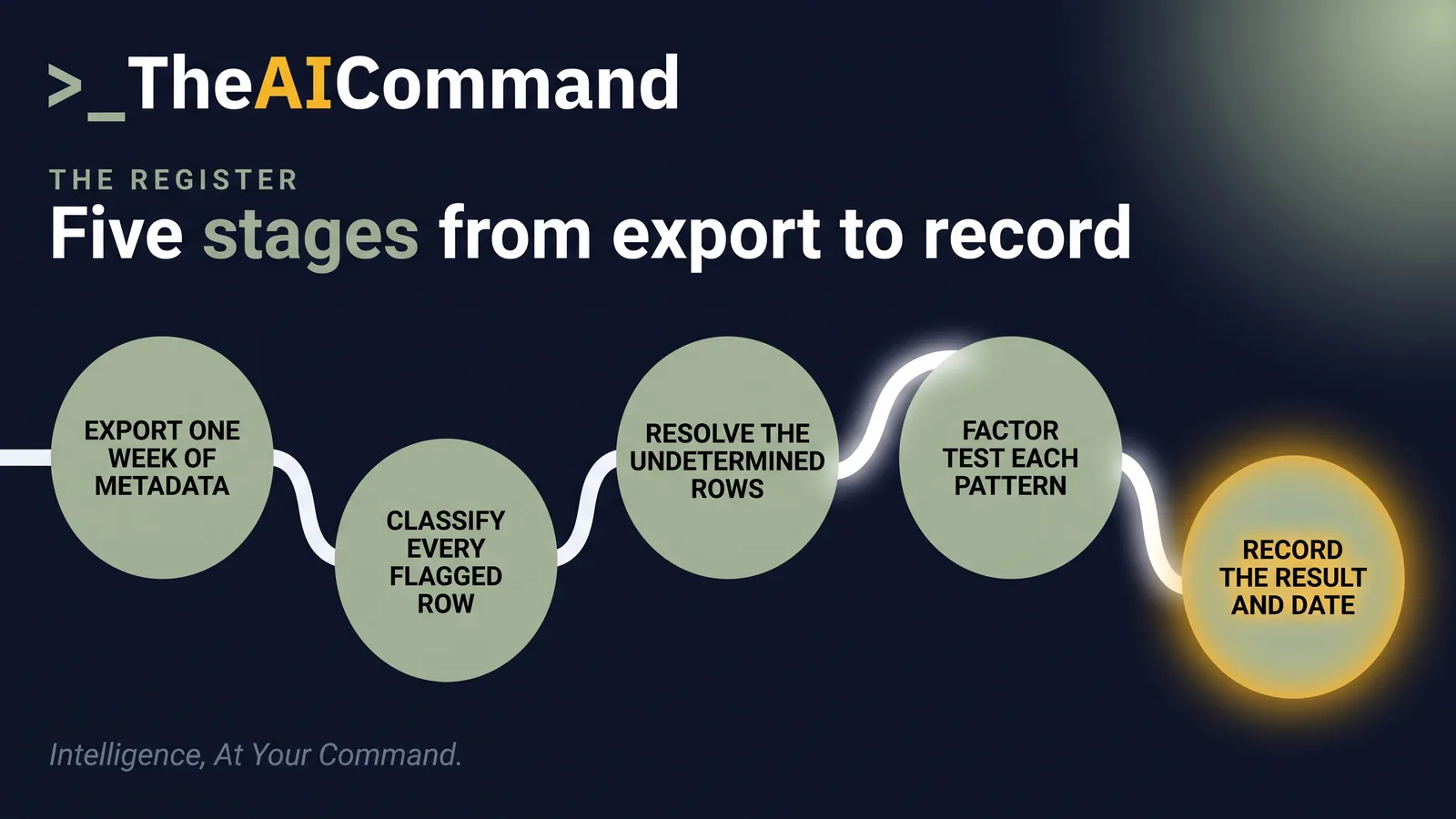
What to check: open the undetermined list first and confirm every row names a specific missing field, because a model that returns an empty undetermined list has almost certainly guessed. Then take ten rows the model called human timed and trace each one back to the column it cited in the export. If the model has reasoned from the hour or the role rather than from a logged scheduling field, the classification is not evidence and the export needs a field the source system is not yet giving. Then confirm the counts table totals the number of rows you exported, because a run that dropped rows still returns a tidy table.
Answering the five factors before anyone asks
The register produces a shortlist of recurring patterns: the Sunday roster publish, the Friday night payroll reminder, the assistant that follows up on an unsubmitted timesheet at 20:00. Each is what a workplace level discussion under section 333N(2) will be about.
The task is to make sure the responsible manager can answer the section when asked, with a source for each answer. Write the pattern summary as six lines: the sending system, the trigger, the usual send time and day, the recipient group by role, the channels used, and what the message asks the recipient to do. Those six lines come off the register.
What to check: confirm every factor in the output is quoted from the section text you attached, word for word against the compilation you pasted, because the prompt forbids the model from adding any factor that is not in the file. Then read the evidence column: if more than one or two factors point at a record nobody keeps, the finding is about the logging, and the pattern goes back to the system owner before it goes anywhere near a policy rewrite.
Closing the gap between the policy and the clause
The Fair Work Ombudsman page Discussing the right to disconnect, content last updated 18 June 2026, states that "Employers and employees are encouraged to discuss out of hours contact and set expectations that suit the workplace and the employee's role." The page sets out what those discussions cover, including preferred contact channels, which other people need to know about the arrangement, what internal policies and documents need updating, and how it is recorded.
If the organisation has an out of hours contact policy, the question the review asks of it is whether it names a system as a sender.
What to check: every gap must carry a quotation from one of the attached documents, so delete any row that cites nothing. Check the human sender list by hand against the policy text, because that is the finding the whole review exists to produce. Then confirm nothing in the output reads as a redraft, since the wording is an industrial relations decision.
Do this Monday
The artefact is the after-hours outbound register: one row per after-hours send, one timing origin per row, one dated verdict per recurring pattern.
The owner is the human resources systems owner, the role that holds administrative access to the human resources information system and the rostering tool, not the employment relations lead who owns the policy.
The first step fits in an hour.
- Pick one sending system.
- Export seven days of outbound metadata with the nine columns the first prompt names, and no message bodies. Map the sending system's own scheduling field onto the table values above, and leave it blank where it logs none.
- Join each recipient to their rostered days and hours by role code, not by name. If that join is not available in an hour, set the standard span for the role and record that you did.
- Run the first prompt over the export.
The run worked when every row carries a bucket, every undetermined row names the missing field, and the ten human timed rows traced above each come back to a logged column. If the count is large, the register has done its job on day one: the organisation now knows what it cannot yet evidence. Put a review date on the register and give the recurring patterns to the responsible managers before the next roster cycle.
The bottom line
Section 333M attaches the right to refuse to the contact, the work relationship and the hours, and it does not say that a person must have chosen the delivery moment. Coverage has been complete across employer sizes since 26 August 2025 and, as at 24 September 2026, the term sits in every modern award, so neither employer size nor award coverage decides the question for a national system employer any more. No written guidelines had been made as at 24 September 2026 and the Full Bench recorded on 21 November 2025 that it had resolved no significant dispute on the substantive provisions, so an automated send cannot honestly be called contact or not called contact. Build the register first: which after-hours sends a person timed, which a system timed, and which the logs cannot tell apart. Then hold the conversation section 333N(2) requires.
TheAICommand. Intelligence, At Your Command.