
The Commission judged the conduct, not the tool.
On 18 March 2026, Deputy President Slevin dismissed an unfair dismissal application in Wibmer v Fujifilm Data Management Solutions Pty Ltd [2026] FWC 835. On 2 July 2026 a Full Bench refused permission to appeal in [2026] FWCFB 159, and the decision is now settled. Most coverage framed it as the first Australian AI dismissal case. That framing is wrong in a way that matters for anyone drafting an AI policy, because the Commission was careful to do the opposite: it separated the tool from the behaviour, and then decided the behaviour.
For HR, this is the useful part. The question that arrives at your desk is never "did they use AI". It is whether what the person did meets the standard your organisation actually set.
What happened
The employee had worked for the employer for more than 11 years, and the decision records that there was no complaint about his performance or his conduct in that time. The events began on 30 May 2025 with a disagreement with a colleague over a work criticism made in a Microsoft Teams exchange. He complained that the exchange was bullying, would not accept an apology, and asked for an investigation.
As that matter was investigated, he made further complaints and, in the words of the decision, "engaged in an inordinate exchange of communications with several FujiFilm managers". Most were emails. Many were long. He agreed that in preparing those emails he relied upon an artificial intelligence large language model, and managers who attended meetings with him gave unchallenged evidence that he appeared to be referring to a chatbot on his phone to frame his responses in the room.
The Commission found the dismissal was not harsh, unjust or unreasonable. The conclusion at paragraph 117 names the conduct: he "had become ungovernable", his communications were inappropriate, his refusal to respond to allegations directly and honestly was improper, and his refusal to accept the outcomes of his complaints was obstinate.
Nothing in that list is an AI finding. Every item is a conduct finding.
What the Commission did with the AI
This is the part worth reading twice, because the Deputy President raised it himself. At paragraph 113 the decision records that it "was not raised but I have considered whether it was relevant as mitigation for his conduct that Mr Wibmer was collaborating with AI in preparing the myriad of communications that contributed to his dismissal".
The employee's own account was that he used his actual intelligence in collaboration with the tools available to him, that he assessed, edited and finalised the drafts, and that he accepted ultimate responsibility for what the communications contained. The decision also notes he used an application to transcribe audio recordings he had made of meetings with his managers and HR, that he used AI to generate text in his application to the Commission, and that he attributed his knowledge of specific statutory provisions to directed research using AI.
The Deputy President's assessment at paragraph 114 is blunt: "Mr Wibmer's use of AI was unfortunate. It was counterproductive. It led to his demise." The communications it produced "were dense, repetitive and often rambling", they were "demanding and overbearing" and they "lacked context and perspective". The use of AI, the decision continues, "appears to have given Mr Wibmer a false sense of security that his communications, laden as they were with allegations of impropriety by his managers and demands for corrective action, were appropriate and acceptable in a workplace setting. Objectively, they were not."
Then the conclusion at paragraph 115: because he was clear that he took responsibility for what was sent, "I do not regard Mr Wibmer's use of AI as an explanation for his conduct".
Three propositions follow, and they will outlast this case.
AI is not a new category of misconduct. The Commission did not need one. Existing standards about honesty, respectful communication and cooperation carried the entire analysis.
AI is not a defence. Responsibility follows the person who sends the message. An employee who edits and sends output has adopted it, exactly as they would a template or a colleague's draft.
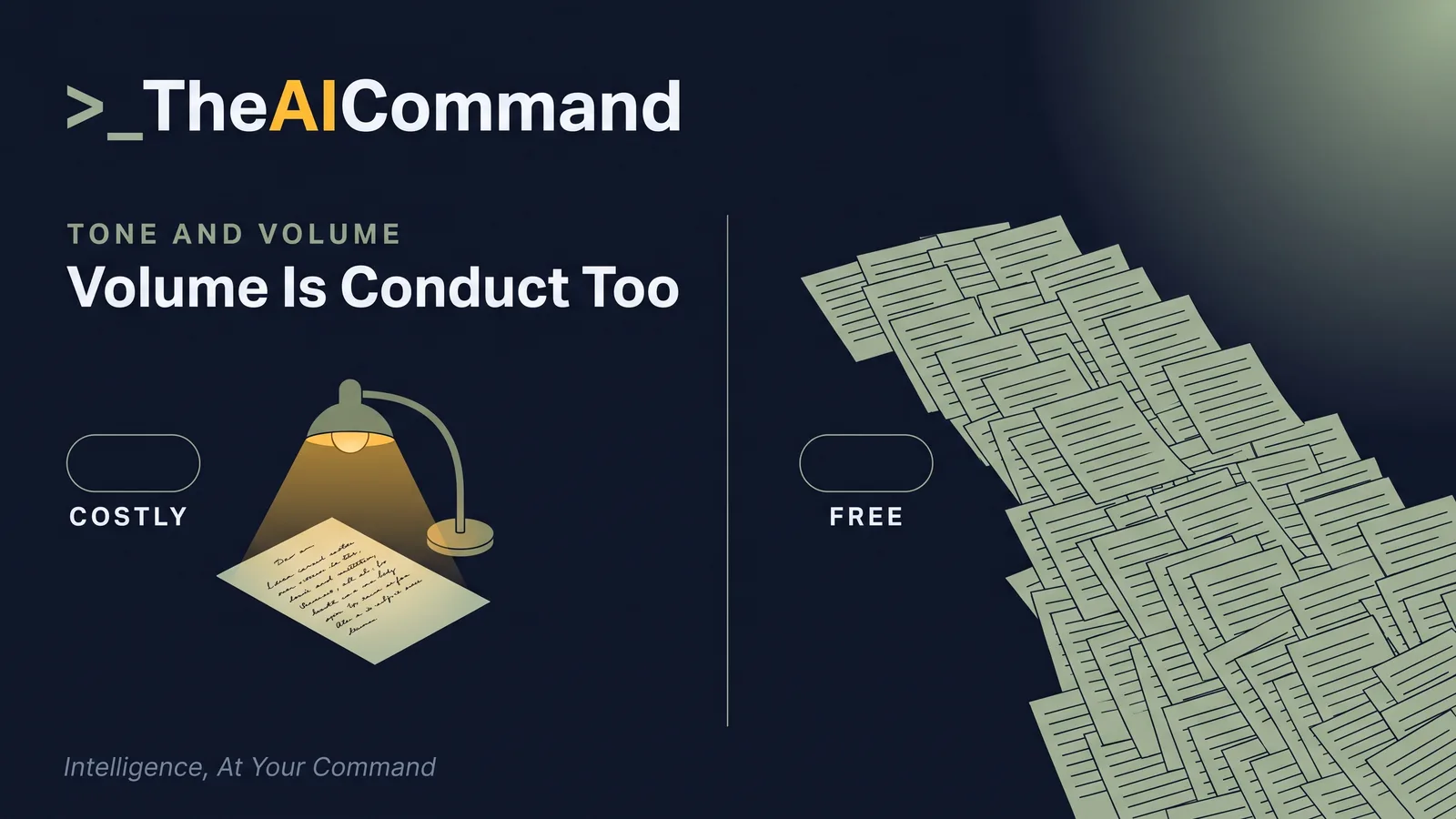
Volume and tone are conduct. This is the operational shift. AI collapses the cost of producing long, formal, aggressive correspondence. A single person can now generate more of it in a week than a manager can absorb in a month, and the decision describes precisely that effect. Policies written when writing was expensive assumed volume was self-limiting. It no longer is.
One more detail deserves attention. The decision describes the employee's disclosure of his AI use as "commendable", even while finding the collaboration did not serve him well. Candour was treated as a point in his favour. That is a useful thing to be able to tell your workforce.
Your policy is probably not a conduct standard yet
Most Australian AI policies list approved tools and prohibit entering confidential information. That is a procurement statement with a security clause attached. It is not a conduct standard, and a conduct standard is what a manager needs when the behaviour is the problem.
The gap shows in the workforce data. Research commissioned by ELMO Software and conducted by YouGov, surveying 1,055 Australian employees between 5 and 13 January 2026 and published on 3 March 2026, found that only 19 per cent said leadership expectations around AI use were clear, and only 14 per cent felt strongly supported to use AI responsibly and effectively. Twenty-nine per cent reported using a mix of approved and non-approved tools, and 12 per cent were unsure which tools were officially approved.
An organisation where four in five employees cannot describe the expectation has not set one. That is a poor position from which to run a disciplinary process, and it is an avoidable one.
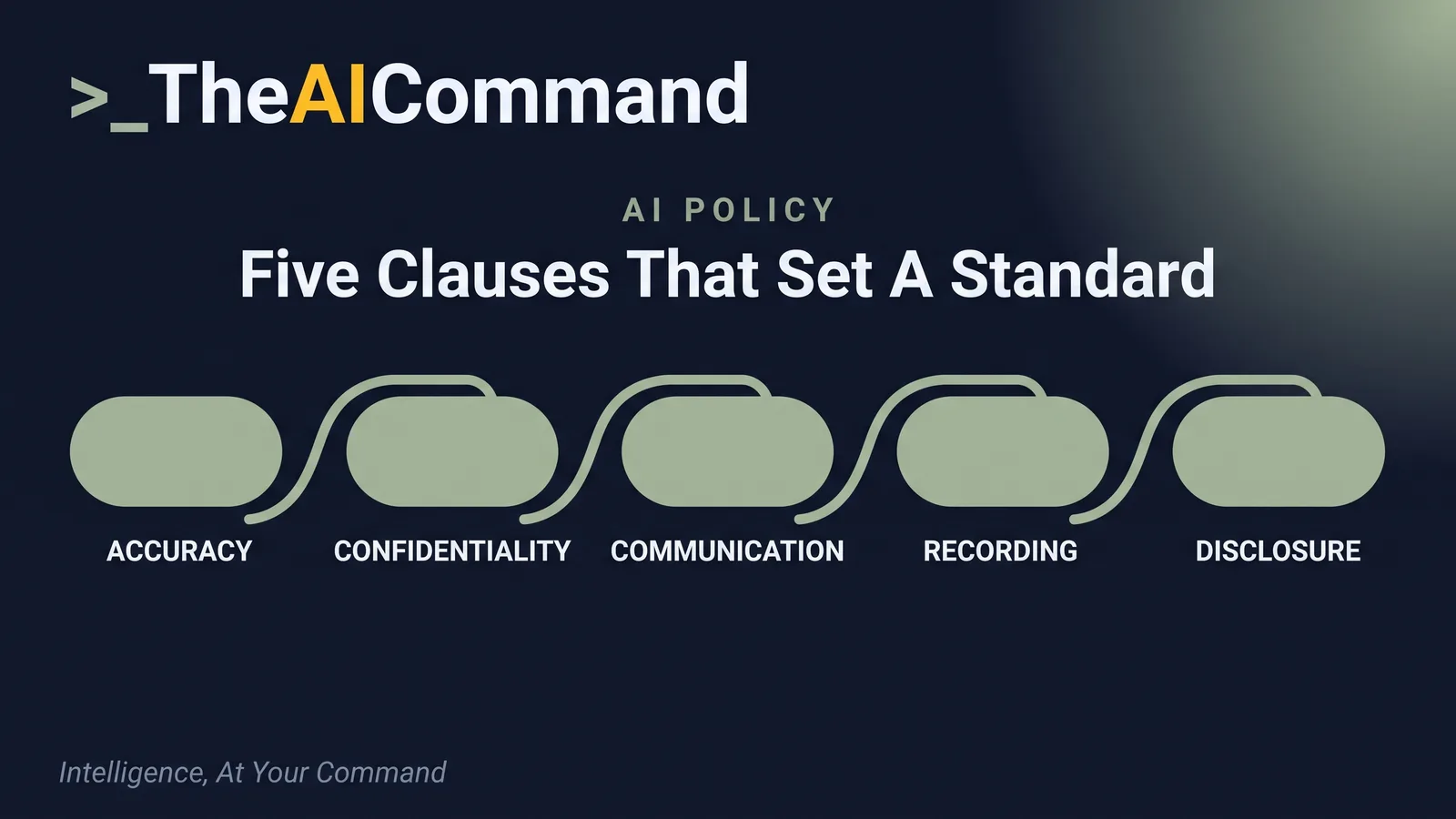
Five clauses turn a tool list into a standard people can be held to.
- Accuracy and verification. The person who sends it owns every fact, figure, citation and legal reference in it. This is the same standard the Commission applies to material filed in its own proceedings, covered in our piece on the Commission's three rules for AI in a case.
- Confidentiality and personal information. Name what must never be entered into a tool: customer records, employee records, health information, anything under a confidentiality obligation. Name the approved destinations for each.
- Communication standards apply unchanged. State that respectful, proportionate and clear communication is required regardless of how a message was drafted, and that length is not thoroughness.
- Recording and transcription. Meeting capture is a separate obligation with its own consent rules, which we cover in AI note-takers in HR meetings. Say who may record, when, and with whose knowledge.
- Disclosure. Say where AI assistance must be disclosed. Formal complaints, investigation responses, performance documentation and anything going to a regulator or tribunal are the obvious set.
Then do the unglamorous part. Publish it, train on it, and record that you did. A standard nobody was told about is not a standard a decision can rest on.
The conversation a manager actually has
Assume [EMPLOYEE_NAME] in [TEAM] has sent eleven long emails in six days about an unresolved grievance, each one restating the last with added allegations. The instinct is to raise the AI. Do not lead with it.
Lead with the observable conduct: the volume, the effect on the people receiving it, and the standard expected. "Eleven emails in six days on a matter already under investigation is not a workable way to raise a concern. The expectation is one written summary, then the process." Then separate the substance: the grievance still gets dealt with on its merits, on the timetable you commit to in the room.
If AI comes up, treat it as context rather than the charge. It explains how the volume was produced. It does not change whether the volume was appropriate, and the Commission has now said as much.
There is a second thread in this decision that HR teams keep missing. The employee did not only draft with AI. He recorded meetings with his managers and with HR, and ran those recordings through a transcription application. Capture of that kind is now a default feature rather than a deliberate act, and it arrives in your investigation file as a transcript nobody in the room agreed to. Decide in advance whether recording is permitted in grievance and investigation meetings, say so at the start of every one of them, and make the same rule apply to the organisation's own note-taking tools. A rule that binds employees and exempts managers will not survive its first hearing.
Where the conduct is serious enough to move to a formal process, the ordinary requirements apply without modification: a valid reason grounded in facts a person has verified, notice of the reason, an opportunity to respond, and a proportionate outcome. Our piece on AI-drafted performance documents covers the employer side of that, and the principle is symmetrical. If an employee cannot rely on a tool to explain their conduct, an employer cannot rely on one to justify a decision.
What never to automate
Do not let a model score, rank or classify employee communications for tone or aggression and feed that into a disciplinary decision. Do not use AI to draft findings of fact. Do not treat an AI detector's output as evidence that an employee used AI, because those tools are unreliable and the question is almost never load bearing. And do not turn an AI policy breach into the primary allegation when the real allegation is about honesty, confidentiality or respect. The Commission looked past the tool, and so should the process.
Bottom line
A dismissal decision now final on appeal considered whether AI use mitigated an employee's conduct and concluded it did not, because the employee had taken responsibility for what was sent. AI creates no new category of misconduct and offers no new defence. What it does change is the volume and register of communication a single person can produce, and whether your policy has ever told them what the standard is. Set the standard as conduct, communicate it, and let managers address behaviour rather than tools. Leaders set the tone here too, which we cover in setting your team's AI norm.
Do this Monday:
- Read your AI policy and mark every line that is a tool list rather than a conduct standard
- Add the five clauses: accuracy, confidentiality, communication, recording, disclosure
- Confirm you can evidence that the policy was communicated and trained, with dates
- Brief managers to raise the conduct, never the tool, and to keep the substantive complaint on its own track
- Tell your workforce that disclosing AI assistance is welcomed, not penalised
TheAICommand. Intelligence, At Your Command.