
The clause is perfect. The agreement is still unenforceable.
That sentence is now the most useful thing an Australian HR team can understand about settlement drafting. Since 1 July 2026, a workplace non-disclosure agreement covering sexual harassment connected to Victoria binds the complainant on the harassment itself only if a specific sequence of events happened before anyone signed. None of those events is a clause. None of them can be produced by a document generator. And the tool most likely to draft the deed, a general purpose model working from your precedent bank, has no reliable knowledge of the regime in operation.
What actually changed on 1 July?
The Restricting Non-disclosure Agreements (Sexual Harassment at Work) Act 2025 (Vic) commenced on 1 July 2026. It applies to agreements entered into on or after that date and, under section 6(4), does not touch anything made before commencement.
Three features of the Act matter more than the headlines it attracted.
The first is reach. Section 3 defines a non-disclosure agreement as a contract or agreement, "or any part or term of a contract or other agreement", whose purpose or effect is to prevent a party from disclosing certain information, "regardless of whether that purpose or effect is achieved directly or indirectly". The examples in the section name a non-disparagement clause in a settlement agreement alongside the obvious confidentiality clause. That second example is the one that catches people. A non-disparagement term does not read like a gag. It reads like ordinary commercial tidiness, and it is squarely inside the definition.
The second is that validity is procedural. Section 8(1) sets five preconditions: the complainant requests the agreement, it is their express wish and preference, they are given the approved information statement after requesting and before entering, they are given at least 21 days to review, and each party signs an acknowledgement in a form approved by the Secretary confirming the first four were met. Section 8(2) lets the complainant request a shorter period or waive it, so the 21 days is a floor the complainant controls rather than a delay the employer manages. Section 8(3) adds a sixth precondition that the employer, the respondent, or "a person acting on behalf of" either must not exert undue influence or undue pressure on the complainant's decision.
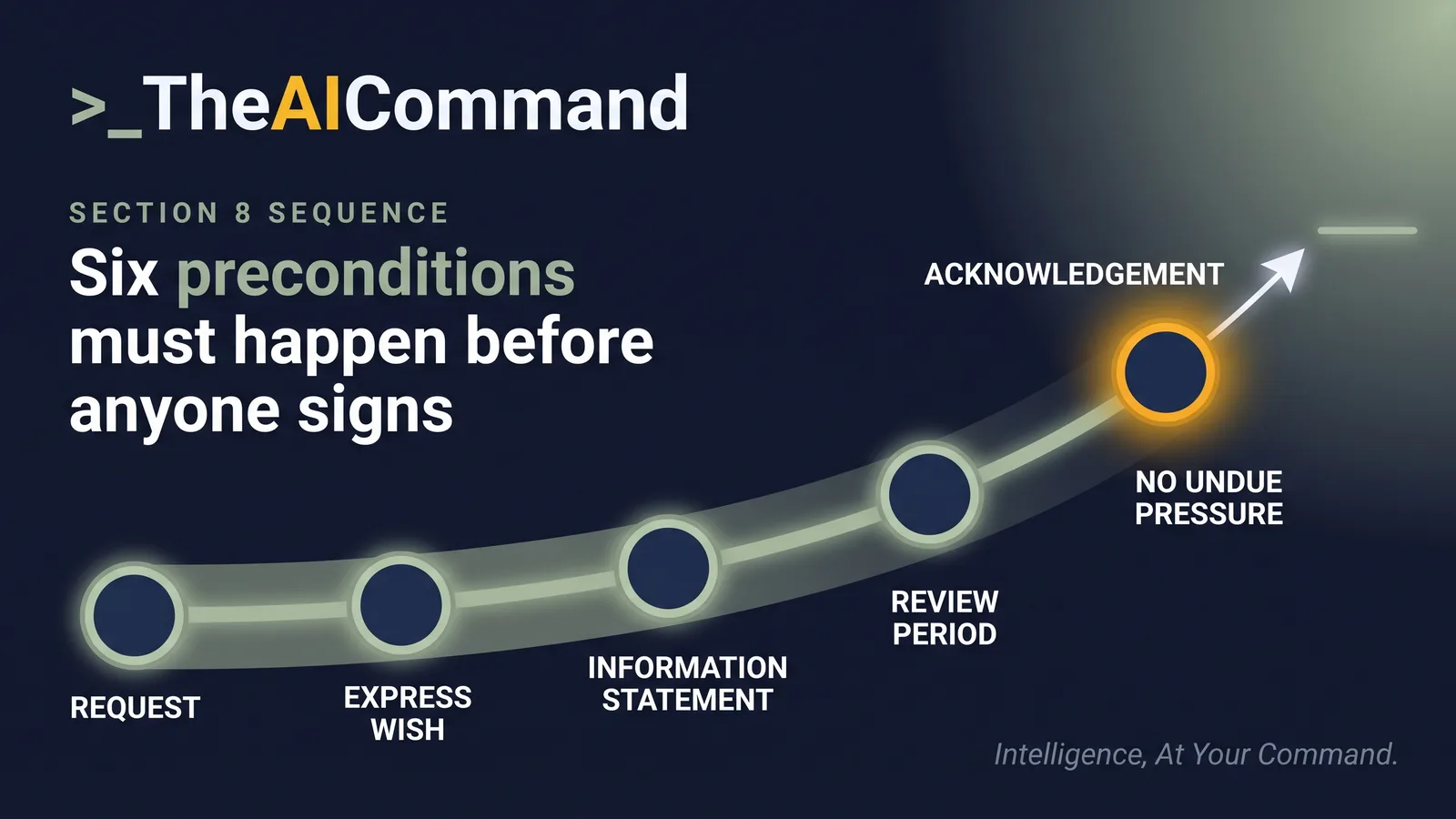
The third is the consequence, and it is not what most summaries suggest. The Act creates no offence and imposes no penalty. Everything runs through section 14: the agreement "is not enforceable against a complainant" to the extent it would prevent them disclosing material information about workplace sexual harassment, unless the preconditions have been met.
Read the carve-out with it, because it decides how much of the deed is at risk. Section 3 defines material information as the identity of the respondent and details of the conduct, and defines protected information as the amount of any financial compensation and, where the respondent was under 18, their identity. Section 14(3) takes protected information out of section 14(1) altogether, and sections 19(1), 20(4) and 21(2) do the same in their own contexts, so confidentiality over the settlement sum holds whatever happened with the preconditions. Section 23 then preserves the rest of the agreement and, where the NDA sits inside a settlement agreement, the settlement agreement itself. What fails is the gag on the harassment, against the complainant, and only to that extent.
Enforcement is triggered by the complainant serving a breach notice, after which sections 16 and 17 give the other parties 30 days to apply to the Industrial Division of the Magistrates' Court. If nobody applies in time, the preconditions are taken not to have been met. Silence loses the argument.
So the risk is not a fine. The risk is that an organisation believes a matter is closed when it is not.
Why is this the one thing AI cannot draft?
Because enforceability does not live in the words.
Every one of the six preconditions is an event with a date and an actor. Who asked first. Whether it was genuinely their preference. Whether the statement was handed over after the request and before signing. How many days sat between. Whether anyone leaned on them. A language model generating a settlement deed can produce all the correct terms, in plain language as section 9 requires, and still be describing a process that never happened in that order.
This is a different failure from the one HR teams have learned to watch for. We have trained ourselves to check AI output for invented facts and fabricated citations. Here the output is accurate. The document is fine. What is missing sits outside the document entirely, in a file that either does or does not contain a dated, signed acknowledgement on the Secretary's approved form.
There is a second, quieter problem. A model drafting from your precedent bank is optimising for consistency with what you have used before, and what you have used before was written for a legal position that changed three months ago. Anthropic publishes a reliable knowledge cutoff for each model, and as at 21 September 2026 every cutoff it publishes falls before the 1 July commencement, the most recent being June 2026. Anthropic's published definition of the term is that a model's "knowledge base is most extensive and reliable on information and events up to" that date. Ask a model to tidy up a confidentiality clause and it will do exactly that, competently, against the old world.
What should HR actually do before a deed goes out?
Treat the agreement as the last artefact in a process, not the first. The workflow below is a general operating pattern rather than legal advice, and matters of any complexity belong with your employment lawyer.
- Classify the matter before anything is drafted. Is the harassment connected to Victoria under section 6? If the complainant usually works in Victoria, assume yes and route the matter down this path even if the employer sits in another state. Then classify the terms, because the preconditions attach only to a term restricting material information about the harassment. A term keeping the settlement sum confidential, or the identity of a respondent who was under 18, sits outside the sequence under sections 3 and 14(3), and the employer can still propose it.
- Wait for the request, and record it. For a gag on the harassment itself, the complainant must ask. An employer or respondent proposing that agreement does not just fail precondition (a), it invites the undue pressure question under section 8(3). Note the date and the form the request took.
- Issue the information statement, then start the clock. The order is fixed by section 8(1)(c): after the request, before the agreement. File the copy you sent and the date you sent it. The statement is not one of the approved forms: under section 26 the Secretary prepares it and the Minister approves it, while the acknowledgement, breach and termination forms are approved by the Secretary under sections 8(1)(e), 16(2)(d) and 19(3)(a).
- Let the review period run on the complainant's terms. At least 21 days unless they ask for less or waive it, and that choice is theirs to make and record, not yours to suggest.
- Complete the approved acknowledgement form. It is a dated, signed record in which the complainant selects which of the three review-period outcomes applied and the employer signatory confirms they are authorised to make the declaration. Note that the published form contains a small typographical error in the review-period option, which is worth knowing before someone assumes the file copy has been altered.
- Give the complainant both documents. Section 10 requires a copy of the signed agreement and a copy of the acknowledgement.
- Check what the agreement does not block. Section 11 and Schedule 1 require the agreement to permit disclosure to a listed set of recipients including a lawyer for legal advice, a union officer, a health practitioner, a family member for support and a prospective employer of the complainant. Section 11(2) carves protected information out of every one of them, so the compensation amount is not something Table 1 opens up, although section 13 separately requires disclosure of that amount to a financial adviser, a tax agent or Centrelink to be permitted. What makes a clause that sweeps wider unenforceable to that extent is section 15, not section 11.
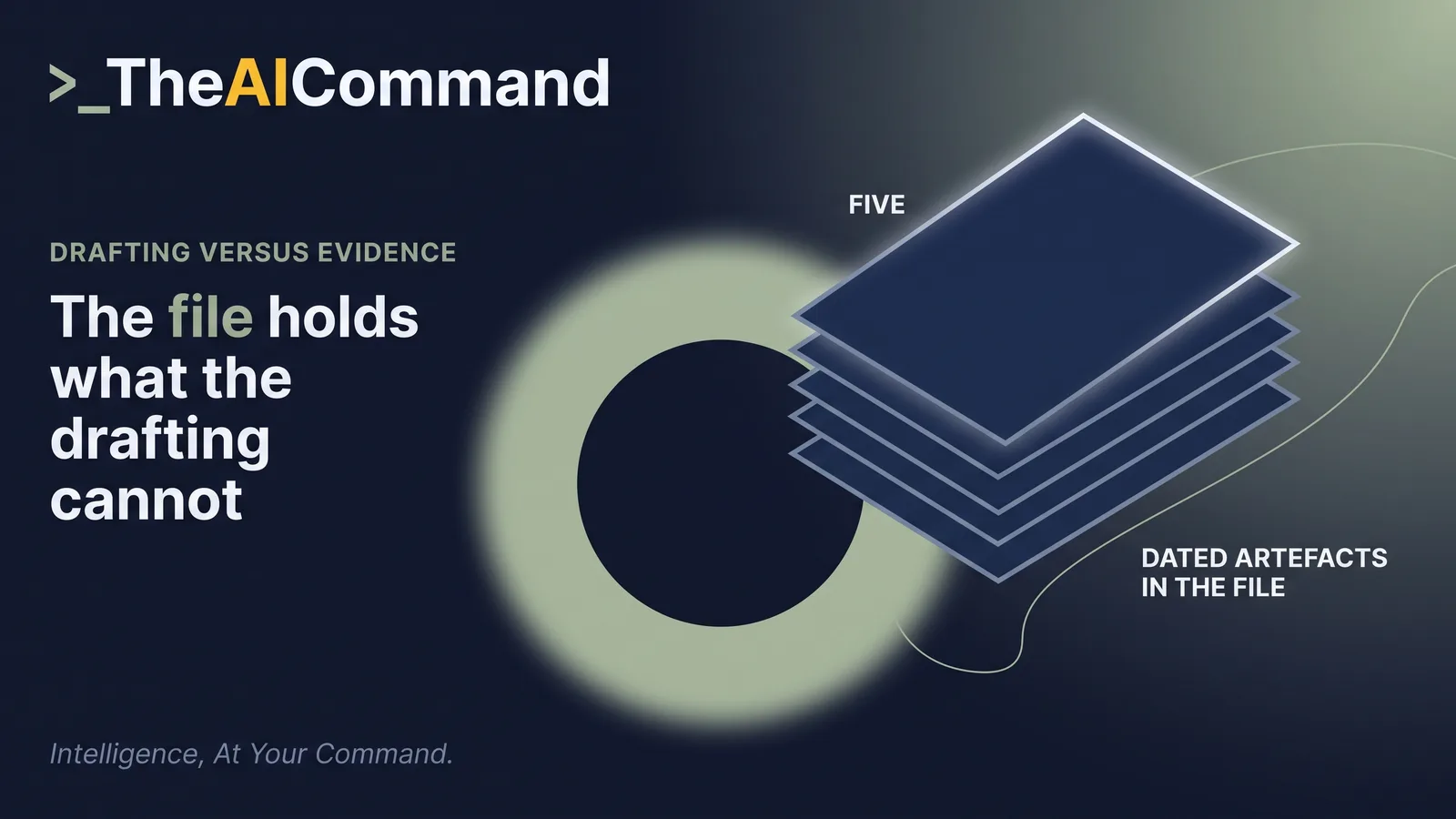
A worked example makes the sequencing visible. [EMPLOYEE_NAME] raises a complaint in [TEAM]. The investigation substantiates part of it. Weeks later, [EMPLOYEE_NAME] tells the People lead they want the matter finalised confidentially and asks whether that is possible. That request is logged with its date. The information statement goes out the following day. [EMPLOYEE_NAME] takes 16 days and confirms in writing they do not want to wait the full period. The deed and the acknowledgement are signed on the same day, copies go back to [EMPLOYEE_NAME], and the file holds five dated artefacts. The clauses in that deed might well have been drafted with AI assistance. It is the five artefacts, not the drafting, that make it hold.
What about the contracts you already have?
Section 21 is the provision most likely to be missed, because it has nothing to do with complaints or settlements. A term of an employment contract "is not enforceable against the worker to the extent that the term, if enforced, would have the effect of preventing the worker from disclosing material information about workplace sexual harassment". Section 21(2) preserves the term to the extent it relates to protected information.
That reaches the standard confidentiality clause sitting in your contract template and your offer letter pack. Section 21 is limited to a contract of employment, so a contractor's confidentiality clause arrives by a different route: where the contractor is the complainant, the clause can itself be a workplace non-disclosure agreement under sections 3 and 4, and section 6(3) confirms that it does not matter that the agreement precedes the harassment. Either way the sweep is the same piece of work. This is genuinely useful AI work, and it is safe work, because it involves no personal information at all. Give a model your template library and the section 3 definition, and ask it to flag every term whose purpose or effect could prevent a worker disclosing that category of information, directly or indirectly. Then have a person confirm each flag. You are using AI to search a corpus against a definition, which is a task it is good at, rather than to produce an instrument whose validity it cannot see.
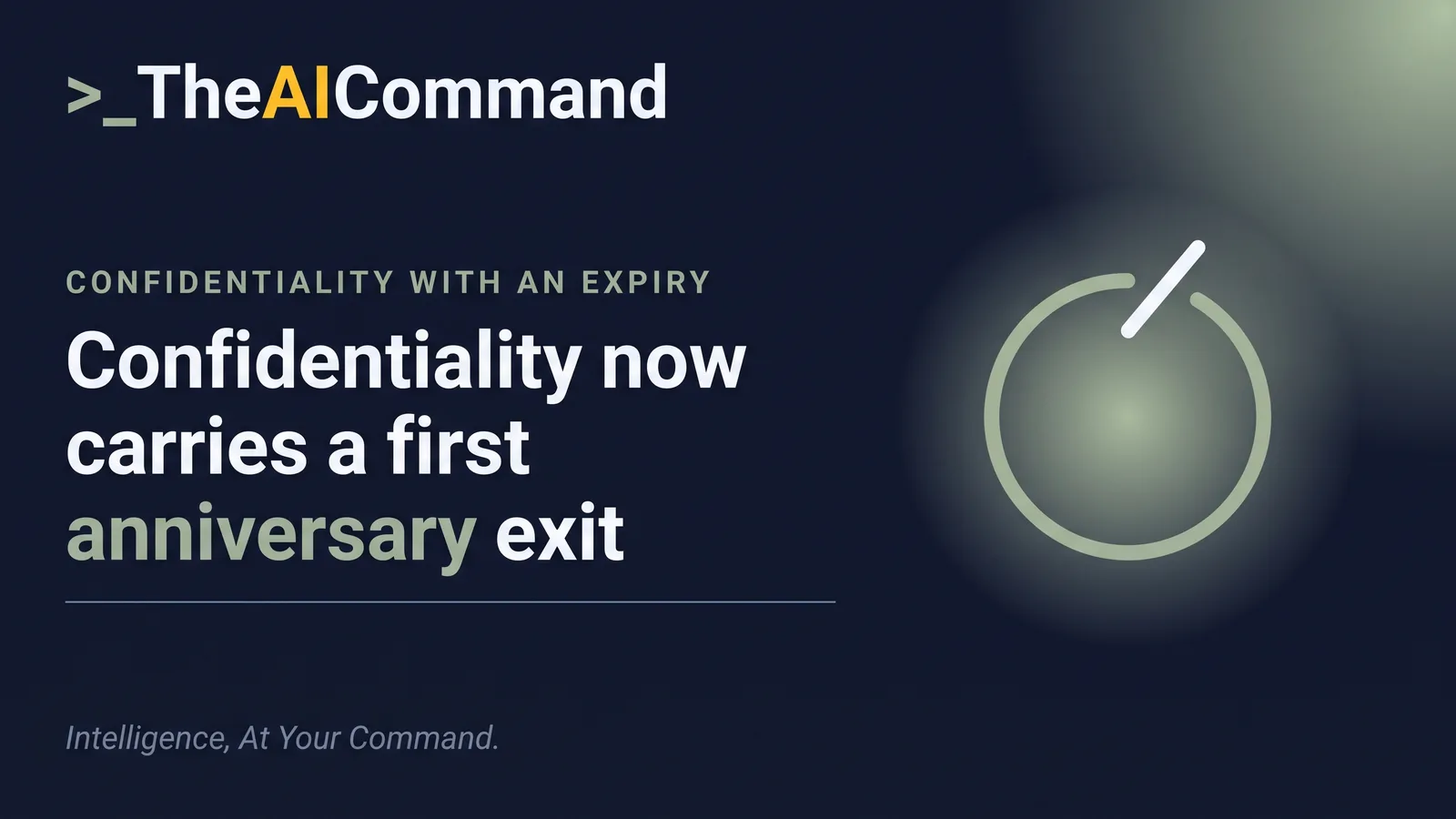
Two more design points belong in the review. Under section 19 a complainant may terminate a workplace NDA, compliant or not, at any time on or after its first anniversary, on at least seven days written notice in the approved form, but only to the extent it gags material information other than protected information. The rest of the deed survives. And under section 20, where the employer has substantiated the allegations, an NDA with the respondent cannot stop the employer telling a prospective employer of the respondent, protected information aside. Confidentiality here has a shelf life and a carve-out, and any internal briefing that describes these agreements as permanent is now wrong.
Where does the privacy line sit?
The temptation in a live matter is to paste the complaint facts into a chatbot and ask for a deed. Do not. The OAIC recommends as a matter of best practice that organisations "do not enter personal information, and particularly sensitive information, into publicly available generative AI tools, due to the significant and complex privacy risks involved". A harassment complaint file is close to the worst candidate available.
Note too that the Victorian Legal Services Board and Commissioner has told lawyers acting for employers or respondents that they "must not propose an NDA or pressure a person complaining to enter an NDA", and that misuse may expose them to disciplinary action. If external counsel declines to draft first, that is the regime working as intended, not a service problem.
What never to automate
- The request. It has to come from the complainant, unprompted by anyone acting for the employer.
- The judgement about pressure. Section 8(3) reaches persuasive messaging drafted by anyone acting on the employer's behalf, and a model asked to make an offer sound more attractive is doing exactly the thing the section prohibits.
- The acknowledgement. It is a declaration by a named authorised person that specific events occurred. Nobody can generate it.
- The decision to settle at all, and the conversation in which it is discussed.
Bottom line
The words were never the hard part. Victoria has moved the test for enforceability out of the document and into the process that produced it, and process is precisely what a drafting tool cannot evidence. Use AI where it is strong, auditing templates against a definition and building the checklist. Keep the request, the timing, the pressure judgement and the acknowledgement with people, and keep the file, because from 1 July the file is the agreement.
Do this Monday
- Identify every settlement or deed template that contains a confidentiality or non-disparagement term and mark which are used for Victorian-connected matters
- Download the three approved forms and the information statement from the Victorian Government Act page and store them where the ER team actually works, not in a policy folder, noting that vic.gov.au currently serves two copies of each form at different URLs and the Act page links the later ones
- Run an AI-assisted sweep of your employment contract and offer letter templates against the section 3 definition, then have a person confirm every flag
- Build the file checklist covering the six preconditions and attach it to the ER matter workflow so the artefacts are captured as they happen
- Brief anyone who negotiates settlements that for a gag on the harassment the complainant must ask first, and that the employer proposing that agreement is now a problem, while confidentiality limited to the settlement sum can still be asked for
References
- Restricting Non-disclosure Agreements (Sexual Harassment at Work) Act 2025 (Vic), No. 51 of 2025, Authorised Version No. 001 incorporating amendments as at 1 July 2026, sections 3, 4, 6, 8, 9, 10, 11, 13, 14, 15, 16, 17, 19, 20, 21, 23, 25, 26 and Schedule 1. https://content.legislation.vic.gov.au/sites/default/files/2026-07/25-51aa001-authorised.pdf
- Victorian Government, Restricting Non-disclosure Agreements (Sexual Harassment at Work) Act 2025, page updated 5 August 2026. https://www.vic.gov.au/restricting-non-disclosure-agreements-sexual-harassment-work-act-2025
- Victorian Government, Acknowledgment that non-disclosure agreement preconditions have been met, approved form, June 2026. https://www.vic.gov.au/sites/default/files/2026-06/Acknowledgement-Form-FINAL.pdf
- Victorian Legal Services Board and Commissioner, Guidance for lawyers: using non-disclosure agreements to resolve workplace sexual harassment complaints. https://lsbc.vic.gov.au/lawyers/nda
- OAIC, Guidance on privacy and the use of commercially available AI products, October 2024. https://www.oaic.gov.au/privacy/privacy-guidance-for-organisations-and-government-agencies/guidance-on-privacy-and-the-use-of-commercially-available-ai-products
- Anthropic, Models overview, compare-models table, reliable knowledge cutoff row. https://platform.claude.com/docs/en/about-claude/models/overview
- Anthropic, Transparency Hub, model knowledge cutoff date entries. https://www.anthropic.com/transparency
TheAICommand. Intelligence, At Your Command.