
An AI summary can help organise an ASIC request. It cannot replace responsive source records, settle the notice's scope or make a privilege claim. Build a request-to-source ledger that lets legal reviewers trace every request item to native material, exclusions, gaps and the human production decision.
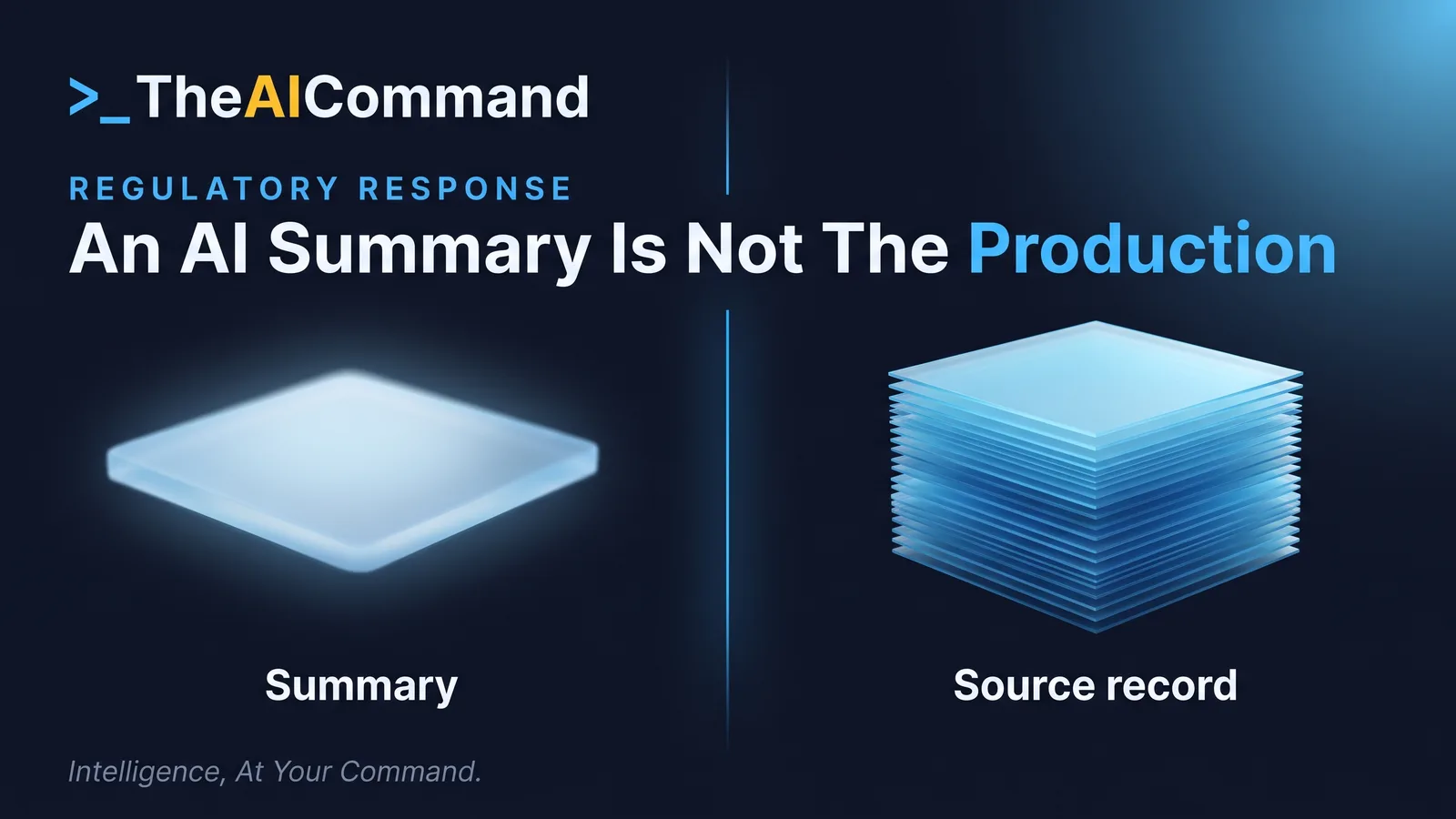
When ASIC asks for books, a polished AI summary is usually the wrong object. It is a derived working note. It may omit metadata, attachments, versions, context and records that do not fit its narrative.
Use AI to map request items, propose source locations and expose gaps. Preserve the source material and put scope, responsiveness, completeness, privilege and release under human legal control.
The practical control is a request-to-source ledger. It starts with each ASIC request item and ends with a source record, an itemised privilege treatment, a documented non-production reason or an open exception. This is a proposed internal control from TheAICommand, not a format prescribed by ASIC. It differs from an incident evidence pack because it does not reconstruct an event or response. It reconciles the regulator's words to the records searched, reviewed and produced.
Was it a compulsory notice or a voluntary request?
Answer that before opening a search tool. The authority, wording and service of the request determine the response route.
ASIC Information Sheet 145, reissued March 2020, explains that ASIC can use compulsory powers to require documents or information and, in a formal investigation, attendance at an examination or reasonable assistance. For document production, ASIC says it issues a written notice describing the documents sought and the time and place for production. The notice must state the basis for the requirement in general terms and may request electronic data or files.
ASIC may also ask for material voluntarily. INFO 145 says it considers voluntary production before using a compulsory document power, and expects voluntary production to be more likely in surveillance work. INFO 242 expressly addresses books produced either voluntarily or in response to compulsory powers.
Do not collapse those routes. A voluntary request is not made compulsory merely because it comes from ASIC. A compulsory notice is not reduced to an informal questionnaire because the organisation is cooperating. Record the request type, instrument or power cited, service date, deadline, issuing officer, exact item text and every agreed clarification. A lawyer must decide the legal effect and response obligations in the circumstances.
The Federal Register currently lists the ASIC Act 2001 as in force. Its latest registered compilation is C2026C00337, Compilation 107, compiled on 1 July 2026 and effective to 6 July 2026. The Register also flags a commenced amendment from 7 July 2026 that is not yet incorporated into that compilation. That amendment inserts transitional provisions for the financial-reporting system reform; it does not amend the Part 3 information-gathering provisions used in this article (Treasury Laws Amendment (Financial Reporting System Reform) Act 2026).
Part 3 of the current compiled ASIC Act contains several document-production powers. Section 63 makes specified failures to comply offences, subject to its terms and reasonable-excuse provisions, while section 64 addresses information or statements that are false or misleading in a material particular, whether given in purported compliance with a Part 3 requirement or in the course of an examination. The exact notice and circumstances matter. An AI assistant must not decide that a search was sufficient, that a response is complete or that non-production is legally justified.
If the request is unclear or compliance may be difficult, INFO 145 says to contact the ASIC officer named in the notice, seek independent legal advice, or do both. Put that communication in the ledger. Do not let the model silently resolve ambiguity by choosing the narrower interpretation.
Why is the AI summary not the evidence?
ASIC uses the statutory term “books” broadly. INFO 242 and its production guidelines cover documents and other recorded information in electronic or hard-copy form. The guidance says ASIC generally prefers electronic books in original native file format with associated metadata. The guidelines also address document families, litigation-support productions, database extracts, duplicate handling and cover letters.
These are preferred production methods and technical guidance. The notice and any method agreed with ASIC control the particular production. Do not describe every field or format in the production guidelines as a statutory requirement in every case.
The distinction still matters. A native email can retain sender, recipient, timestamp, attachments and other metadata. An AI paragraph that says what the email “means” is a new object generated after collection. It cannot establish that the whole responsive family was preserved, show every statement in context or prove which version existed at the relevant time.
The production guidelines attached to INFO 242 recognise manual review, keyword or concept searches and technology-assisted review such as predictive coding. They encourage recipients to document the review approach, how it was conducted, decisions made and the outcome. AI-assisted classification can sit inside that review process if approved. The method, sampling, exception treatment and human decisions still need to be recorded.
Use a three-layer rule:
- Source object: the native book or agreed representation, associated metadata and document-family relationship.
- Review object: search result, AI label, reviewer note, responsiveness decision and privilege status.
- Production object: the exact file or agreed representation delivered, with production identifier, batch and date.
Never overwrite the source object with the review object. Preserve summaries separately. Counsel must assess whether each is responsive, privileged or otherwise within scope. A summary cannot substitute for an underlying source record.
How do you build a request-to-source ledger?
Give every request item its own row or linked group. Do not build the ledger around the folders that happen to be easiest to search.
Record:
- request ID, route, item number, exact wording, deadline and approved interpretation;
- relevant date range, custodians, business units, systems and data stores;
- collection steps, search method, query version, reviewer and exception testing;
- native source ID, location, format, metadata, document family and integrity value;
- responsiveness decision, rationale, reviewer and approval timestamp;
- privilege holder, claimed category, basis, schedule entry and masked version where applicable;
- production ID, agreed format, batch, cover letter and delivery confirmation; and
- gaps, unavailable sources, clarification requests, owners and due dates.
Use this prompt to create the first mapping from approved material. A human lawyer and response lead must verify the request route, interpretation, sources and every legal decision before search or production.
The ledger also needs a negative-space control. Every item should end in one of five human-approved states: PRODUCED, NOT FOUND AFTER DOCUMENTED REVIEW, OUTSIDE APPROVED SCOPE, WITHHELD UNDER ITEMISED LPP CLAIM or OPEN. These are proposed internal workflow labels, not ASIC terminology. A blank cell is not evidence that nothing existed.
Privilege needs a separate gate. INFO 165, updated July 2024, says a recipient of a compulsory notice must provide responsive information except information subject to a valid legal professional privilege claim. It says ASIC will not accept a blanket claim and asks that document claims be individually itemised with specified details, including authors, recipients, date, document type, privilege category and basis, everyone claiming the right to assert the privilege, format, location and whether the claim covers all or part. Where only part is claimed, INFO 165 says an appropriately masked version of the document must be provided to ASIC.
INFO 165 also identifies choices available to a notice recipient, including withholding privileged information, waiving privilege or, where you are the privilege holder, seeking limited confidential disclosure under ASIC's process. Those are legal choices for the privilege holder and counsel. The assistant may detect candidate material for segregated review. It must not confirm privilege, decide waiver, draft a final basis without legal review or release the document.
Fictional worked example: Compulsory notice [NOTICE_ID], item [REQUEST_ITEM_ID], seeks specified books concerning changes to [CONTROL_PROCESS] between [START_DATE] and [END_DATE]. An AI map proposes email and the governance repository. The ledger shows [CHAT_ARCHIVE] as unsearched, so human lead [RESPONSE_LEAD_ROLE] keeps the item OPEN. The later collection finds a chat with attached spreadsheet [SOURCE_FILE_ID] and version history. The native family is preserved. Counsel [LEGAL_REVIEWER_ROLE] itemises a claim over part of one communication and approves the masked version required for that treatment. The AI summary remains an internal review object. Human approver [PRODUCTION_APPROVER_ROLE] releases batch [PRODUCTION_BATCH_ID] only after every item has a supported state. The example is fictional and does not determine any real notice, scope or privilege claim.
Use this prompt as an exception check. Counsel and the authorised production owner must resolve every exception and make the completeness and release decisions.
This ledger is not a statutory safe harbour. A documented search method does not by itself prove compliance. It gives the responsible people a reconstructable basis for challenge, clarification and correction before release.
Do this Monday
- Classify one live request. Record whether it is compulsory or voluntary, the cited authority, deadline, service details and named ASIC contact. Have legal counsel confirm the route.
- Split the request into items. Copy the exact words before adding interpretations. Record ambiguities and any clarification agreed with ASIC.
- Map the source universe. Identify custodians, systems, archives, date limits, record families and inaccessible locations. Mark missing systems
OPEN. - Separate the three objects. Preserve source, review and production versions. Prevent summaries, redactions or converted files from overwriting native records.
- Install the privilege gate. Route candidates to counsel, maintain an itemised schedule and keep waiver or disclosure decisions outside the AI workflow.
- Run a pre-release reconciliation. Require a human-approved state for every request item, resolve gaps and link each production object back to its source and review decision.
Bottom line
AI can make a large ASIC request easier to navigate. It cannot turn a derived summary into the responsive source record, settle ambiguous scope or make the legal choices around privilege and production. Use a request-to-source ledger to expose every searched source, review decision, missing item and production object. Keep completeness, privilege, waiver and release with the people authorised to carry them.
This article is general information and education only. It is not legal, compliance, financial or professional advice. Obligations vary by organisation and circumstance. Verify current requirements against the primary sources cited and seek advice specific to your situation.
References
- Australian Securities and Investments Commission, Information Sheet 145: ASIC's compulsory information-gathering powers, reissued March 2020. https://www.asic.gov.au/about-asic/asic-investigations-and-enforcement/asic-s-compulsory-information-gathering-powers/
- Australian Securities and Investments Commission, Information Sheet 242: ASIC's document production guidelines, issued March 2020. https://www.asic.gov.au/about-asic/asic-investigations-and-enforcement/asic-s-document-production-guidelines/
- Australian Securities and Investments Commission, Document production guidelines (attachment to INFO 242), March 2020, with October 2023 note update. https://download.asic.gov.au/media/aauj34nc/asic-document-production-guidelines-published-october-2023.pdf
- Australian Securities and Investments Commission, Information Sheet 165: Claims of legal professional privilege, updated July 2024. https://www.asic.gov.au/about-asic/asic-investigations-and-enforcement/claims-of-legal-professional-privilege/
- Federal Register of Legislation, Australian Securities and Investments Commission Act 2001, current title and latest registered compilation C2026C00337, Compilation 107, compiled 1 July 2026. https://www.legislation.gov.au/C2004A00819/latest
- Federal Register of Legislation, Australian Securities and Investments Commission Act 2001, all versions and unincorporated-amendment status. https://www.legislation.gov.au/C2004A00819/latest/versions
- Federal Register of Legislation, Treasury Laws Amendment (Financial Reporting System Reform) Act 2026, Act No. 61 of 2026. https://www.legislation.gov.au/C2026A00061/asmade/text
TheAICommand. Intelligence, At Your Command.