
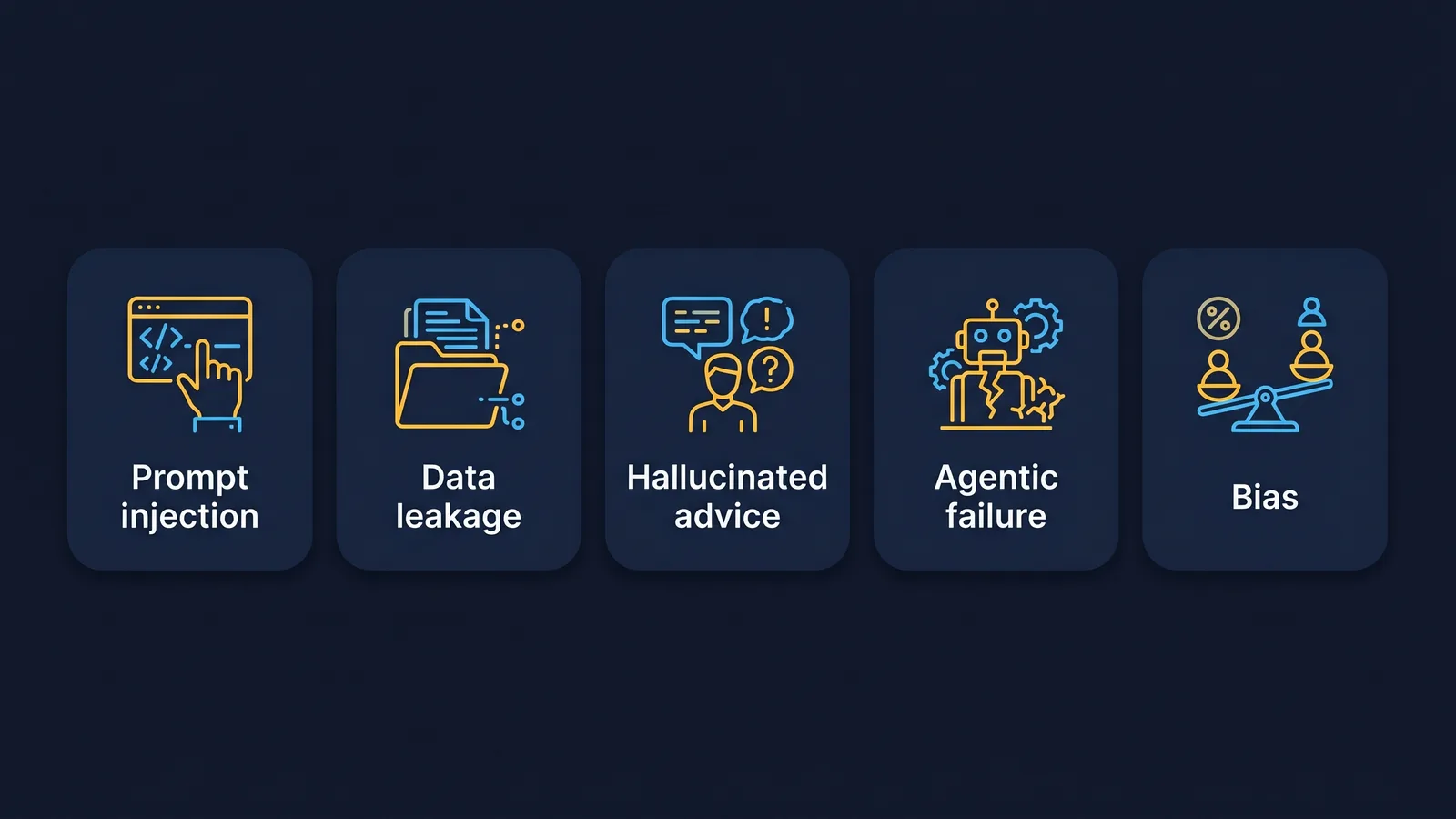
AI incident response needs an evidence pack, not just a playbook, so the organisation can preserve the prompt, output, data pathway, human review step and business impact when an AI failure happens. Most organisations have incident response processes for cyber, privacy, technology outages and operational disruption. Fewer have a practical process for AI incidents. That gap matters because AI failure modes do not always look like traditional system outages. A model can produce a harmful recommendation while the platform remains available. A chatbot can expose sensitive information without a network breach. An agent can take the wrong action because a prompt injection changed its instructions. APRA's April 2026 AI letter identifies prompt injection, data leakage, insecure integrations, exploit injection and autonomous agent misuse as emerging AI attack paths.
For GRC teams, the task is not to create a separate bureaucracy for every AI event. It is to extend existing incident management so that AI-specific evidence is captured early, preserved and escalated to the right decision-makers. A playbook tells people what to do. An evidence pack proves what happened, why it mattered, who was affected, what controls worked and what changed afterwards.
Why are AI incidents different from traditional outages?
Traditional incident taxonomies often rely on observable categories: system unavailable, unauthorised access, data loss, fraud event, regulatory breach or customer harm. AI incidents can cut across all of these categories. The Organisation for Economic Co-operation and Development defines an AI system as a machine-based system that infers from inputs how to generate outputs such as predictions, content, recommendations or decisions that can influence environments. That definition explains the challenge. AI incidents can arise from inputs, outputs, training data, retrieval sources, integrations, decision pathways or human over-reliance.
A retrieval-augmented chatbot may give an employee the wrong policy answer because the source document was outdated. A model may summarise a customer complaint inaccurately, leading to poor case handling. A coding assistant may introduce a security flaw. An agent may follow malicious instructions hidden inside a webpage. In each case, the incident record needs more than the standard time, owner and remediation fields.
The evidence burden is especially important in regulated sectors. NIST's AI Risk Management Framework encourages organisations to govern, map, measure and manage AI risks. Those verbs are useful for incident response because they remind teams that AI incidents are not solved by technical remediation alone. The organisation must understand context, measure impact, manage residual risk and strengthen governance.
How do you triage a suspected AI incident?
Many AI incidents will initially be reported as ordinary problems. A staff member might say that a tool produced a strange answer. A customer team might report inconsistent summaries. A cyber team might flag unusual tool behaviour. The risk is that these reports are treated as low-level glitches until the evidence is gone.
GRC teams can reduce this risk by building an AI triage layer into existing incident intake. The triage layer should not require deep technical detail from the first reporter. It should ask a few practical questions: Was AI used? Did the AI system access sensitive data? Did the output influence a decision or action? Was a customer, employee or external party affected? Did the system use a third-party model, plugin, browser, code interpreter or workflow automation? Was the output independently checked before it was used?
Where the answers point towards a regulatory clock, the triage record needs to separate what AI can assemble from what only an accountable person can decide. AI can build a source-linked chronology and surface similar incidents, but it cannot decide when a licensee first knew, or was reckless about, grounds for a reportable situation, so it cannot start, pause or restart a statutory reporting clock. The same issue arises with vendor pathways: under the Privacy Act an organisation typically still holds information it has handed to an AI provider if it retains control of it, so a provider's data leakage can start the organisation's own notification assessment clock rather than the vendor's, and the evidence pack needs to record whose clock is running.
The triage outcome should determine escalation. Low-risk productivity issues can remain within technology support or business quality assurance. Material incidents should be escalated to risk, legal, privacy, cyber, technology and accountable executives. Where an incident affects critical operations, regulated services or vulnerable stakeholders, senior management reporting should be mandatory.
What should an AI incident evidence pack contain?
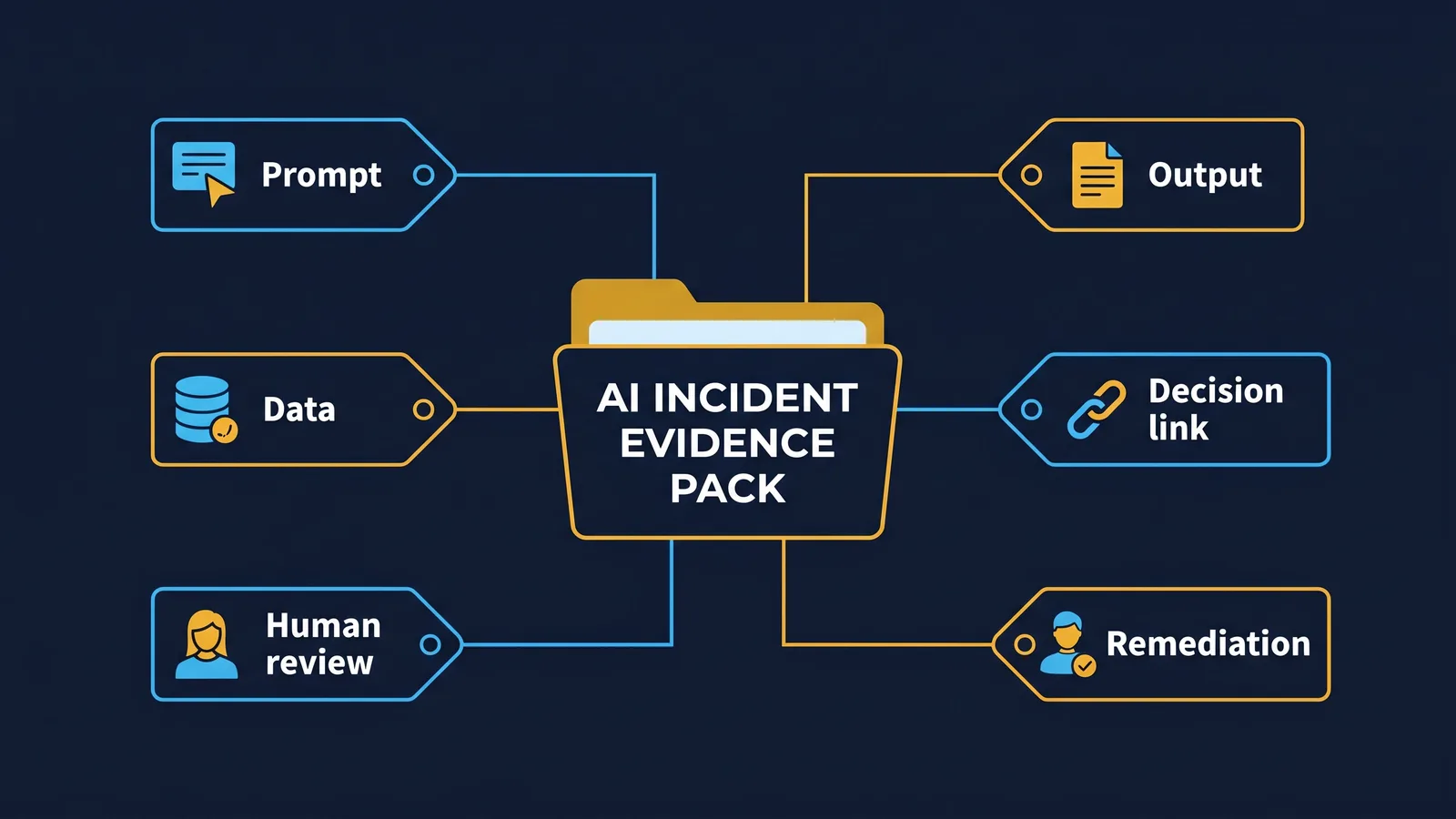
An AI incident evidence pack should be concise enough to use under pressure and structured enough to support later assurance. It should capture the incident timeline, the AI system involved, the business process, stakeholders affected, data categories, prompts and outputs, model or vendor details, access permissions, human review steps, immediate containment, root cause, control failures, customer or employee impact, regulatory assessment and remediation actions.
The pack should also record uncertainty. AI incidents often begin with incomplete facts. That is acceptable if the record clearly distinguishes confirmed facts, working assumptions and unresolved questions. This is important because over-certainty in early incident reporting can create poor decisions and undermine later credibility.
That structure matters again if a regulator later asks for the file. An AI-generated summary of what happened is a derived working note, not the responsive record itself, so the evidence pack should preserve source material a regulator can independently trace back to, not only the narrative built from it. The same discipline applies to the "prompts and outputs" field: once a run has passed through retrieval, tool calls and more than one model version, a single logged prompt rarely captures what happened, so treating each incident-relevant execution as its own run with a source-to-output lineage packet keeps that evidence assembly-ready rather than reconstructed after the fact.
The Australian voluntary AI Safety Standard supports this evidence-based approach through guardrails on accountability, risk management, data governance, testing, human oversight, transparency and contestability. These guardrails are useful incident lenses. If an AI incident occurs, GRC should ask which guardrail failed, which guardrail worked and which guardrail was missing. As at 20 September 2026, the Department of Industry, Science and Resources has also published complementary Guidance for AI Adoption (21 October 2025), which distils the standard into six essential practices for industry; the ten underlying guardrails remain the more granular lens for an incident review.
Connecting incidents to accountability
A mature AI incident process must connect events to accountability. This is not about blaming the nearest user. It is about identifying whether governance allocated responsibility before the incident occurred. APRA's AI letter highlights board and senior management oversight, risk appetite and third-party dependencies. The Digital Transformation Agency's AI policy, updated to Version 2.0 with effect from 15 December 2025, similarly makes a designated accountable official and AI use-case accountability mandatory requirements within government contexts.
Regulator coordination on this point has sharpened since this article was first published. In an 8 May 2026 letter, ASIC required all licensees and market participants to table its cyber uplift guidance at ultimate board and risk governance committee level, treating cyber resilience as a core licensing obligation rather than an IT issue. A joint ASIC and APRA statement on 27 August 2026, following roundtables with more than 600 financial system participants, went further: it found that decisions on risk appetite, escalation authority, recovery priorities and communication strategy need to be made at board level before a crisis hits, because frontier AI compresses incident response timeframes. For GRC teams, that means the escalation criteria in this article cannot wait to be finalised until after an incident; the accountability chain the evidence pack later has to prove needs to already be traceable before the incident occurs.
The practical GRC question is simple: who was accountable for approving, monitoring and accepting residual risk for this AI use case? If the answer is unclear during an incident, the governance model is probably unclear during normal operations as well.
How to start without overbuilding
Organisations do not need a perfect AI incident regime on day one. They need a minimum viable extension to existing incident management: an AI incident intake checklist, an evidence pack template, escalation criteria and post-incident review questions. These artefacts should link to the AI use-case register, privacy assessment process, cyber incident playbook and vendor management framework.
Internal audit can then test whether AI incidents are being identified, classified, preserved and remediated consistently. Useful samples include helpdesk tickets, cyber alerts, privacy enquiries, model monitoring exceptions and business complaints.
The hardest AI incidents are rarely the dramatic ones. They are the quiet ones where an output looked plausible, a person trusted it, a record was incomplete and nobody could later reconstruct what happened. GRC's role is to make those incidents visible, manageable and learnable.
The bottom line
AI incident response should not sit outside existing operational risk, cyber and privacy processes. It should strengthen them. The key is evidence. If an organisation cannot preserve the prompt, output, data pathway, human review step and business impact, it may struggle to prove that it responded appropriately.
In 2026, the GRC test is no longer whether the organisation has an AI policy. The test is whether the organisation can explain an AI failure when it happens.
References
- APRA letter to industry on artificial intelligence
- OECD AI system definition
- NIST AI Risk Management Framework
- Australian Government Voluntary AI Safety Standard
- Policy for the responsible use of AI in government
- Guidance for AI Adoption
- ASIC 26-092MR: ASIC calls for urgent cyber uplift as AI accelerates cyber threats
- ASIC 26-201MR: ASIC and APRA warn frontier AI awareness must turn to action
Do this Monday
- Add the AI triage questions to your existing incident intake form: did AI influence a decision, recommendation or communication, was personal, confidential or regulated data involved, was a third party involved, was an automated action performed, and was the output reviewed by a human before use.
- Draft a one-page evidence pack template covering the timeline, the AI system and its owner, input and output, data exposure, decision linkage, control status, containment and remediation.
- Build a field into that template that separates confirmed facts from working assumptions and unresolved questions, so early uncertainty is recorded rather than smoothed over.
- Write escalation criteria that route material incidents to risk, legal, privacy, cyber, technology and the accountable executive, and leave low-risk productivity issues with technology support or business quality assurance.
- Take your highest-exposure AI use case and name who approved it, who monitors it and who accepts residual risk, then write those names into the register before an incident forces the question.
- Link the template to the AI use-case register, the privacy assessment process, the cyber incident playbook and the vendor management framework so the artefacts reference each other.
- Ask internal audit to sample helpdesk tickets, cyber alerts, privacy enquiries, model monitoring exceptions and business complaints, and test whether AI incidents are being identified, classified and preserved consistently.
Content disclaimer: This article is for general educational and informational purposes only. It does not constitute legal advice, regulatory guidance, or a substitute for professional compliance judgement. Regulatory obligations vary by entity type, licence, and circumstance. Always refer to primary source guidance from APRA, ASIC, or the relevant regulatory authority.
TheAICommand. Intelligence, At Your Command.