
A new default model does not make your AI system safe. The guardrails do.
Every few weeks a lab ships a more capable model, and the temptation is to treat the model as the product. But the model is the engine, not the car. Whether an AI system in production is reliable, safe and defensible is decided far more by the layer you build around the model: what you let in, what you constrain it to, what you check before you trust its output, and what you refuse to let it do on its own. That layer is the guardrails, and it is the part no vendor can ship for you. This piece walks through the architecture, runs a worked example that turns a written policy into running rails, and leaves you with two prompts and a checklist so you can build your first rail this week.
Is the model's built-in safety enough?
Model providers do ship safety. Moderation endpoints, refusal training, jailbreak-resistant tuning and, increasingly, dedicated classifiers that sit between you and the model. Those are real and useful. But it is worth being clear about what they are for. Built-in safety is tuned to protect the provider's platform and general reputation: to stop the model producing content that would embarrass the lab or breach its usage policy. It is not tuned to your application, your data or your obligations, because the provider does not know them.
Your risks are specific. A customer's personal information leaking into a prompt and out through a third party. The model acting on an instruction hidden in a document it was asked to summarise. An unvalidated model output being passed straight into a downstream system that trusts it. A confident, wrong answer reaching a customer as if it were verified. None of those are things a provider's general-purpose safety layer is designed to catch, because catching them requires knowing your policy. That is the shift the whole guardrails discipline rests on: the safety that protects you is the safety you add.

What are the four rails around the model?
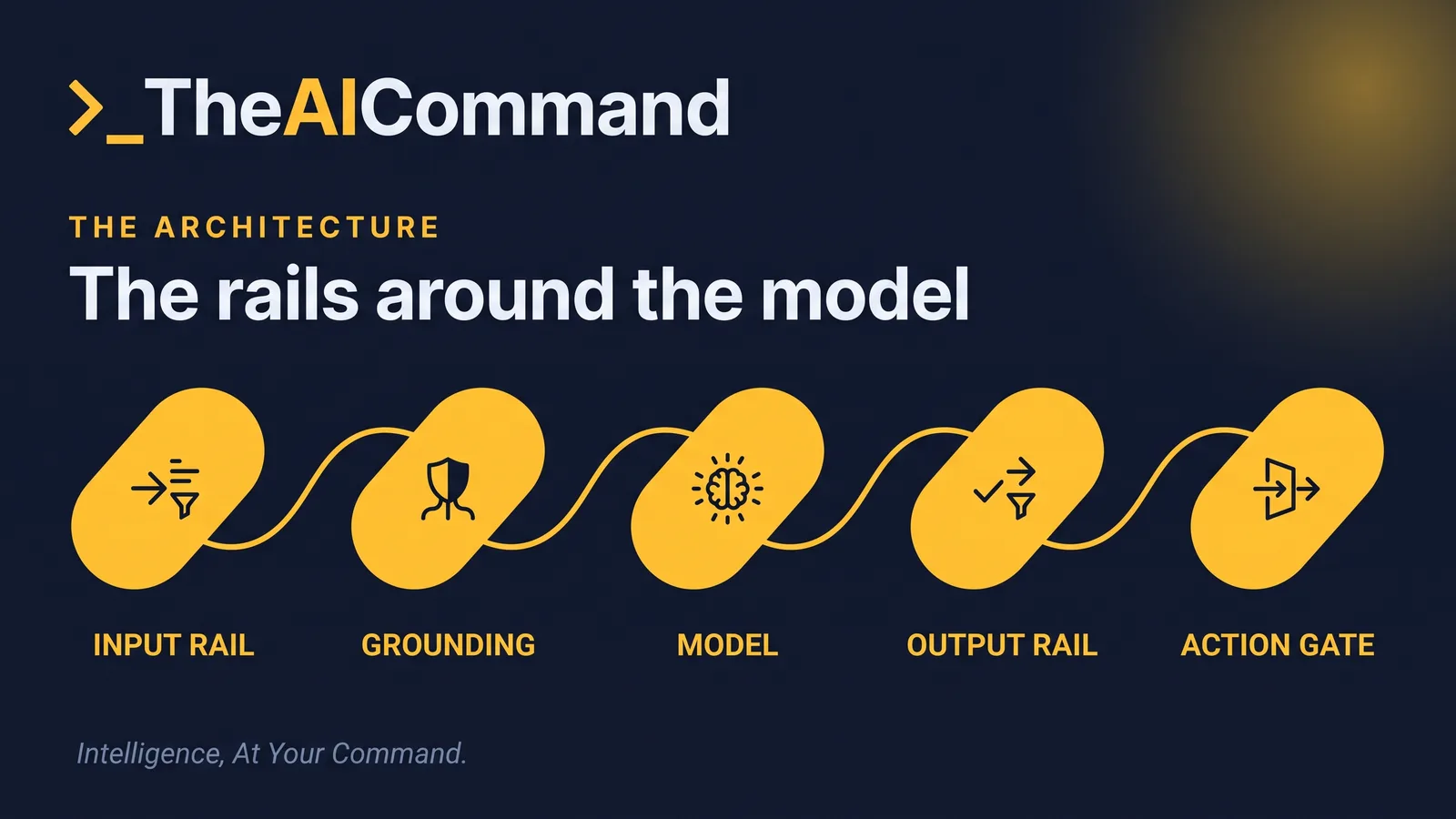
A useful way to think about guardrails is as four checkpoints on the path a request takes through your system. The names vary between frameworks, but the shape is consistent.
Input rails sit between the user, or the incoming data, and the model. They validate the request, redact or mask sensitive data before it ever reaches the model, and screen for prompt injection. This last one matters more than most teams realise. OWASP defines prompt injection, the number one risk on its 2025 list for large language model applications, as occurring "when user prompts alter the LLM's behavior or output in unintended ways" (LLM01:2025). The dangerous version is indirect injection, where the malicious instruction is not typed by a user but sits inside a website or file the model is asked to read. An input rail that strips or flags injected instructions, and that redacts personal information before it leaves your boundary, is your first line.
Grounding is the second rail, and it is quieter but decisive. Rather than let the model answer from its training, you constrain it to retrieved, authoritative context: your policy document, the actual clause, the current instrument. Grounding is not only a quality move; it is a safety move, because a model answering from memory is a model free to confabulate, and confabulation is one of the twelve generative AI risk categories NIST names in its Generative AI Profile (NIST-AI-600-1). The facts a model is worst at recalling are often the precise ones that matter most, so pinning it to the source is a guardrail, not just an optimisation.
Output rails sit between the model and everything downstream. This is where teams are most exposed, because it is tempting to trust the output once you have a good model. OWASP is blunt about why you should not: its Improper Output Handling category (LLM05:2025) is "insufficient validation, sanitization, and handling of the outputs generated by large language models before they are passed downstream". Unhandled, that can lead to cross-site scripting, server-side request forgery, privilege escalation or remote code execution on backend systems. The recommended stance is zero trust: "Treat the model as any other user, adopting a zero-trust approach, and apply proper input validation on responses coming from the model to backend functions." An output rail validates format, checks the response against policy, filters unsafe content, and refuses to let anything act on the output until it has been checked.
Action gates are the fourth rail, and the most important for anything consequential. Before the system does something that matters, sends money, changes a record, emails a customer, deletes a file, a gate requires a human to approve it. OWASP's own guidance on prompt injection is explicit: "Implement human-in-the-loop controls for privileged operations to prevent unauthorized actions." The gate is what turns an autonomous agent from a liability into a tool, because it bounds the blast radius of everything upstream going wrong.
You do not have to build all of this from scratch. NVIDIA's NeMo Guardrails is, in its own words, "an open-source toolkit for easily adding programmable guardrails to LLM-based conversational applications", with distinct input rails that can reject or alter input, for example by masking sensitive data, and output rails that can reject or alter a response before it reaches the user. Content classifiers such as Meta's Llama Guard can act as an off-the-shelf rail for hazard detection. The tooling is maturing quickly, and none of it is exotic; a rail can be as simple as a regular expression that redacts an account-number pattern, or as involved as a second model that classifies the output. The design decision, what your rails must enforce, is the part that is yours, because it depends on your policy and your risk, not the vendor's.
From written policy to running rails: a worked example
Here is what the architecture looks like when a practitioner applies it, with every identifying detail replaced by a placeholder.
The situation. A governance analyst at an Australian insurer supports a claims team piloting an internal assistant that summarises claim files and drafts customer letters. The written AI policy contains two sentences that matter: personal information must be de-identified before it is sent to any AI tool, and no AI-drafted customer communication may be sent without human approval. Both are policy on paper. Neither is yet a control.
The prompt used. The analyst opens ChatGPT, Claude or equivalent and pastes:
What came back. A four-part rail specification. An input rail that redacts [CLAIMANT_NAME], [CLAIM_NUMBER] and [DATE_OF_BIRTH] by pattern matching before anything is submitted, logging a redaction count per request. Grounding that restricts the assistant to the current claims manual and the de-identified file it was given. An output rail that scans every draft letter for reappearing identifiers and off-policy commitments, blocking and logging on a hit. An action gate that holds every customer letter in a queue until a named officer approves it, recording the approver and the timestamp. The model also flagged one policy sentence, that AI use must be consistent with organisational values, as not enforceable by a technical rail.
What the human verified and decided. The analyst tested the proposed redaction patterns against the claim number formats actually in use and found one format the pattern missed. They confirmed the claims manual version was current. They rejected the model's suggestion to auto-release letters it scored as low risk, because the policy requires human approval on every send, with no exceptions. And they sequenced the build: input rail and action gate first, the classifier-based output check in a later sprint. The model drafted the specification; the human tested it against reality and made every call that mattered.
That is the pattern worth copying. The policy went in as sentences and came out as rails, each with a trigger, an action and a log event, and the parts the model got wrong were exactly the parts a practitioner would catch in twenty minutes of checking.
Why do guardrails matter for regulated Australian work?
For anyone doing regulated work in Australia, the guardrail layer is not an engineering nicety. It is where a written policy becomes an enforced control, and where you can produce evidence that the control operated.
Consider the gap between a policy and a guardrail. A policy that says "de-identify personal information before sending it to an AI tool" is a sentence in a document until an input rail actually redacts it, at which point it is a control you can point to and test. An obligation to keep a human in the loop for consequential decisions is an aspiration until an action gate stops the model acting alone, at which point it is enforced. This maps directly onto the expectations that already govern Australian regulated firms: privacy obligations to minimise and protect personal information, the CPS 234 style expectation to secure information assets, and the CPS 230 style expectation to control and evidence the operation of critical processes. A guardrail layer is the mechanism that carries those expectations from paper into the running system.
It is also where your audit trail lives. Every rail decision, an input redacted, an injection flagged, an output rejected, an action held for approval, is an event you can log. That log is the difference between asserting you govern your AI and being able to show it. Frameworks help here too: NIST's AI Risk Management Framework organises the work into four functions, Govern, Map, Measure and Manage, and the guardrail layer is largely where Manage becomes concrete.
The hype check: defence in depth, not a force field
Two cautions keep this honest. First, no single guardrail is a solution. Prompt injection in particular is not solved; the OWASP guidance offers mitigations, not a cure, and a determined adversary can often work around any one control. Guardrails work as defence in depth, several imperfect layers that together make an attack much harder, not one perfect wall. Anyone selling a guardrail product as the answer is overselling it.
Second, guardrails have a cost, and the cost is real. Every rail adds latency and can produce false positives, an input rail that blocks a legitimate request, an output rail that rejects a good answer. That is a genuine trade-off, the same safety-versus-utility tension that vendors themselves wrestle with when they tune a classifier too tight. The answer is not to skip the rails; it is to tune them to the consequence of the workflow. A low-stakes internal drafting tool needs light rails. A system that can move money or touch a customer's file needs heavy ones. Matching the guardrail to the stakes is itself a judgement, and it is yours to make.
Map your gaps with one prompt
Before you build anything, find out what you already have. Paste this into ChatGPT, Claude or equivalent, describing the workflow in general terms only, with no personal or confidential data.
The output is a draft, not an audit. Its value is that it forces the four questions onto one page, in the right order, for a workflow you actually run.
What to do this Monday
- Pick one workflow. Choose the AI use with the highest consequence if it goes wrong: anything touching customer data, money or outbound communication. Write one paragraph covering who uses it, what goes in and where the output lands.
- Open ChatGPT, Claude or equivalent, paste the gap-review prompt above with your paragraph, and save the result. That is your draft rail map.
- Verify the map against reality. Walk the actual request path and confirm every rail the model marked present by finding the code, configuration or manual step that implements it. Downgrade anything you cannot point to.
- Build the cheapest missing input rail first: a redaction step for names, claim or account numbers and dates of birth before content leaves your boundary. A tested pattern match is enough to start.
- Put a human gate on the highest-consequence action. Nothing sends, changes or deletes until a named person approves it, and the approver is recorded.
- Turn on logging for both rails, so every redaction, block, hold and approval writes an event you could show an auditor.
- Book a thirty-minute review a fortnight out: count the false positives, tune the rails, and pick the next workflow.
The minimum viable guardrail checklist
For any AI workflow that touches real data or real customers, you should be able to tick every line. Each miss is a specific, foreseeable failure waiting for its day.
- An input rail redacts personal information before it leaves your boundary, and the patterns are tested against your real data formats.
- Content the model reads from documents, email or the web is screened or flagged for embedded instructions.
- The model is grounded in a named, current, authoritative source for anything factual.
- Output is validated before any person or system acts on it, and raw model output never feeds a downstream system directly.
- Every irreversible or consequential action requires a named human approver.
- Every rail decision writes a log event: redactions, blocks, holds and approvals.
- Someone owns tuning, and false positives are counted and reviewed on a schedule.
- Each rail can cite the policy sentence it enforces, so the control traces back to the obligation.
The model will keep changing under you; that is the one certainty. The guardrails are what stay constant, and they are the part of your AI system you actually control. Build them deliberately, match them to the stakes, and log them, and a model swap becomes a routine event instead of a risk. That is the layer no vendor can ship for you, and it is the one that decides whether your AI is safe.
Bottom line
A new default model does not make your AI system safe; the guardrail layer around it does. Guardrails are four checkpoints, input rails, grounding, output rails and action gates, that work as defence in depth and turn a written policy into an enforced, logged control you can show an auditor. The model keeps changing under you, so build the layer you actually control and match it to the stakes.
Do this Monday:
- Pick your highest-consequence AI workflow and write one paragraph on who uses it, what goes in and where the output lands.
- Run the four-rail gap review and verify each rail against the real request path, downgrading anything you cannot point to.
- Build the cheapest missing input rail: redact names, claim or account numbers and dates of birth before content leaves your boundary.
- Put a human gate on the highest-consequence action, and record the named approver.
- Turn on logging so every redaction, block, hold and approval writes an event.
TheAICommand. Intelligence, At Your Command.