
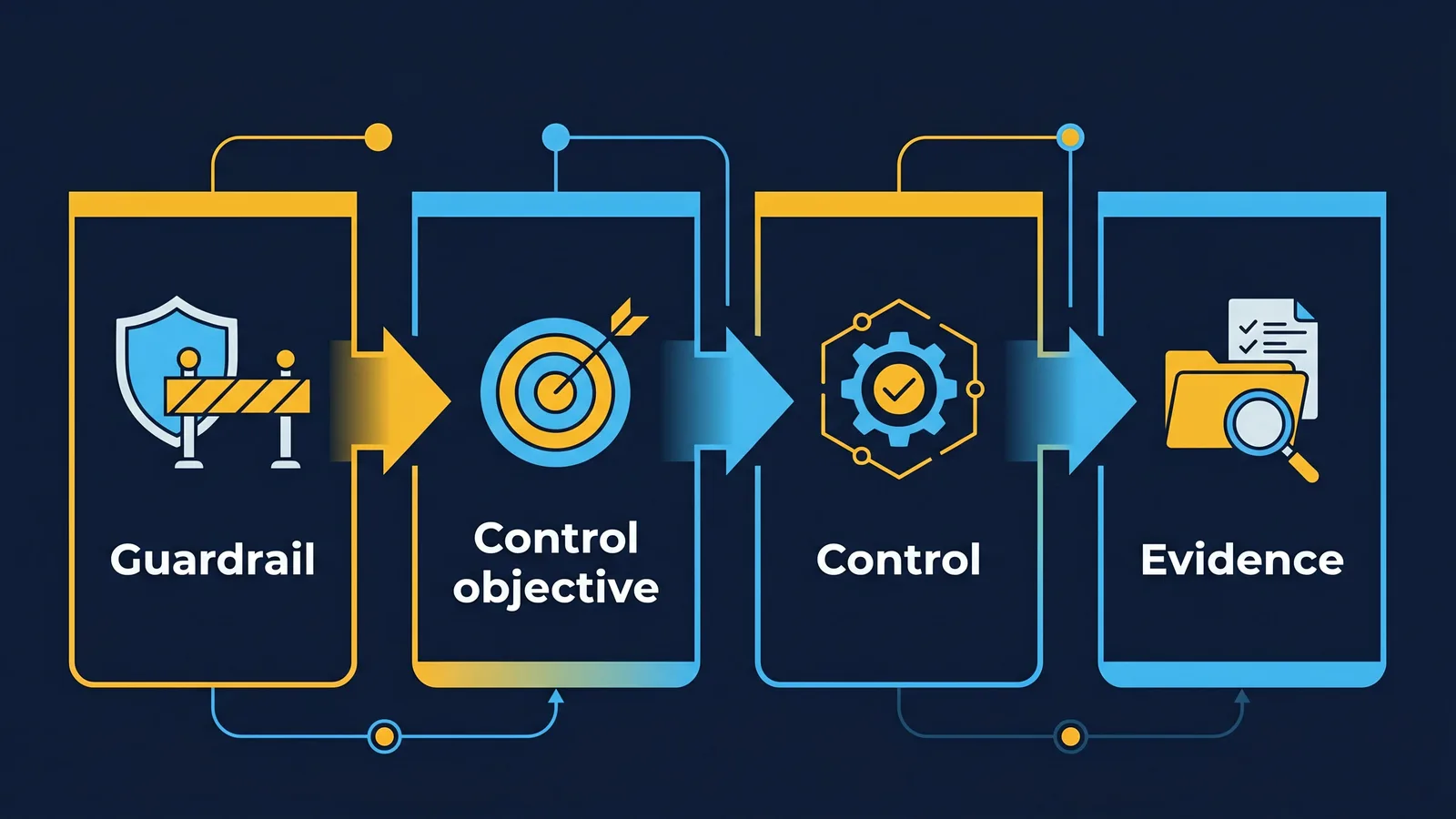
Voluntary AI guardrails become audit evidence when GRC teams translate each guardrail into a control objective, a control that makes it true and a record that proves the control operated. Australia's voluntary AI Safety Standard gives organisations a useful language for responsible AI, but GRC teams face a practical problem. A guardrail is not the same as a control. A principle can tell an organisation what good looks like, but assurance needs evidence. Without that translation layer, responsible AI becomes an attractive policy document that is difficult to test.
The standard sets out 10 voluntary guardrails covering accountability, risk management, data governance, testing, human oversight, transparency, contestability, supply chains and monitoring. It also aligns with proposed mandatory guardrails, AS ISO/IEC 42001:2023 and international approaches such as the NIST AI Risk Management Framework. That alignment is helpful, but it does not remove the need for local implementation. Each organisation still needs to decide which AI systems are in scope, which risks are material, which controls are required and what evidence will satisfy management, audit and governance committees.
Why do AI guardrails need translation into controls?
Responsible AI frameworks often fail at the handover from policy to operations. Senior leaders approve principles, business teams adopt tools, technology teams manage platforms, legal teams review terms, risk teams update registers and audit teams ask for evidence. If those activities are not connected, the organisation can appear well governed on paper while AI use expands through procurement, workflow tools and employee experimentation.
The Australian Human Rights Commission's Human Rights and Technology final report emphasises consultation, inclusion, accountability and robust safeguards when new technologies affect people. Those concepts matter because AI governance is not only a technical discipline. It is also about the people affected by recommendations, summaries, classifications, prioritisation and automated actions.
The translation does not need to be complicated. It does need to be specific. A statement that "humans remain in the loop" is not assurance evidence. A workflow showing where a trained reviewer checks AI output before a decision is finalised, plus a sample of records showing that review occurred, is evidence.
Start with the AI use-case register
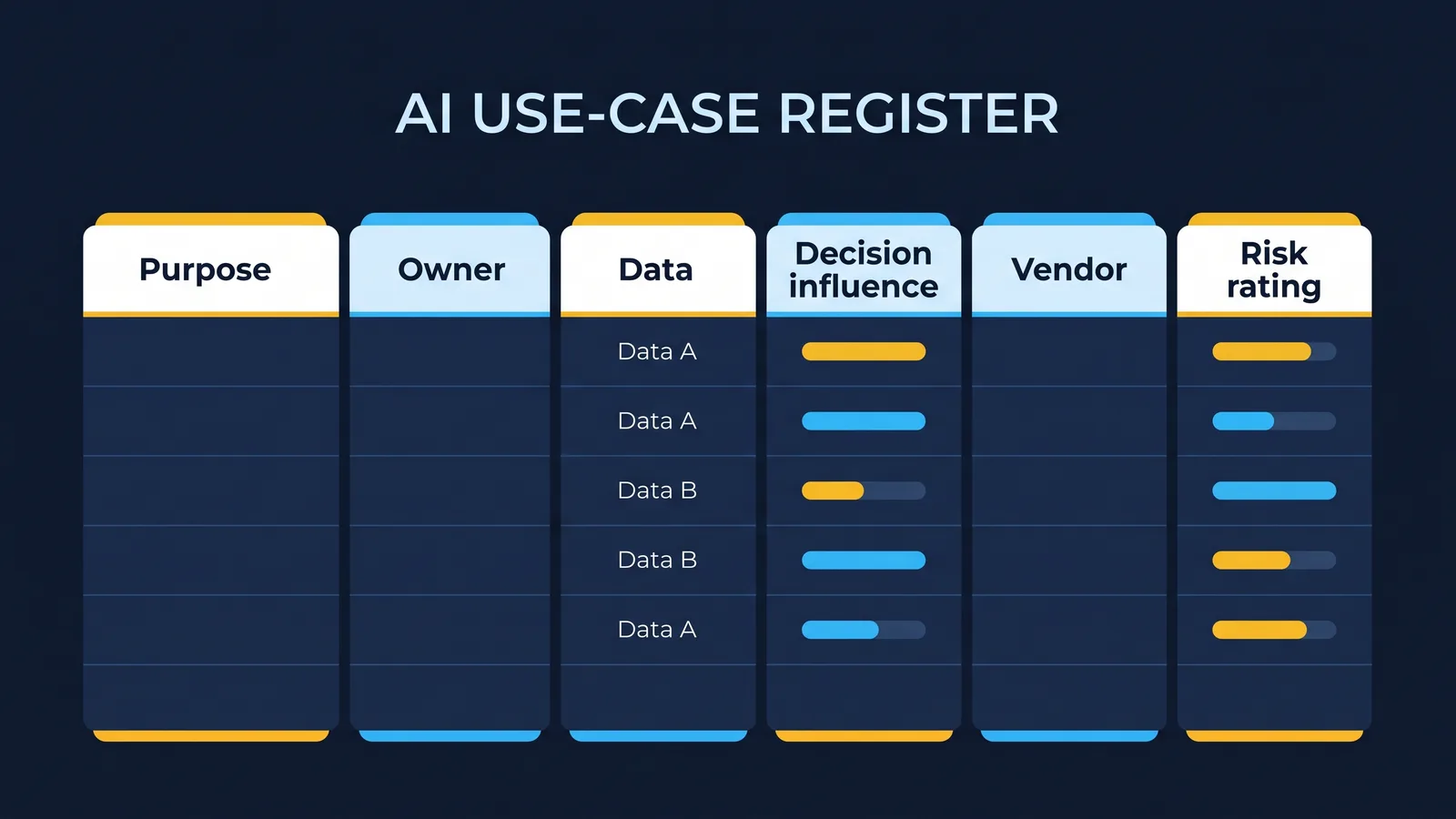
The use-case register is the foundation for assurance because it defines the population of AI activity. If the register is incomplete, every downstream test is weakened. A register built for board reporting should capture the business purpose, owner, system, model or vendor, users, affected stakeholders, data categories, decision influence, automation level, criticality, risk rating, approval status and review date.
This is where GRC teams can avoid a common mistake. Not all AI uses require the same assurance depth. A low-risk internal writing assistant may need policy guidance, training and data-handling controls. A model that supports employment decisions, claims decisions, credit decisions, fraud flags or customer vulnerability triage needs much stronger assessment, testing, oversight and contestability.
The register also provides a bridge to the Digital Transformation Agency's approach to AI transparency. The DTA maintains a central list of Commonwealth AI transparency statements under the Policy for the responsible use of AI in government, intended to build public trust and create a consistent basis for understanding how agencies use AI. Private sector organisations may not be subject to the same policy, but the underlying discipline is useful: if AI use cannot be described clearly, it probably cannot be assured clearly.
How do you turn a guardrail into a control objective?
The next step is to convert guardrails into control objectives. A control objective describes what must be true. A control describes how the organisation makes it true. Evidence proves whether the control operated.
For example, the guardrail on human oversight can become this control objective: material AI outputs that influence decisions must be reviewed by a competent human before the decision is finalised. The controls might include workflow gating, reviewer training, system permissions and periodic sampling. The evidence might include approval records, reviewer notes, exception logs and audit samples.
The NIST AI Risk Management Framework supports this evidence approach by organising AI risk work into governance, mapping, measuring and managing. The practical benefit is that assurance teams can test whether the organisation understood the context, measured performance and risk, managed controls and maintained governance over time.
These tests are deliberately practical. They ask whether the surrounding governance system works, not just whether the model performs well.
What does AI assurance require for supply chain and resilience?
AI supply chains create hidden dependencies. A business application may use a model provider, a cloud platform, a data labelling service, a vector database, a plugin, a transcription tool and a monitoring product. Each layer may introduce risk. APRA's April 2026 AI letter points to third-party dependencies, operational resilience and emerging cyber threats in AI environments.
For assurance, this means vendor due diligence should not stop at security questionnaires. It should cover data use, model changes, logging, incident notification, subcontractors, service availability, exit arrangements and the ability to explain or test outputs where needed. If an AI service supports a critical operation, resilience testing should consider what happens if the provider changes the model, the service fails, logs are unavailable or data must be removed quickly.
This is not just an APRA issue. Any organisation using AI in material processes should know whether it can continue operating if a tool is withdrawn, degraded or found to be unsafe. The assurance evidence should include fallback processes, ownership of decision records, and exit plans that do not depend entirely on vendor goodwill.
Make monitoring continuous
AI assurance cannot be a once-a-year policy check. Models change, data changes, user behaviour changes and business processes change. The voluntary standard's monitoring concepts only become real when the organisation defines what will be monitored, how often, by whom and with what escalation triggers.
Useful monitoring indicators include new AI tools detected through procurement or technology logs, high-risk use cases without current review, unresolved red-team findings, exceptions to human review, incidents, vendor model changes, complaint themes and staff policy breaches. These indicators should feed ordinary risk reporting rather than sit in a separate AI dashboard that no governance forum reads.
The bottom line
Australia's voluntary guardrails are valuable because they give organisations a common starting point. Their real value, however, appears only when GRC teams translate them into controls, artefacts and assurance tests. A board or risk committee does not need another abstract responsible AI statement. It needs testable audit evidence that material AI systems are known, owned, tested, monitored and contestable.
The move from guardrails to evidence is where GRC can make responsible AI operational.
Do this Monday
- Open the AI use-case register and test it against reality. Procurement records, expense claims and technology logs will surface tools the register does not have.
- For every entry, confirm the fields that drive assurance depth are actually populated: business purpose, owner, affected stakeholders, data categories, decision influence, third-party dependency and risk rating.
- Take the highest-rated use case and write its control objective as a single sentence describing what must be true before that system is used.
- For that objective, name the control that makes it true and the record that proves the control operated. Where no record exists, what you have is a statement of intent.
- Sample decisions where a human was meant to review AI output, and check whether the reviewer could genuinely change or reject it, or was only signing off.
- Read your AI vendor contracts for the terms assurance depends on: data use, model changes, logging, incident notification, subcontractors, service availability and exit.
- Pick the monitoring signals you will actually report, name the escalation trigger for each, and route them into ordinary risk reporting rather than a separate AI dashboard.
- Book a walkthrough with internal audit on one use case, so the translation from guardrail to evidence is tested by someone who has to be convinced.
References
- Australian Government Voluntary AI Safety Standard
- Australian Human Rights Commission, Human Rights and Technology Final Report
- Australian Government AI transparency statements
- NIST AI Risk Management Framework
- APRA letter to industry on artificial intelligence
Content disclaimer: This article is for general educational and informational purposes only. It does not constitute legal advice, regulatory guidance, or a substitute for professional compliance judgement. Regulatory obligations vary by entity type, licence, and circumstance. Always refer to primary source guidance from APRA, ASIC, or the relevant regulatory authority.
TheAICommand. Intelligence, At Your Command.