
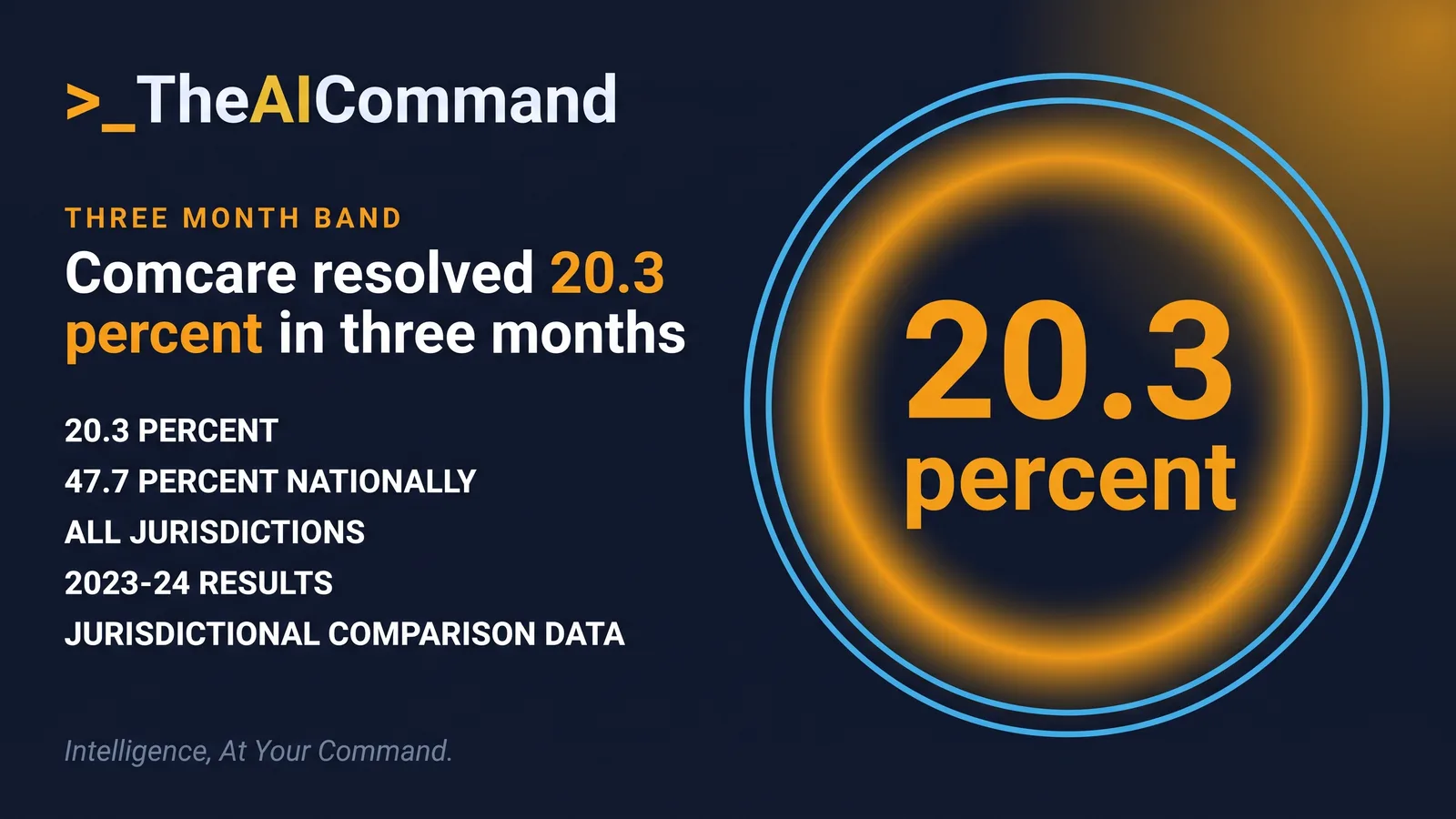
Comcare resolved 20.3 percent of disputes within three months. Nationally, the figure was 47.7 percent. Both numbers sit in the same table of Safe Work Australia Jurisdictional Comparison data, published 8 December 2025 and reporting 2023-24 results.
The practitioner consequence is a reporting one before it is a performance one. Anyone claiming that an artificial intelligence (AI) step, whether triage, summarisation or drafting, shortened dispute duration has to report duration in the four cumulative bands the national dataset uses, at one, three, six and nine months. An internal average has no published comparator. Build the bands before measuring anything.
What the national dispute dataset actually measures
The series a practitioner is most likely to reach for no longer exists. Safe Work Australia has discontinued the Comparative Performance Monitoring report, and the dataset page records that the data "is now available through the jurisdictional comparison dashboard and the downloadable data file". The dispute indicators survived the move: Table 5.2 of the Jurisdictional Comparison detailed data file, Indicator 23, carries the cumulative percentage of disputes resolved within selected time periods, by jurisdiction, for the five years to 2023-24.
The Safe Work Australia data dictionary linked from that page defines a dispute as an appeal to a formal mechanism, such as a review officer, conciliation or mediation service, against an insurer decision. It does not state, for the Comcare scheme, whether reconsiderations, tribunal applications, or both, are inside that count. Nothing fetched for this article resolves it.
The durations are cumulative, not exclusive: the three month figure includes everything resolved inside one month, and reading them as separate buckets inverts the picture. The file does state the denominator, the cases closed in the reference financial year, so an internal band set counts closed disputes for a period and not everything lodged. The dictionary publishes no day-count convention behind the bands, so a register's thresholds are its own and have to be written down.
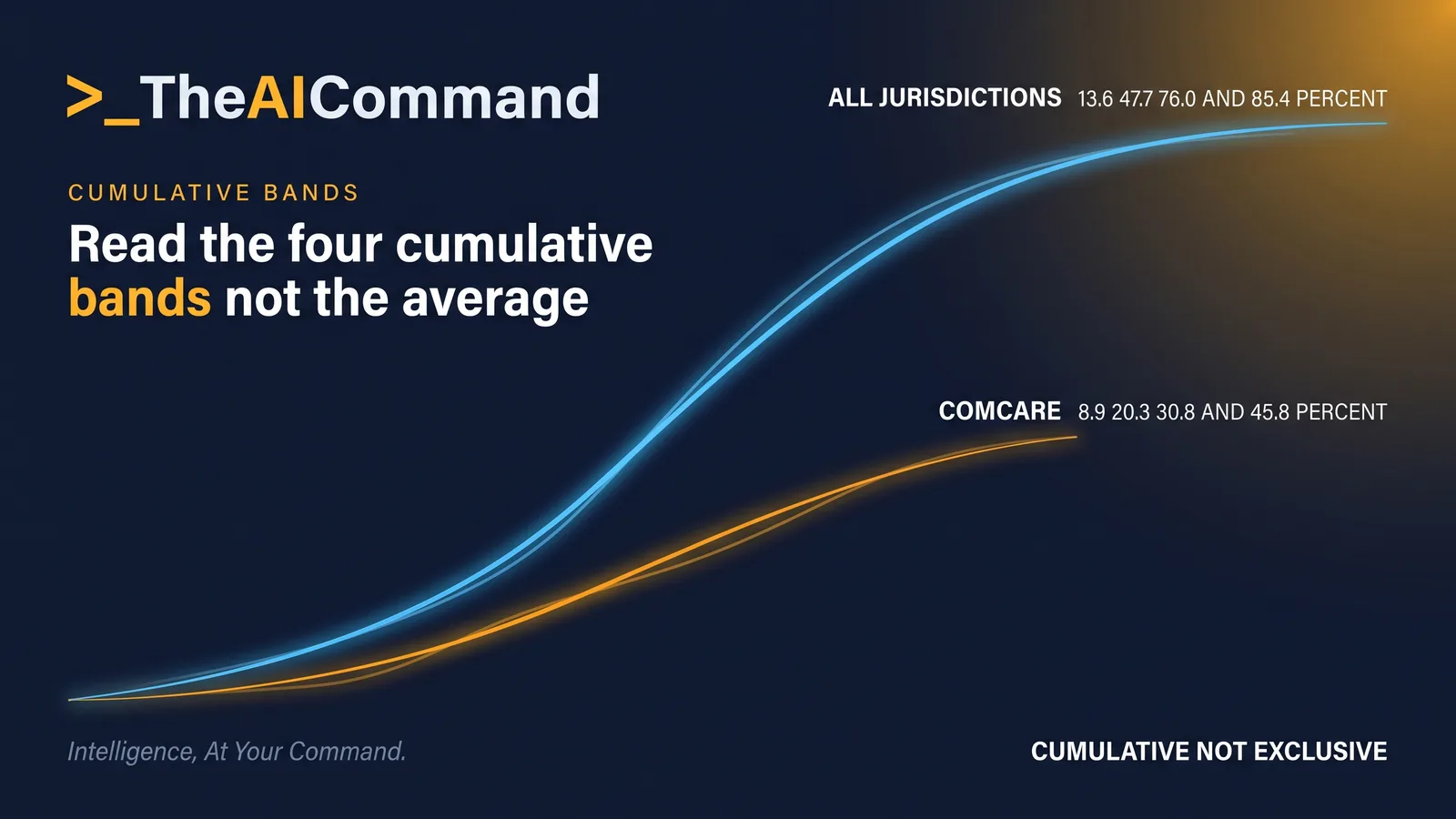
Every figure in that table is Indicator 23 of the detailed data file, published 8 December 2025, reporting 2023-24, as at 24 September 2026. Every gap in this article is computed from the unrounded values, so it can sit 0.1 of a point away from subtracting the rounded percentages. The widest gap is not at the headline three month mark but at six months, where the national rate had cleared three disputes in four and Comcare fewer than one in three.
Two notes published with the same data file belong beside the Comcare row. Its notes to Table 5.2 record that Australian Capital Territory Government public sector data is included in the Comcare data, so the row is not Comcare alone. The same notes carry the publisher's own explanation of the gap: Comcare and Seacare "generally take more time to resolve their disputes than other jurisdictions due to the complexity of the disputes and the nature of the decisions", with a warning that small application numbers make the percentages volatile. That warning is part of the finding.
Did the gap close between 2019-20 and 2023-24?
Yes, and at nine months for the right reason.
At nine months, Comcare moved from 34.8 percent in 2019-20 to 45.8 percent in 2023-24, a rise of 11.0 points. The national figure was 85.4 percent in both years. The gap narrowed from 50.6 percentage points to 39.7 on the unrounded figures, and every point of that narrowing is Comcare moving.
At three months the story is split. Comcare rose from 12.5 percent to 20.3 percent, a gain of 7.8 points. The national figure fell from 56.5 percent to 47.7 percent, a drop of 8.8 points. The gap narrowed 16.6 points, and slightly more than half of that came from the national rate falling rather than Comcare rising.
The so what is a reporting discipline. A gap that narrows because the comparator deteriorated is not a result anyone can bank, and an internal report that shows a closing gap without both series is not telling the reader what moved.
One caution for anyone holding an older paper. The national totals in the retired Comparative Performance Monitoring report 25th edition are not the national totals in the current file: it recorded 57.2 percent resolved within three months in 2021-22 where the current dataset records 51.3 percent, and its notes record that South Australia did not supply resolution-time data. The current file carries South Australian figures for every year from 2019-20. Compare within one series, or do not compare.
Where Comcare sits among the reporting jurisdictions
Precision matters here, because the overstatement is easy and wrong. Safe Work Australia's note on the table states that resolution speed must be compared between jurisdictions with caution because systems and processes differ, and the dataset page records that adjustment factors are applied to the national figures.
Every row is Indicator 23 of the same file, reporting 2023-24, where the file labels the Comcare and all jurisdictions rows Aus Gov and AUST. The Northern Territory figure is a design artefact: the notes to that table record that its dispute resolution process must be completed within 28 days of the grievance being lodged, so all resolutions occur within one month.
The ranking moves band by band, which is why a single claim about it is usually wrong. Within one month, Comcare at 8.9 percent sits above South Australia at 2.0 percent, Queensland at 4.2 percent and New South Wales at 6.8 percent. Within three months it sits above Seacare and South Australia only, and within six and nine months above Seacare alone, at 26.4 and 43.4 percent.
So the defensible statement is narrow. Comcare is not the slowest reporting jurisdiction in any band. An internal paper that calls it the slowest scheme in the country has overstated the source.
The volume side needs the same care. Table 5.1 of the same file, Indicator 22, records disputes on 7.0 percent of Comcare claims in 2023-24 against 4.6 percent nationally, fourth highest of nine jurisdictions, behind Seacare at 34.6 percent, South Australia at 25.0 percent, a figure the publisher records as revised up significantly after an error in the historic reporting of active claims values, and Tasmania at 12.1 percent. More disputes than average, resolved more slowly than average, is the accurate summary. Highest disputation rate in the country is not.
What the statute already fixes, and what it does not
The Commonwealth scheme has a two-stage path, and the first stage carries a hard statutory clock.
A claimant who wants a determination reconsidered gives the request to the determining authority within 30 days after the determination first came to that person's notice, under section 62(3)(b) of the Safety, Rehabilitation and Compensation Act 1988, at Compilation No. 82, compilation date 1 July 2026. That period is extendable, and is stated as at 24 September 2026.
Section 62(4) requires the reconsideration to be carried out by the determining authority or by a delegate other than a person who made, or was involved in making, the original determination. Section 62(6) requires the request to be decided within the period prescribed by the regulations. Regulation 11A(2) of the Safety, Rehabilitation and Compensation Regulations 2019 sets that period at 30 calendar days starting on the day the determining authority receives the request, at Compilation No. 2, compilation date 1 April 2024, as at 24 September 2026.
From there, section 64(1) allows an application to the Administrative Review Tribunal for review of a reviewable decision, and section 65(4) requires it within 60 days after the applicant is served with notice of the decision, subject to an extension under section 19 of the Administrative Review Tribunal Act 2024. Comcare guidance on reconsiderations states the same 60 day window and records the tribunal's change of name on 14 October 2024. The Administrative Review Tribunal workers compensation page confirms it and states that there is no fee to apply for a review of a workers compensation decision. Each period, and the fee position, is stated as at 24 September 2026.
The Act and the Regulations fix a 30 calendar day decision period at the reconsideration stage, and the published figures show 8.9 percent of Comcare disputes resolved inside one month. Those facts can coexist, because the dataset does not say which stage it counts, which is why internal reporting has to define its own population and its own lodgement and resolution points in writing.
How does a 30 calendar day reconsideration period compare with other schemes?
Design differs sharply between schemes, which is worth knowing before any duration figure is read as an execution result.
The Safe Work Australia Comparison of Workers' Compensation Arrangements in Australia and New Zealand 2025, 30th edition sets out each dispute resolution process in Table 5.11. It is a snapshot as at 31 December 2025 and tells readers to confirm details with the jurisdiction, so it is dated, not current law.
In the South Australian row, the table records that the reconsideration of the disputed decision "must be completed within 10 business days after receiving notice of the dispute". In the Comcare row, it records that the tribunal processes "include compulsory conciliation".
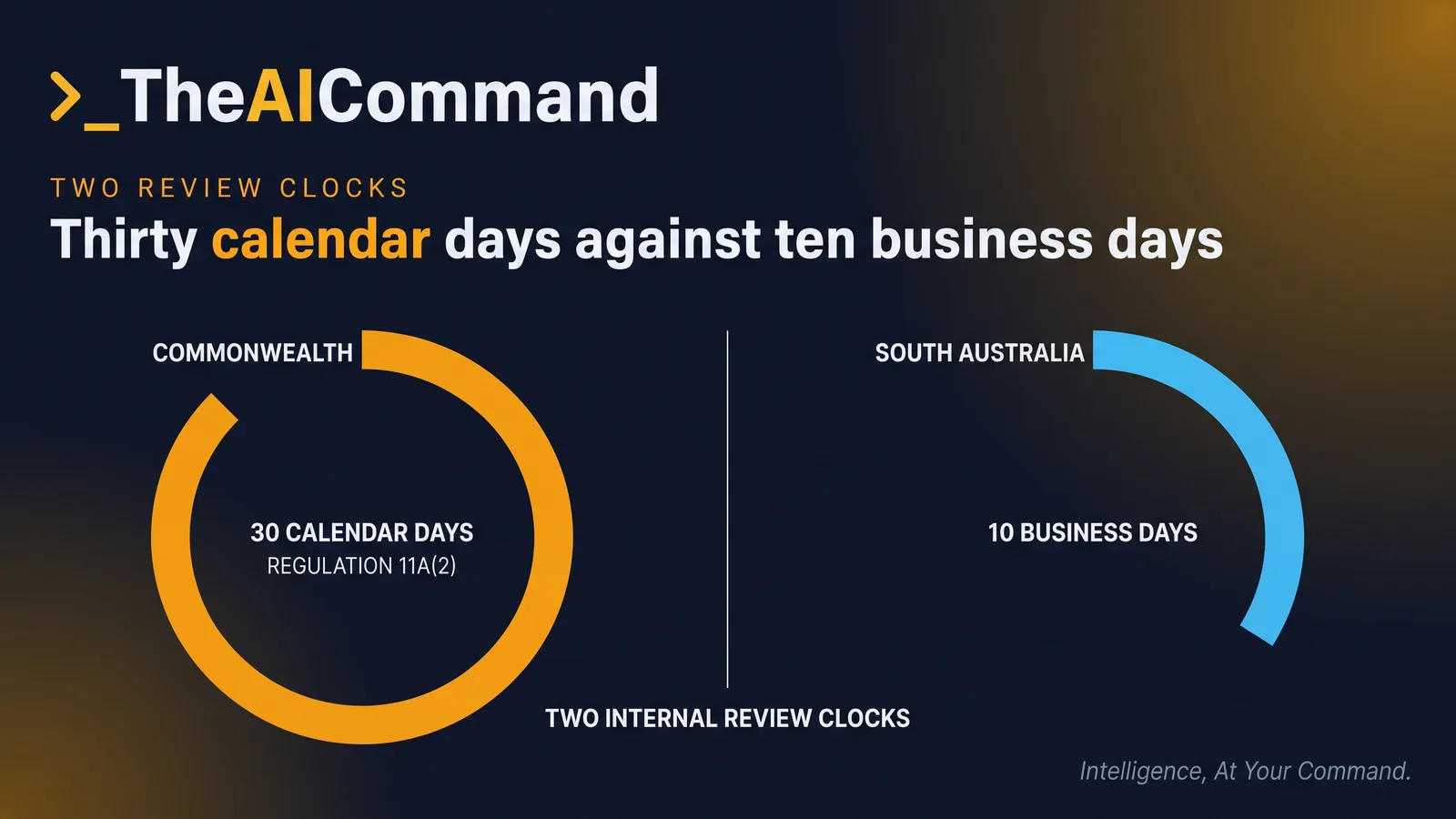
Ten business days is about fourteen calendar days, so the Commonwealth internal review window is roughly double the South Australian one, before any external stage. The contrast shows only that the two schemes set different internal review clocks. It does not explain the duration gap, and the publisher's note quoted above is the explanation Safe Work Australia publishes. Record the statutory internal review period beside the bands, so a later reader can see how much of any cross-scheme gap is the clock rather than the work.
Where an assistant fits inside the 30 day window
Narrowly, and on the evidence-assembly step only.
TheAICommand works to the Verified Draft Method: de-identify the inputs, ground the model in your own source material, keep a person at the decision point, verify against the primary source, and log what happened.
Inside a 30 calendar day reconsideration period, part of the work is assembly rather than judgement: building the chronology, finding which reports are referenced but missing, and identifying which assertions in the original determination have no document behind them. That is a retrieval and listing task on a closed set of attachments. The decision is not, and section 62(4) places the reconsideration with a person other than the maker of the determination.
De-identify the document text before anything is uploaded, and scope that pass to what is practical inside the window, the determination and the reports in dispute rather than the whole file. Replace every party name, claim number, date of birth and contact detail with the placeholders the prompt uses, and leave out any attachment that cannot be de-identified. Then rename the attachments to neutral labels, Doc 1 to Doc N, because claim system exports are routinely named with a surname or a claim number, which carries an identifier straight into the output. Keep both mappings outside the chat. Replace [DETERMINATION_DOC] in the prompt with the label of the determination, for example Doc 3.
What to check: confirm the output names the same determination document you intended, then confirm that every chronology row carries a document label and a page, because an entry without one is the model supplying the fact rather than finding it. Spot-check three references against the documents themselves, confirm the missing-document list does not include anything that is in fact attached, and confirm the de-identification stop condition did not trigger.
Can an internal average prove an AI step made disputes faster?
No, and the reason is structural.
An average duration has no published comparator. Safe Work Australia publishes dispute duration only as cumulative percentages in four bands, so an average cannot be placed beside it. An average also hides the distribution: a scheme can improve the one month band and worsen the nine month band while the average stays flat.
The fix is to report in the same shape: take the closed disputes for a period, compute the cumulative percentage resolved within one, three, six and nine months, and set them beside the Comcare and national rows above.
What to check: confirm the excluded-record count is stated and that supplied equals used plus excluded, because a silently dropped record is the most common way a band distribution flatters itself. Confirm from the spreadsheet, not the model's closing line, that the four counts never decrease down the table. Recalculate one band by hand from the export before the number leaves the team. Then check that the day thresholds in the output are the ones the register defines, because the national dataset publishes no convention to match.
A worked example makes the arithmetic visible, on illustrative counts. Out of 120 closed reconsiderations, 9 resolved within one month, 34 within three months, 61 within six months and 88 within nine months, which is 7.5, 28.3, 50.8 and 73.3 percent. Set against the 2023-24 rows, that portfolio sits below Comcare in the first band, above it in the other three, and below the national rate in all four. A single average would say none of it.
What this data cannot tell you
State the limits, because they keep the register honest.
The most recent published national dispute-duration figures are 2023-24, released in December 2025, as at 24 September 2026. A register closing disputes this month is being set against a national picture roughly two years old.
The dataset publishes percentages, not the counts behind them, so the small application numbers warning cannot be quantified against the benchmark. Report the count in each band beside the percentage, so a reader can see how thin that base is.
The Comcare scheme performance pages publish a reconsideration rate, an affirmation rate and an appeal rate, not duration bands, on a page last reviewed 28 July 2026.
The Safety, Rehabilitation and Compensation Commission performance results report on self-insured licensees as a cohort, including reviews of decisions, and route readers to the Comcare scheme performance pages rather than publishing duration bands. Neither publishes duration bands at licence level, which is the practical reason a licensee builds them internally.
Do this Monday
Build the dispute-duration register, in the national bands, and put a name against it.
The artefact is a dispute-duration register that reports closed disputes in four cumulative bands, at one, three, six and nine months, measured from lodgement to resolution, with the count in each band, the percentage, the total, and a written definition of what it counts as a dispute and of both dates.
The owner is the delegate responsible for reconsiderations reporting, or in a licensed self-insurer the claims and compliance manager. One role, named in the file.
The first step fits in an hour:
- Write three sentences, one naming what the register counts as a dispute, one naming the date it counts as lodgement and one naming the date it counts as resolution.
- Export the last 12 months of closed reconsiderations with three columns only, record id, lodgement date and resolution date, so nothing identifying leaves the claims system.
- Compute the four cumulative percentages, by spreadsheet or with the second prompt above, using 31, 92, 183 and 274 days as the band boundaries and recording those thresholds beside the definitions.
- Write the four numbers into a table beside the Comcare row at 8.9, 20.3, 30.8 and 45.8 percent, and the national row at 13.6, 47.7, 76.0 and 85.4 percent, both labelled Jurisdictional Comparison data, 2023-24 results, and add a line recording that the national rows may count a different population, so the comparison is indicative.
The check that proves it worked has four parts:
- The four internal percentages increase or stay level across the bands, read from the spreadsheet, not any model output.
- One band is recalculated by hand from the export and matches the reported figure to one decimal place.
- The number of records excluded for missing dates is stated on the same page.
- The file records, in one sentence each, what counts as a dispute, what counts as lodgement and what counts as resolution.
If that fourth part is missing, the register is a number without a definition, and it will not survive an audit.
The bottom line
On the most recent published national comparison, 2023-24, Comcare resolved 20.3 percent of disputes within three months against 47.7 percent nationally, and 45.8 percent within nine months against 85.4 percent, on Safe Work Australia Jurisdictional Comparison data published 8 December 2025. The nine month gap has narrowed 11.0 points since 2019-20 entirely because Comcare improved while the national figure held. Neither Comcare nor the Safety, Rehabilitation and Compensation Commission publishes duration bands at licence level, so they have to be built internally before any AI-assisted step can be credited. Build the register first. Then measure the intervention against it.
This article is general information and education only. It is not legal, compliance, financial or professional advice.
TheAICommand. Intelligence, At Your Command.