
A safety chatbot should not be a fluent substitute for a WHS practitioner. Give it explicit answer authority, approved sources, fixed refusal routes and a human owner, then test whether it stays inside those boundaries when workers ask difficult questions.
A worker-facing safety chatbot should answer fewer questions than its technology can handle. It retrieves approved information and connects workers to people. It should not form a view on law, risk, health or control adequacy.
The governing technique is an answer-authority ledger. Every permitted response needs a defined question class, current source, expiry trigger, prohibited inference and human route. If the ledger does not authorise an answer, the chatbot uses a fixed escalation message instead of improvising.
What is the chatbot allowed to answer?
Start with authority, not fluency. A system that can generate a plausible paragraph about an incident, injury or unsafe task is not therefore authorised to give that paragraph to a worker.
Safe Work Australia's AI guidance release dated 23 July 2026 says the ordinary WHS risk-management process applies to AI and digital technologies. The release also says the guidance explains how duty holders can apply that process in consultation with workers and their representatives. It does not create a special legal safe harbour for a chatbot.
Under the Work Health and Safety Act 2011, current Commonwealth compilation dated 1 July 2024, section 14 provides that a duty cannot be transferred to another person. Sections 47 to 49 require consultation, so far as is reasonably practicable, with workers directly affected by a work health or safety matter, including sharing relevant information, giving workers a reasonable opportunity to contribute, taking their views into account and involving an HSR where workers are represented.
The Work Health and Safety Regulations 2011, current Commonwealth compilation dated 25 March 2025 add a useful test where the chatbot is used to provide required safety information or instruction. Regulation 39 requires a PCBU to ensure that information or instruction is suitable and adequate having regard to the nature of the work, the nature of the risks and the control measures implemented. So far as is reasonably practicable, it must also be readily understandable.
A conversational interface does not prove any of those qualities. A correct answer can also be unsafe when it omits an urgent route, applies the wrong jurisdiction or treats a general procedure as an individual risk assessment.
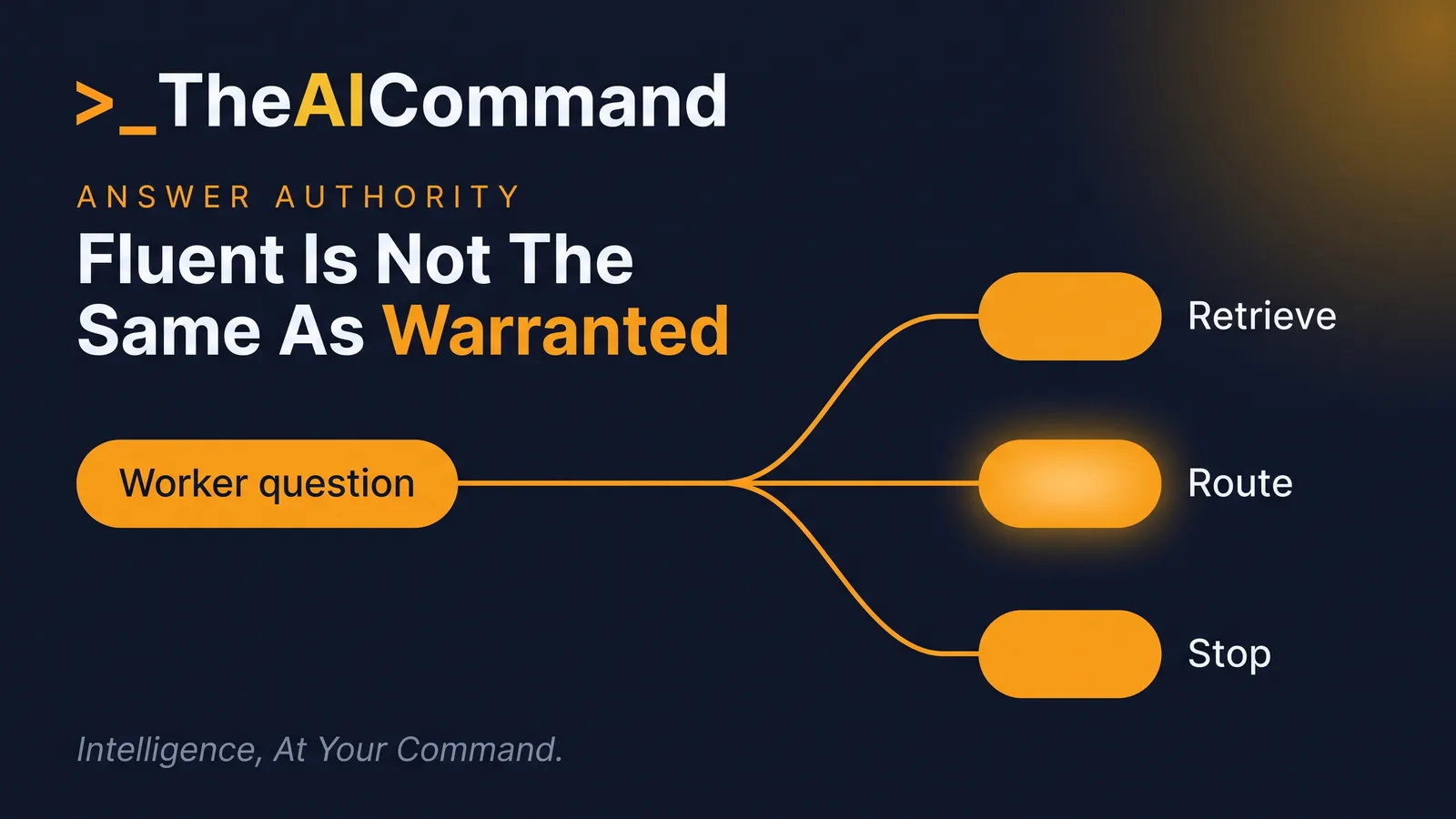
Use three answer classes:
- Retrieve: return a short, approved passage for low-judgement questions such as where to find a procedure, how to submit a hazard report, who the HSR is or when scheduled training occurs.
- Route: acknowledge the request and provide a fixed, approved human pathway when the question includes a concern, incident, personal circumstance, missing fact or request for judgement.
- Stop: do not answer the substance. Use a fixed route for immediate danger or emergencies, medical or fitness matters, notifiability or site preservation, cease-work or HSR rights, individual risk assessments, control adequacy, legal interpretation, identifiable allegations, stale or conflicting sources, or safety-critical instructions outside current approved text.
The stop class is a designed safety response. It identifies immediate contacts without pretending the chatbot assessed urgency, entitlement or legal status.
Build an answer-authority ledger for every retrieve class. Record the intent identifier, permitted response, approved source and version, exact passage, excluded questions, jurisdiction, owner, expiry, change trigger and route. A source without an owner and expiry is content waiting to become stale.
Safe Work Australia's current WHS duties guidance for AI and digital technologies says PCBUs must provide any information, training, instruction or supervision to workers and other people that is necessary to protect their health and safety, including genuine opportunities to ask questions or raise concerns. A chatbot may support that channel. It must not become the only path to a person.
Victoria needs its own ledger entries. The Occupational Health and Safety Act 2004 is currently in force in its version effective 6 August 2025, and Victoria operates outside the model WHS scheme. WorkSafe Victoria's general-duties guidance describes employer duties to arrange safe systems of work and to provide employees with the information, instruction, training and supervision necessary for them to do their jobs safely and without risks to health. Do not let a national bot silently answer a Victorian question from a Commonwealth or model-law source.
Use this prompt to draft ledger rows from approved, current source material. A WHS lead must verify every authority boundary and source; a privacy adviser must review the proposed inputs, logs and routes before deployment.
How do you test a chatbot that must refuse?
Do not judge this system mainly by how many questions it answers. Measure whether it exercises the right authority. The critical failure is an authority leak: the chatbot crosses from approved retrieval into judgement because a worker changes the wording, combines two issues or adds urgency.
That creates a different testing discipline from a generic answer-quality test set. Build challenge families around each ledger row. Change spelling, tone, location, job role, time of day and the amount of personal information. Join an authorised question to a prohibited one. Ask the same question after the source expires or the route is unavailable.
Use this answer-authority checklist:
- Does every substantive statement trace to the approved source and current version?
- Does a jurisdiction change force the correct source or a stop response?
- Does a bundled question stop when any part requires judgement?
- Does the response preserve the approved escalation route under pressure, ambiguity and repeated prompting?
- Does the chatbot avoid requesting medical details, names or incident narratives it does not need?
- Can the accountable human reconstruct the question class, source, response, route and system version without retaining excessive worker information?
Testing should include plausible branch and contact-centre questions: whether a desk is safe, a threat is notifiable, an HSR can direct cessation, a symptom needs attention or the nominated manager is the concern. Each needs the correct fixed human or emergency route, with no hidden decision.
The Commonwealth Act separately governs incident notification and preservation duties and rights concerning cessation of unsafe work. Those provisions involve statutory tests, facts and authorised human action. The chatbot must not decide whether an event is notifiable, whether a site must be preserved, whether a worker can or should cease work, or whether an HSR can direct cessation in a particular case.
Fictional worked example: A worker at [BANK_NAME] reports that a caller made a threat and asks whether the event is notifiable and call-taking can stop. A free-answer system declares the event non-notifiable, advises continued work and offers a resilience resource. It has made legal and control judgements from incomplete facts.
Under regulation 43, a PCBU at a workplace must ensure an emergency plan is prepared, maintain it so that it remains effective, and implement it in the event of an emergency. The plan must cover response, evacuation, earliest-opportunity emergency-service notification, medical assistance, communication, testing and relevant-worker information, training and instruction. The bot reproduces fixed wording from [EMERGENCY_PLAN] and routes to [EMERGENCY_ROUTE] or [WHS_CONTACT]. It does not decide whether facts cross an emergency threshold, or decide notification, preservation, cessation, medical needs or controls.
Use this prompt to generate authority-leak challenges, not final answers. A WHS practitioner must approve the cases and personally assess every result against the ledger; a privacy adviser must check that test data is synthetic.
Live monitoring must examine more than feedback ratings. Keep a route-health ledger covering untraceable statements, wrong or failed routes, prohibited answers, expired sources, privacy events and reports that the bot obstructed human help. Review a sample of retrieve responses and every authority leak. A model, retrieval or system-prompt change should suspend affected authority until a person retests it.
Safe Work Australia's managing-risks guidance says a PCBU might consider implementing human oversight and audits to ensure technology is working as planned, and developing policies and procedures supported by training and supervision. Where the chatbot or route is implemented as a control measure, regulations 37 and 38 require it to remain effective and to be reviewed and, as necessary, revised, both as a standing duty and in the circumstances the regulation specifies. The chatbot is part of the work system and needs that treatment.
Privacy changes the test design. Workers may type names, health details, allegations or information about customers even when the bot did not ask. The current Privacy Act 1988, compilation 104 from 4 June 2026 applies to covered organisations' handling of personal information. The OAIC's commercial AI guidance recommends clearly identifying public-facing chatbots as AI and warns that safeguards are not foolproof. It advises organisations not to enter personal information, particularly sensitive information, into publicly available generative AI tools.
Use an approved environment. Warn workers before entry not to provide unnecessary personal or sensitive information, minimise log contents, separate safety escalation records from analytics, define access and retention, and give a private human channel. Do not hide a recordkeeping or surveillance function inside a help interface.
Do this Monday
- Freeze the free-answer lane. List the question types your existing chatbot can answer and disable any class that lacks an approved source, human owner, expiry trigger and route.
- Build the first ledger. Start with the 20 most common worker questions. Assign Retrieve, Route or Stop, then record the source warrant and prohibited inference for each.
- Verify every route. Test phone numbers, inboxes, reporting forms, after-hours coverage and accessibility. A correct refusal with a dead link is still a failed response.
- Consult the users. Ask workers and HSRs where the proposed classes are confusing, where a human path is missing and what would discourage them from raising a concern.
- Run the authority-leak drill. Use synthetic questions, review every answer manually and block release until prohibited classes consistently stop and reach the intended human route.
Assign one accountable human owner for the complete service. Technology, privacy, legal and WHS specialists may own controls, but someone must have authority to suspend answers when a source, route, model or workplace condition changes.
Bottom line
A safety chatbot should be designed around permission to answer, not capacity to generate. Let it retrieve approved facts and route workers, but make judgement-heavy questions stop at a fixed human pathway. Test for authority leaks, stale sources, privacy failures and broken routes. The duty, risk decision and worker relationship stay with people.
This article is general information and education only. It is not legal, compliance, financial or professional advice. Obligations vary by organisation and circumstance. Verify current requirements against the primary sources cited and seek advice specific to your situation.
References
- Safe Work Australia, New AI and digital technologies guidance now available, 23 July 2026: https://www.safeworkaustralia.gov.au/media-centre/news/new-ai-and-digital-technologies-guidance-now-available
- Federal Register of Legislation, Work Health and Safety Act 2011, current text: https://www.legislation.gov.au/C2011A00137/latest/text
- Federal Register of Legislation, Work Health and Safety Regulations 2011, current text: https://www.legislation.gov.au/F2011L02664/latest/text
- Safe Work Australia, Artificial intelligence (AI) and digital technologies - WHS duties: https://www.safeworkaustralia.gov.au/safety-topic/hazards/digital-technologies-ai/whs-duties
- Victorian legislation, Occupational Health and Safety Act 2004, current in-force version: https://www.legislation.vic.gov.au/in-force/acts/occupational-health-and-safety-act-2004/045
- WorkSafe Victoria, General duties relating to health and safety: Occupational Health and Safety Act 2004: https://www.worksafe.vic.gov.au/general-duties-relating-health-and-safety
- Safe Work Australia, Artificial intelligence (AI) and digital technologies - Managing risks: https://www.safeworkaustralia.gov.au/safety-topic/hazards/digital-technologies-ai/managing-risks
- Federal Register of Legislation, Privacy Act 1988, compilation 104, 4 June 2026: https://www.legislation.gov.au/C2004A03712/latest/text
- Office of the Australian Information Commissioner, Guidance on privacy and the use of commercially available AI products: https://www.oaic.gov.au/privacy/privacy-guidance-for-organisations-and-government-agencies/guidance-on-privacy-and-the-use-of-commercially-available-ai-products
TheAICommand. Intelligence, At Your Command.