
AI involvement does not make a contractor safety pack useless, and contractor expertise does not make it sufficient. Test the document against the work, expose every shared-duty interface and verify that the controls operate. Your assurance must follow influence and control, not the logo on the cover.
The contractor says AI helped write the safety pack. The wrong response is automatic rejection. The equally wrong response is approval because a specialist supplied it.
Your organisation still needs to understand the risks it can influence or control, consult where duties overlap and test whether the proposed controls fit the work. AI provenance is a reason to examine the evidence trail. It is not a substitute for examining the work.
For financial-services operations, the difficult points usually sit at interfaces: a security provider and branch team responding to aggression, a facilities contractor and office manager coordinating access, or an outsourced contact centre working to service levels set by a bank or insurer. The useful assurance unit is not the document. It is the interface between two operating systems.
What changes when a contractor says AI helped write the safety pack?
The legal duties do not move with authorship. Under the current Commonwealth Work Health and Safety Act 2011, section 14 says a duty cannot be transferred. Section 16 allows more than one person to have the same duty, requires each duty holder to meet the statutory standard and preserves responsibility according to each person's capacity to influence and control the matter. Section 46 requires duty holders with duties relating to the same matter to consult, cooperate and coordinate, so far as is reasonably practicable.
The Federal Register identifies the current Commonwealth text as compilation 16, in force from 1 July 2024. Safe Work Australia explains that the model laws have been implemented in all jurisdictions except Victoria, and that some jurisdictions have made variations in their WHS laws compared with the model laws. Confirm the applicable enacted law.
These principles do not mean every supplier in the technology stack is a concurrent duty holder for every matter. Safe Work Australia's guidance says duties might be shared where businesses are involved in the same activities, owe duties to the same workers or share a workplace. The relationship to the particular WHS matter is critical. A software licence, invoice or AI authorship disclosure does not settle that question.
A contractor performing work may be a PCBU in its own right. The engaging organisation may also influence the people, timing, premises, systems or service settings around that work. Comcare's current PCBU guidance says contracted parties may have responsibilities as workers and may be PCBUs. Identify the actual parties and work arrangements. Do not assign legal status from a template.
For Commonwealth PCBUs, Comcare's general contractor-management guidance says a PCBU can rely on specialist expertise, but that reliance does not absolve the PCBU of its duties. Its practical checks include verifying the expert's capability, safety systems and performance against stated procedures, while continuing consultation and providing appropriate instructions.
That does not impose constant supervision of specialist work. The same Comcare guidance says the legislation was not intended to create a general obligation to supervise a specialist contractor. Reasonable action depends on actual control, knowledge, expertise and capability. Target the interfaces you can affect.
AI changes the reliability inquiry, not the duty allocation. Ask what the tool did: retrieve approved material, organise evidence, propose controls, draft prose, translate instructions or invent unsupported detail. Then ask which competent person checked each material output against current sources and the work as performed. A document can be fluent and still contain a wrong site assumption, a stale escalation path or a control nobody can use.
Safe Work Australia's AI duties guidance says PCBUs must manage physical and psychosocial risks from AI and digital technologies, consult workers and HSRs, and consult other PCBUs who hold duties relating to the same matter. Its risk guidance explains that PCBUs must monitor and review controls. A polished pack is an input to those processes. It is not evidence that they occurred.
Victoria requires separate mapping. It has an OHS regime rather than the model WHS Act. The current authorised version of the Occupational Health and Safety Act 2004 is version 045, incorporating amendments as at 6 August 2025. Section 21(3) extends the employer duty to independent contractors and their employees for matters over which the employer has control, or would have control but for an agreement purporting to limit or remove it. Section 35 extends consultation to those contractors and employees within the same control boundary. WorkSafe Victoria's general-duties summary provides an overview. Use the Victorian framework, not copied model-law section labels.
Where do shared duties meet the contractor's evidence?
Build an interface assurance ledger. This is a short record that sits between the contract register and the risk register. Each row covers one matter where the organisations' work, people, premises or controls touch.
Use these fields:
- WHS matter: the hazard, affected workers and activity, described in operational terms.
- Duty-holder basis: the enacted provision or other verified basis relevant to each party, with uncertainty escalated for legal review.
- Influence and control: what each party can set, change, stop, resource, monitor or communicate.
- Evidence lineage: source records used in the pack, AI involvement, drafter, competent reviewer, version and review date.
- Control interface: the hand-off, dependency or assumption that must work across both organisations.
- Worker evidence: consultation completed, HSR involvement, concerns raised and outcomes communicated.
- Verification: observation, sample, system record or worker check showing whether the control operates.
- Change trigger: the event that reopens the row, such as a roster change, new channel, software update, incident or failed escalation.
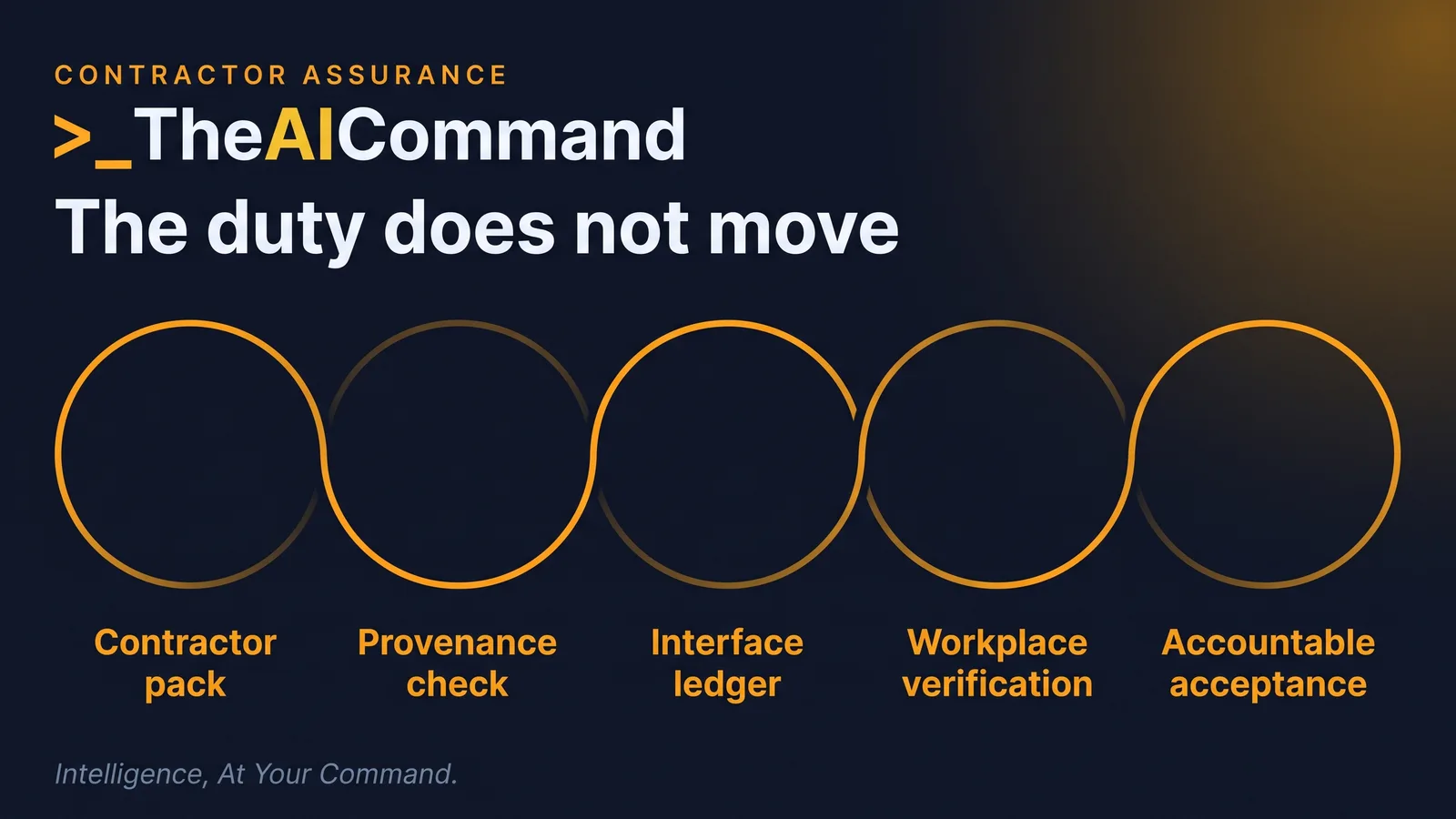
The ledger prevents two familiar failures. First, each party assumes the other owns an interface risk. Second, the safety pack is assessed as writing rather than as a set of claims about work. It also gives the same two-hop discipline that an officer's due diligence file applies to dashboards: link each favourable claim to its source record, then to an independent workplace check.
Use this prompt to create a first-pass interface map from de-identified records. A WHS practitioner and legal adviser must verify the duty mapping, and operational owners from both organisations must confirm their real influence and control.
Fictional worked example: [FINANCIAL_SERVICES_FIRM] engages [CONTACT_CENTRE_PROVIDER] to handle after-hours customer complaints. The provider discloses that an approved AI tool helped draft its safety pack. The pack describes an aggression escalation process, completed training and supervisor support.
The interface ledger changes the discussion. [FINANCIAL_SERVICES_FIRM] sets complaint categories, service levels and the transfer route for high-risk calls. [CONTACT_CENTRE_PROVIDER] controls rosters, local supervision and immediate worker support. Workers report that the transfer queue closes before the outsourced shift ends. The pack cites the daytime procedure and contains no evidence from the after-hours team.
The response is not to ask AI whether the pack is compliant. The firms' operational and WHS leads verify the hours, sample failed transfers, consult affected workers and agree an interim escalation while the interface is repaired. The contractor corrects the pack and evidence references. Each organisation records the actions within its own governance system, according to its duties and capacity to influence or control the matter.
Use this prompt to challenge document claims before approval. The contract owner and WHS manager must review the source records, and affected workers or HSRs must test whether proposed controls are workable.
Provenance questions should remain proportionate. Ask for the approved tool or equivalent, source set, relevant instruction record, human reviewer and version history. These proposed fields are voluntary assurance controls, not a claim that WHS law generally mandates an AI authorship declaration. A contract or organisational policy may require one. The objective is traceable, testable claims without exposing personal, confidential or security-sensitive information.
Safe Work Australia's consultation guidance says consultation records can be brief and should capture the matter, affected people, participants, issues, decision, reasons, owner, due date and completion. Use that discipline for shared-duty meetings. Minutes saying "pack accepted" conceal the very interfaces the meeting should resolve.
Do this Monday
- Select one live contractor arrangement. Choose office security, facilities, labour hire or an outsourced customer operation where your organisation affects how work is performed. Confirm the jurisdiction and the entities involved.
- Ask one provenance question. Establish whether AI assisted research, drafting, analysis or translation, which sources were used and who performed competent review. Apply approved information-handling rules before sharing any document with another AI tool.
- Build three interface rows. Start with the highest-consequence hand-offs. Record what each party can control, what each depends on and which fact remains unverified.
- Run a field check. Sample a record, observe a task or speak with affected workers and HSRs. Compare operating reality with one material control claim in the pack.
- Close or escalate visibly. Record the agreed action, responsible party, due date, interim control and review trigger. Escalate uncertain duty allocation for legal advice rather than asking AI to settle it.
The output is not a bigger contractor file. It is a smaller set of verified interfaces that shows who is doing what, why the arrangement is workable and when it must be checked again.
Bottom line
A contractor can use AI to assist drafting, but neither the tool nor the contract relocates your WHS duty. Map the enacted duties, identify actual influence and control, and consult across genuine shared-duty interfaces. Test material claims against source evidence and the work as performed instead of approving fluent documents. Keep legal conclusions, control decisions and acceptance with accountable people.
This article is general information and education only. It is not legal, compliance, financial or professional advice. Obligations vary by organisation and circumstance. Verify current requirements against the primary sources cited and seek advice specific to your situation.
References
- Federal Register of Legislation, Work Health and Safety Act 2011, current text: https://www.legislation.gov.au/C2011A00137/latest/text
- Safe Work Australia, Model WHS laws: https://www.safeworkaustralia.gov.au/law-and-regulation/model-whs-laws
- Safe Work Australia, Principles that apply to work health and safety duties: https://www.safeworkaustralia.gov.au/law-and-regulation/duties-under-whs-laws/principles-apply-work-health-and-safety-duties
- Safe Work Australia, Consulting, cooperating and coordinating activities with other duty holders: https://www.safeworkaustralia.gov.au/safety-topic/managing-health-and-safety/consultation/consulting-cooperating-and-coordinating-activities-other-duty-holders
- Safe Work Australia, WHS duties in a contractual chain: https://www.safeworkaustralia.gov.au/doc/whs-duties-contractual-chain-factsheet
- Safe Work Australia, WHS duties: Consultation: https://www.safeworkaustralia.gov.au/safety-topic/managing-health-and-safety/consultation/whs-duties-consultation
- Comcare, PCBUs: https://www.comcare.gov.au/roles/pcbu
- Comcare, Contractor Management: Guidance for Commonwealth PCBUs: https://www.comcare.gov.au/sites/default/files/docs/contractor-management-guidance-for-pcbus.pdf
- Safe Work Australia, Artificial intelligence and digital technologies: WHS duties: https://www.safeworkaustralia.gov.au/safety-topic/hazards/digital-technologies-ai/whs-duties
- Safe Work Australia, Artificial intelligence and digital technologies: Managing risks: https://www.safeworkaustralia.gov.au/safety-topic/hazards/digital-technologies-ai/managing-risks
- Victorian legislation, Occupational Health and Safety Act 2004, authorised version 045: https://content.legislation.vic.gov.au/sites/default/files/2025-08/04-107aa045-authorised.PDF
- WorkSafe Victoria, Summary of the OHS Act 2004: General OHS Duties: https://www.worksafe.vic.gov.au/summary-ohs-act-2004-general-ohs-duties
TheAICommand. Intelligence, At Your Command.