
A career conversation should not pretend to know which jobs AI will remove. Map the work that remains human-led, becomes AI-assisted, creates oversight demand or supports an adjacent option, then give each proposed move evidence, a capability test and a human owner.
Your team does not need another confident prediction about jobs in 2030. They need a credible answer to a nearer question: what should this person learn and practise next, given the work that is actually changing here?
Build that answer from tasks, not headlines. Use a four-lane task-shift map, then place any adjacent career option in a register with evidence, a gap, a next test and an owner. This is an individual development conversation. It is not a role redesign, a redundancy process or a promise that a position will continue.
AI can organise approved evidence and expose missing information. A person must confirm the task map, discuss the employee's goals, approve development activity and make every workforce or employment decision.
Why is a job forecast the wrong unit?
A job title bundles tasks with different exposure, importance and constraints. One activity may be suitable for an AI-assisted first pass. Another may depend on a customer relationship, source interpretation, accountable judgement or an organisation's control requirements. Calling the whole role "safe" or "at risk" hides the useful detail.
Jobs and Skills Australia's national Gen AI Capacity Study concludes that generative AI is more likely to augment human work than replace it. The study covers exposure, adoption, adaptation, labour-market dynamism and skills across Australia (Jobs and Skills Australia). That is a labour-market finding, not a guarantee for any employee, employer or occupation. The same study supports an argument about why capability cannot be allowed to concentrate in one team. This piece works one level down from that, at the level of a single person's next task.
JSA's labour-market summary says displacement is limited so far, with most impacts involving upskilling, redeployment and evolution of roles (Jobs and Skills Australia). "So far" is the boundary.
The study's detailed analysis explains the distinction leaders must preserve. Its exposure scores indicate how technology could be applied to current tasks. They do not directly estimate wages or employment, do not reflect the practical context of the task, including the inherent value of human involvement, and assume that current Gen AI technologies are implemented in full to their peak potential. JSA says exposure estimates cannot, with any certainty, be taken as definitive measures of expected employment or wage effects (JSA analysis papers).
Put a forecast quarantine around every external claim, the same discipline any other AI governance evidence gets. Record whether it describes technical exposure, observed adoption, historical mobility, modelled scenarios or an actual change in your team's work. Never let an exposure score become "your role will disappear" in a career conversation.
The same discipline applies to mobility. JSA reports that historically about 15 per cent of Australian workers changed occupation from one year to the next, based on linked administrative data. Its detailed paper says those historical pathways are not yet showing consequential generative-AI changes clearly, and some underlying sources predate mainstream use of large language models (JSA analysis papers). Fifteen per cent is context about normal movement. It is not a target, a probability for [EMPLOYEE_NAME] or proof of an available destination.
What belongs on the four-lane map?
Map a defined role or work area across four lanes. Use completed work, approved workflow changes, quality records and conversations with the people doing the work. Do not infer capability from a title, tool usage or confidence in a meeting.
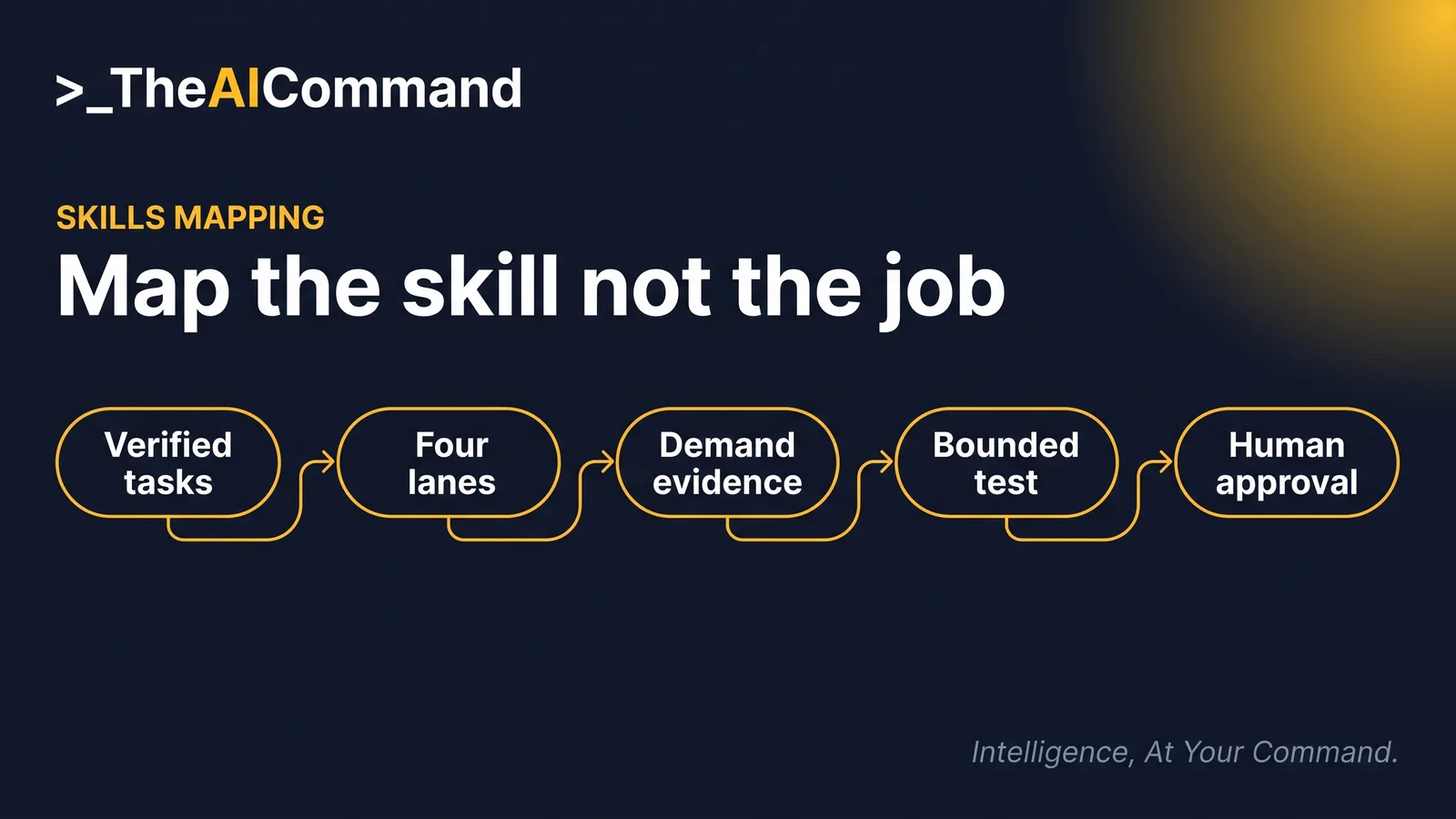
Lane 1: human-led work. Record tasks for which a person still frames the issue, engages the stakeholder, weighs evidence, applies context, makes or approves the judgement, or carries accountability. "Human-led" does not mean untouched by technology. It identifies where responsibility and substantive control remain with a person.
Lane 2: AI-assisted work. Name the bounded activity, approved tool or equivalent, permitted inputs, required source grounding and human acceptance test. "Drafting" is too broad. "Create a first-pass chronology from approved, de-identified records for human source checking" is usable.
Lane 3: new oversight work. Capture tasks created or expanded by AI use: testing outputs, resolving exceptions, documenting evidence, maintaining approved knowledge, monitoring quality and escalating incidents. Do not assume these tasks are spare capacity or automatically assign them to the person who adopted the tool first. Oversight load is real work that needs planned capacity like any other.
Lane 4: adjacent option evidence. Identify a plausible next direction based on demonstrated capabilities, work the employee wants to explore and evidence that the organisation or external market needs it. This lane records an option, not a destination. A generic label such as "AI specialist" fails because it says nothing about the work, entry requirements or demand.
Jobs and Skills Australia's skills analysis says a foundational level of digital and AI capability is important for everyone, and that beyond this the skills system must deliver digital and AI skills, knowledge and attitudes across a spectrum of AI capabilities as well as non-digital capabilities (Jobs and Skills Australia). Its detailed analysis also finds Australian businesses commonly nominated familiarity with generative AI, digital skills, communication and critical thinking when asked what matters for working with the technology. That supports a mixed capability map, not a prompt-only curriculum, and it is why structured practice beats a tool licence (JSA analysis papers).
Use this prompt to structure a first pass from approved, de-identified evidence. The employee, manager and relevant process or risk owner must correct the classifications and confirm every proposed development need before use.
Here is a fictional worked example. [EMPLOYEE_NAME] works in [INSURANCE_OPERATIONS_TEAM]. A source-based case chronology sits in Lane 2 because the approved AI tool or equivalent can create a first pass, while [EMPLOYEE_NAME] checks every material statement against the record. Explaining a disputed matter to [CUSTOMER_PLACEHOLDER] and approving the final response sit in Lane 1. Designing a sample for chronology accuracy and logging recurring failures sit in Lane 3.
Lane 4 records "quality and control testing" as an adjacent option because [EMPLOYEE_NAME] has produced accepted defect analyses and has expressed interest in assurance work. It does not record "future AI assurance manager". The evidence does not support that title, vacancy or promise.
How do you make an adjacent option credible?
An option becomes credible when it has two keys. The evidence key shows that relevant work exists and identifies its actual requirements. The experience key gives the person a bounded way to demonstrate the missing capability. Without both, a career conversation becomes either a market prediction or a training catalogue.
Use a career-option register with these fields:
An NBER working paper shows why destination evidence matters. Its May 2026 revision analyses 1.9 million occupational training spells funded by the United States Workforce Innovation and Opportunity Act from 2012 to 2024, linking training moves to task-level AI exposure and comparing trainees with matched workers who sought workforce services but received only job-search assistance. The paper attributes recent estimated earnings gains for trainees from highly exposed occupations mainly to moves into less-exposed work and, to a lesser extent, expanded training in AI-complementary skills (NBER).
This is a working paper about United States workforce-service participants, using a matched comparison rather than random assignment. It does not estimate the return from a course for an Australian financial-services employee, and it does not say people should flee exposed work. It shows that "learn AI" is not a complete pathway. Starting occupation, destination and labour-market conditions matter.
Use this prompt to prepare options for discussion. The employee and accountable leader must choose whether to open, change or close an option, and authorised people must approve any assignment or learning support.
Before the conversation closes, check that every option passes five tests: it is specific enough to investigate; demand evidence is current and scoped; the employee wants to explore it; a real capability gap is named; and an authorised owner can provide a next test. Close an option openly when one of those conditions fails. A shorter honest register is more useful than a page of imaginary careers.
Do this Monday
- Choose one person and one work area. Explain that the exercise supports development and does not forecast their job, then invite their goals and concerns in their own words.
- Build the four lanes. Use recent tasks, approved AI-assisted changes, quality evidence and the employee's input. Mark each entry observed, trialled, proposed or unknown.
- Quarantine forecasts. Label every external claim by source, date, scope and evidence type. Remove any line that converts exposure or a scenario into an individual outcome.
- Open no more than two options. For each, record demand evidence, transferable proof, one gap, one bounded test, support, owner and review date.
- Fund the next test. Secure the work access, supervision and protected time before presenting the option as active. Review what the task demonstrated, not whether the person sounded confident about AI.
- Return control to the person. Give [EMPLOYEE_NAME] the corrected map and register. Ask what they want changed, confirm that no outcome is promised, and set [REVIEW_DATE].
Bottom line
Do not answer career anxiety with a confident job prediction. Map changing tasks, preserve the difference between exposure and outcomes, and make each adjacent option earn credibility through evidence and a bounded test. AI can organise the record, but people confirm capabilities, choose development and make every workforce decision. A career conversation becomes useful when it produces the next honest experiment, not a fictional future.
This article is general information and education only. It is not legal, compliance, financial or professional advice. Obligations vary by organisation and circumstance. Verify current requirements against the primary sources cited and seek advice specific to your situation.
References
- Jobs and Skills Australia, "Australia's AI Transition: Jobs, Skills and the Future of Work", final release 30 September 2025. https://www.jobsandskills.gov.au/studies/generative-artificial-intelligence-capacity-study
- Jobs and Skills Australia, "Our Gen AI Transition - Skills", accessed 31 July 2026. https://www.jobsandskills.gov.au/studies/generative-artificial-intelligence-capacity-study/our-gen-ai-transition-skills
- Jobs and Skills Australia, "Our Gen AI Transition - Labour Market Dynamism", accessed 31 July 2026. https://www.jobsandskills.gov.au/studies/generative-artificial-intelligence-capacity-study/our-gen-ai-transition-labour-market-dynamism
- Jobs and Skills Australia, "Our Gen AI Transition: Implications for Work and Skills, Analysis Papers", published 2 September 2025. https://www.jobsandskills.gov.au/download/19828/our-gen-ai-transition-analysis-papers/3404/our-gen-ai-transition-analysis-papers/pdf
- Benjamin G. Hyman, Benjamin Lahey, Karen Ni and Laura Pilossoph, "How Retrainable are AI-Exposed Workers?", NBER Working Paper 34174, issued August 2025 and revised May 2026. https://www.nber.org/papers/w34174
TheAICommand. Intelligence, At Your Command.