
A correction is not organisational learning. Use a focused AI retro to convert incidents, near misses and repeated corrections into one owned control change, then keep the action open until a human-reviewed retest provides evidence that the changed workflow behaves as intended on the agreed cases.
The third time your team corrects the same AI-assisted output, the problem is no longer the output. It is the process that allowed the same failure to return.
Run an AI retro when there is an incident, a near miss or a repeated correction with a credible consequence. The meeting should produce one documented control change, a human owner, a retest date and evidence for closure. Discussion without a changed control is observation, not improvement.
This is a conversion mechanism for a specific failure pattern, not another general operating-rhythm meeting. It does not replace formal incident response, notification, remediation, consultation or root-cause processes where they apply.
Why does the same correction keep returning?
Teams are good at fixing the item in front of them. An analyst restores the missing source. A manager adds the caveat. A subject-matter expert rewrites an unsupported conclusion. The work then moves, while the prompt, source set, template, authority boundary or review rule that produced the defect remains unchanged.
That creates correction debt. Each repair appears local, but the organisation keeps paying for the same weakness through expert time, delay and exposure, the same quiet cost described in the expert safety work that polished output hides. The retro should therefore begin with artefacts, not recollection: the output as received, the source material available at the time, the correction, the existing control and any earlier examples of the same pattern.
Research on debriefs supports structured reflection, but not a monthly AI-meeting promise. Keiser and Arthur's meta-analysis synthesised 61 studies, covering 915 teams and 3,499 individuals, and reported improvement across training-evaluation criteria. Alignment to the individual or team and objective performance-review media consistently contributed to effectiveness (peer-reviewed meta-analysis). The settings were training and debriefs, not generative AI governance in Australian financial services.
A 2024 meta-analysis by Leblanc, Harvey and Rousseau found a positive relationship between team reflexivity and performance, with results varying by team size and team tenure. Estimates were higher in cross-sectional than longitudinal research, which cautions against causal overclaiming (peer-reviewed meta-analysis). Structured reflection is associated with performance, but the study does not validate a fixed cadence or this control-conversion method.
The practical move is to trigger a retro from evidence rather than the calendar. Use three entry conditions:
- an incident where AI-assisted work contributed to an actual adverse outcome
- a near miss where human review caught a credible consequence before use
- a repeated correction where the same defect class appears in two or more reviewed outputs
A near miss only reaches the retro if someone could safely stop the work and record the concern in the first place; that stop-and-challenge route is its own control, covered in silence is not human oversight.
Set thresholds for the workflow's consequence, volume and incident framework. One severe event may require immediate escalation. A suitably authorised person decides the response and whether other processes must run.
What must the AI retro produce?
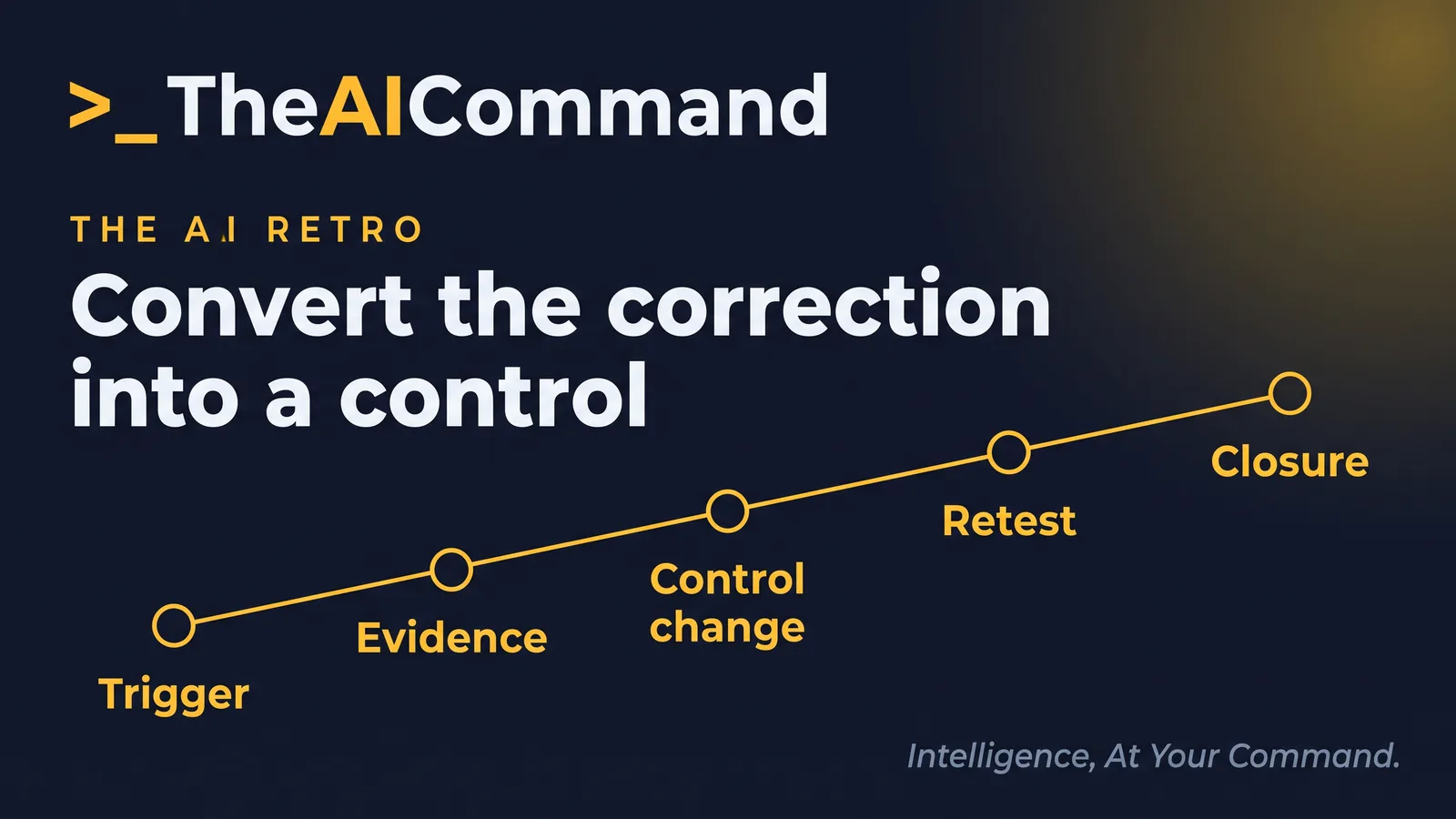
Use a six-field control-conversion record. It keeps the meeting aimed at changed work rather than an elegant explanation.
- Trigger. State why the retro was opened: incident, near miss or repeated correction. Name the affected workflow and the decision point the output could influence.
- Evidence. Attach approved, de-identified artefacts. Separate what was observed from hypotheses about prompt, source, model, data, interface, workload or human-review causes.
- Control change. Record the specific change to the workflow. "Be more careful" is not a control. A source-version rule, required citation field, authority check, test case or routing change can be.
- Owner. Name the human who has authority and capacity to implement the change. Meeting attendance is not ownership.
- Retest. Define the cases, acceptance criteria, human reviewer and due date before implementation begins.
- Closure. Link the completed change and test evidence. Record the authorised human who accepted the result and any residual issue that remains open.
Choose the control at the weakest point that can reasonably prevent or expose recurrence. If the model used an obsolete procedure because the knowledge source retained both versions, telling reviewers to check dates adds labour but leaves the source weakness intact. Fix the source lifecycle, then retain proportionate output review.
The National AI Centre's implementation guidance calls for records of governance decisions, testing, incidents and monitoring; says reporting near misses and corrective measures is good practice; calls for reassessing risks after controls are implemented; and recommends regular performance review cycles with stakeholders and subject-matter experts (National AI Centre). This is official Australian Government guidance, not legislation.
Safe Work Australia's current guidance says AI and digital-technology risks should be managed through the ordinary WHS risk-management process, including consultation, control, monitoring and review. It says control measures must be modified or replaced if they are not working effectively, and identifies events that require review under the model WHS framework (Safe Work Australia). Safe Work Australia is not a regulator. Check the applicable Commonwealth, state or territory WHS law and local consultation arrangements rather than treating the page as jurisdiction-specific advice.
Use this prompt to organise approved, de-identified retro evidence. The meeting chair and relevant domain expert must review every grouping, source and proposed question before the pack is circulated.
Reconstruct what happened. Compare expected and observed behaviour. Test why the existing control failed to prevent or expose the defect. Select the highest-leverage change within the team's authority, the same boundary work covered in decision rights in AI-enabled teams, then escalate anything outside it.
How do you test whether the control changed the work?
Do not retest only the example that failed. A workflow can pass the repaired case because the team has effectively memorised it. Use a three-case retest:
Set acceptance criteria before the control is changed. That reduces the temptation to call an ambiguous result a pass. Evidence might include source traceability for every material claim, correct separation of dates, successful routing at an authority threshold or zero disclosure of fields outside the approved data boundary. A human domain owner decides whether the criteria are appropriate and whether the evidence supports closure.
Here is a fictional worked example. [RISK_TEAM_NAME] finds that an approved AI assistant has merged occurrence dates and detection dates in three operational-event summaries. Human reviewers corrected each summary before committee use, so no AI system made a risk decision. The repeated repair triggers a retro.
The evidence shows that the source form labels both fields clearly, but the drafting template asks for one "event date". The team changes the template to require separate occurrence, detection and reporting fields, each linked to its source. [CONTROL_OWNER] owns implementation.
The retest uses the original fictional event, an adjacent event where detection occurs a week later and a boundary case where the occurrence date is unknown. The acceptance criteria require the first two cases to keep all supplied dates separate and the third to state "not established" rather than infer a date. [DOMAIN_REVIEWER] checks the source links and accepts the test evidence. The action closes only after the updated template, results and residual limitation are attached to the record.
Use this prompt to draft a retest plan after authorised people have selected the control change. The process owner and domain expert must review the cases and acceptance criteria, execute the test in an approved environment and make the closure decision.
Use this closure checklist:
- the control change exists in the live approved workflow, not only in meeting notes
- the named owner confirms implementation
- reproduction, adjacent and boundary cases were run
- the human reviewer checked results against pre-set acceptance criteria
- failed or ambiguous cases remain open
- closure evidence is linked to the incident, near miss or correction pattern
- affected staff receive the changed instruction without unnecessary personal information
Do this Monday
- Select one pattern. Take one incident, near miss or repeated correction from an approved workflow. Confirm whether formal incident, legal, compliance, privacy, WHS or customer-remediation processes also apply.
- Build the evidence pack. Collect the original output, available sources, human correction and existing control. De-identify it and restrict access to people who need it.
- Run a 30-minute retro. Reconstruct expected and observed behaviour, test possible causes against evidence and select one high-leverage control change within the team's authority.
- Complete all six fields. Record trigger, evidence, control change, owner, retest and closure requirements. Give the action a due date and escalation route.
- Run three cases. Test the reproduction, adjacent and boundary cases against criteria agreed before implementation. Keep the result open if evidence is incomplete.
- Return the lesson to the workflow. Update the approved instruction, template, source set or routing rule. Tell affected staff what changed and schedule any broader control review the evidence requires.
Bottom line
An AI retro earns its place only when the workflow changes. Convert a specific event or pattern into an owned control, then test the original failure, an adjacent case and a boundary case. Keep closure with an authorised human and require evidence that the change reached the live process. Otherwise, the error has been discussed but remains available to become the process.
This article is general information and education only. It is not legal, compliance, financial or professional advice. Obligations vary by organisation and circumstance. Verify current requirements against the primary sources cited and seek advice specific to your situation.
References
- Keiser, N. L. and Arthur, W. Jr., "A meta-analysis of the effectiveness of the after-action review (or debrief) and factors that influence its effectiveness", Journal of Applied Psychology, 106(7), 1007-1032, 2021. https://doi.org/10.1037/apl0000821
- Leblanc, P.-M., Harvey, J.-F. and Rousseau, V., "A meta-analysis of team reflexivity: Antecedents, outcomes, and boundary conditions", Human Resource Management Review, 34(4), 101042, 2024. https://doi.org/10.1016/j.hrmr.2024.101042
- National AI Centre, "Guidance for AI adoption: implementation guidance", live page listing the download as published 5 May 2026; downloadable guidance dated October 2025. https://www.ai.gov.au/staying-safe-and-responsible/essential-ai-practices/guidance-ai-adoption-implementation-guidance
- Safe Work Australia, "Artificial intelligence (AI) and digital technologies - Managing risks", current page accessed 31 July 2026. https://www.safeworkaustralia.gov.au/safety-topic/hazards/digital-technologies-ai/managing-risks
TheAICommand. Intelligence, At Your Command.