
An AI rollout is a consultation event, not an announcement.
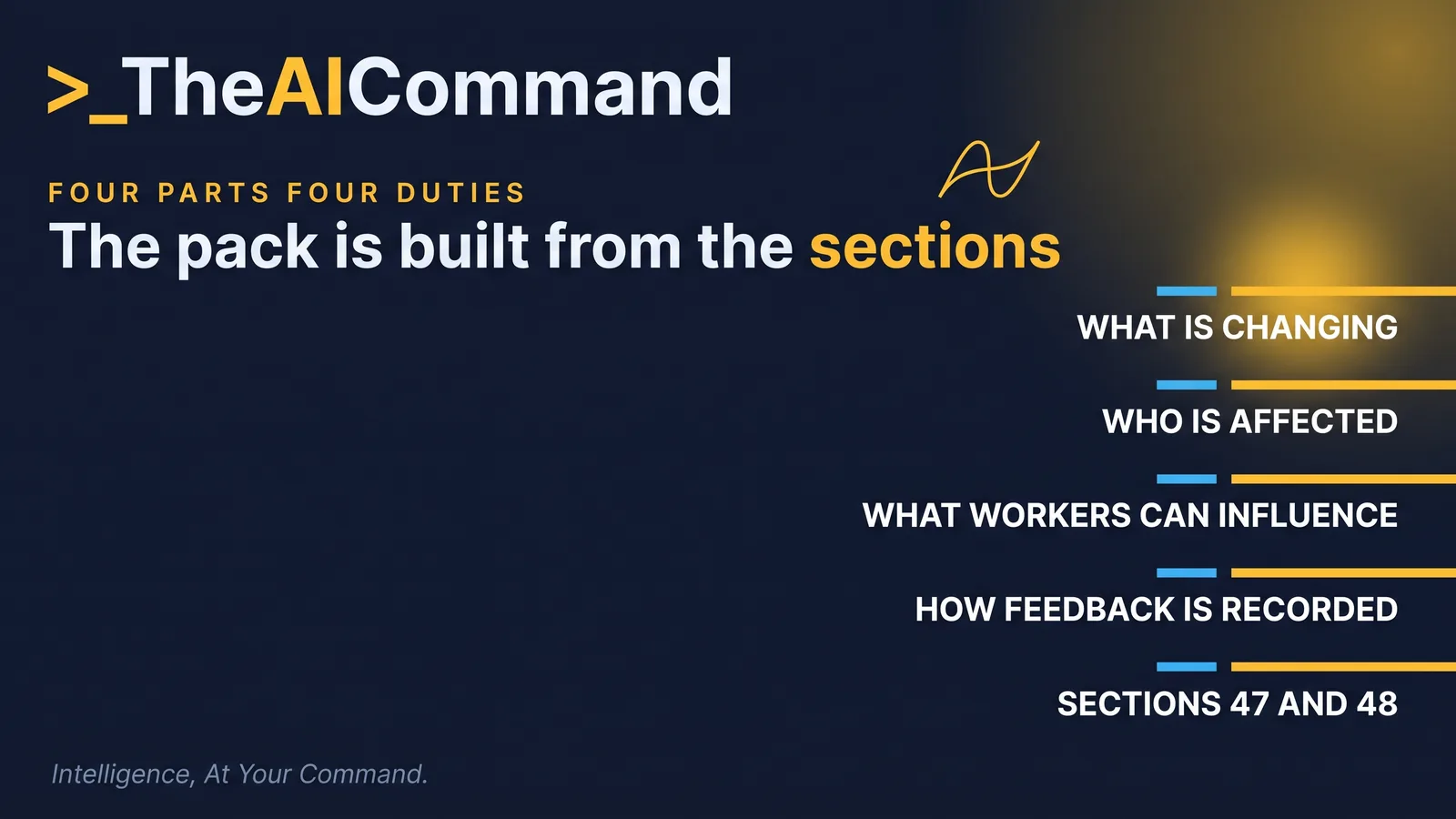
The obligation is specific, and it falls due before the tool arrives. Section 49(d) of the Work Health and Safety Act 2011 (Cth), which reproduces the model provision, requires consultation "when proposing changes that may affect the health or safety of workers". A tool that changes how a team's work is designed, managed and supported is that kind of proposed change. The practitioner consequence is an artefact rather than a meeting: a four part consultation pack, written and issued before the tool lands, covering what is changing, who is affected, what workers can genuinely influence, and how feedback is recorded and answered.
Each of the four parts exists because a limb of section 47 or section 48 requires it. The pack is the record of how each of those limbs is to be answered, arranged in an order a reader can check line by line.
Why is a tool rollout a consultation trigger?
Section 47(1) of the Act requires a person conducting a business or undertaking (PCBU) to "consult ... with workers who carry out work for the business or undertaking who are, or are likely to be, directly affected by a matter relating to work health or safety", so far as is reasonably practicable. Safe Work Australia's model Code of Practice on WHS consultation, cooperation and coordination, July 2023 edition, page last updated 10 August 2023, puts it plainly: "You must consult with workers ... who are (or are likely to be) directly affected by a health and safety matter."
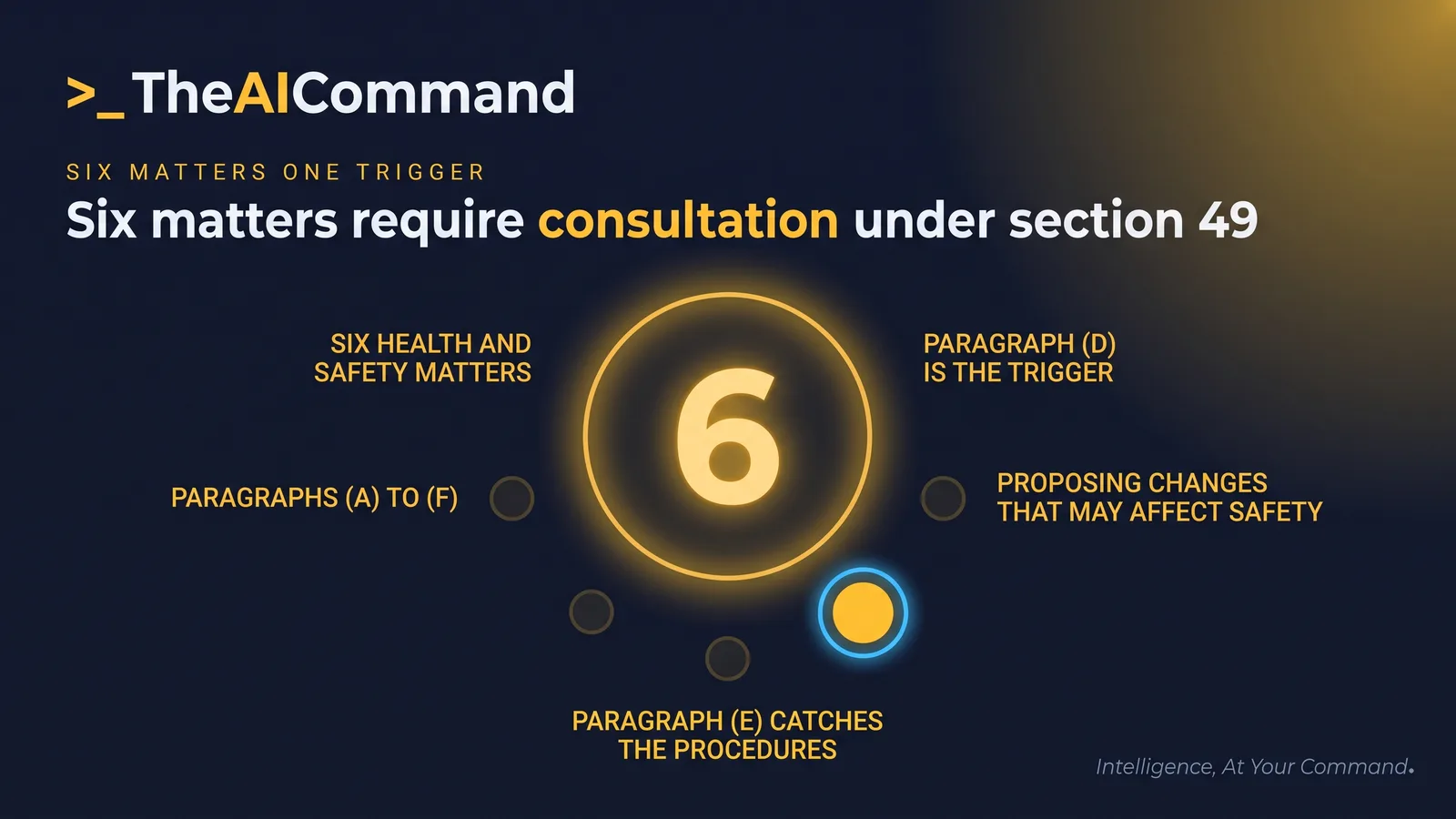
Section 49 then lists the health and safety matters that require consultation. There are six, paragraphs (a) to (f). Paragraph (d) is the one an AI rollout lands on, and paragraph (e) catches the decisions about the procedures that sit around it, including those for "providing information and training for workers".
The bridge from a software decision to a safety duty runs through the Regulations. Regulation 55A of the Work Health and Safety Regulations 2011 (Cth) defines a psychosocial hazard as one that "arises from, or relates to: (i) the design or management of work" and that "may cause psychological harm". Regulation 55C requires a PCBU to "manage psychosocial risks in accordance with Part 3.1". Regulation 55D(2) names what a PCBU must have regard to when choosing control measures, including "the design of work, including job demands and tasks", "the systems of work, including how work is managed, organised and supported", and "the information, training, instruction and supervision provided to workers". The Regulations were checked at Compilation No. 28, 25 March 2025, and the Act at Compilation No. 16, 1 July 2024, both as at 26 September 2026.
Read those three limbs back as a description of an AI rollout: it changes the design of tasks, how work is managed and supported, and the training and supervision workers receive.
Safe Work Australia's model Code of Practice on managing psychosocial hazards at work, published 1 August 2022, closes it. The code itself, which carries a July 2022 cover date, names "Organisational change management that is poorly planned, communicated, supported or managed" as a psychosocial hazard, its first example being "Insufficient consultation, consideration of new hazards or performance impacts when planning for, and implementing, change". The standard is stated on the code's landing page: "Under WHS laws, PCBUs must eliminate or minimise psychosocial risks so far as is reasonably practicable."
Under the psychosocial code, the skipped consultation is itself the hazard the rollout introduced.
What does consultation actually require?
The consultation code is blunt about what does not count. It states that "Consultation does not mean telling your workers about a health and safety decision or action after it has been taken." It states the positive duty just as directly: "You must consult your workers when proposing changes that may affect their work health and safety." Its list of change triggers is broader than the word change suggests, reaching to purchasing new equipment and restructuring the business, and its own worked example is a large information technology company changing its client management system.
Section 48(1) sets out what consultation has to contain, and three of the four parts answer its limbs directly. Part two answers the prior question in section 47(1), which is who has to be consulted at all. The Act requires "that relevant information about the matter is shared with workers"; a reasonable opportunity "to express their views and to raise work health or safety issues" and "to contribute to the decision-making process"; "that the views of workers are taken into account"; and "that the workers consulted are advised of the outcome of the consultation in a timely manner". Section 48(2) adds that "If the workers are represented by a health and safety representative, the consultation must involve that representative."
Where work is shared, section 46 requires each person with a duty to "consult, co-operate and co-ordinate activities with all other persons who have a duty in relation to the same matter", so far as is reasonably practicable. Where contractors or labour hire workers use the tool, the pack goes to the other duty holder too.
Part one: what is changing
This part satisfies section 48(1)(a). It states what the tool does, which tasks it touches, when it arrives, and why the change is being made.
The psychosocial code's control for managing and communicating organisational change is to provide authoritative information about upcoming changes and the options being considered as soon as possible, and to give workers the reasons for the changes. Its hazard list runs the other way, naming information that is insufficient for workers to understand and engage with the change.
That pairing is what separates part one from a reassurance note. A paragraph that reassures without saying which tasks change is the hazard the code describes, circulated. Name [TOOL] by function, name [ROLLOUT_DATE], list the tasks, and say which decisions have not been made yet.
Part two: who is affected
This part satisfies section 47(1) and the code's test of who is directly affected or likely to be. The code is explicit that consultation runs to the workers affected by the matter and does not have to reach every worker in the business.
Write it as roles and tasks, not as a headcount. [ROLE] performs a task, that task changes in a stated way, and that is why [ROLE] is in scope. Then write the exclusions and the reason for each.
Two entries belong here: the health and safety representative (HSR) for [TEAM], written as [HSR], and any other duty holder covered by section 46. The representative is involved in the consultation, which section 48(2) requires, rather than copied on its output. Section 46 is a separate duty between duty holders and sets no order, so issuing the pack to the other duty holder alongside the representative is the practical way to run both.
Part three: what can workers actually influence?
This is the part to write last and check hardest. It satisfies section 48(1)(b)(ii), the reasonable opportunity to contribute, and the same window carries limb 48(1)(b)(i), the opportunity to express views and to raise issues.
Split the part into two lists and keep them visibly separate. The open list holds decisions genuinely still available:
- the sequence of the rollout
- the shape and timing of training
- which tasks stay manual
- what the review trigger is
- what a worker does when the output looks wrong
The closed list holds decisions already made, each with the reason from the rollout plan attached. A closed decision presented with its reason is defensible. A closed decision presented as an invitation is the failure this part exists to prevent.
Being explicit about the closed list does not weaken the pack, because consultation was never a consent mechanism. The Fair Work Ombudsman's best practice guide on consultation and cooperation in the workplace states that "Employers who take a consultative and cooperative approach still have the right to make the final decision on how to manage their business". The Ombudsman also describes the second duty layer, the consultation clause in the applicable award or enterprise agreement, which generally requires consultation "where an employer has decided to introduce major changes in production, programming, organisation, structure or technology that are likely to significantly affect employees". A tool rollout can satisfy that description, and the clause runs on its own timing. The description is current as at 26 September 2026, and the page records its content as last updated on 6 May 2026.
One objection deserves an answer: workers cannot comment usefully on a tool they have never used. The National AI Centre's Guidance for AI adoption: implementation guidance, which carries an October 2025 publication date on its cover, answers it in practice 2.1.8 by asking organisations to equip stakeholders with the skills and tools necessary to give meaningful feedback. A demonstration before the window opens is part of the consultation. The guidance is voluntary and sits alongside the WHS duty rather than replacing it.
Part four: how feedback is recorded and answered
This part satisfies section 48(1)(c) and (d). It names [FEEDBACK_CHANNEL], names who reads what arrives, states the date by which the decisions are written, and states how the outcome reaches the people who raised the issues, which is what limb (d) requires.
Frame the records correctly. The consultation code states that "Consultation with workers and with other duty holders does not have to be documented unless specifically required under the WHS Regulations." Records are good practice, not a general legal requirement. Two recommendations still point the same way. The psychosocial code states that "You should record your risk management process and the outcomes, including your consultation with workers." The implementation guidance asks organisations to "Keep clear records of governance decisions, testing, incidents and monitoring."
Close the part with [REVIEW_DATE], a stated point after go live at which the same group is asked what happened to the work.
Three prompts that draft the pack
TheAICommand works to the Verified Draft Method: de-identify the inputs, ground the model in your own source material, keep a person at the decision point, verify against the primary source, and log what happened.
The worked example is a leader of [TEAM] who has been told [TOOL] arrives in six weeks, and who holds two documents already: the rollout plan and the current role descriptions. The leader writes the decisions and signs the pack.
Three things happen before prompt one.
- Replace every personal name in both documents with the role title, so the inputs are de-identified rather than redacted after upload.
- Where no written rollout plan exists, request one from the person who owns the tool, because a pack drafted from an unwritten plan has no source line to check.
- Run prompts one and two in one conversation so the table stays available, then run prompt three in a fresh conversation with the completed pack attached, so the check tests the document and not the assistant's memory of drafting it.
What to check: open the rollout plan beside the table and confirm every source line is real and appears where the row says it does, allowing for the replaced names. Then check the silence. Every cell reading "Not stated in the documents" must be genuinely absent from the plan, because a quietly filled gap becomes a claim the leader must stand behind. Two rows of a passing table look like this, the second a task whose change the documents do not state.
What to check: read list (a) against the plan and delete anything already decided there, because a closed decision dressed as an open one is the failure part three exists to prevent. Then read list (b) and confirm each reason is the plan's, not a plausible reason the assistant supplied. A passing part three reads: open, the rollout sequence; open, what a worker does when the output looks wrong; closed, [TOOL] itself, carrying the plan's own words, "[TOOL] is the approved tool for [TEAM] from [ROLLOUT_DATE]." Finally, ask whether part one tells a worker which of their tasks change. If it only tells them the change will be supported, it has been softened into the hazard.
What to check: the answer has to be a sentence lifted from the pack, not a heading and not a summary. Search the pack for each quoted sentence and confirm it appears word for word, because a quote that is not there is the invention failure mode and the limb it claims to satisfy is still open. Limbs (c) and (d) are answered on the face of the pack by the commitments it makes, and are discharged only when the views are actually taken into account and the outcome advised. Any limb answered "No sentence in the pack satisfies this" is a real gap to close before the pack goes anywhere, and so is the representative question.
Where does the assistant get this wrong?
Four failure modes are worth checking for, each visible in the draft.
- Invention. The assistant adds a benefit the rollout plan never claimed. The source line column is the test.
- The false open list. Asked for decisions workers can influence, an assistant lists decisions the plan records as settled.
- Softening. Part one drifts from what changes into how well the change will be supported, which is the hazard named in part one above.
- The missing representative. Where an HSR exists, section 48(2) requires the consultation to involve that representative, and a pack issued to the team without that involvement does not satisfy the section.
The sequence, and why the pack goes first
The order is the argument. A pack issued after the tool arrives documents an announcement, whatever its contents say. Where the rollout has already been announced, the pack is still written, and part three carries only the decisions genuinely still open, with the closed list stating plainly that the decision to proceed was among them.
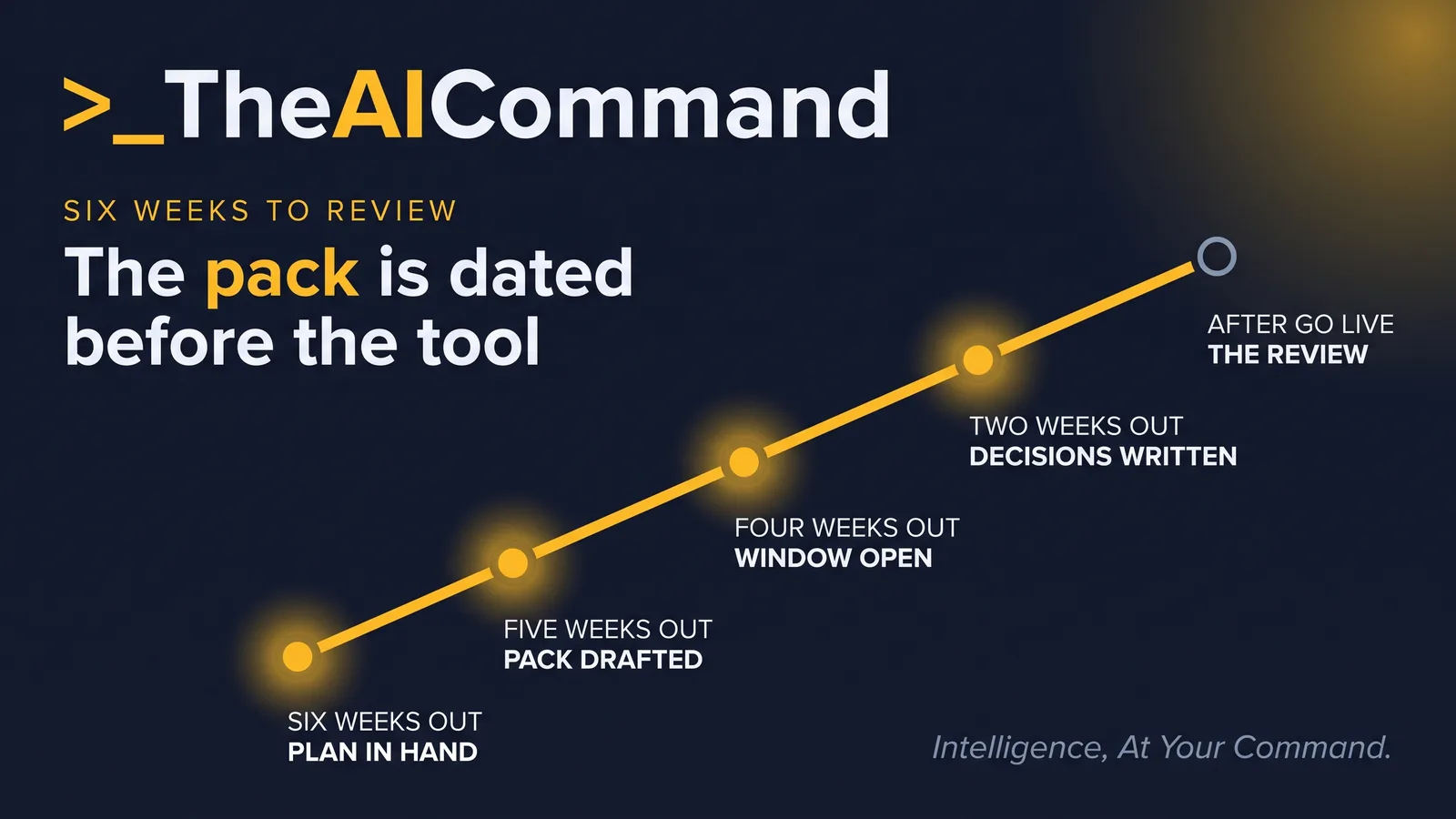
In the worked example the sequence runs like this.
- Six weeks out, the two source documents exist.
- Five weeks out, the pack is drafted and [HSR] is involved.
- Four weeks out, the window opens and [TEAM] has the pack and a demonstration.
- Two weeks out, the decisions are written and the outcome is advised.
- After go live, [REVIEW_DATE] asks what changed in the work.
The Act sets no interval, only that outcomes are advised in a timely manner.
Does the duty reach your jurisdiction?
Safe Work Australia's model WHS laws page records that "The model laws have been implemented in all jurisdictions except Victoria", and that "To become legally binding the Commonwealth, states and territories must separately implement them as their own laws." That is the position as at 26 September 2026. Enforcement sits with the regulator in each jurisdiction that implements the laws.
Victoria did not adopt the model laws, and the duty there is materially similar. WorkSafe Victoria's summary of the Occupational Health and Safety Act 2004 (Vic), reviewed 13 March 2025, describes section 35 as requiring that "Employers must, so far as is reasonably practicable, consult with employees on certain matters related to health or safety that directly affect, or are likely to directly affect them." That is the regulator's summary rather than the section text, and it is enough to tell a Victorian leader the pack is worth writing.
Do this Monday
- The artefact is the four part consultation pack, one page, for a single named tool and a single named team.
- The owner is the leader accountable for the work and the workers, not the project manager who owns the tool. The duty under section 47(1) sits with the PCBU; the pack sits with the leader.
- The first step fits inside an hour. Replace every personal name in the rollout plan and the role descriptions with the role title, then run prompt one on both. Where no written rollout plan exists, request one first.
- The check on that hour is the table. Every row carries a source line that can be found where the row says it is, and every cell reading "Not stated in the documents" is genuinely silent in both documents.
- The check on the finished pack, before it is issued, is sections 47(1) and 48. Part two names the roles directly affected and why, each limb is answered by pointing at a sentence rather than a heading, and where a health and safety representative exists, that representative has been involved in the consultation.
The bottom line
A tool that changes how work is designed, managed and supported is a proposed change that may affect health or safety, which is the matter in section 49(d), and the model Code of Practice states that consultation is not telling workers after the decision is taken. The four part pack answers sections 47(1) and 48(1) in a form somebody else can check. What the assistant cannot do is decide what stays open, which is the decision the leader signs. Draft with the model. Sign the decisions yourself.
TheAICommand. Intelligence, At Your Command.