
What did the government just make mandatory?
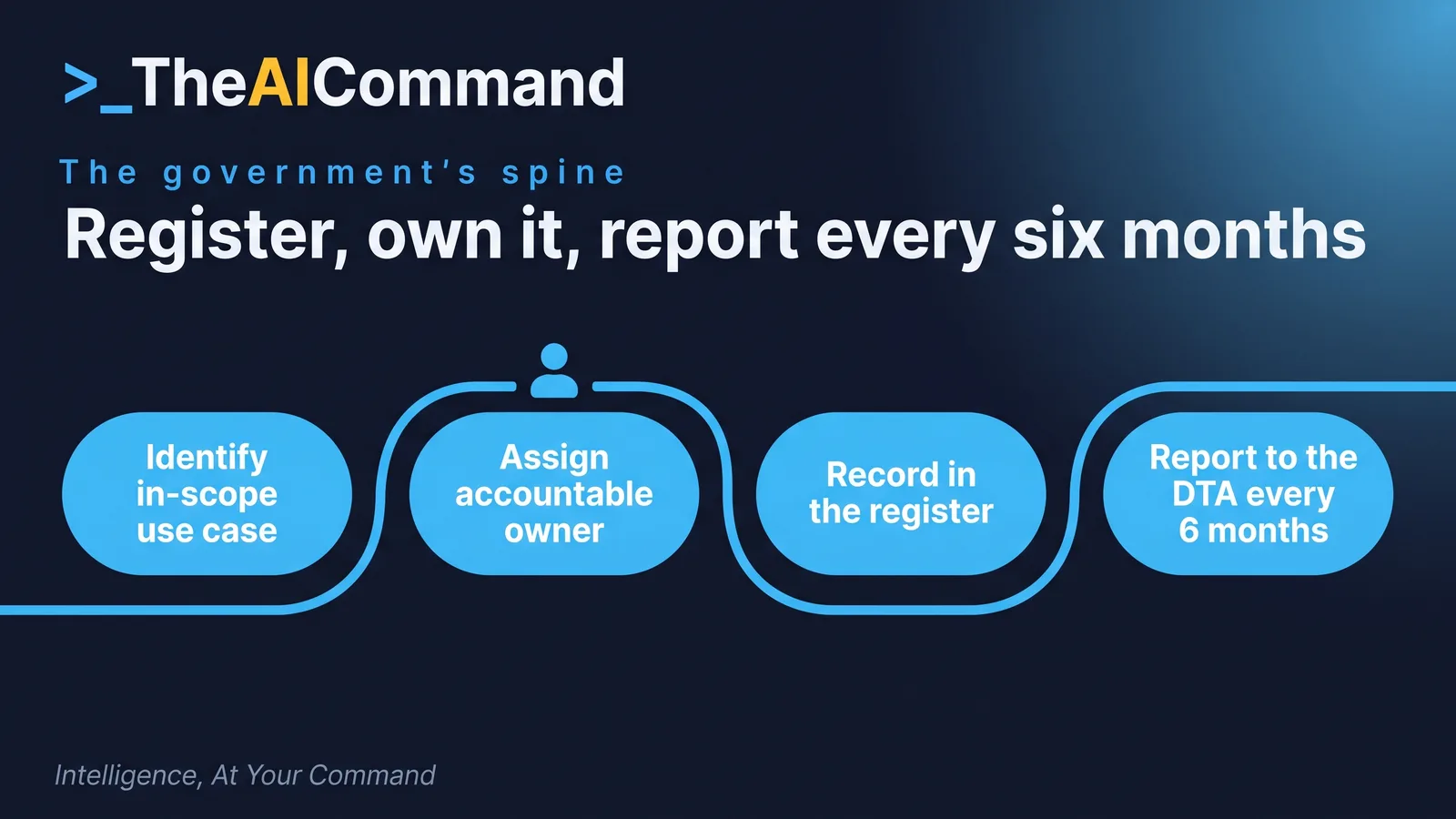
The Australian Government has made an internal AI use-case register mandatory for its own agencies, with a named accountable owner for every in-scope use case and a report to the Digital Transformation Agency every six months. Private-sector governance, risk and compliance (GRC) teams cannot copy the obligation wholesale, but the government's field set, ownership split and reporting cadence are a working template worth studying before the next review cycle.
The mechanism is version 2.0 of the Digital Transformation Agency's (DTA) Policy for the responsible use of AI in government, which took effect on 15 December 2025. The policy phases in its obligations. The first new mandatory requirement took effect on 15 June 2026: a strategic position on AI adoption, developed and communicated to staff. The remaining requirements, including the internal register, mandatory staff training on responsible AI use and AI use-case impact assessments, come into effect in December 2026, and agencies have until 15 December 2026 to fully implement them.
The register sits inside that timeline. Under the policy's Standard for accountability, each agency must designate one or more accountable officials, and every AI use case that is in scope of the policy must have a designated accountable use case owner recorded in an internal register. The register must be created within 12 months of the policy taking effect, and it must be shared with the DTA every six months. The government has now signed itself up to the register discipline it has spent two years telling everyone else to consider. That is what makes it worth reading closely.
Why a public-sector mandate matters to a private-sector team
This is a government policy binding non-corporate Commonwealth entities, with some exceptions. It does not bind a bank, an insurer or a superannuation trustee, and nobody at the DTA will ask a private company for its register. So why should a private-sector GRC team care?
Because the hard part of building an AI register is not deciding to build one. It is deciding what a minimum viable entry actually contains, who owns it, and how often it moves. Most private-sector guidance answers those questions in the abstract. The government has just answered them concretely, in a document it has to live by, for real use cases across the Australian Public Service. That is a rare thing: a fully specified, in-force reference implementation you can inspect for free.
The timing is also useful. APRA-regulated entities have just passed the 1 July 2026 material-service-provider deadline under CPS 230, and APRA's 30 April 2026 letter to industry set minimum expectations that include an inventory of AI tooling and AI use cases, and ownership and accountability across the AI lifecycle. A GRC team refining an AI use-case register that a board can actually use is answering the same design questions the DTA has already published answers to. Studying the government template is not about compliance. It is about not reinventing a field set someone else has already stress-tested.
The site has covered the private-sector register from the board-evidence angle. This piece is deliberately narrower: it decodes the government mandate itself, so a private team can lift what transfers and adapt what does not.
What the government register actually requires
The most instructive part of the mandate is how precisely it defines the floor, and how deliberately it separates two roles.
The Standard for accountability sets a defined minimum field set for each in-scope entry. Two fields do the descriptive work:
- A description. What the AI does, its business objective, and, where relevant, the name of the underpinning product. This is the plain-language answer to "what is this and why do we run it".
- The AI technology type. One or more of generative AI, machine learning, natural language processing or computer vision.
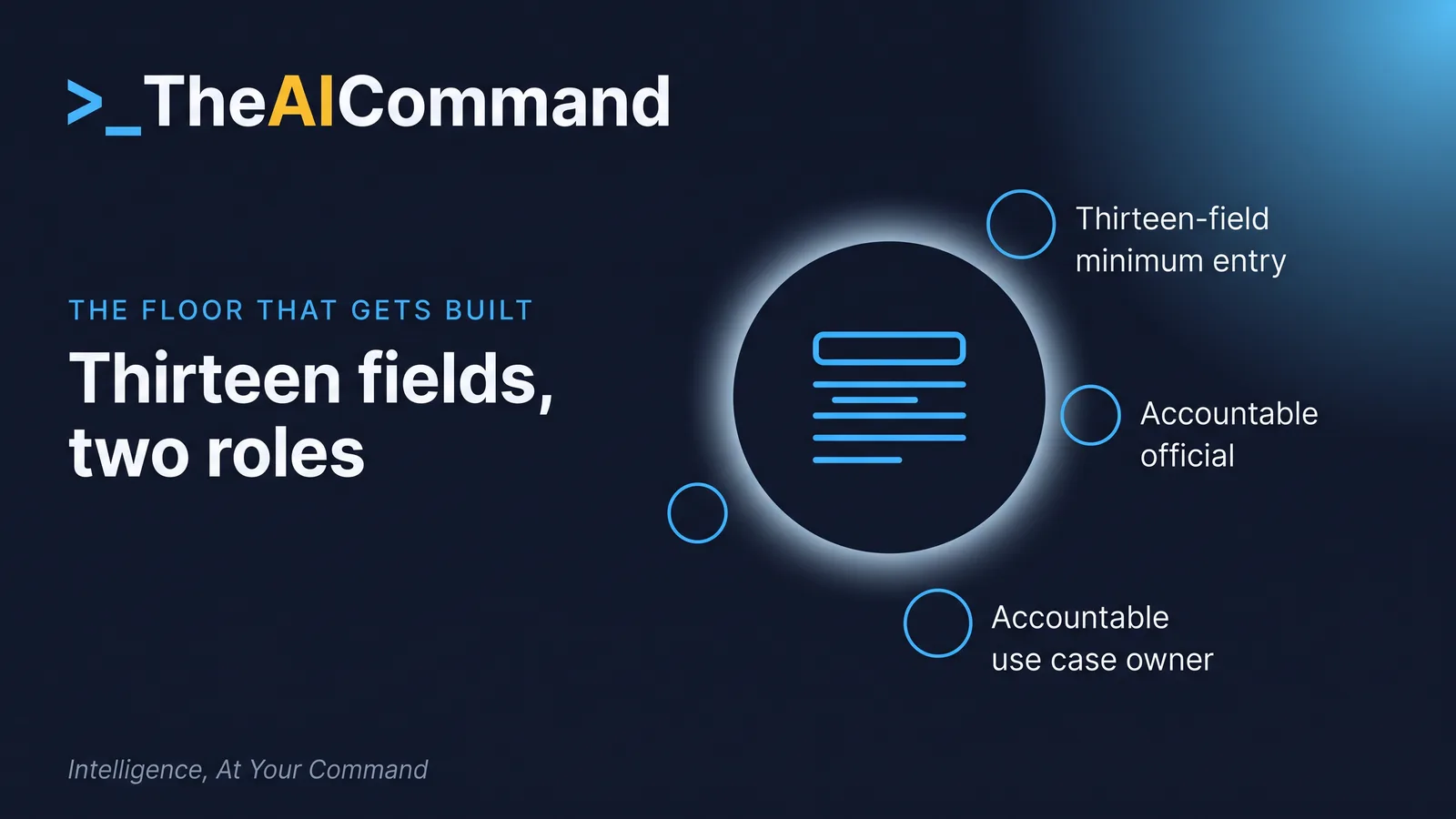
The full minimum runs to thirteen fields, adding a use case name, an agency identifier, the lifecycle stage, whether the government's AI technical standard has been applied, the domain and usage pattern, the accountable use case owner's name and email, the scope criteria the use case met, and inherent and residual risk ratings from the impact assessment. High-risk use cases also record review dates. That is a deliberate design choice: every field answers a governance question a board or the DTA will actually ask, and none is decorative. For any GRC team that has watched a governance spreadsheet die of its own ambition, a bounded field set with a clear purpose per field is the most useful idea in the mandate.
The second design choice is the split between two roles. The policy separates the accountable official, a senior officer accountable for implementing the policy across the agency, from the accountable use case owner, the person accountable for a specific use case. Accountable officials must implement the policy, act as the contact point for whole-of-government coordination, respond to DTA requests for information, and notify the DTA whenever the agency identifies a new high-risk use case. Accountable use case owners must ensure their use case is registered and apply the actions required by the impact-assessment process.
That split matters because it prevents the two failure modes of a single owner. One official owning every use case cannot credibly stand behind any of them. A use case with no named person above it has no escalation path. The mandate names both layers, and a private register that only names one is missing half the structure.
Around the register sit the other phased obligations: a mandatory AI use-case impact assessment before deployment, a strategic position on AI adoption that agencies must communicate to staff, and published AI transparency statements collected in a central register. Alongside the policy, the government has established a whole-of-government AI Review Committee to give agencies expert scrutiny and risk-based advice on AI proposals. The register is the spine that connects them. Every other obligation attaches to an entry in it.
What transfers, and what a private team has to adapt
Not everything in a government mandate survives contact with a private balance sheet. The value is in separating the two.
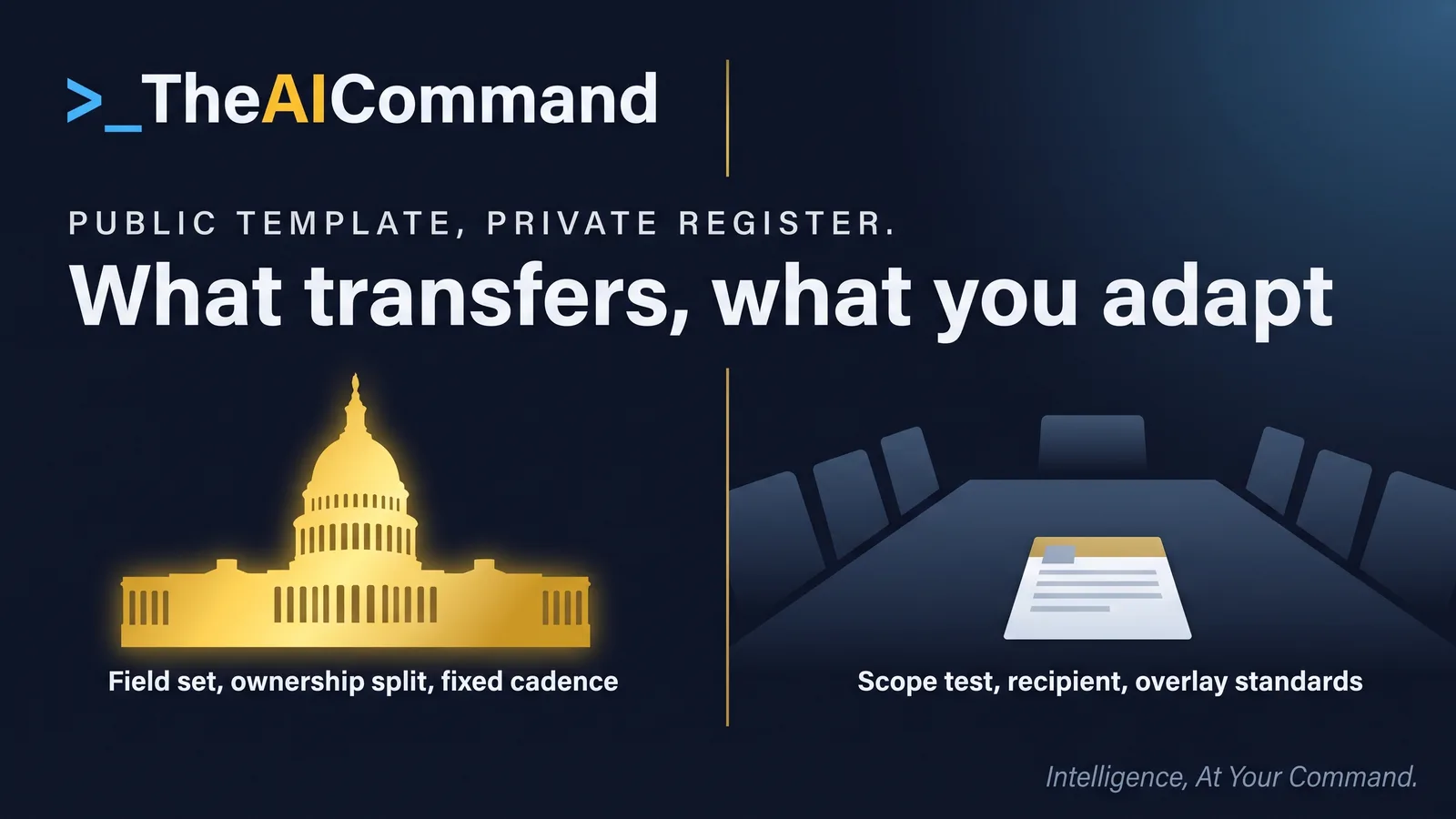
What transfers almost unchanged:
- The minimum field set as a starting floor, enriched with the control and review fields a board needs.
- The two-layer ownership split: a senior accountable official for the whole register, a named accountable owner for each use case.
- The idea that registration is a gate. In the government model, an in-scope use case that is not registered with the accountable official is not properly governed. A private register can adopt the same rule.
- A fixed reporting cadence. The DTA's six-monthly rhythm turns the register from a document that decays into a process that recurs.
What a private team has to adapt:
- The scope test. The government defines in-scope AI use cases against public-sector criteria. A private team must draw its own materiality line, usually against customer impact, regulatory exposure and the risk categories its board already uses.
- The recipient. There is no external DTA for a private register. The six-monthly report goes to a board or risk committee, not a central agency. The cadence is the transferable part, not the destination.
- The overlay standards. A government register answers to the DTA policy. A private register answers to CPS 230, the Financial Accountability Regime, the Voluntary AI Safety Standard and, for regulated decisions, sector rules. The government field set is a floor to build on, not a ceiling.
On cadence specifically, the comparison with APRA is worth drawing carefully. The DTA sets a fixed six-monthly report to a central agency. CPS 230 requires regulated entities to maintain registers and manage operational risk, and to notify APRA of material operational risk incidents, but it does not prescribe a fixed six-monthly submission of an AI register. The lesson a private team should take is the discipline of a set cadence, not the specific six-month interval. A board that reviews the AI register on a fixed rhythm, whatever the interval, is doing what the government has now made itself do.
Copy-paste prompts
Use these with a workspace AI on a de-identified inventory. Never paste live vendor contracts, personal information or security detail into a general model.
Do this Monday
- Pull the government reference. Read the Standard for accountability and note the minimum field set and the accountable-official versus accountable-owner split. This is your benchmark.
- Locate your own register. Find where your AI inventory actually lives today. If it is three spreadsheets and a shared inbox, that is your real starting point, not the policy in the drawer.
- Test your floor. Check that every entry has at least a plain description and a technology type. If entries are missing even that, fix the floor before adding fields.
- Name two layers, not one. Confirm there is a single senior owner for the whole register and a named owner for each use case. Fill any gap this week.
- Set a cadence and a recipient. Decide how often the register goes to your board or risk committee, and put the next two dates in the calendar now.
- Draw your scope line. Write one paragraph defining what counts as an in-scope AI use case for your organisation, tied to customer and regulatory impact.
- Map the overlays. For each material use case, note which standard it answers to (CPS 230, FAR, sector rules) so the register connects to obligations rather than sitting beside them.
Register readiness checklist
- Every in-scope use case has at least a description and a technology type.
- Every use case has a named accountable owner who is a real, current person.
- One senior officer is accountable for the register as a whole.
- Registration is a gate: an unregistered in-scope use case is treated as ungoverned.
- The materiality test for "in scope" is written down and applied consistently.
- A fixed review cadence is set, with the next two review dates scheduled.
- Each entry links to the standard or obligation it answers to.
- High-risk or high-impact use cases carry an impact assessment, not just a register line.
- The register is stored where the board can actually see it, not buried in a team drive.
A worked example
Picture a mid-sized mutual, an APRA-regulated entity with no public-sector obligations at all, using the government mandate as a checklist rather than a rule.
Its GRC lead pulled the DTA Standard for accountability and compared it against the mutual's existing AI inventory, a spreadsheet with eleven entries. Two problems surfaced immediately. Four entries had no technology type recorded, so nobody could say whether they were generative AI or a much older machine-learning model with a different risk profile. And three entries listed a team as the owner rather than a person, which meant no individual could be asked to stand behind them at a risk committee.
The lead did not adopt the government's scope test, which is built for the public service. Instead the mutual kept its own materiality line, drawn against member impact and regulatory exposure. But it borrowed three things directly: the description and technology-type fields as the non-negotiable core of every entry, the accountable-official-plus-owner split, and a fixed reporting rhythm to the risk committee. The register was reported to the committee on a set cadence rather than whenever someone remembered.
No member data, no vendor contract and no security detail ever went near an AI tool during the exercise. The de-identified inventory was enough to scaffold the structure, and the human GRC lead made every ownership and materiality call. The government supplied the template. The mutual supplied the judgement.
Bottom line
The DTA's mandate makes an internal AI use-case register compulsory for the Australian Government's own agencies, with a named accountable owner for every in-scope use case and a report to a central agency every six months. A private-sector GRC team cannot inherit the obligation, but it can inherit the design: a bounded field set where every field earns its place, a two-layer ownership split that closes both failure modes, and a fixed cadence that keeps the register alive. Read it as a preview of what a minimum viable AI register looks like when a large, risk-averse organisation is forced to build one for real, then adapt it to the standards your own board answers to.
Do this Monday:
- Read the DTA Standard for accountability and note the minimum field set and the ownership split.
- Check that every entry in your own register has at least a description and a technology type.
- Confirm one senior owner for the register and a named owner for each use case.
- Set a fixed review cadence and schedule the next two dates.
- Write down your in-scope materiality test and map each material use case to the standard it answers to.
Content disclaimer: This article is for general educational and informational purposes only. It does not constitute legal advice, regulatory guidance, or a substitute for professional compliance judgement. The DTA's Policy for the responsible use of AI in government binds Commonwealth entities and is referenced here as a template, not as an obligation on private organisations. Regulatory obligations vary by entity type, licence and circumstance. Always refer to primary source guidance from the DTA, APRA, ASIC or the relevant authority.
TheAICommand. Intelligence, At Your Command.