
What did APRA change on 16 June 2026, and why does it matter for AI oversight?
APRA's draft CPS 510, released for consultation on 16 June 2026, consolidates five governance standards into one and removes duplicative fit-and-proper reporting for roughly 6,000 individuals, which hands board and executive time back from process paperwork. Read next to APRA's 30 April 2026 letter to industry on artificial intelligence, which named weak board AI literacy and gaps in AI lifecycle management as live findings, the freed capacity has an obvious destination. This piece treats the two announcements as one agenda item: process simplification that creates room, and a named oversight gap that should fill it.
On 16 June 2026, APRA commenced the next phase of its push to strengthen and streamline governance requirements, releasing an updated draft of Prudential Standard CPS 510 Governance for a further round of consultation. The draft does two things at once. It raises the bar on how boards are structured and how they demonstrate their own effectiveness, and it strips out reporting that had become duplicative. The net effect on a board's calendar is a reduction in low-value compliance activity, not an increase.
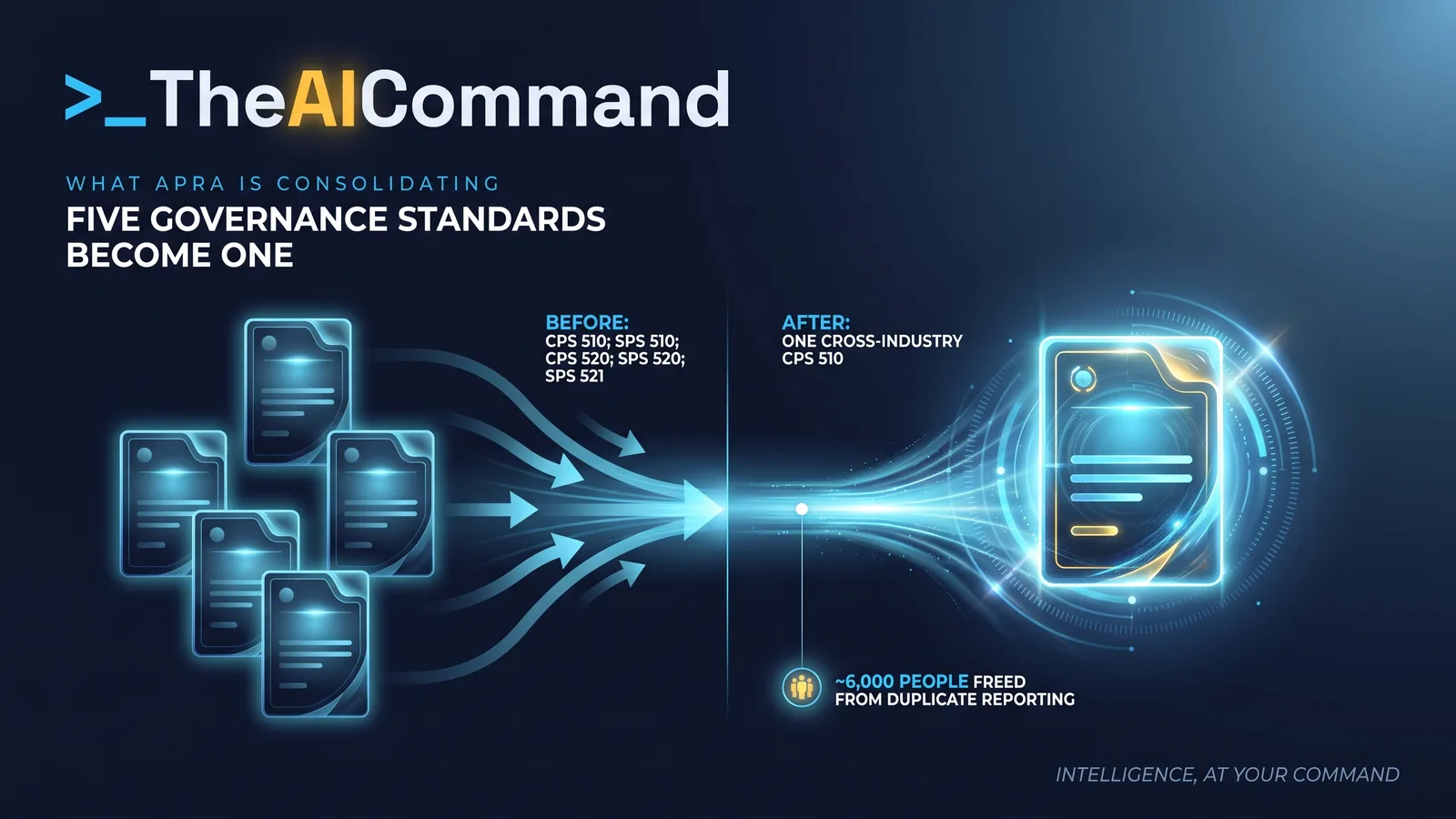
The consolidation is the headline. Draft CPS 510 brings five existing standards into a single cross-industry standard: CPS 510 and SPS 510 Governance, CPS 520 and SPS 520 Fit and Proper, and SPS 521 Conflicts of Interest. In place of separate banking, insurance and superannuation instruments with overlapping requirements, boards get one set of consistent governance minimums. APRA also proposes to end routine fit-and-proper reporting that had become redundant under the Financial Accountability Regime, removing forms covering roughly 6,000 individuals. That is attestation and form-filling that will no longer sit between a board and its actual work that will no longer sit between a board and its actual work.
The reforms tighten board effectiveness at the same time
Simplification is only half the story, and the other half is where the AI connection sharpens. The same draft raises expectations on how a board proves it functions well.
- Director tenure gains a default hard limit of 12 years for non-executive directors, supported by explicit renewal and succession planning. APRA moved the limit up from an earlier, tighter proposal to better fit existing board cycles, and the count captures total time served, including non-consecutive terms and time at predecessor entities. Boards may approve an extension of up to 12 months in exceptional circumstances and must notify APRA.
- Independence is assessed more carefully. APRA intends to remove the presumption of independence for a director who also sits on a related group board, so groups can no longer assume a shared director is independent by default.
- Boards must maintain a documented skills matrix, evaluate their capabilities against it, and actively address gaps. APRA does not prescribe which skills are required, which leaves each board to decide whether AI and technology risk literacy belong on that matrix.
- Performance assessment is strengthened. Boards, committees and individual directors face stronger annual assessment, and significant financial institutions must commission an independent external review of board performance at least every three years.
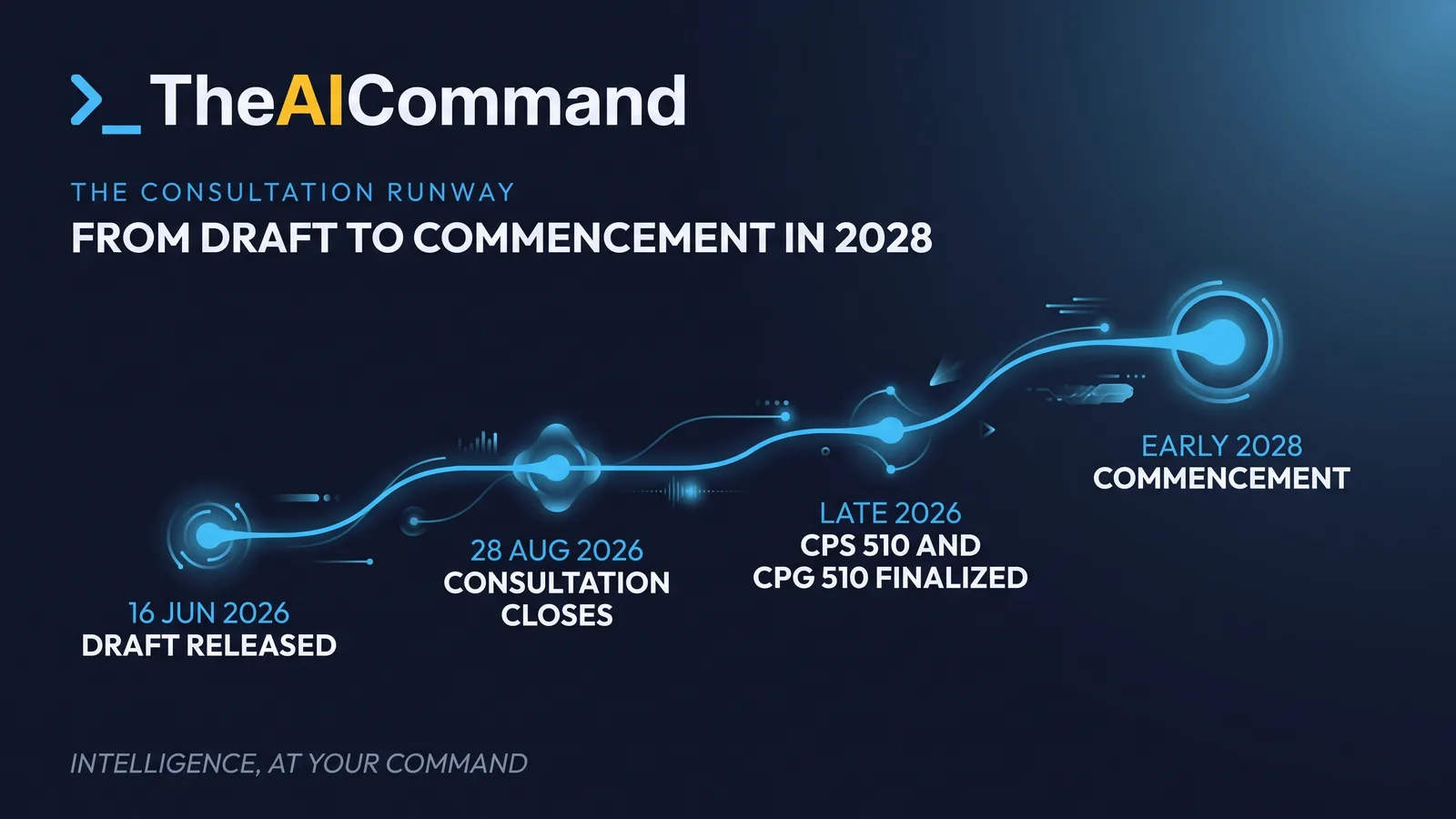
Consultation on the draft is open until 28 August 2026. APRA expects to finalise CPS 510 and a unified practice guide, CPG 510 Governance, in late 2026, with commencement expected from early 2028. That timeline matters for sequencing, because it sits just past the CPS 230 material service provider deadline of 1 July 2026, which has already forced AI vendor arrangements into the open. A board that spent the first half of 2026 mapping critical operations and material service providers now has a governance rewrite to respond to, and a window before 2028 to build the oversight muscle the new standard will test.
The second signal: APRA's April AI letter named the gap
In the weeks before the CPS 510 draft, APRA sent a different message. Its 30 April 2026 letter to industry on artificial intelligence called for a step-change in how banks, insurers and superannuation trustees manage AI risk, and it was specific about what is missing at the top of the organisation.
APRA observed that many boards are still developing the technical literacy needed to provide effective challenge on AI risk. It flagged an overreliance on vendor presentations and summaries, without enough independent examination of issues such as unpredictable model behaviour and the impact on critical operations. It expects entities to maintain an inventory of AI tooling and AI use cases, with clear ownership and accountability across the AI lifecycle, and it named weak post-deployment monitoring, weak model behaviour monitoring, change management and decommissioning as recurring gaps across the AI lifecycle. The letter set expectations across four areas: information security practices, governance maturity, supplier risk management, and change management and assurance.
None of this is new to readers who followed APRA's earlier signals on board AI literacy as a control expectation and its model risk thematic review. What the April letter added was bluntness: the gap is at the board, not only in the model risk team, and it will not close through a vendor deck.
Reading the two together, honestly
It would overstate the evidence to claim APRA designed CPS 510 to make room for AI oversight. APRA has not said that, and the governance review has been under way since APRA's March 2025 discussion paper. The honest reading is narrower and more useful. In the same quarter, one regulator has reduced the process burden on boards and named an oversight gap those boards are best placed to fill. The connection is not APRA's stated intent; it is a scheduling opportunity a GRC team can act on.
The link becomes concrete through the new performance review. If a significant financial institution must commission an independent external assessment of board performance every three years, that assessment is the natural place to ask whether the board can genuinely challenge AI risk. The April letter supplies the test questions. Can directors interrogate a model risk report without relying on the vendor's own summary? Does the board know which AI systems touch critical operations, and who owns each one across its lifecycle? Turning the April letter's concerns into criteria for the triennial review converts a soft literacy worry into an evidenced control, which is exactly the kind of evidence APRA looks for.
What board AI oversight actually looks like on the agenda
Freed capacity only helps if it lands somewhere specific. A board agenda item that demonstrates AI oversight is not a standing "AI update" slot filled by whoever built the tool. It has a defined shape.
- A current inventory of in-scope AI use cases, each with a named accountable owner, mirroring the discipline in an AI use-case register built for board evidence.
- A short list of AI systems that touch critical operations, cross-referenced to the CPS 230 material service provider register, so concentration and single-provider exposure are visible.
- One model risk item presented so directors can challenge it, with the vendor's summary and an independent view side by side, not the summary alone.
- A lifecycle status line for each material AI system: in development, in production, under monitoring, or being decommissioned, with monitoring findings since the last meeting.
- A skills-matrix note recording whether the board has the literacy to challenge the above, and what training or recruitment closes any gap before the next external review.
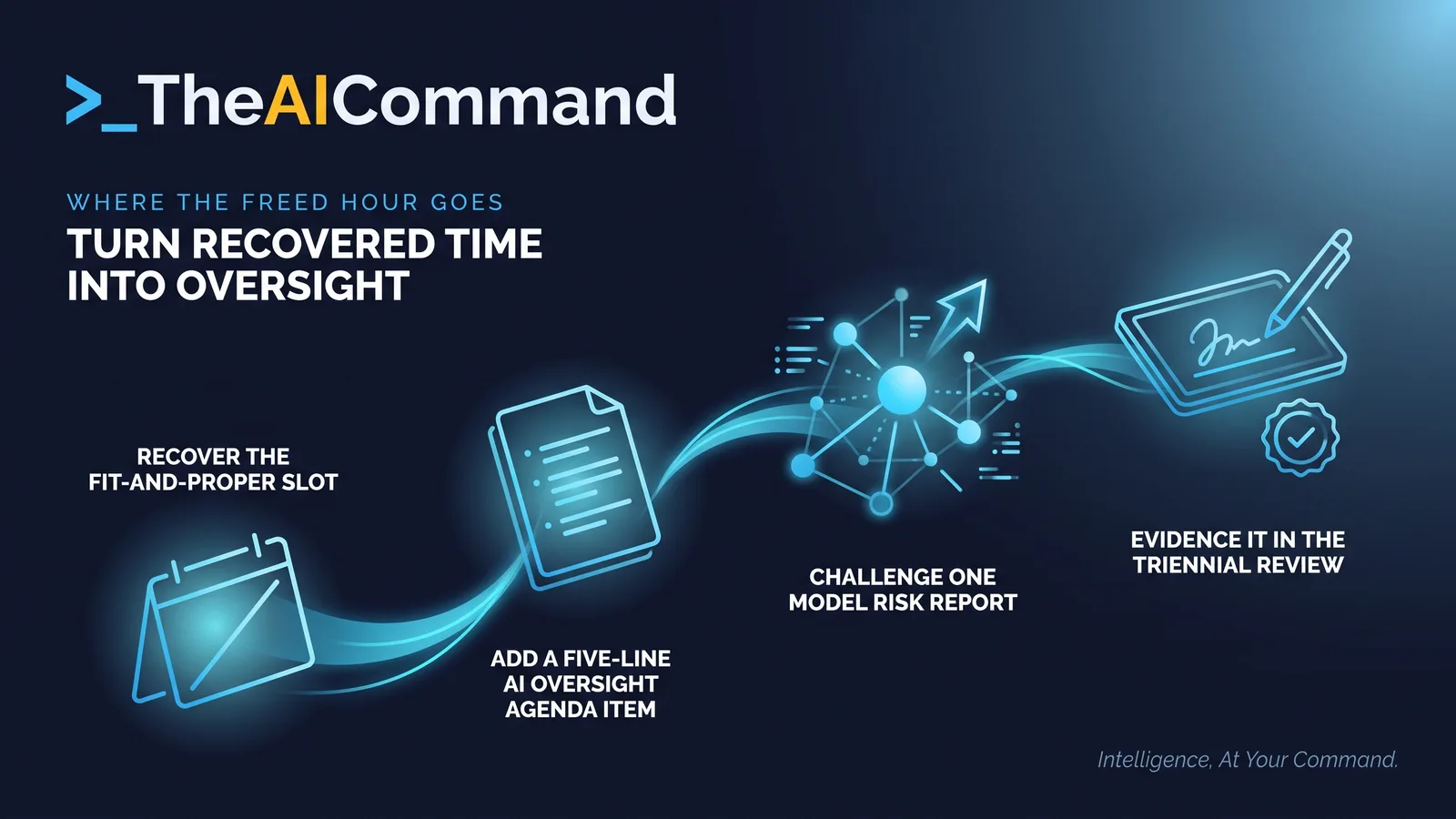
That is five lines on an agenda, not a new committee. It is small enough to fit the hours CPS 510 gives back, and specific enough to answer the gaps the April letter named.
Two prompts to structure the work
These prompts help a GRC team prepare board-ready material from documents it already holds. Run them on your own drafts and registers, never on unverified regulatory claims, and treat every output as a draft for human review. Neither prompt should be used to invent facts, figures or citations.
Do this Monday
- Pull the draft CPS 510 consultation package from the APRA consultation page and note which of the five consolidated standards currently drive board reporting in your entity.
- List the fit-and-proper and governance reporting your board and executives complete today, and mark which items become redundant once CPS 510 removes the FAR-duplicative forms. That list is the capacity you are recovering.
- Add one line to the next board agenda: an AI oversight item with the five-part shape above, owned by a named executive, not by the vendor.
- Cross-reference your AI use-case inventory against the CPS 230 material service provider register, and surface any AI system touching critical operations that is not yet on both.
- Draft two or three AI-literacy criteria for the board skills matrix, so the next assessment records whether directors can challenge model risk without leaning on a vendor summary.
- If you are a significant financial institution, brief whoever will run the triennial external board review to include the April letter's gap themes as test questions.
- Diarise a submission to APRA before the 28 August 2026 consultation deadline if the reforms affect how your board evidences AI oversight.
A checklist for the transition window
- We have identified which current board reporting obligations CPS 510 consolidates or removes.
- We have quantified the freed board and executive time, at least roughly, so it is a deliberate reallocation rather than a vacancy.
- Our board agenda carries a defined AI oversight item, not an open-ended AI update.
- Every in-scope AI use case has a named accountable owner across its lifecycle.
- AI systems touching critical operations appear on both the AI register and the CPS 230 material service provider register.
- The board skills matrix names AI and technology risk literacy as an assessed capability.
- The triennial external board review scope includes the ability to challenge AI risk.
- We know our consultation position on draft CPS 510 and whether to make a submission before 28 August 2026.
A worked example
Consider a mid-sized APRA-regulated insurer, de-identified here, whose board meets monthly and whose directors spend a recurring slot each year re-attesting fit-and-proper status through forms that also feed its Financial Accountability Regime obligations. Under the current standards, that attestation is duplicated across instruments. Once CPS 510 removes the routine, FAR-duplicative reporting, the board recovers that slot.
The GRC team treats the recovered time as a budget, not a saving. It proposes one new standing agenda line: an AI oversight item covering the entity's four production AI systems, two of which sit behind a single cloud model provider already flagged on the CPS 230 material service provider register. At the next meeting, the model risk lead presents the pricing model's monitoring results with the vendor summary and an independent review side by side. A director asks why post-deployment drift was not caught earlier, which is exactly the effective challenge APRA's April letter said boards were struggling to provide. The board records the exchange, adds an AI literacy criterion to its skills matrix, and asks that the next triennial external review test whether the board can repeat that challenge without prompting. No individual is named in the board pack, and no regulatory claim is asserted that the team has not verified against APRA's own documents. The freed hour did not disappear into a lighter meeting; it became evidence of oversight.
Bottom line
APRA's draft CPS 510 is a simplification and a tightening at once. It consolidates five governance standards into one, removes duplicative fit-and-proper reporting for around 6,000 individuals, and raises the bar on tenure, independence, skills and board performance review. Separately, APRA's 30 April 2026 AI letter named weak board AI literacy, vendor overreliance and gaps in AI lifecycle management as live findings. The two do not have to be linked by APRA for a GRC team to link them in practice: the reforms give boards back time, and the April letter says where it is needed. The move is to treat the recovered capacity as a deliberate reallocation to evidenced AI oversight, and to build that habit before the new requirements take effect in early 2028.
Content disclaimer: This article is for general educational and informational purposes only. It does not constitute legal advice, regulatory guidance, or a substitute for professional compliance judgement. Regulatory obligations vary by entity type, licence, and circumstance. Draft CPS 510 is in consultation and may change before it is finalised. Always refer to primary source guidance from APRA or the relevant regulatory authority.
TheAICommand. Intelligence, At Your Command.