
Yes, Australian HR teams can use AI in recruitment, but hiring remains a human accountability process: use AI to prepare, organise and draft, and do not let it decide who gets opportunity. AI hiring tools are tempting because recruitment is full of high-volume, text-heavy work. HR teams need to screen applications, summarise resumes, prepare interview questions, compare capabilities and communicate with candidates. Used carefully, AI can reduce administrative load. Used poorly, it can turn a people decision into a poorly documented automation process.
The key question for Australian HR teams is not whether AI can help recruitment. It can. The better question is where AI should support hiring, where it should not decide, and what evidence HR needs to show that the process was fair, private and human-led.
Hiring is a high-trust process
Recruitment involves personal information, career opportunity and organisational reputation. The Fair Work Ombudsman's workplace privacy guide explains that personal information can include names, addresses, phone numbers, emails, photos, bank details, tax file numbers, superannuation details, driver's licence information and academic records. It also identifies sensitive personal information, including health information, religious beliefs, criminal records and trade union membership.
That matters because recruitment data is often richer than people realise. A resume may reveal age, location, education, career breaks, caring responsibilities, visa history, disability adjustments, union activity or health-related gaps. A cover letter may reveal personal circumstances. Interview notes may record subjective assessments. If HR uploads this information into a tool without understanding retention, training use, access controls and third-party processing, the privacy risk is immediate. The same workplace AI privacy trust test HR cannot outsource applies here.
The Australian Privacy Principles require organisations covered by the Privacy Act 1988 to manage personal information openly and transparently, only collect information where reasonably necessary, and take reasonable steps to protect information from misuse, interference, loss and unauthorised access. Even where a specific employer falls outside part of the Privacy Act because of size or exemption, the trust standard for recruitment should be higher than the minimum legal threshold.
Where should HR start using AI in hiring?
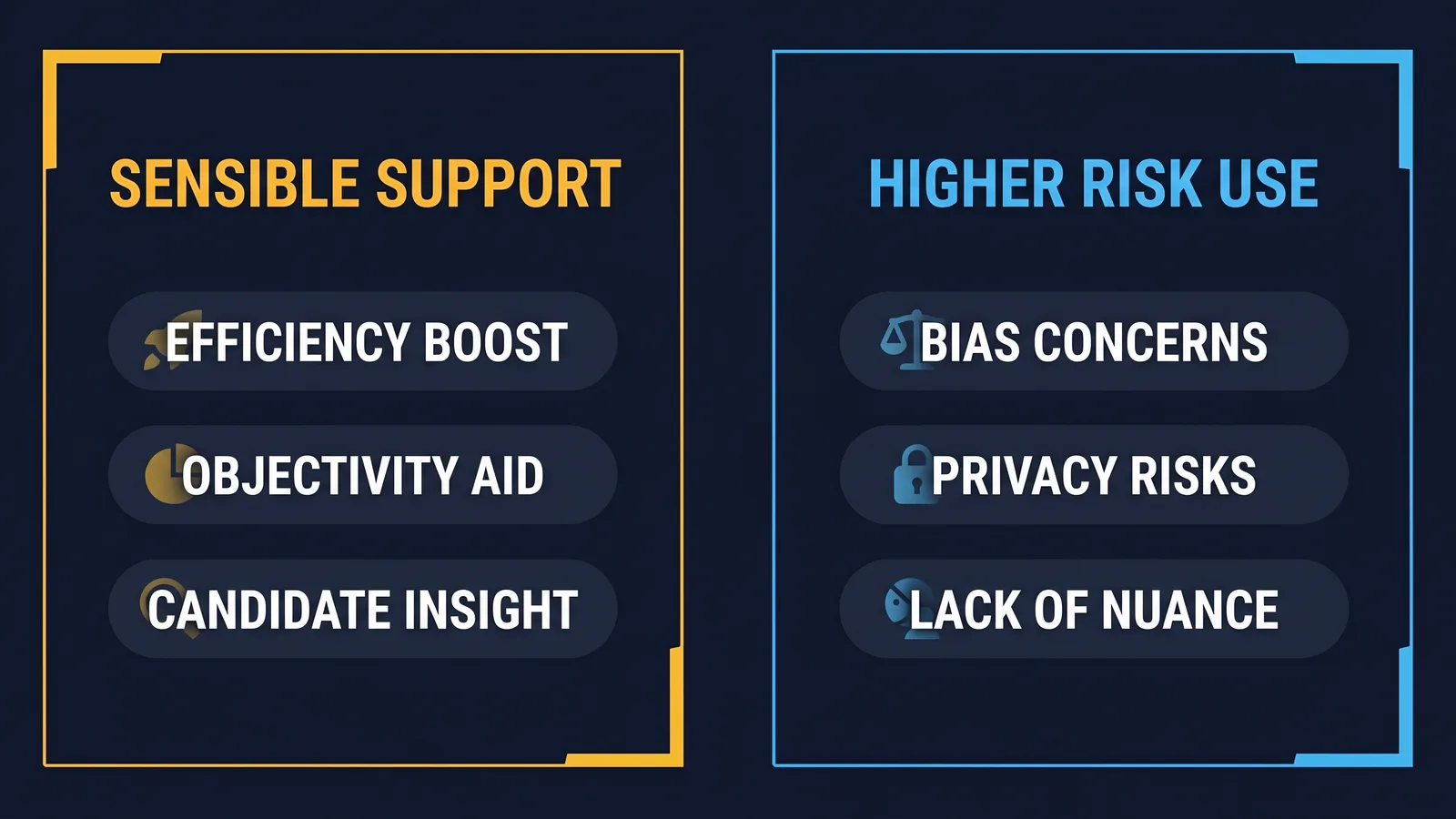
AI is most defensible in recruitment when it supports low-risk administrative work. HR teams can use AI to draft interview guides from an approved position description, convert selection criteria into structured scorecard language, summarise long policy documents for panel members, prepare candidate communication templates and check whether job advertisements use unnecessarily complex language.
These uses still need controls. The safest pattern is to remove personal information before using general-purpose AI tools, keep prompts limited to role content rather than candidate content, and have a human reviewer check all outputs. TheAICommand's standing rule applies here: all AI drafts need human review before use.
The Fair Work Commission's own AI transparency statement provides a useful public benchmark. It states that the Commission will not use generative AI to make decisions under the Fair Work Act 2009 or the Fair Work (Registered Organisations) Act 2009, because those powers can only be exercised by an appropriate human office holder. HR hiring decisions are not the same as tribunal decisions, but the principle is relevant, and it echoes the Fair Work Commission's three rules for AI in a case. AI may assist preparation, search, summarisation and productivity. It should not quietly become the decision-maker.
Is bias in the AI tool or in the whole hiring process?
AI hiring risk is often described as algorithmic bias, but the operational problem is broader. Bias can enter through historical hiring data, vague job criteria, inconsistent panel scoring, over-weighted keywords, unrepresentative training data, inaccessible application processes and untested model outputs. The Australian Human Rights Commission's Human Rights and Technology final report emphasises that new technologies should be consultative, inclusive and accountable, with robust human rights safeguards.
A common mistake is to ask whether the AI tool is biased, as if bias is only inside the vendor model. A better question is whether the whole recruitment process is defensible. The process should start with genuine role requirements, not a recycled wish list. It should use structured criteria, not subjective impressions, and assess the person rather than AI-polished prose. It should make reasonable adjustments available. It should preserve records of human judgement. It should give candidates a meaningful way to ask questions or challenge errors.
These controls also make AI more useful. If the role criteria are vague, the model's output will be vague. If panel scoring is inconsistent, the model may summarise inconsistency as if it were insight. If candidate records are messy, AI can make them look more coherent than they are. Good HR process improves both fairness and AI performance.
Candidate transparency should be practical
Transparency does not mean overwhelming candidates with technical detail. It means telling candidates enough to understand how their information may be used and where humans remain accountable. If AI is used to help draft advertisements or interview questions, that may not require the same notice as using AI to summarise candidate materials. If AI is used in screening or assessment, candidate communication should be clearer.
A practical candidate notice can explain what AI is used for, what it is not used for, whether candidate personal information is processed by a third party, whether AI output is reviewed by humans, and who to contact if a candidate wants to raise a concern. This aligns with the general direction of AI transparency in the public sector, where Commonwealth entities publish transparency statements to build public trust and provide a consistent basis for understanding AI adoption.
What should HR leaders do now?
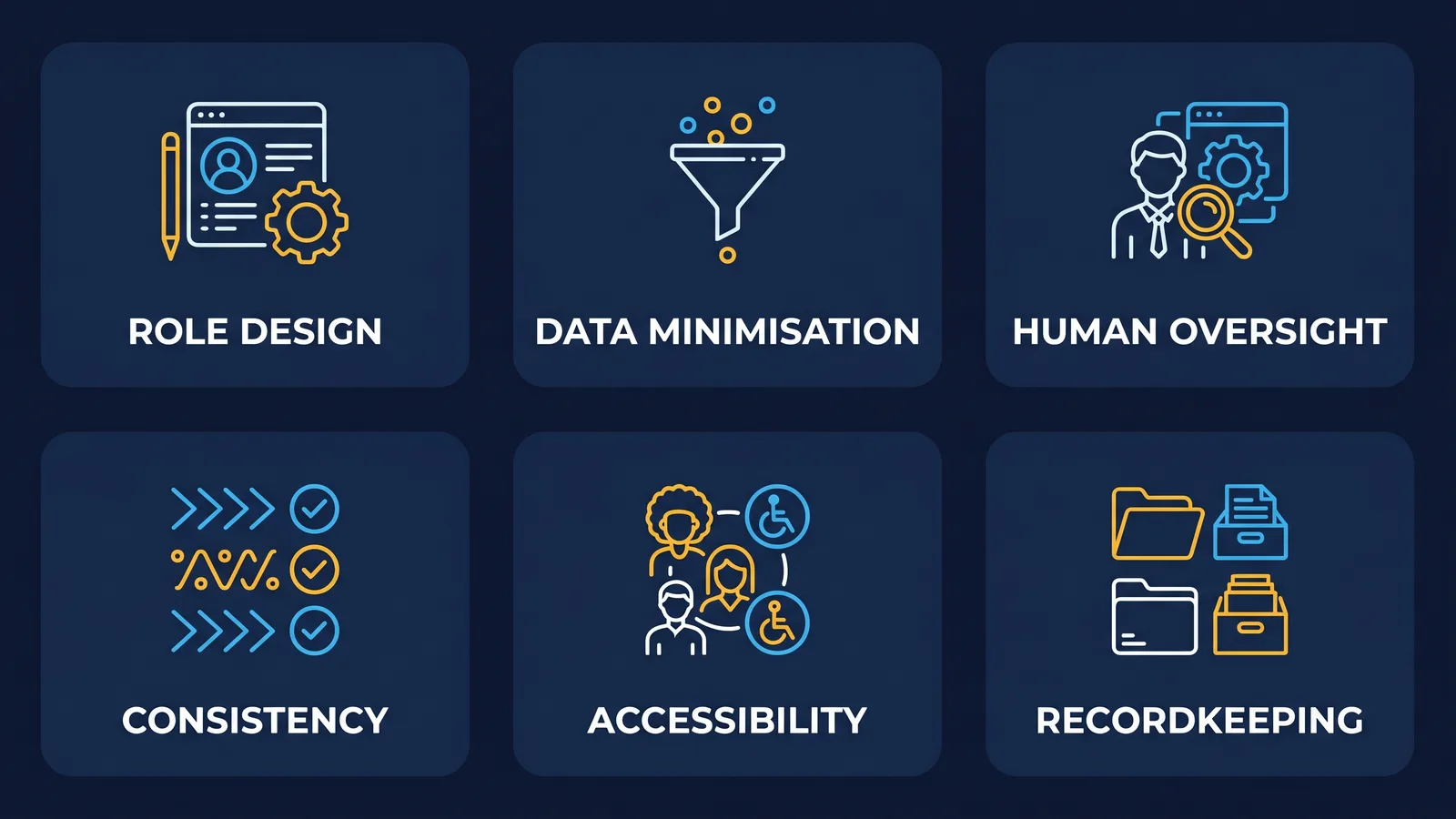
HR leaders should build an AI hiring standard before tools proliferate. The standard should define approved and prohibited uses, privacy requirements, de-identification expectations, vendor approval steps, human review requirements, candidate transparency rules and recordkeeping requirements. It should also require legal, privacy and risk review for any AI use that ranks, recommends, rejects or materially influences candidates, and our companion guide covers AI hiring and performance tools under Australia's positive duty.
The standard should be simple enough for recruiters to use. A one-page decision tree can work better than a dense policy. For example: if the tool uses candidate personal information, check privacy approval. If the tool influences screening, complete a fairness and human review assessment. If the tool is external, check vendor terms. If the output will be sent to a candidate, complete human review. If the tool makes or appears to make a decision, stop and escalate.
The bottom line
AI can improve recruitment administration, but hiring remains a human accountability process. The most responsible HR teams will not be the ones with the most sophisticated AI screening tool. They will be the ones that can show candidates, managers and regulators that AI was used transparently, proportionately and under human control.
For now, the safest rule is simple: use AI to prepare, organise and draft. Do not let it decide who gets opportunity.
Do this Monday
- Write down where AI is allowed to support hiring and where it must not go, using the steps recruitment already runs: advertisement drafting, application screening, interview preparation, candidate communication and selection records.
- Check whether any tool in use ranks, recommends, rejects or materially influences candidates. If one does, stop and route it through legal, privacy and risk review before the next campaign opens.
- Remove personal information before anything goes into a general-purpose AI tool, and keep prompts to role content rather than candidate content.
- Test each selection criterion against the actual role, and drop anything that is a recycled wish list item or a proxy for an unrelated attribute.
- Draft the candidate notice in plain language: what AI is used for, what it is not used for, whether a third party processes personal information, whether output is human-reviewed, and who to contact about an error.
- Give every panel structured questions and a scorecard, so the file records the human basis for selection rather than a model-generated conclusion.
- Turn the standard into a one-page decision tree recruiters will actually use, and confirm a trained person still makes the shortlist and selection calls.
References
- Fair Work Ombudsman, Workplace privacy best practice guide
- Office of the Australian Information Commissioner, Australian Privacy Principles
- Fair Work Commission, Artificial intelligence transparency statement
- Australian Human Rights Commission, Human Rights and Technology Final Report
- Australian Government AI transparency statements
General information only. Not legal, compliance, financial, or professional advice.
TheAICommand. Intelligence, At Your Command.