
HR cannot outsource the privacy risk of workplace AI, because everyday tools widen the data collected about employees and only HR can own the people impact before adoption scales. AI tools are moving from experimentation into everyday work. Employees now use assistants to draft emails, summarise meetings, search internal documents, prepare reports and analyse trends. Managers also see AI tools marketed for productivity analytics, sentiment analysis, rostering, performance insights and workforce planning. For HR, the privacy question is not limited to whether a tool is secure. The deeper question is whether employees understand what information is collected about them, how it is used and whether AI changes the balance of trust in the workplace.
The Fair Work Ombudsman's workplace privacy guide states that best practice employers have clear policies about what employee personal information the business can collect and keep, and when it can be passed to others. That principle becomes more important when AI systems can ingest text, meetings, chats, documents, metadata and behavioural signals at scale.
How does AI change the workplace privacy surface?
Traditional workplace privacy controls often focus on obvious records: personnel files, payroll information, medical certificates, performance records and contact details. AI widens the data surface. A meeting transcription tool may collect voice data and sensitive workplace discussion. A summarisation assistant may process performance concerns or health-related absence information. A productivity tool may infer patterns from emails, calendars and collaboration platforms. A chatbot connected to HR policy may log employee questions about leave, grievances, workplace conflict or entitlements.
The Fair Work Ombudsman guide explains that personal information includes details such as names, addresses, phone numbers, emails, photos, bank information, tax file numbers, superannuation details, licence information and academic records. It also identifies sensitive personal information such as health information, sexuality, religious beliefs, criminal records and trade union membership. AI tools can touch many of these categories indirectly, even when introduced for convenience rather than HR decision-making.
The Australian Privacy Principles require covered organisations to be open and transparent about personal information management, limit collection to information that is reasonably necessary and take reasonable steps to protect information from misuse, interference, loss and unauthorised access. HR should treat those principles as design requirements, not only legal references.
Is AI monitoring the same as management?
A major risk in workplace AI is that analytical insight becomes behavioural surveillance. A tool that measures collaboration patterns may be sold as a way to improve work design. The same tool can become a proxy performance monitor if managers use it to flag employees who send fewer messages, attend fewer meetings or appear less active online. That shift can occur without a formal policy change.
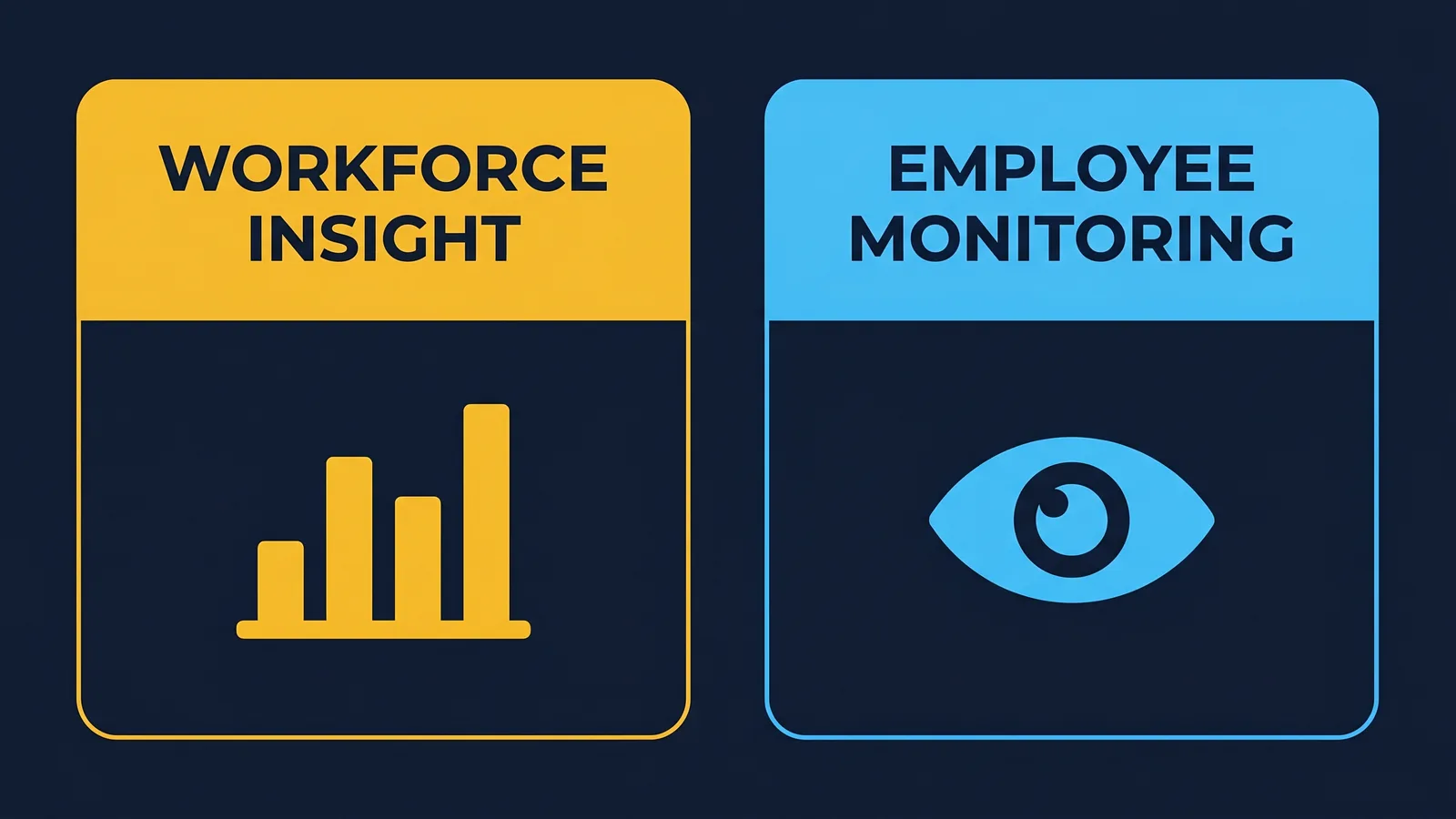
HR should separate workforce insight from employee monitoring. Workforce insight uses aggregated, proportionate data to improve systems of work. Employee monitoring tracks individuals in a way that can affect performance, discipline, rostering, promotion or employment security. The difference matters because employee trust depends on purpose, proportionality and transparency.
The Australian Human Rights Commission's Human Rights and Technology final report says Australia should innovate consistently with liberal democratic values, including consultation, inclusion, accountability and robust safeguards. In a workplace context, consultation is a risk control, not a courtesy. Employees who understand a tool's purpose are more likely to use it appropriately, report concerns and trust the organisation's motives.
Why must HR own the people impact of workplace AI?
AI workplace adoption is often led by technology, digital transformation or procurement. HR may be invited late, after the vendor has been selected and the pilot is underway. That sequence is backwards when employee data or employee experience is involved. HR should not own every technical decision, but it must own the people impact assessment.
A practical people impact assessment should ask whether the tool processes employee personal information, whether it could influence employment decisions, whether affected employees have been told, whether it creates new monitoring capability, whether accessibility issues arise, and whether managers could misuse the output.
The Fair Work Commission's AI transparency statement is a useful public example of boundaries. It explains that the Commission explores AI for analytics, insights, workplace productivity, summarisation, transcription, redaction and creative content, but states that generative AI will not make decisions under the Fair Work Act 2009 or the Fair Work (Registered Organisations) Act 2009. HR can apply a similar distinction internally: support tools are one thing; AI-shaped employment decisions are another.
Policy needs to be specific enough to guide behaviour
A broad policy saying that employees must use AI responsibly is not enough. Employees need practical rules. Managers need boundaries. HR needs escalation triggers. A useful workplace AI privacy policy should answer six questions: which tools are approved, what information must not be entered, what logs are kept, who can access the logs, how long information is retained and whether AI output can be used in employment decisions.
The policy should also distinguish between employee use and employer use. Employee use covers how staff use AI to perform work. Employer use covers how the organisation uses AI to understand, assess or manage employees. These are different risk categories.
These rules should appear in manager training, not only in policy libraries. The most likely misuse of workplace AI is not malicious. It is a manager pasting sensitive information into a tool to save time, relying on a summary without checking the source, or treating a dashboard as a performance truth.
The trust test
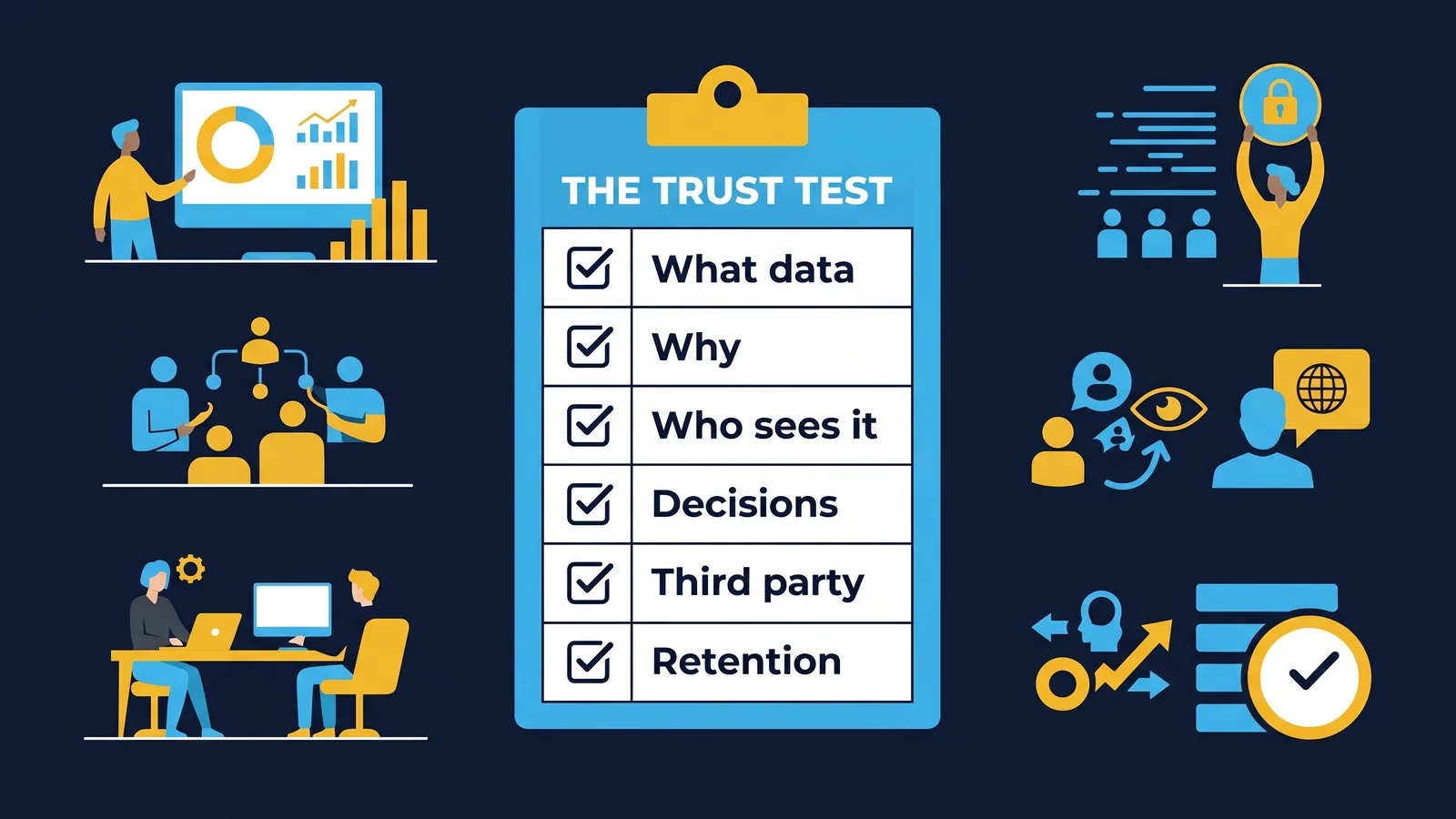
Before deploying workplace AI, HR can use a simple trust test: would the organisation be comfortable explaining this data use to employees in plain English? If the answer is no, the issue is not only communications. The design may be wrong.
A transparent explanation should say what data is collected, why it is collected, who can see it, whether it affects decisions, whether it is sent to a third party, how long it is kept and how employees can raise a concern. This is consistent with the broader direction of government AI transparency, where published statements help the public understand how agencies adopt AI.
The bottom line
AI can improve workplace productivity, accessibility and knowledge management, but it can also expand monitoring in ways employees do not expect. HR's role is to protect trust before trust is damaged. That means insisting on privacy by design, clear boundaries for managers, practical employee notice and human accountability for employment decisions.
The organisations that get workplace AI right will not be the ones that collect the most data. They will be the ones that can explain why the data is necessary, how people are protected and where human judgement remains in control.
References
- Fair Work Ombudsman, Workplace privacy best practice guide
- Office of the Australian Information Commissioner, Australian Privacy Principles
- Australian Human Rights Commission, Human Rights and Technology Final Report
- Fair Work Commission, Artificial intelligence transparency statement
- Australian Government AI transparency statements
Do this Monday
- List every AI tool already touching employee data, including the ones a team adopted without going through procurement, and note what each one collects.
- Run each tool through the trust test: could the data use be explained to employees in plain English, and would the organisation be comfortable doing it?
- Split the list into employee use and employer use, because how staff use AI to do their work and how the organisation uses AI to assess staff are different risk categories.
- Find any tool that infers performance from activity data, and rule out its output as standalone performance evidence.
- Ask each vendor the retention, training-use, data-location and administrator-access questions, then set a retention period wherever logs are being kept indefinitely.
- Draft a short, specific notice for the tools employees actually touch, covering what is collected, why, who can see it, whether it affects decisions, how long it is kept and how to raise a concern.
- Move the people impact assessment to the front of the next procurement, before the vendor is chosen rather than after the pilot starts.
- Put the manager boundaries into manager training, not only the policy library, starting with the rule that employment decisions need a human decision-maker, documented reasoning and a review pathway.
General information only. Not legal, compliance, financial, or professional advice.
TheAICommand. Intelligence, At Your Command.