
Two clocks, thirty days, one window that closes itself.
That is the shape of section 45 of the Safety, Rehabilitation and Compensation Act 1988, and it is a genuinely awkward provision for anyone running a claims operation well. Doing the job properly, assessing promptly and paying on time, is the thing that ends the worker's right to make a different choice. There is no scheme guidance on it. Most claims systems do not track it. And it is exactly the kind of date-driven, high-consequence interaction where AI is useful in a narrow way and dangerous in a broad one.
What does section 45 actually do?
It offers a trade, once.
Section 45(1) allows an employee to elect in writing to institute an action for damages for non-economic loss, and it fixes the moment that option expires: the election may be made "at any time before an amount of compensation is paid to the employee under section 24, 25 or 27 in respect of that injury". Section 45(3) is one sentence long. "An election is irrevocable."
What the election costs is set out in section 45(2)(b): compensation is not payable after the date of the election under sections 24, 25 or 27 in respect of the injury. Those three sections are the permanent impairment lump sum, the interim payment provision and non-economic loss. On the face of the subsection, incapacity payments and medical treatment costs are not named. That is a narrower waiver than the common shorthand suggests, and the distinction is worth getting right in any explanation given to a worker.
The narrowing describes the election, not the outcome. If damages are recovered, section 48(4) provides that compensation is not payable under the Act after the date on which they were recovered, and section 48(3) makes the worker liable to pay the relevant authority an amount equal to the compensation already paid or the damages, whichever is less. So the incapacity and medical treatment entitlements survive the election and do not survive a recovery. An explanation that carries the first half without the second is materially incomplete about a decision the Act makes irrevocable.
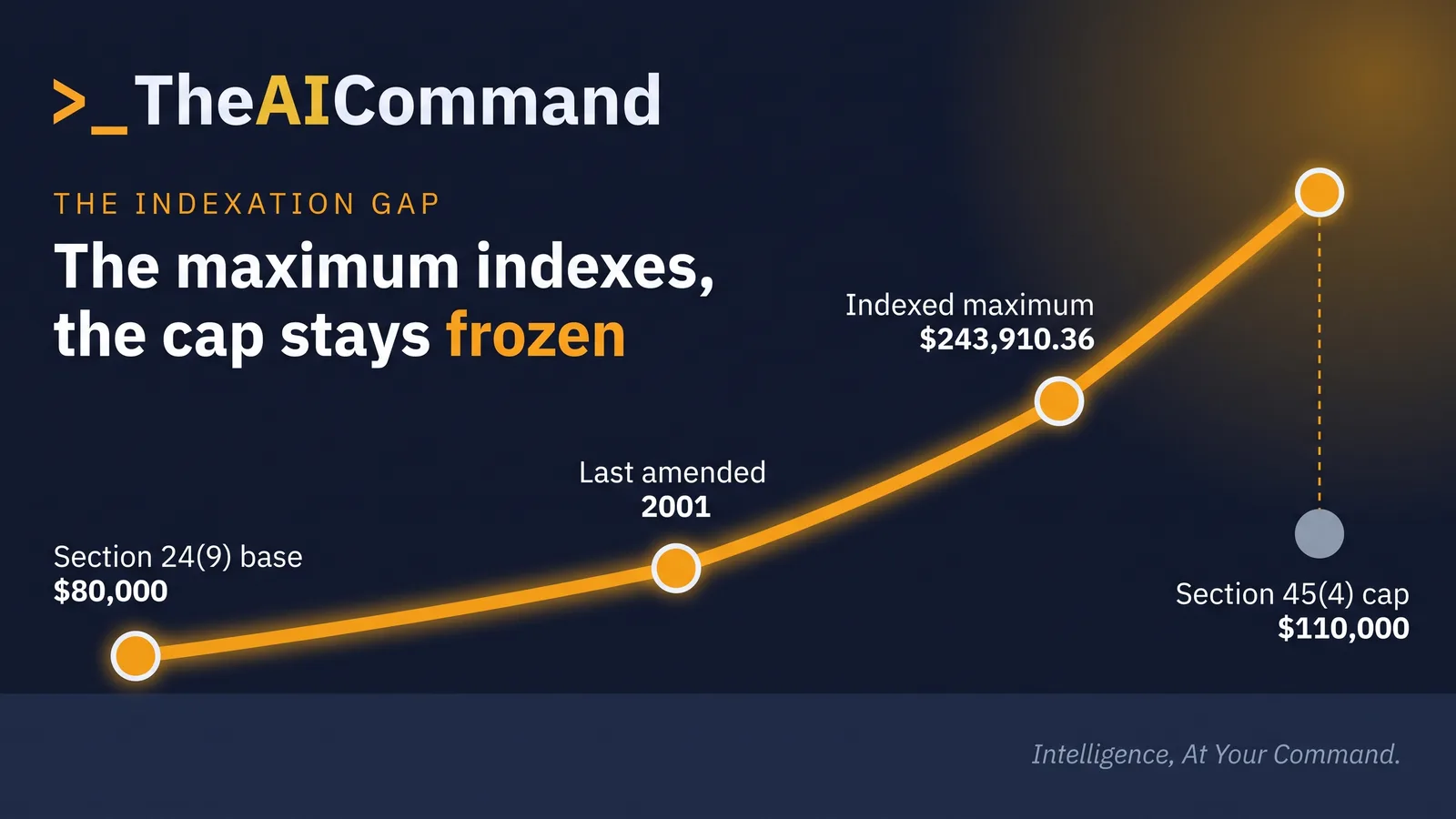
What the election buys is capped. Section 45(4) provides that in any resulting action a court "shall not award the employee damages of an amount exceeding $110,000 for any non-economic loss suffered by the employee".
Why has that cap fallen so far behind?
Because it is not on the indexation list.
Section 13(1) defines the "relevant amount" that indexation operates on, and it enumerates specific provisions: paragraph 18(4)(a) and subsections 19(7), (8) or (9), 24(9), 27(2), 29(1) or (3), 30(1) and 137(1). Section 45(4) does not appear. The consequence compounds annually.
Section 24(9) sets its statutory base at $80,000. After indexation, Comcare's statutory rates table records the maximum payable for lump sum permanent impairment from 1 July 2026 as $243,910.36, applying a CPI factor of 1.036. Non-economic loss under section 27(2) is published as two separate components, 'A' and 'B', each capped at $45,733.22, which is a detail routinely flattened into a single figure and should not be.
The damages cap has not moved. Section 45 was last amended in 2001.
That gap has not gone unexamined. The independent review of the SRC Act, released on 12 December 2025, went to section 45 directly and reasoned from the same indexation problem, noting that the permanent impairment maximum indexes while the common law limit for non-economic loss remains at the original $110,000, and recording the consequence the figures imply: elections to sue for non-economic loss at common law are now rare. Recommendation 95 is that a worker with at least a 10 percent degree of impairment can irrevocably elect to take common law action for non-economic loss in lieu of permanent impairment compensation, and that the cap on damages for non-economic loss be removed. No bill has been introduced. The cap is $110,000 on the day this publishes, and a licensee building a control around section 45 should build it knowing the provision is under active reform.
None of that tells you what a worker should do, and it is not the claims manager's question. It does tell you why the decision is consequential enough that the Act made it irrevocable, and why the surrounding process deserves more care than it usually gets.
Where is the window, exactly?
Section 45(1) does not set a period. It sets an event. The election has to arrive before the money does.
The period comes from elsewhere. Section 26(1) requires that, subject to that section, an amount of compensation payable under section 24 or 25 "shall be paid to the employee within 30 days after the date of the assessment of the amount", and section 26(2) makes interest payable if that is missed. So in the ordinary case the Act obliges the relevant authority to close the window promptly, and penalises it for leaving the window open.
The qualifier carries weight. Section 26(4) switches the whole section off, both the 30 day obligation and the interest, where a reconsideration of the section 24 or 25 determination has been requested under Part VI, or a Part VI proceeding has been instituted. Comcare's scheme guidance on the interest rate names a third circumstance in which interest does not run, being delay caused by compliance with the Health and Other Services (Compensation) Act 1995. This is not a remote carve-out for this article's scenario. A worker unhappy enough with a determination to be weighing an irrevocable election is the same worker most likely to seek reconsideration first, and Comcare tells claimants to lodge that application within 30 days of the determination. For that worker the payment clock stops and the window stays open well past 30 days, which is precisely when a notification date trail earns its keep.
Comcare's published material does not reconcile the two clocks. What it publishes on section 45 is claimant-facing: an election form, a factsheet and a section on its long-term injury page. The factsheet fixes the deadline at the payment rather than at a date, telling the worker the election can be made "at any time before you receive the lump sum payment" and that "once you make a section 45 election you cannot cancel it". The form itself says nothing about timing at all, which is the gap in sharper form. None of that material sets a number of days for returning the form, because the Act does not give the worker days. It gives the worker whatever interval the relevant authority leaves between assessment and payment.
For claimants, Comcare puts it plainly on its long-term injury page: "You cannot make an election to sue once the permanent impairment or non-economic loss payment is received", followed by "Given the significance of this decision, you may wish to seek legal advice."

What does this mean for a self-insured licensee?
It means you are building this control without a map, on ground that is being resurveyed.
The Comcare scheme guidance index, read in full on 21 September 2026, contains no guidance on section 45 and nothing on elections at all. The permanent impairment grouping covers multiple injuries, upper limb arthroplasty and the interest rate. The only Part IV scheme guidance, SRC344 on provisions preventing double payment, was last updated in March 2026, is expressly written for the government sector and self-insured licensees, and addresses sections 46, 48 and 50, with sections 49 and 51 in its endnotes. It does not mention section 45.
One further point needs handling carefully. A 10 percent figure circulates around this decision, and the useful precision is about where it lives and how it reaches the election. Comcare's claimant factsheet places it where the Act does, on eligibility for the payment: in most cases a doctor must assess a permanent impairment of at least 10 percent before a permanent impairment payment is available. That is section 24(7), with the section 24(8) exceptions for a finger, a toe, taste or smell, and the separate 5 percent binaural hearing loss test in section 24(7A).
Section 45 imposes no impairment threshold in its own text. It does not need one. Section 45(1)(a) makes the election available only where compensation is payable under section 24, 25 or 27, and below the threshold nothing is payable under any of them: section 24(7) says no amount is payable under that section, section 25(1)(b) requires a degree equal to or more than 10 percent, and section 27(1) operates only where compensation is payable under section 24. So the threshold gates the election indirectly, and the factsheet reaches the same place operationally when it tells a worker not to sign the form where Comcare has determined they are not eligible for a permanent impairment payment. Record 10 percent in a licensee procedure as a section 24(7) eligibility gate that reaches the election through section 45(1)(a), not as a rule found in section 45. Recommendation 95 of the review would write it into the election itself.
There is also a question worth naming precisely rather than overstating. Section 4(1) defines the relevant authority as the licensee for a licensee's employee and Comcare for everyone else. Section 108C(3)(a) expresses its redirection of notices and claims to the licensee in terms of Part V, and section 45 sits in Part IV, but Part IV is not a redirection void. Sections 4(10) and 4(10A) deem a reference to Comcare anywhere in the Act, other than in section 28 and Parts III, V, VI, VII and VIII, to be a reference to the licensed authority or licensed corporation in relation to its own employee, and Part IV is not on that exclusion list. Section 108E(d)(ii) points the same way, making it a licensee function to meet any obligation that would be required of Comcare. SRC344 quotes the deeming provisions in its own endnotes.
Part IV is also not silent about direction, though what it directs is the claim rather than the election. Section 47(1) requires the employee to notify Comcare in writing, as soon as practicable and in any event not later than 7 days after first becoming aware of the claim, of a claim for damages against the Commonwealth, a Commonwealth authority, a licensed corporation or another employee. That is the same party set section 45(1) uses, and section 47(2) makes it an offence of strict liability carrying 5 penalty units. For a licensee's own employee, section 4(10A) reads that notice as going to the licensee. A worker who is told the election exists and not told this is being sent one step down a path with an offence provision on it.
What remains genuinely unresolved is narrower, and still worth closing. Section 45(1) names no recipient for the election at all. The Comcare form tells the worker to forward it to Comcare, while Comcare's claimant page tells employees of self-insured organisations to contact their human resources team instead. So a licensee should record with its own advisers, in writing and before the next determination issues, where a section 45 election is to be directed and who acknowledges receipt. It is not a gap to close by assumption.
Where does AI belong, and where does it not?
The boundary here is unusually clean, so state it before designing anything.
AI must not model, predict, score or advise on whether a worker should elect. That is a legal decision with an irrevocable consequence, and for a self-insured employer, forming a view on it sits on the wrong side of a conflict. Nothing in this workflow should produce an output that reads as a recommendation about the worker's interests.
What AI can do is detect and evidence. Three uses hold up.
Flag the closing window. Given a determination date and a scheduled payment date on a de-identified record, an AI-assisted check can surface every claim where a section 24, 25 or 27 payment is pending and the file does not yet record that the worker was told about the election. That is a completeness check on a date field, not a judgement.
Draft the neutral notification. A model can produce plain-English wording that states the option exists, states that it is irrevocable, states that it cannot be exercised once payment is received, states that a damages claim then carries its own written notice obligation within 7 days under section 47, and refers the worker to independent legal advice. A person reviews and sends it. The drafting is genuinely useful precisely because the content must be neutral, and neutrality is easier to check than to write.
Assemble the date trail. Determination date, notification date, referral date, form return date if any, payment processing date. Five dates in order, extracted onto a single record for human verification. That trail is the whole evidence base if the handling is ever questioned.

Neutral is a testable standard, which is what makes it a good fit for a drafted-then-reviewed document. A neutral notification states the option, states that it is irrevocable, states when it closes, names the section 47 notice that a damages claim triggers, and refers the worker elsewhere for advice. It does not characterise the option as favourable or unfavourable, does not compare figures, does not mention what similar claims have produced, and does not invite the worker to discuss the merits with the person handling their claim. If a draft does any of those things, it fails review.
A worked example, fully de-identified. [CLAIMANT_NAME], claim [CLAIM_NUMBER], has an accepted injury and a completed impairment assessment. The determination issues. An AI-assisted review of the de-identified claim record flags that a payment is scheduled and no notification date is recorded. The delegate sends the reviewed neutral notification the same day, referring [CLAIMANT_NAME] to independent legal advice, and the referral is filed. Payment is processed inside the section 26(1) period. The file now shows the worker was told before the option closed, and it shows it with dates rather than with a recollection.
Note what did not happen. No model estimated what [CLAIMANT_NAME] might recover. No system suggested a course of action. The AI found a missing date.
Bottom line
Section 45 is the rare provision where good administration and a worker's option pull against each other, and the Act resolves it in favour of paying on time. That makes the notification and its date trail the only real control available. Build it deliberately, because there is no scheme guidance to inherit and the review has recommended replacing the provision, and keep AI on the detection side of the line. Flag the window, draft the neutral notice for review, hold the dates. The decision belongs to the worker and their own adviser, and the determination belongs to the delegate.
Do this Monday
- Pull every open claim with a completed impairment assessment and check whether the file records a date on which the worker was told about the election
- Write the neutral notification wording once, have it reviewed, and make it a standard step attached to the determination rather than to the payment
- Add the five dates to the claim record as discrete fields so the trail can be sampled rather than reconstructed
- For licensees, put the question of where a section 45 election is to be directed to your advisers in writing, and record the answer in the procedure
- Check that no AI-assisted output in this workflow expresses a view on whether an election is in the worker's interests
This article is general information and education only. It is not legal advice, and it is not advice about any individual claim. Decisions under the Safety, Rehabilitation and Compensation Act 1988 are made by human decision-makers on the individual merits of each claim, and claimants have reconsideration and review rights in respect of determinations. Whether to make an election under section 45 is a decision for the worker with the benefit of their own independent legal advice. Seek advice specific to your scheme and circumstances.
References
- Federal Register of Legislation, Safety, Rehabilitation and Compensation Act 1988, Compilation No. 82, C2026C00285, compilation date 1 July 2026, sections 4, 13, 24, 25, 26, 27, 45, 47, 48, 108C and 108E. https://www.legislation.gov.au/C2004A03668/latest/text
- Comcare, Statutory rates for compensation, table effective 1 July 2026, indexation factor CPI 1.036. https://www.comcare.gov.au/claims/statutory-rates
- Comcare, Section 45 Election form. https://www.comcare.gov.au/about/forms-pubs/docs/forms/claims/section-45-election-form.pdf
- Comcare, Permanent Impairment and Section 45 Election factsheet, advice for injured workers. https://www.comcare.gov.au/about/forms-pubs/docs/pubs/claims/permanent-impairment-payments-and-section-45-elections.pdf
- Comcare, Long-term injury or impairment. https://www.comcare.gov.au/claims/supports-benefits/long-term-injury
- Comcare, Scheme guidance - Provisions under the SRC Act to prevent double payment of compensation, document SRC344, last updated March 2026. https://www.comcare.gov.au/scheme-legislation/src-act/guidance/provisions-under-the-src-act-to-prevent-double-payment-of-compensation
- Comcare, Scheme guidance - Interest rate for late compensation payments for permanent impairment, exceptions to section 26(2). https://www.comcare.gov.au/scheme-legislation/src-act/guidance/interest-rate-for-late-compensation-payments-for-permanent-impairment
- Department of Employment and Workplace Relations, Safety, Rehabilitation and Compensation Act 1988 Review, Final Report: Getting the best outcomes for injured and ill workers, September 2025, released 12 December 2025, pages 338 and 340, Recommendation 95. https://www.dewr.gov.au/workers-compensation/resources/safety-rehabilitation-and-compensation-act-1988-review-final-report
TheAICommand. Intelligence, At Your Command.