
A complaint can seek better service, challenge a determination and raise a licence concern in the same paragraph. AI can expose those parallel pathways, but a human must classify the message, protect every clock and approve every response.
A complaint response cannot substitute for reconsideration. Resolving the caller's concern about tone, delay or communication does not decide whether the same message also asks for a determination to be reconsidered. Closing the service ticket must never close a statutory right.
The safe AI task is multi-lane routing. It identifies possible service, reconsideration, ART and licence-compliance signals, preserves the original receipt evidence and gives a human reviewer a rights-preservation check. It does not decide what the person legally requested, whether a breach occurred or how any claim should be determined.
That distinction matters most for a self-insured bank, insurer or superannuation organisation. Its own complaint process governs its service response. Comcare's public complaint framework and service aims describe Comcare's operations. They do not automatically become the licensee's complaint standards.
Which lane does the message actually open?
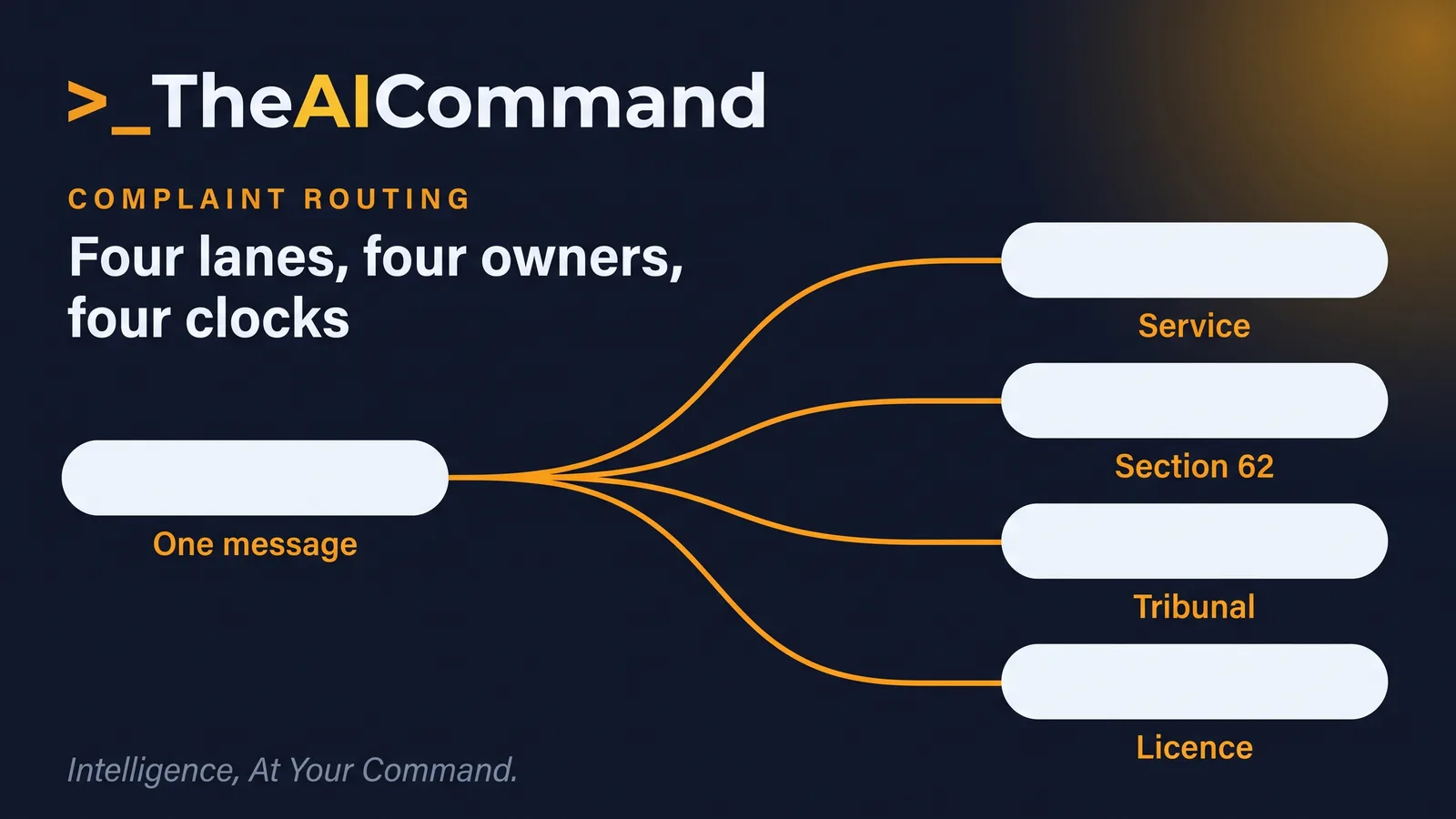
Do not force an incoming message into one category. One paragraph can open several work lanes, each with a different owner, consequence and clock. This piece maps the routing decision at the front door; the wider map of the clocks that run across a claim's life sits in statutory timeframes under the SRC Act, and the receipt-integrity discipline that protects day one at intake is covered in section 54 intake and the claim clock.
The service lane concerns how a person was treated or how a process was delivered. Comcare's current feedback and complaints page distinguishes feedback about its services from review of a claim determination, which follows a separate legislative process. Its aims to make contact within two business days and provide a formal written response within 15 business days describe Comcare's service. They do not bind a licensee. A licensee needs its own approved complaint policy, ownership rules and response standards.
The reconsideration lane concerns dissatisfaction with a determination. Under the current Safety, Rehabilitation and Compensation Act 1988 (the SRC Act), Compilation No. 82 in force from 1 July 2026, section 60 defines which SRC Act decisions are determinations for Part VI. Section 62 requires a request to set out reasons and reach the determining authority within 30 days after the determination first came to the requester's notice, unless the authority allows a further period.
The subject line is not decisive. Comcare's reconsideration guidance says a request need not be written, can be implied by the circumstances and should be clarified when correspondence is unclear. A model must therefore flag a possible request. It must not dismiss one because the person wrote "complaint", or declare that one exists without human legal and procedural review. Section 62(4) also keeps reconsideration with the determining authority or a delegate who did not make, and was not involved in the making of, the original determination.
For a claimant's request, section 62(6) and regulation 11A(2) of the current SRC Regulations prescribe 30 calendar days to decide it, starting on the day the determining authority receives it. Comcare's statutory-timeframes guidance confirms receipt is day one and the rule applies to Comcare and self-insured licensees. The evidence pauses in regulation 11A(3) apply to initial section 14 claims, not claimant reconsideration requests.
The ART lane arises after a reviewable decision, not as a substitute for section 62 reconsideration of a primary determination. Section 63 requires the reviewable decision notice to state that application may be made to the Administrative Review Tribunal, and section 64 identifies who may apply. Section 65(4) requires an application within 60 days after the person is served with notice of the reviewable decision, while noting that an extension may be sought under section 19 of the Administrative Review Tribunal Act 2024. The ART's workers compensation guidance directs a person to check the decision letter and explains how to request an extension. A complaint does not pause either statutory period.
The licence lane concerns a possible failure against a self-insurance licence or a potentially systemic practice. The SRCC's feedback guidance distinguishes claim information requests, complaints about claim management, potential licence breaches and matters outside its remit. It says Comcare reviews licence concerns and refers them to the SRCC where appropriate. It also says neither body can change an individual claim decision through that feedback pathway.
The practical rule is simple. Route by substance, permit multiple lanes and never suggest that progress in one lane suspends or resolves another.
How can AI route an issue without closing a right?
Build a rights-preservation header before generating any response. It sits above the complaint summary and survives every hand-off:
- original message ID and unaltered receipt timestamp
- sender and human-verified representative authority, where relevant
- exact decision or service event identified by the sender
- candidate lanes, with the words that triggered each one
- statutory clock source and human-verified due date
- separate human owner for each active lane
- any ambiguity requiring contact with the sender
- confirmation that no lane is treated as withdrawn or resolved by another lane.
This is not a merits map. A reconsideration issue map organises grounds after a request is identified. This router operates earlier. It prevents a complaint inbox, chatbot or central service team from burying the possible request before the reconsideration team sees it.
Use this prompt to create candidate routes from a de-identified message. A trained human must compare every trigger with the original, decide the route and verify all receipt and due dates.
The system should copy the source words, not paraphrase them into a stronger allegation. "This keeps happening" is not evidence that a systemic breach occurred. "Determination [DECISION_ID] should change because the report was overlooked" is not proof that the report was overlooked. Both are routing signals requiring human attention.
Receipt integrity is equally important. Do not reset the date when the complaint team forwards the message to claims. Preserve when the determining authority received the request and have a practitioner decide the legally operative receipt point. The workflow should escalate uncertainty, not manufacture a later date.
What does a safe response look like?
A good response answers the service concern and separately states what has happened to every other potential lane. It does not say "your complaint is closed" without qualification when a reconsideration or licence concern remains active.
Consider this fictional, de-identified scenario. An email from [CLAIMANT_NAME], received as [MESSAGE_ID], says a case manager did not return calls, disagrees with determination [DECISION_ID] because [REPORT_ID] was allegedly not considered, and says colleagues have experienced the same delay.
The service team may own the contact complaint. A suitably authorised claims practitioner must decide whether the words meet section 62 and, if they do, register the request using the preserved receipt evidence. A compliance professional must decide whether the broader allegation requires internal escalation or information about the external self-insurance feedback pathway. None of those steps establishes that the report was omitted, that the determination should change or that a licence breach occurred.
The human-approved response could acknowledge three separate actions: the service complaint is being handled under the licensee's policy; the possible reconsideration request has been referred for urgent human review without altering the original receipt record; and the broader allegation has been preserved for compliance assessment. If the person has received a reviewable decision instead, the response must preserve the ART information in that notice rather than redirecting them into another service loop.
Use this second prompt as a post-draft control. A human must repair and approve the response, confirm the organisation's policy and verify every legal statement before issue.
AI use also needs a privacy gate. Do not send claim correspondence to an unapproved public tool. Replace direct identifiers with merge fields and address indirect identification risk, access, security and vendor handling under the OAIC's guidance on commercially available AI products. Keep the original message and official records in the controlled claims or complaint system, not in the model transcript.
Do this Monday
- Take ten fully fictional messages and label every service, reconsideration, ART and licence signal. Allow more than one lane per message.
- Add the rights-preservation header to the complaint intake template, including the original receipt evidence, source words, human owner and unresolved ambiguity.
- Configure a hard alert for possible section 62 language. Do not let a service classification suppress it or recalculate its receipt date.
- Test the router with misleading subject lines such as "feedback", "payment question" and "formal complaint". Record every missed statutory signal as a critical failure.
- Have claims, complaints, compliance and privacy specialists approve the routing rules, response control and de-identification method.
- Audit closed complaints monthly for any parallel lane that was left unregistered, unacknowledged or incorrectly described as resolved.
Bottom line
A complaint is not a reconsideration, but the same communication can contain both. The defensible AI workflow opens parallel lanes, preserves the first receipt evidence and shows a human exactly where rights may be engaged. It never treats service closure as withdrawal of a statutory request or proof that a licence concern lacks substance. People classify the message, protect the clocks and approve every response.
This article is general information and education only. It is not legal advice, and it is not advice about any individual claim. Decisions under the Safety, Rehabilitation and Compensation Act 1988 are made by human decision-makers on the individual merits of each claim, and claimants have reconsideration and review rights in respect of determinations. Seek advice specific to your scheme and circumstances.
References
- Federal Register of Legislation, Safety, Rehabilitation and Compensation Act 1988, Compilation No. 82, 1 July 2026: https://www.legislation.gov.au/C2004A03668/latest/text
- Federal Register of Legislation, Safety, Rehabilitation and Compensation Regulations 2019, Compilation No. 2, 1 April 2024: https://www.legislation.gov.au/F2019L00423/latest/text
- Comcare, Feedback and complaints: https://www.comcare.gov.au/about/contact/provide-feedback
- Comcare, Scheme guidance - Considerations in the reconsideration process, document SRC311, updated December 2024: https://www.comcare.gov.au/scheme-legislation/src-act/guidance/considerations-in-reconsideration-process
- Comcare, Scheme guidance: Statutory timeframes for decision-making under the SRC Act, document SRC339, updated April 2025: https://www.comcare.gov.au/scheme-legislation/src-act/guidance/statutory-timeframes-decision-making
- Safety, Rehabilitation and Compensation Commission, Providing feedback about a self-insured licensee: https://www.srcc.gov.au/employees-of-self-insurers/providing-feedback
- Administrative Review Tribunal, Workers' compensation: https://www.art.gov.au/applying-review/workers-compensation
- Office of the Australian Information Commissioner, Guidance on privacy and the use of commercially available AI products: https://www.oaic.gov.au/privacy/privacy-guidance-for-organisations-and-government-agencies/guidance-on-privacy-and-the-use-of-commercially-available-ai-products
TheAICommand. Intelligence, At Your Command.