
A complete register can still be out of date. The product name is listed, the file opens, and the safety data sheet (SDS) behind it states a review date from years before the last restructure. Nothing in the register looks wrong, because the failure sits in a field nobody reads.
That failure is arithmetic rather than judgement. Every SDS is required to state its own review or preparation date, so the age of each sheet in the folder can be computed against a single run date. An assistant grounded in the organisation's own SDS folder and its own register export can turn that comparison into a dated exception list inside an hour. What it cannot do is decide what happens to any line on that list.
The practitioner consequence sits at the other end of the run. A change to the SDS or to the register is itself a trigger to review control measures, so the exception list opens a control review rather than closing a filing task.
This walkthrough is written for the Commonwealth scheme, where Comcare is the regulator.
Why does a current register still fail?
Regulation 346(2) of the Work Health and Safety Regulations 2011 (Cth), Compilation No. 28, compilation date 25 March 2025 and in force as at 25 September 2026, requires the register to include "a list of hazardous chemicals used, handled or stored" and "the current safety data sheet for each hazardous chemical listed". Regulation 346(1) requires that "the register is maintained to ensure the information in the register is up to date".
The load-bearing word is current. The regulation says what the register holds, not how old a sheet in a workplace folder may be. The duty that creates the age sits upstream, with the manufacturer or importer, and the workplace inherits the consequence without a reminder.
Scope is the other half of the problem, and it runs the opposite way. Safe Work Australia's hazardous chemicals register guidance says a register should only include chemicals classified as hazardous chemicals, and that leaving a chemical off the register does not remove the duty to communicate information about its safe use, handling and storage. The primary duty at section 19(3)(d) of the Work Health and Safety Act 2011 (Cth), Compilation No. 16, compilation date 1 July 2024 and in force as at 25 September 2026, covers "the safe use, handling and storage of plant, structures and substances" whether or not a line exists in a spreadsheet.
So there are two distinct failures. One is a missing line, a scoping question. The other is an aged sheet behind a line that is present, an arithmetic question. A review built on row counts finds the first and cannot see the second. The run here is built for the second.
The two clocks every register line inherits
Clock one belongs to the supplier. Regulation 330(3)(a), in the same compilation and in force as at 25 September 2026, requires the manufacturer or importer to "review the safety data sheet at least once every 5 years". Safe Work Australia's model Code of Practice on the preparation of safety data sheets, publication date 1 July 2020 and last updated 16 June 2023, sets where that period starts: the five years run from the date of original preparation or the last revision of the sheet, not from the date the organisation saved the file. That start point comes from model guidance rather than from an approved instrument, so a reader confirms it with their own regulator. The same section adds that no review is owed where the manufacturer or importer has not made or imported the chemical in the last five years, so a sheet can be genuinely old with no replacement owed.
The date is a required field, and it has two known locations. Schedule 7 clause 1(1)(b) of the Regulations requires the sheet to "state the date it was last reviewed or, if it has not been reviewed, the date it was prepared". Clause 1(2) sets 16 numbered sections and clause 1(3) requires the sheet to use those headings in that order. Section 3.16 of the same model code on preparing safety data sheets places the date of preparation of the latest revision in Section 16 of the sheet. A required field in a fixed structure is what makes the comparison arithmetic rather than judgement.
Clock two belongs to the workplace. Regulation 344(2), in the same compilation and in force as at 25 September 2026, provides that a hazardous chemical "is taken to be first supplied to a workplace if the supply is the first supply of the hazardous chemical to the workplace for 5 years". Regulation 344(1)(a) requires the SDS to be obtained not later than when the chemical is first supplied for use at the workplace, or where that is not possible, as soon as practicable after first supply and before the chemical is used. Regulation 344(3) requires that the current sheet is readily accessible. A chemical that fell out of use and returns after five years arrives as a first supply, with the obtaining duty live again rather than satisfied by the copy in the folder.
Neither clock sends a notification. A register touched only when a new chemical arrives cannot notice either one.

What does the assistant actually do here?
Two inputs, both the organisation's own documents: a register export for one site and the SDS folder behind it. Nothing from the open web enters the run.
TheAICommand works to the Verified Draft Method: de-identify the inputs, ground the model in your own source material, keep a person at the decision point, verify against the primary source, and log what happened.
De-identification here is modest but real. The sheets are published supplier documents. The sensitivity sits in the register export, which describes what is stored where and in what quantity, so site names, location codes, quantities and account references are replaced with placeholders such as [SITE_NAME] and [ORGANISATION] before the export is pasted anywhere.

The run has three mechanical steps and one gate. Extraction turns the folder into a table with a date column. The crosswalk joins that table to the register export and sorts the result. The gate is a competent person working the exceptions one line at a time.
The first prompt does extraction only. It is forbidden from reasoning about hazard, compliance or what a missing field might mean.
What to check: open three of the attached sheets at random and confirm the printed date matches its row, including the part of the sheet it was read from. Then filter for rows marked not stated and confirm each of those documents carries no review or preparation date.
The second prompt does the join and the arithmetic. It produces five buckets and a reconciliation line, and is told not to recommend anything.
What to check: start at the reconciliation line. The five bucket counts plus the passing table must equal the register lines plus the sheets paired to no register line, with the superseded sheets counted separately. Fewer rows than that means the join dropped rows; more means duplicate sheets the de-duplication step did not catch. Confirm the columns named as product name and supplier are the ones intended. Spot-check two pairings in bucket four by opening both documents, because a renamed product and a substituted product look identical in a text comparison. Read bucket one and bucket three side by side before sending the list on, because a chemical whose product name and supplier both changed appears once in each, and only a person who knows the site will see that they are the same line. Confirm the run date used is the day of the run, not the export date, since the whole age calculation moves with it.
The shape of a correct output is worth seeing first. Two sheets go in: [PRODUCT_NAME], a solvent-based cleaner from [SUPPLIER_NAME] carrying [SDS_REVIEW_DATE] in Section 16, and [PRODUCT_NAME_2], a two-part adhesive whose sheet prints no date. The first prompt returns them in its own columns.
The crosswalk then splits them into two bucket tables.
Bucket 2 (1)
Bucket 5 (1)
An example reconciliation line then reads: 42 register lines in, 41 sheets in, buckets of 3, 6, 1, 2 and 1, 30 rows in the passing table, one superseded sheet set aside. That balances on both axes. Register lines: 3 plus 6 plus 2 plus 1 bucketed, plus 30 passing, is 42. Sheets: 6 plus 1 plus 2 plus 1 bucketed, plus 30 passing, plus 1 superseded, is 41.
Which document states the five-year age test?
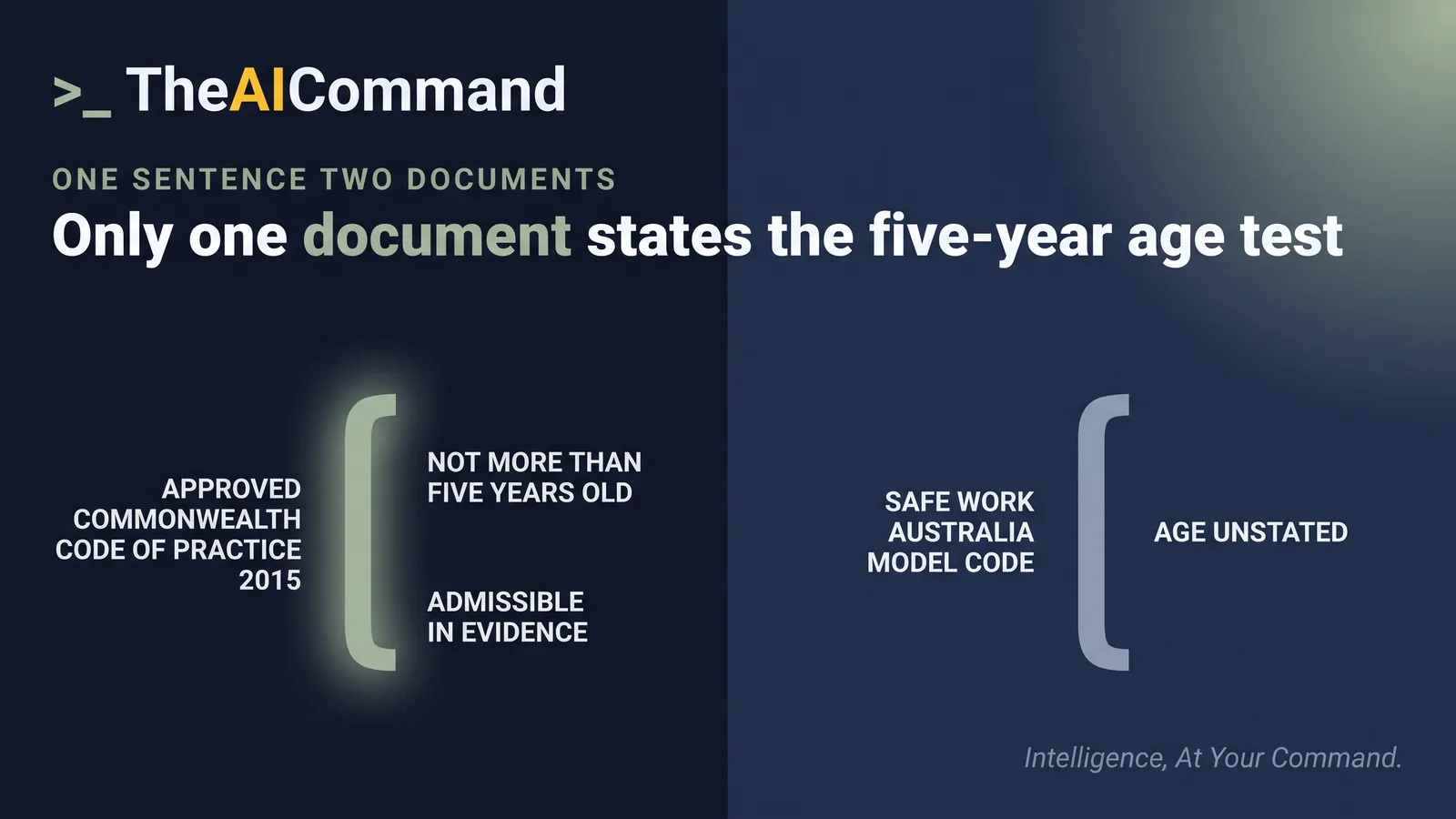
The Regulations never say that a sheet held at a workplace goes stale at five years. The approved code does. Section 1.6 of the Work Health and Safety (Managing Risks of Hazardous Chemicals in the Workplace) Code of Practice 2015 (Cth), F2016L00420, registered 30 March 2016 and in force as at 25 September 2026, describes the register as a list of the product names of all hazardous chemicals used, handled or stored at the workplace "accompanied by the current SDS (one that is not more than five years old) for each hazardous chemical listed".
The same sentence in Safe Work Australia's current model Code of Practice: Managing risks of hazardous chemicals in the workplace, publication date 24 February 2021 and last updated 16 June 2023, reads without that parenthetical. It describes the register as the list "accompanied by the current SDS for each hazardous chemical listed", and that sentence leaves the age unstated.
Which document carries weight is a question the Act answers. Section 274(1) provides that "the Minister may approve a code of practice for the purposes of this Act", and in a proceeding for an offence against the Act, section 275(2) provides that an approved code "is admissible in the proceeding as evidence of whether or not a duty or obligation under this Act has been complied with". Comcare's codes of practice page lists both the 2015 hazardous chemicals code and the 2015 code on preparing safety data sheets among the approved codes for the Commonwealth jurisdiction.
A model code is a template. It takes legal effect in a jurisdiction only when that jurisdiction approves it, which is why Safe Work Australia directs readers to their own regulator.
The practical consequence is precise. The five-year threshold in bucket two is not a convention invented by the assistant. In the Commonwealth jurisdiction it is the wording of the instrument that is admissible in evidence. Outside it, a reader confirms their own approved code first, and adjusts the prompt if it differs.
The exception list is a trigger, not a result
Regulation 352 is the reason the run matters beyond the folder. Control measures must be reviewed and as necessary revised "following any change to the safety data sheet for the hazardous chemical or the register of hazardous chemicals", and in any event "at least once every 5 years", again in Compilation No. 28 and in force as at 25 September 2026.
A replacement sheet that moves a hazard statement, an exposure value or a handling instruction is a reason to look again at storage, ventilation, decanting practice, protective equipment and training content. Route the exception list to the people who own those controls, with the changed fields named, not only to whoever maintains the spreadsheet.
The third prompt is optional, and it exists because the decision record is the evidence that the gate was real.
What to check: every row carries a decision, a role and a date, and the count of rows with no decision recorded is zero before the list is treated as closed. Read the reason column against the notes wherever the wording has become smoother than its source.
What must the assistant never decide?
Classification is the first boundary. The Safe Work Australia Hazardous Chemical Information System warns that if a chemical is not listed in the database, do not assume it is not hazardous, and directs the reader to the manufacturer, importer or supplier, or to independent professional advice. An absence in a lookup is not a finding, and a model asked to decide will answer as confidently as it wrote everything else.
Carve-outs are the second boundary. Regulation 344(4) switches off the obtaining and ready-access duties where the chemical is in transit, where a retailer holds a consumer product for supply to other premises and does not open it on site, or where a consumer product is foreseeably used at the workplace only in quantities and a way consistent with household use. Regulation 346(4)(b) carries that exclusion into the register where the chemical is a consumer product for which no sheet is required under regulation 344. In transit is the Regulations' own defined term, in the same compilation and in force as at 25 September 2026, and its three limbs are cumulative: the chemical is supplied to or stored at the workplace in containers not opened there, it is not used at the workplace, and it is kept there for not more than five consecutive days. Regulation 346(4)(a) brings it back onto the register where its presence in transit is significant or frequent. Cleaning chemicals stored on site by a contracted cleaner sit on the occupier's register, and Safe Work Australia's hazardous chemicals register fact sheet of April 2012 says so. What the documents cannot supply is the judgement underneath each test: how much is present, how often, and how it is actually used.
Sourcing a replacement is the third. Section 2.2 of the Safe Work Australia model code on managing risks of hazardous chemicals says a third party sheet, one produced by someone other than the Australian manufacturer or importer, is not by itself sufficient to meet the duty. A search result is not a source for a compliance document, and an assistant told to find a newer sheet will find one.
That boundary has been argued on this site before, in a risk register is not current because AI reworded it, where the currency test was an opinion about control effectiveness rather than a printed date.
Do this Monday
The artefact is a Hazardous Chemicals SDS Exception List for one site, named [SITE_NAME] SDS Exception List [RUN_DATE]. The owner is the WHS manager for that site, [WHS_MANAGER], who holds the register and carries each line to the competent person, [COMPETENT_PERSON], where classification or use is in question.
The first step fits in an hour for a folder of up to about sixty sheets, which is three batches. A larger site is run one storage area at a time, with its own exception list and run date. Export the register for one site, then delete or placeholder its location, quantity and account-reference columns, keeping the product name and supplier columns the crosswalk uses. Gather the SDS folder that sits behind it and run the first prompt over the folder in batches of no more than twenty files, appending each batch table to the same extraction file and confirming that the total row count equals the number of files in the folder. Then run the second prompt over that extraction table and the scrubbed export, with the run date set to that day. Save the output with the run date in the file name, because the list is only true for the date it was computed. For a register line rebuilt from scratch, the Safe Work Australia hazardous chemicals register template, published 19 September 2019, is an adaptable target layout written to the model Work Health and Safety Regulations rather than to the Commonwealth instrument.
The check that it worked is a reconciliation, not a feeling. At the end of the hour, every file in the folder has a row in the extraction table, every register line sits in exactly one bucket or in the passing table, and the reconciliation line balances. Every sheet in the superseded table is removed from the folder or moved to an archive that is not the register's source, and [WHS_MANAGER] records the removal with the run date. At the end of the cycle, not the hour, every bucket row carries a decision, the role that made it and the date, and the count of rows with no decision recorded is zero.
The bottom line
A hazardous chemicals register ages through the sheet behind each line, and the age is printed on a required field in a fixed structure. That makes the crosswalk between an SDS folder and a register export a mechanical task an assistant runs in an hour, producing five exception buckets against a stated run date, on the five-year test in the approved Commonwealth Code of Practice 2015, in force as at 25 September 2026, which a reader elsewhere checks against their own approved wording. The decision on each exception stays with a competent person, and the record of those decisions is what turns the run into evidence. Build the exception list first. Then run the control review that regulation 352 requires.
TheAICommand. Intelligence, At Your Command.