
Machine translation can widen access to safety information, but it can also reproduce one wrong instruction at scale. Lock the approved source, preserve a translation manifest, use the right human language professional and test worker comprehension before anyone relies on the result.
The right test is not whether the translated paragraph sounds fluent. It is whether the safety meaning survived, the source is still current and the people who need the information can use it correctly.
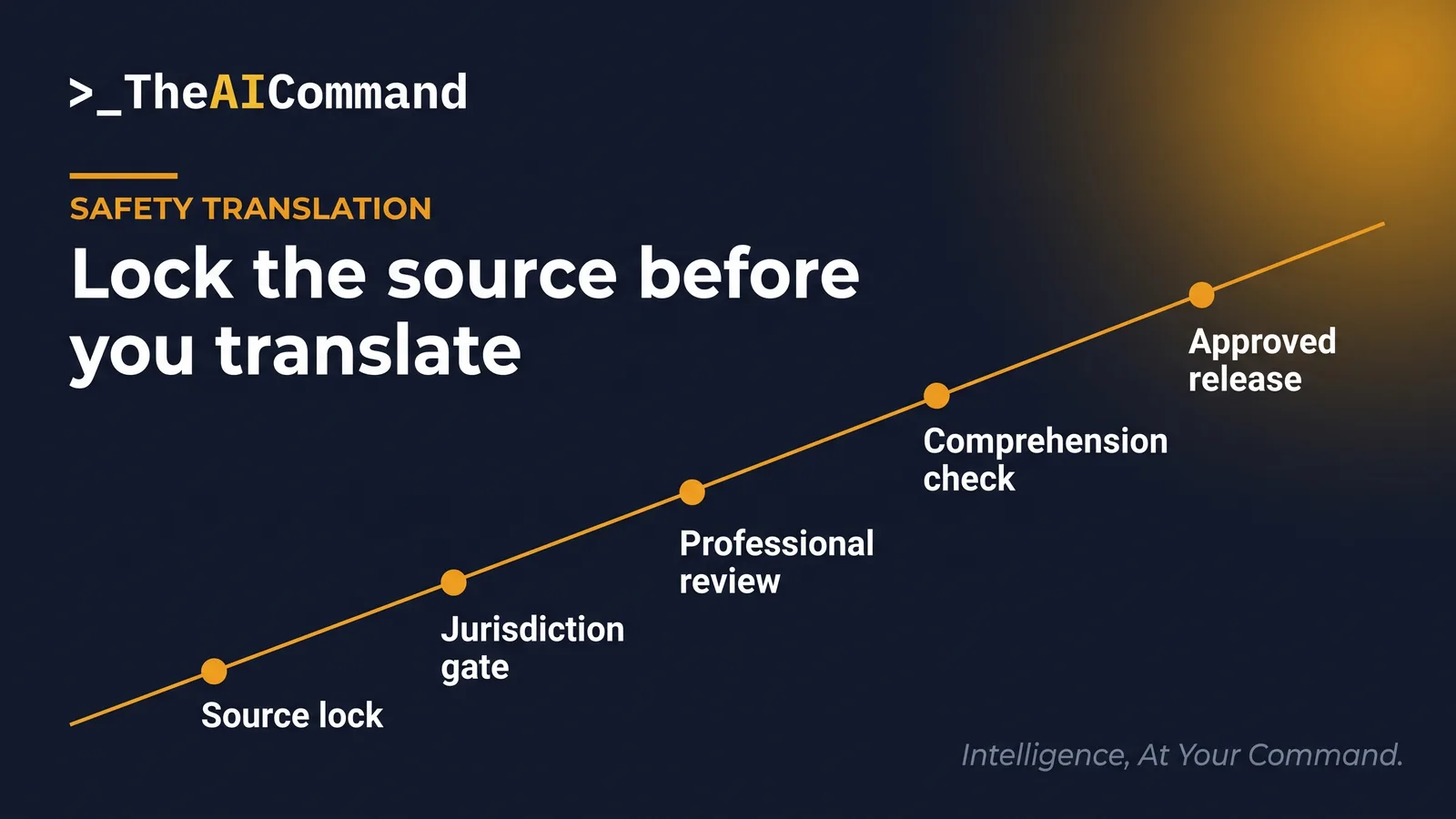
That requires three gates between AI and reliance: a source lock, an accountable language review and evidence of comprehension. Victoria needs a stricter lane because its current compliance code says machine-automated tools should not be used to translate OHS information.
This is cross-language fidelity, not training design or competence assessment.
What must be locked before anything is translated?
Start with the controlling English source. If it is wrong, stale or under consultation, translation makes the problem larger. Do not ask AI to rewrite and translate in one step because you will lose the origin of any changed instruction.
The Work Health and Safety Act 2011, current Commonwealth compilation dated 1 July 2024 requires a PCBU, under section 19(3)(f), to ensure so far as is reasonably practicable the provision of any information, training, instruction or supervision necessary to protect all persons from risks to their health and safety arising from the work. Sections 47 to 49 separately require a PCBU, so far as is reasonably practicable, to consult workers who are or are likely to be directly affected, including when decisions are made about procedures for providing information and training or when changes are proposed that may affect health or safety.
The Work Health and Safety Regulations 2011, current Commonwealth compilation dated 25 March 2025 make the communication test sharper. Regulation 39 requires information, training and instruction to be suitable and adequate having regard to the work, risks and controls. So far as is reasonably practicable, it must be provided in a way that is readily understandable by any person to whom it is provided.
Regulation 39 does not prescribe a translation technology. That is not approval for unreviewed machine translation. It leaves the PCBU with an outcome that fluent text alone cannot prove.
Safe Work Australia's November 2024 PCBU information sheet advises PCBUs to find out how workers prefer to communicate and to use multiple consultation methods. Its source document points to translated materials, diagrams, questions and task demonstrations, while warning that a bilingual worker supporting others may need workload adjustment.
Build a language profile, not a nationality proxy. Record relevant languages, dialects, scripts, literacy needs and formats. Speaking a language does not establish literacy in it.
Then create a source lock with:
- source title, owner, jurisdiction, version and an immutable identifier
- intended work group, task, channel and conditions of use
- critical instructions, prohibitions, quantities and escalation routes
- blocking questions, expiry and procedure, control, contact or legal change triggers.
The translation manifest sits beside it. Record the source identifier, locale and script, method and tool version, glossary, reviewer, exceptions, approval, channel, comprehension evidence and withdrawal trigger. This is the chain of custody for meaning.
Do not treat all text as one risk class. Emergency actions, controls, prohibitions, rights and reporting routes need the highest review level and a professional translator familiar with the context.
This is the same pattern as any other safety control that has to be verified rather than assumed. The difference here is that the failure is silent: a fluent sentence gives no signal that its meaning has moved.
Victoria is not a footnote. The Occupational Health and Safety Act 2004 is in force in version 045 from 6 August 2025. Section 21(2)(e) requires such information, instruction, training or supervision as is necessary to enable employees to perform their work safely. Section 22(1)(c) requires an employer, so far as is reasonably practicable, to provide information concerning health and safety at the workplace in such other languages as appropriate.
WorkSafe Victoria continues to publish its Communicating occupational health and safety across languages compliance code. The page explains that the guidance is not mandatory, but a duty holder who complies with it is considered to have complied to the extent it deals with a duty or obligation.
The code itself says machine-automated interpreting and translating tools cannot be guaranteed to be accurate and should not be used to translate OHS information. It advises professional translation for most OHS information, with an accredited professional for complex or technical material. It also calls for current sources, target-group comprehension checks and updates when the English source changes.
The practical Victorian rule is direct. Do not use an AI-generated translation as the OHS translation. AI may assist people to lock sources, compare versions or prepare a glossary, but worker-facing translation stays with the appropriate professional and comprehension check.
Outside Victoria, use this prompt only where your approved jurisdictional workflow permits an AI-assisted first draft. A WHS practitioner must verify the source lock and a professional translator or appropriately competent bilingual reviewer must review every target-language segment before release.
How do you prove the message survived translation?
A bilingual reviewer compares the locked source and target for safety effect. Did the hazard, action, prohibition, trigger, sequence or help route move, disappear or become optional? If so, the translation fails.
Here, competent bilingual reviewer is a workflow role, not a statutory title. Define it through language proficiency, translation direction, WHS terminology, work familiarity and independence from the machine output. Use an accredited professional translator for complex or high-consequence content.
Back-translation is only a diagnostic. A second system can repeat the error, while a literal return can distort a sound contextual choice. Do not use it alone as approval evidence.
Review critical meaning in a separate instruction ledger. For every segment, compare:
- who must or may act
- what action is required or prohibited
- when it applies and in what order
- quantities, times, thresholds and contact details
- the hazard or control the instruction addresses
- the route when the instruction cannot be followed.
Only then test comprehension with workers who will use the information. WorkSafe Victoria's code recommends asking people to restate information in their own words, identify equipment or sign meanings, answer content questions or demonstrate the task. It says employers should phrase questions so the employee is required to give more than a yes or no answer.
This is not an assessment of language ability or certification of role competence. It tests whether this approved message works for the work group and format. Focus on the instruction, not the worker's identity.
Fictional worked example: [BANK_NAME] updates its aggressive-customer procedure for [CONTACT_CENTRE_TEAM]. An AI draft renders "end the interaction when the threat is immediate" in [TARGET_LANGUAGE] as "after the threat occurs". Back-translation misses the timing shift.
The instruction ledger exposes the change because the trigger no longer matches the locked source. A professional translator corrects it. In a comprehension check, workers explain in their own words when to disconnect, whom to contact and where the duress route sits. The WHS owner records results by language and channel, not worker performance, and fixes any pattern of misunderstanding before release.
Do not turn one bilingual colleague into an unpaid control. Safe Work Australia flags workload adjustment. WorkSafe Victoria limits multilingual facilitators to general, simple and low-risk matters and requires employers to check the facilitator is confident and willing and that employees consent.
Use this prompt to draft a comprehension-check pack from an approved translation. A WHS practitioner and professional language reviewer must approve the questions and expected meanings, and a person must conduct the check with affected workers before reliance.
Record misunderstanding as evidence about the communication control, not as a worker defect. Patterns may point to translation, literacy, layout, supervisor explanation or the English source.
Safe Work Australia's current AI risk guidance applies the ordinary identify, assess, control, monitor and review process, the same cycle that should already be routing triggers into your risk register, in consultation with workers and representatives. It identifies human oversight and audits as possible controls. The manifest makes that oversight testable; people still decide release.
Do this Monday
- Quarantine uncontrolled translations. Find multilingual safety PDFs, intranet pages, chatbot answers, videos and branch cards. Mark any item without a current source ID, reviewer and owner as not approved for reliance.
- Set the jurisdiction gate. Route Victorian OHS translations to an appropriate professional translator. For every other jurisdiction, verify the enacted requirements and document whether AI may assist a non-reliance draft.
- Lock one high-consequence source. Choose an emergency, customer-aggression or incident-reporting procedure. Freeze its version, critical instructions, contacts and change triggers before translation begins.
- Build the manifest. Link every language version to the exact source and record method, reviewer, glossary decisions, approval, comprehension evidence and withdrawal trigger.
- Test with the work group. Consult affected workers and HSRs on language and format, then use open questions or a safe demonstration. Correct the communication before release if meaning does not land.
- Install the change alarm. When the English source, control, contact, law or work group changes, automatically withdraw or flag every dependent translation for human review.
Bottom line
Translation is a safety control only when meaning, currency and comprehension survive the journey. Lock the source, preserve the manifest and put the right language professional between machine output and worker reliance. In Victoria, keep AI out of the worker-facing OHS translation lane. The duty and the release decision remain human.
This article is general information and education only. It is not legal, compliance, financial or professional advice. Obligations vary by organisation and circumstance. Verify current requirements against the primary sources cited and seek advice specific to your situation.
References
- Federal Register of Legislation, Work Health and Safety Act 2011, current text: https://www.legislation.gov.au/C2011A00137/latest/text
- Federal Register of Legislation, Work Health and Safety Regulations 2011, current text: https://www.legislation.gov.au/F2011L02664/latest/text
- Safe Work Australia, PCBU information sheet: Communicating with migrant and multicultural workers about work health and safety: https://www.safeworkaustralia.gov.au/doc/pcbu-information-sheet-communicating-migrant-and-multicultural-workers-about-work-health-and-safety
- Safe Work Australia, Communicating with migrant and multicultural workers about work health and safety, source PDF: https://www.safeworkaustralia.gov.au/sites/default/files/2024-11/04112024_communicating_with_migrant_and_cald_workers-pcbu-english.pdf
- Victorian legislation, Occupational Health and Safety Act 2004, current in-force version 045: https://www.legislation.vic.gov.au/in-force/acts/occupational-health-and-safety-act-2004/045
- WorkSafe Victoria, Compliance code: Communicating occupational health and safety across languages: https://www.worksafe.vic.gov.au/resources/compliance-code-communicating-occupational-health-and-safety-across-languages
- WorkSafe Victoria, Communicating occupational health and safety across languages compliance code, July 2022 PDF: https://content-v2.api.worksafe.vic.gov.au/sites/default/files/2022-07/ISBN-Compliance-code-communicating-OHS-across-languages-2022-07.pdf
- Safe Work Australia, Artificial intelligence (AI) and digital technologies - Managing risks: https://www.safeworkaustralia.gov.au/safety-topic/hazards/digital-technologies-ai/managing-risks
TheAICommand. Intelligence, At Your Command.