
AI can prepare the agenda, capture discussion and draft the minutes. It cannot be the authority for what the group decided. Use a named human decision owner and a compact record that preserves evidence, caveats, dissent and action.
Let AI prepare and compress. Do not let it certify. A meeting assistant can help structure a pre-read, identify unanswered questions and produce draft notes, but a named person must confirm what was decided and what happens next.
That distinction matters because a fluent recap is not proof of an accurate record. The Office of the Australian Information Commissioner says generative AI can produce inaccurate or false results, and that organisations should embed appropriate human oversight when using commercial AI products involving personal information (OAIC). A missed condition in a bank risk meeting, insurance claims forum or superannuation operations committee can change the meaning of the decision.
The practical fix is a two-layer meeting. AI occupies the assistive layer. It prepares, listens where approved and drafts. People occupy the authoritative layer. They frame the question, weigh the evidence, decide, preserve dissent and approve the record.
What job should AI have in the meeting?
Give AI three bounded jobs: prepare, observe and compress. None includes deciding.
Before the meeting, use it to turn verified material into a decision agenda. Ask what evidence is missing, which trade-offs need attention and who must be present. Keep the original papers available. The model's output is navigation, not a substitute for reading them.
There is promising but limited evidence for this kind of preparation. A 2025 ACM study used a generative AI prototype to help 18 employees reflect on the purpose, barriers and success conditions of upcoming meetings. Participants reported clearer purposes and changes to preparation, communication and plans, but the study was a small technology-probe study, not proof that an AI pre-read improves decisions across workplaces (Microsoft Research).
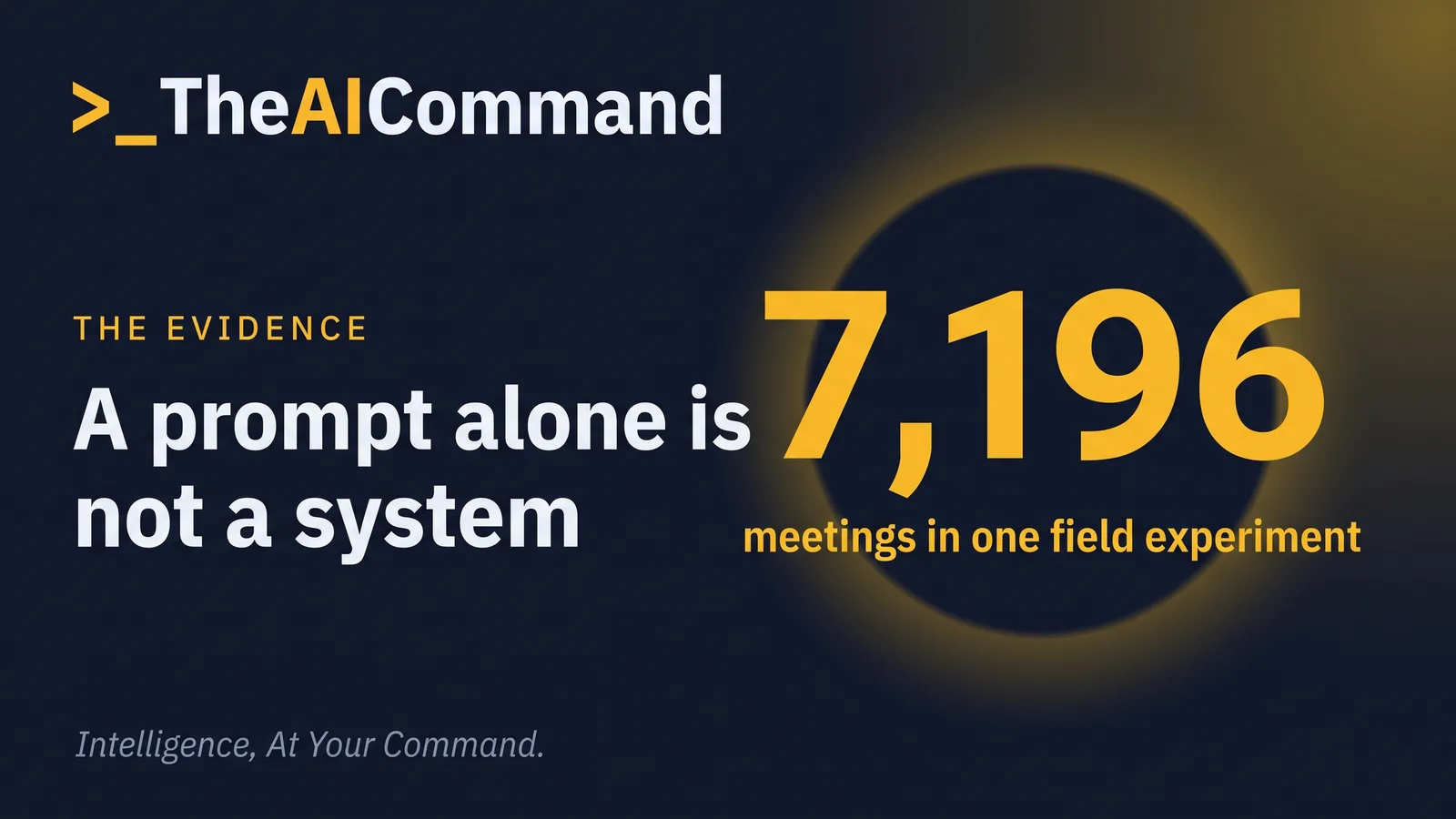
A larger preregistered field experiment offers a useful warning against easy claims. It involved 361 employees and 7,196 meetings. A brief pre-meeting goal prompt did not produce a statistically significant improvement in reported meeting effectiveness. Awareness and behaviour improved across both groups, and the researchers concluded that repeated post-meeting reflection may itself have acted as an intervention (Microsoft Research). The lesson is not that preparation is pointless. It is that a prompt alone is not a meeting system.
Use this to turn an approved, non-sensitive pre-read into a decision agenda. The chair must verify every item against the source material and set the final decision question.
During the meeting, an approved assistant can identify candidate decisions, commitments and open questions. Tell participants how it is being used and apply your organisation's access, retention and recording settings. Nominate a human decision recorder as well. That person listens for the exact decision and asks the chair to resolve ambiguity while everyone is still present.
Who confirms what was actually decided?
The person with authority for the decision confirms it. If authority sits with a committee, the chair confirms the record against the committee's governance rules. The AI operator, meeting organiser and model are not default decision owners. If your team has already mapped decision rights for AI-enabled work, the meeting record is where that map gets exercised.
Australia's National AI Centre advises organisations to assign, document and communicate accountability, maintain human oversight and keep clear records of governance decisions, testing, incidents and monitoring (National AI Centre). APRA's 30 April 2026 industry letter similarly expects regulated entities to establish ownership and accountability across the AI lifecycle, with human involvement and accountability for high-risk decisions (APRA).
Those sources address AI governance at system and entity level. The practical inference for a team meeting is narrower: do not allow an AI-produced artefact to create doubt about which person or forum exercised the authority. Doubt of that kind is exactly what makes it hard to work out who carries it when AI gets something wrong.
A transcript cannot solve that problem. It records what people said, subject to the tool's accuracy. It does not establish which proposal prevailed, whether a caveat was accepted, or whether a comment was a decision, an option or a question. Conventional minutes can fail in the same way when they record discussion but not the decision's operating conditions.
Use a six-field decision control record instead:
- Decision: the exact conclusion, written as an action or approved position.
- Evidence: the papers, data and advice relied on, including version or date.
- Conditions: caveats, limits, controls and stop triggers attached to the decision.
- Authority and ownership: the person or forum that approved the decision, followed separately by the person responsible for delivery.
- Dissent: material disagreement and unresolved questions, without manufacturing consensus.
- Execution: the due date, review date and authoritative system where the record will live.
The AI can draft those fields. It must not fill gaps by inference. Use [NOT RECORDED] when the source notes do not support an entry, then send the gap back to the chair.
Privacy remains a gate, not a footnote. For organisations covered by the Privacy Act, the OAIC says personal information captured for AI-generated meeting minutes must be reasonably necessary for the organisation's functions or activities. If the system collects sensitive information, participant consent is required unless an exception applies. Because meeting content is uncertain, the OAIC says seeking consent is best practice. Clear notice and any consent are also relevant to whether the collection is lawful and fair. The OAIC separately recommends, as a matter of best practice, not entering personal information, particularly sensitive information, into publicly available generative AI tools (OAIC). The current compilation of the Privacy Act 1988, C2026C00227, is effective from 4 June 2026. Confirm the approved tool, permitted data, participant notice and any consent requirement, access and retention arrangements before using transcription or generated notes.
What should the decision record contain?
Here is a fictional financial-services example. All names and identifiers are merge-field placeholders.
Meeting: [MODEL_RISK_FORUM] Decision: Run a limited trial of AI-assisted complaint-theme coding using approved, de-identified historical material. The tool will not determine or recommend an outcome for any customer. Evidence: [TEST_REPORT_VERSION], [PRIVACY_REVIEW_DATE], [RISK_ASSESSMENT_ID]. Conditions: Approved enterprise environment only; every output reviewed by [HUMAN_REVIEW_ROLE]; pause the trial if [STOP_TRIGGER] occurs; no live customer decisions. Authority and ownership: Decision confirmed by [AUTHORISED_CHAIR_ROLE]. Delivery owned by [PILOT_OWNER_ROLE]. Dissent: [DISSENT_SUMMARY] remains open. [ADVISER_ROLE] will answer [UNRESOLVED_QUESTION]. Execution: Start [START_DATE]. Review [REVIEW_DATE]. Store the approved record in [AUTHORITATIVE_REGISTER].
Notice what is absent. There is no generic claim that the group “supported exploring AI”. There is no summary of who spoke most. The record says what can happen, what cannot happen, why, under whose authority and when the decision returns for review.
Use this after the meeting to draft the record. The chair or authorised decision-maker must compare every field with the approved notes and resolve all gaps before the record is issued.
Before release, the human approver checks that the record names a decision rather than a topic, links to the evidence actually considered, preserves material conditions, identifies both authority and delivery ownership, records unresolved dissent, and specifies the next control point. If any item is missing, the meeting is not administratively complete.
Do this Monday
- Choose one recurring decision meeting. Start with a risk, operations, claims, technology or product forum where decisions regularly create work. Do not begin with a sensitive employment or individual customer meeting.
- Set the AI boundary before the invitation goes out. Confirm the approved tool or equivalent, whether the proposed personal-information collection is reasonably necessary, participant notice and any consent requirement, access, retention and deletion arrangements. Turn transcription off if those controls are not settled.
- Rewrite the agenda around purpose. For each item, state
DECISION,ADVICE,INFORMATIONorEXPLORATION. OnlyDECISIONitems require a decision control record. This prevents a discussion from being rewritten later as approval. - Name the human recorder and confirmer. The recorder captures candidate decisions and missing fields. The chair or authorised decision-maker confirms the final wording. Put both roles on the agenda.
- Close the loop within one business day. Use AI to draft the six fields, resolve
[NOT RECORDED]items with the chair, give participants a defined correction window, and place the approved record in the system that governs the work.
Run the method for four meetings, then inspect the records. Count missing owners, missing evidence, unresolved conditions and decisions reopened because the original wording was unclear. Those are process signals, not a score for the AI tool.
Bottom line
An AI meeting assistant can assist with clerical drafting, but it cannot turn discussion into authority. Give it bounded preparation and drafting work, then require a named person to approve a six-field decision control record. In regulated work, the useful artefact is not the longest transcript or smoothest summary. It is a short, attributable record that preserves the decision, evidence, conditions, authority, ownership, dissent and next control point.
This article is general information and education only. It is not legal, compliance, financial or professional advice. Obligations vary by organisation and circumstance. Verify current requirements against the primary sources cited and seek advice specific to your situation.
References
- Microsoft Research, ACM CHIWORK 2025 study on AI-assisted prospective reflection before meetings. https://www.microsoft.com/en-us/research/publication/what-does-success-look-like-catalyzing-meeting-intentionality-with-ai-assisted-prospective-reflection/
- Microsoft Research, ACM CHI 2026 preregistered field experiment on workplace meeting goals. https://www.microsoft.com/en-us/research/publication/nudging-attention-to-workplace-meeting-goals-a-large-scale-preregistered-field-experiment/
- Office of the Australian Information Commissioner, “Guidance on privacy and the use of commercially available AI products”. https://www.oaic.gov.au/privacy/privacy-guidance-for-organisations-and-government-agencies/guidance-on-privacy-and-the-use-of-commercially-available-ai-products
- Federal Register of Legislation, Privacy Act 1988, latest compilation C2026C00227. https://www.legislation.gov.au/C2004A03712/latest/details
- National AI Centre, “Guidance for AI adoption: implementation guidance”. https://www.ai.gov.au/staying-safe-and-responsible/essential-ai-practices/guidance-ai-adoption-implementation-guidance
- Australian Prudential Regulation Authority, “APRA Letter to Industry on Artificial Intelligence (AI)”, 30 April 2026. https://www.apra.gov.au/news-and-publications/apra-letter-industry-artificial-intelligence-ai
TheAICommand. Intelligence, At Your Command.