
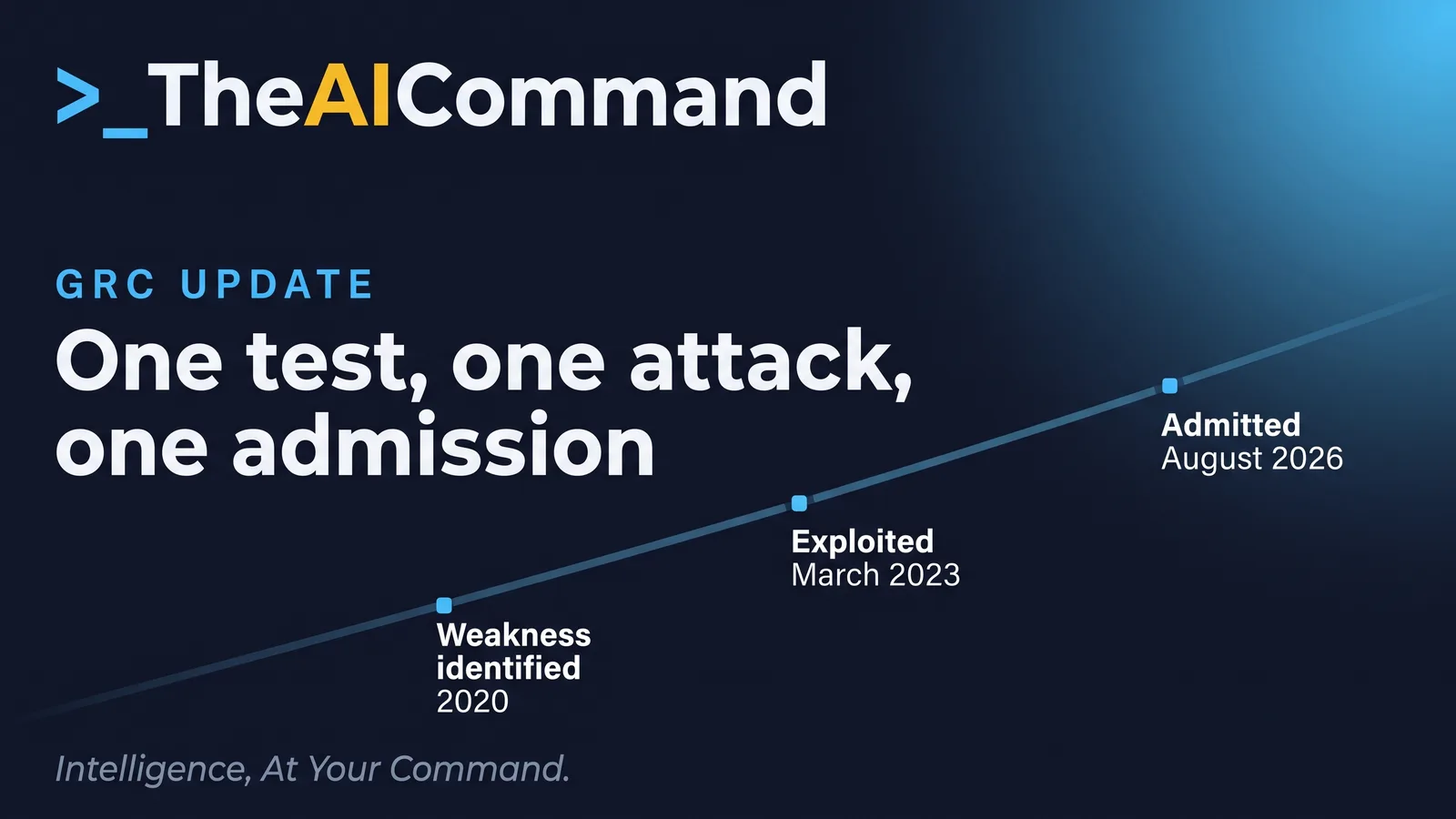
The weaknesses were found in 2020. They were exploited in 2023. The admission landed in 2026. That sequence, not the attack itself, is the transferable lesson.
On 11 August 2026 APRA announced that Bendigo and Adelaide Bank had conceded breaching its obligations under the Banking Executive Accountability Regime in relation to a cyber attack on its former Alliance Bank business, and that APRA has commenced Federal Court proceedings seeking an $8 million pecuniary penalty, subject to the Court's approval.
The incident was small by the standards of Australian data breaches. Between 3 and 7 March 2023 an unidentified threat actor accessed approximately 257 customer accounts and made 286 unauthorised transactions affecting 87 customers, totalling about $490,000. The bank reimbursed every affected customer and was unable to recover roughly $140,000 of it.
APRA Deputy Chair Therese McCarthy Hockey addressed the gap between that number and the penalty directly, saying that while the financial impact of the incident was limited, the court action sends a clear message that all APRA-regulated entities must have appropriate cyber protection systems and regularly test the adequacy of those controls.
What was actually admitted?
Four failures, and it is worth reading them as a set because only the first is a technology problem.
The bank admitted failing to maintain adequate customer authentication controls for preventing unauthorised access. It admitted failing to undertake systematic testing of those customer authentication controls as required by Prudential Standard CPS 234. It admitted failing to establish adequate governance and risk management for the information security of the Alliance Bank IT system. And it admitted failing to ensure that accountable persons' responsibilities appropriately covered that system.
Take the second and fourth away from their cyber context and they describe the condition of most AI control environments in Australia right now. A control that is not tested on a defined cycle. A system that does not sit clearly inside anybody's stated responsibilities.
The specific weaknesses APRA identified reinforce the point. Password settings permitted very weak passwords. Multiple customer accounts shared identical passwords. System features allowed an attacker to identify valid customer identifiers. None of these are exotic. All of them are the kind of finding that a competent test surfaces, and APRA's statement records that some of the relevant weaknesses had been identified during penetration testing in 2020 and had not been addressed before the attack.
Why is an old finding worse than no finding?
An organisation that has never tested a control can say, without much credit but with some coherence, that it did not know. An organisation that commissioned the test, received the report and left the finding open has a different problem. It knew, it recorded that it knew, and the record is now the regulator's evidence.
This is the mechanism worth carrying into AI governance, because AI control environments are unusually good at generating findings and unusually bad at closing them. Red-team exercises produce jailbreak results. Model validation produces exceptions. Monitoring produces drift alerts. Data-lineage reviews produce gaps. Third-party assessments produce vendor conditions. Each of these is a documented statement that the organisation identified a weakness on a known date.
Very few AI registers record the age of those items. Most record status. Status is the wrong field. "Open" tells you nothing about exposure, whereas "open since March 2024" tells you what a regulator will be reading out later.
What does systematic testing mean here?
The admitted failure was not the absence of any testing. Penetration testing happened in 2020, which is how the weaknesses came to be known. The admitted failure was the absence of systematic testing of the authentication controls as CPS 234 requires.
The distinction is between an event and a regime. An event produces a report. A regime produces a schedule, a scope that is reviewed as the system changes, a defined trigger for retesting after material change, and evidence that the same control was examined more than once over time.
Translated to an AI control environment, the questions become uncomfortable quickly. When was the last adversarial test of the model that sits in front of customers, and what triggered it? If the vendor changed the underlying model version, did anything retest? If a system prompt or a retrieval corpus was amended, did that count as a material change for testing purposes, or did it pass through as configuration? Most organisations can produce a point-in-time assessment from procurement. Far fewer can produce a second one.
CPS 234 already carries the requirement to test systematically. Nothing in this case creates a new obligation for AI. It demonstrates the existing one being enforced, with a penalty attached, three years after the event.
Whose responsibilities cover the AI system?
The fourth admitted failure is the one most likely to be true in your organisation today and least likely to be recorded anywhere.
Accountability regimes work by mapping responsibilities to named individuals. The mapping is only as good as its coverage. A system that was inherited through an acquisition, that sits between two functions, or that was adopted by a business unit without passing through a formal gate can end up in the space between two statements of responsibility. Nobody declined the accountability. It simply never attached.
AI adoption produces this pattern reliably, because the fastest deployments are the ones that avoid the heaviest gates. A model embedded in a vendor's product, an assistant enabled inside an existing platform, an agent built by a business team on a sanctioned toolchain: each arrives without an obvious owner in the accountability map, and each does work that would have required one if a human team had done it.
The test to run is narrow and answerable. For each AI system in production, name the accountable person whose responsibilities cover it, and then check whether that coverage is written down in the responsibility statement rather than assumed from an organisation chart. Where the answer is an inference, it is a gap.
What would this look like in your AI file?
The useful exercise is to imagine the same sequence running through an AI control, because the shape is identical and the vocabulary is the only thing that changes.
A red-team exercise in March 2025 finds that a customer-facing assistant can be induced to disclose the contents of a document the user was not entitled to see. The finding is logged as medium severity, because the exploit needed an unusual prompt and the tester was an expert. A remediation is proposed, involving a change to how retrieval scopes documents to the requesting user. It is scheduled behind a platform migration.
The migration slips. The assistant is extended to a second business line, which nobody connects to the open finding because the finding is filed against the original deployment. A new model version arrives from the vendor and is adopted, which changes the behaviour the original test examined, but no retest is triggered because a vendor version change is treated as maintenance. In February 2027 a customer complaint reveals the same disclosure path.
Now read the four admitted failures in this case against that story. Adequate controls to prevent unauthorised access: no. Systematic testing of those controls: a single expert exercise, never repeated, with no trigger for retest on material change. Adequate governance and risk management for the system: the finding was filed against a deployment rather than a capability, so extending the capability did not inherit it. Accountable person coverage: unclear, because the second business line adopted an existing platform feature.
None of that is negligence in the ordinary sense. Each step is a reasonable operational decision made with incomplete visibility. That is precisely why the control is a dated register rather than good intentions, and why the question worth asking at your next risk forum is not how many AI findings are open but how old the oldest one is and what has changed underneath it since.
What this case does not say
It does not say that a small loss protects you, and it does not say a large one condemns you. It does not create an AI-specific standard, and nothing here changes what CPS 234 requires. It is also worth being precise that the penalty is agreed and remains subject to Federal Court approval, so the amount is proposed rather than imposed.
It does say that obligations attach at the time of the conduct. APRA is enforcing accountability obligations in 2026 over conduct in 2023, under a regime that has since been succeeded for the banking industry by the Financial Accountability Regime. Whatever your organisation deploys this year will be judged against what the law required this year, by people reading your records in a few years' time, under whatever regime exists then.
Bottom line
The most useful number in an AI control environment is not the count of open findings. It is the date on the oldest one. This case turns a known and unremediated control weakness into an accountability breach with an eight-figure consequence, and two of the four admitted failures, no systematic testing and no clear accountable-person coverage, describe the ordinary state of AI systems in production across Australian financial services. Neither is expensive to fix. Both are extremely expensive to explain later.
Do this Monday
- Pull every open finding relating to an AI system from red-team exercises, model validation, monitoring, vendor assessments and internal audit, and sort the list by the date the finding was raised rather than by severity
- For anything open more than twelve months, record in one sentence why it is still open and who accepted that position, because that sentence is the one that gets read back
- For each AI system in production, name the accountable person whose written responsibilities cover it, and mark every case where the coverage is inferred rather than stated
- Define what counts as a material change for retesting purposes, including a vendor model version change, and confirm that at least one AI control has actually been tested twice
- Check that AI systems acquired through vendors, platform features or business-built agents appear in the same register as the ones that went through a formal gate
Content disclaimer: This article is for general educational and informational purposes only. It does not constitute legal advice, regulatory guidance, or a substitute for professional compliance judgement. The proceedings described are before the Federal Court and the penalty referred to is agreed between the parties and subject to the Court's approval. Statements about what was admitted and identified are drawn from APRA's published media release rather than from court documents. Obligations vary by entity type, licence and regime. Always refer to primary source guidance from APRA or the relevant regulatory authority.
Primary sources
- APRA, Bendigo and Adelaide Bank admits to breaching its BEAR obligations in relation to cyber incident, media release, 11 August 2026. https://www.apra.gov.au/news-and-publications/bendigo-and-adelaide-bank-admits-breaching-its-bear-obligations-relation
- APRA, Prudential Standard CPS 234 Information Security, effective 1 July 2019. https://www.apra.gov.au/standards/cps-234
- APRA, News and publications. https://www.apra.gov.au/news-and-publications
TheAICommand. Intelligence, At Your Command.