Most organisations now have an AI trial somewhere. Far fewer have a workflow they would trust on a busy Tuesday, with a new staff member running it and an auditor asking how the output was checked. October 2026 made that gap easier to see. Vendors shipped cheaper models and added verification controls, two Australian bodies began requiring people to check AI-assisted documents, and one requires disclosure of AI use in every affected filing, and the month's adoption surveys showed use spreading much faster than deep integration. The short answer for November: treat reliability as a design task. A trial shows that a tool can do something once. A workflow says who supplies the inputs, what the model is allowed to do, how the output is checked, who decides, and what is recorded.
This edition covers developments published, released or taking effect between 1 and 30 October 2026, with a few earlier or later dates included where they set the timing for November and December. Every source was checked against the publisher's own page, with the research cutoff recorded at 13:25 Sydney time on 30 October. Product availability is described as stated by the vendor at announcement. Vendor performance figures are attributed to the vendor, and no hands-on comparison is claimed.
October 2026 in AI: what changed
Models became cheaper and more specialised
Anthropic released Claude Haiku 5.5 on 7 October, available across its own platform and the major cloud providers. Anthropic positions it for narrowly scoped, high-volume work such as summaries, classification and sub-tasks inside larger agent workflows, and says Sonnet 5.5 and Opus 5.5 remain the better choices for complex agentic coding. It estimates Haiku 5.5 costs about 75% less to run than Haiku 4.5 on average, and on the same day halved the price of cache reads for Sonnet 5.5. These are vendor figures, and a new tokenizer means a task can use slightly more tokens than before.
OpenAI moved the Chat experience in ChatGPT to its GPT-6 models on 7 October, with interactive answers that can include charts, forms and buttons, starting with paid plans. It said the models behind ChatGPT Work and Codex did not change in that release. Later in the month OpenAI introduced GPT-6.1 Terra, a cheaper and faster model aimed at computer use and writing, available in ChatGPT Work, Codex and the API for listed plans. OpenAI reports that, on its own internal set of error-inducing prompts, the error rate at low effort fell from 53.6% with the previous Terra model to 16.7%, and at maximum effort fell by 18 percentage points to 4.3%. That is an internal, unpublished benchmark, so it is a reason to test rather than a result to rely on.
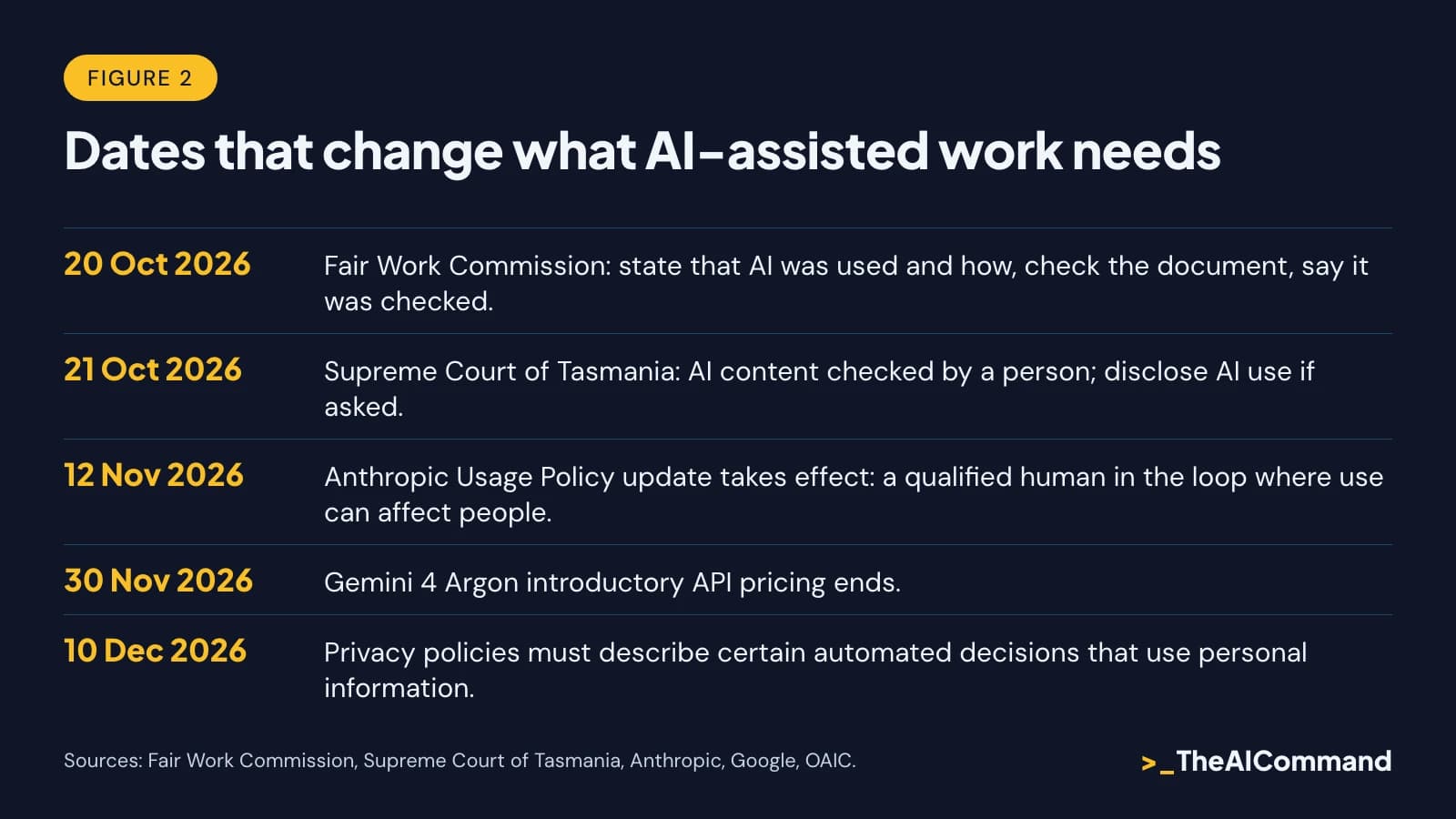
Google released Gemini 4 Argon on 13 October to developers through its API and to paid subscribers in the Gemini app. Its introductory API price runs to 30 November 2026 and then doubles, which matters for anyone building a business case on October pricing. On 28 October Google announced Gemini 4 Carbon but limited access to a subset of cyber defenders, then trusted partners, before any wider release. Mistral released Mistral Large 4 as an API preview on 6 October and published the open weights on 29 October.
None of these pages states Australian availability specifically. Where a vendor says "global", that is the claim; where it names no region, availability here needs confirming in the account before anyone plans around it.
Vendors added the controls that make output checkable
The more useful October releases for working teams were less visible. Google added cell-level web citations to Fill with Gemini in Google Sheets, so each AI-generated cell can show the web source behind it, with requests of up to 3,000 cells. Google Vault can now filter and export Gemini conversations in Workspace for eDiscovery, for supported editions and only where conversation history is on. Google also delayed skills in Workspace "until further notice" while it works to launch them in a safe and reliable manner. A vendor slowing its own release for reliability is worth noting when a project plan assumes a feature date.
Microsoft described a new enforcement layer in Microsoft 365 Copilot that treats untrusted content, starting with external communications, differently from trusted content, to reduce the risk of indirect prompt injection. That is the attack in which instructions hidden in an email or document try to steer the assistant. It needs an administrator setting, availability varies by tenant, and Microsoft says no single mitigation stops every attack. Microsoft also added role-based plugins and connectors to Copilot Cowork, with availability decided by administrators.
Anthropic opened a research preview of Claude Duet, an agent app built for professionals and small-business owners that prepares work in the background and asks for approval before it sends a message, makes a payment, signs a document or deletes anything. Anthropic says the early version may misread a thread or misjudge what is urgent. The preview is limited to Pro and Max users in the United States, through a waitlist. Anthropic also published an updated Usage Policy, taking effect on 12 November, which restates that where use can affect a person's health, legal rights, finances, livelihood or access to essential services, a qualified human must be able to review and change the recommendation, and the affected person must be told AI was used. OpenAI published an updated Model Spec on 29 October and said plainly that current models do not yet fully reflect it. Both documents describe intended behaviour, not a guarantee.
Australian tribunals and courts set disclosure rules
From 20 October, a Fair Work Commission guidance note requires anyone who uses generative AI to prepare a document in a Commission case to state that it was used and how, to check the document, and to state that the check was done. Using AI only to fix spelling or grammar or to format a document is excluded. The possible consequences of non-compliance include a document being given less weight or disregarded, a costs order, or the case being dismissed. The Commission's 2025 to 2026 annual report records 53,666 lodgments, up from 44,075 the year before, and its President infers that generative AI tools have contributed. That link is an inference from timing and from the language of filings, not a measured share.
The Supreme Court of Tasmania began applying generative AI guidelines for court users on 21 October. They do not require users to certify AI use, but users must disclose it if asked, and AI-generated content must be checked by a person, not solely by an AI tool. Overseas, a United States tribunal found that 35 of the 42 legal or record citations in a federal agency's brief were fictitious, erroneous or irrelevant, and said a generative AI tool may have been used. An independent researcher's database of court and tribunal decisions dealing with AI-hallucinated material listed 2,241 decisions worldwide as at 29 October, 112 of them Australian. It is a curated, cumulative count, not an official statistic.
Work health and safety and government
Safe Work Australia announced the publication of its Best Practice Review of the model work health and safety laws on 19 October, with 21 recommendations. One calls for a national strategy on artificial intelligence and other digital technologies, including new regulations or codes where gaps are found. The review takes the view that the existing primary duty already covers the situation addressed by the New South Wales digital work systems amendment, and does not recommend copying that amendment into the model laws. These are recommendations, not adopted law, and the core New South Wales digital work systems provisions were still marked as not commenced when checked on 29 October.
In the Australian Public Service, the AI Review Committee set out its role on 7 October: non-binding expert advice on selected AI use cases before deployment and review of agencies' responses to serious AI incidents, with agencies remaining accountable for their decisions. The Digital Transformation Agency published version 2.1 of its policy for the responsible use of AI in government on 21 October, described as minor updates. In Parliament, the Online Safety Amendment (Digital Duty of Care) Bill 2026 passed the House of Representatives on 28 October. Its explanatory memorandum says the definition of an online service includes services that generate material using AI. It has not passed the Senate and is not law.
Internationally, the European Union published its first harmonised standard under the AI Act, for AI quality management systems, with the implementing decision appearing in the Official Journal on 14 October. Providers that apply it gain a presumption of conformity with the Act's quality management requirements, which matters to Australian providers selling high-risk systems into the European market.
Adoption is wide, depth is not
CPA Australia's 2026 Business Technology Report, released on 9 October, found that 88% of Australian businesses in its survey use AI but only 10% have deeply embedded it across their operations, and 28% reported using agentic AI. Across all five markets surveyed, 29% of organisations allowed AI use with little oversight or no guidance, and a further 19% had expectations that were undocumented or inconsistently applied. The survey is of accounting and finance professionals reporting on their own organisations, not an official statistic.
The Jobs and Skills Report 2026, published by Jobs and Skills Australia in October, reproduced National AI Centre data showing adoption rising from about 31% of firms with fewer than five employees to almost 70% of firms with 200 to 500 employees. The Tech Council of Australia, an industry body whose report was supported by technology companies, put small and medium business use at about one in four, with 5% using AI broadly across the organisation. Its estimate of up to $93 billion a year in additional value is a modelled scenario, not an observed result. The pattern across the three sources is consistent even where the figures differ: many organisations have started, and few have built AI into how the work is reliably done.
Practical takeaways
For professionals
Assume every document may face the question the Fair Work Commission now asks: was AI used, how, and who checked it? Keep a short record with each AI-assisted piece of work: the tool, the task given to it, the sources supplied, and what was checked against the original. For GRC, HR, workers compensation and WHS work, check every citation, section reference, date and figure against the primary source before it leaves your hands. A model that cites a page has not proved that the page says what the output claims, so open it. Where a decision affects a person's entitlements, employment or safety, the model drafts and organises; a qualified person reviews and decides. Workers compensation material stays de-identified, using placeholders such as [CLAIMANT_NAME], [CLAIM_NUMBER] and [DATE_OF_BIRTH] instead of real details.
For leaders
The surveys point at the leadership gap: use is widespread, guidance often is not. Before approving another pilot, ask for three things in writing: the task the workflow performs, the check that proves an output is right, and the person accountable for the decision it supports. Treat new vendor controls, such as citation display, conversation export and handling of untrusted content, as configuration work for your administrators, because several of October's controls are off or partial until someone enables them. Put recurring disclosure into your templates now rather than case by case. And when a vendor price or model changes, as Gemini 4 Argon's introductory pricing will at the end of November, re-test the workflow rather than assume the output is unchanged.
For small-business owners
Start with one repeated task that costs real time each week and has a clear right answer you can check, such as categorising transactions for review, drafting replies to common enquiries, or summarising supplier terms. Write the steps down before adding AI, then let the tool do one step at a time. Keep anything that sends money, signs, deletes or commits you to an agreement behind your own approval, the same boundary Anthropic has built into Claude Duet. Choose the smaller, cheaper model for routine sorting and drafting, and check a sample of outputs every week. If a figure in a modelled report sounds large, remember that a scenario is not a forecast for your business.
Deeper analysis: why trials stall and what makes a workflow hold
A trial proves possibility, not reliability
A typical trial asks whether a tool can do a task. Someone enthusiastic picks a good example, supplies clean inputs, reads the output closely and judges it impressive. That is a fair test of possibility. It says little about what happens on the twentieth run, with a messy input, a time-pressed reviewer and a model version that changed last week. The October surveys describe organisations stuck at exactly this point. Across the five markets in CPA Australia's survey, more businesses reported using AI across several areas than a year earlier, while the share reporting deep embedding did not rise, which is what happens when trials multiply without becoming the standard way the work is done.
Trials also tend to measure the wrong thing. Speed is easy to see and attractive in a business case. Correctness is harder, because it needs someone to check the output against a source the tool did not choose. The FLRA decision is an extreme example of what goes wrong when speed is measured and correctness is assumed: a brief that read as finished failed when its citations were checked. The Commission's new rule and the Tasmanian guidelines answer that failure the same way. They do not ban the tools. They require the person who files the document to check it and to be able to say how it was made.
What a reliable workflow has
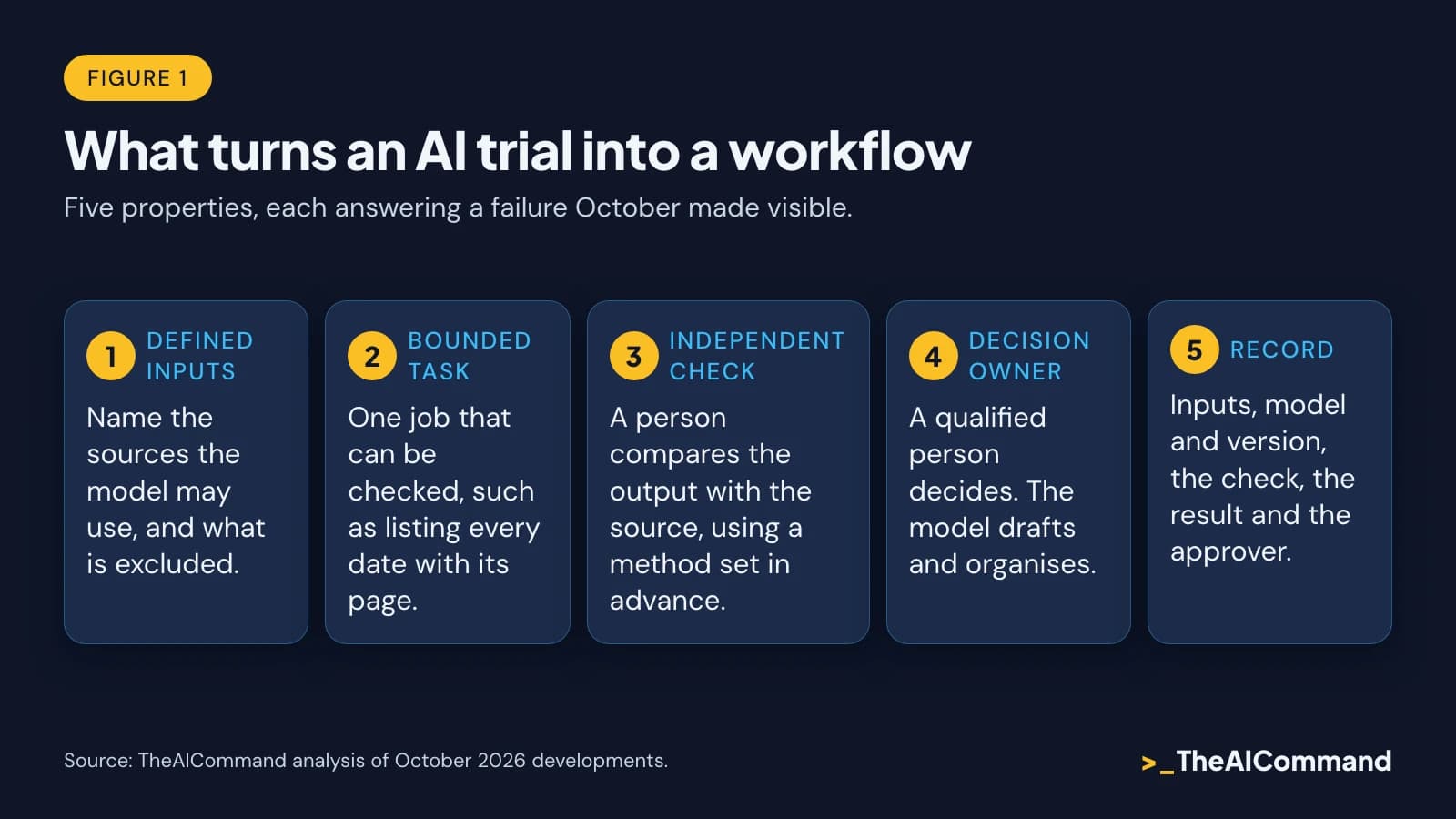
A workflow that holds under ordinary pressure tends to have five properties, and each answers a failure that October made visible.
First, defined inputs. The workflow says which documents, records or data the model may use and what must be excluded, especially personal, health and claims information. The Microsoft enforcement layer exists because content arriving from outside can carry instructions as well as information. A workflow that names its inputs has already made the most important part of that decision.
Second, a bounded task. The model is asked to do one thing that can be checked: extract, classify, summarise against stated headings, draft from a supplied source. "Review this matter and advise" is not a bounded task. "List every date in these three documents with its page number" is.
Third, a check that does not depend on the model. Someone compares the output with the source, using a method written down in advance. Cell-level citations in Sheets make that comparison faster; they do not perform it. Sampling is acceptable for low-risk, high-volume work, provided the sample size and what counts as a failure are decided before the results come in.
Fourth, a named decision-maker. The October sources point the same way from different directions. Anthropic's usage policy requires that, where outcomes affect people, a qualified person who can review and change the output is in the loop and the affected person is told AI was used. The Fair Work Commission and Tasmanian rules make the person filing a document responsible for checking it and for disclosing or explaining AI use to the tribunal. The model can prepare the file, compare the documents and draft the reasons. It does not decide liability, entitlement, discipline or whether a hazard is controlled.
Fifth, a record. Each run leaves a short trace: inputs used, model and version, the check performed, the result and who approved it. The record makes the Fair Work Commission disclosure easy to complete, supports an internal audit, and shows when a model or price change has altered the output. Google Vault's new export for Gemini conversations is a vendor recognising that organisations will be asked to produce this history.
Why the cheaper models matter more than the bigger ones
The headline releases are the larger models, but the more practical October story is cost and specialisation. When a capable small model costs much less to run, it becomes affordable to run a task twice and compare, to add a second checking pass, or to process the full set of records instead of a sample. Reliability often costs extra runs, and cheaper runs make it affordable. The same price changes are a reason to keep the test set. Gemini 4 Argon's introductory pricing ends on 30 November, Haiku 5.5 uses a new tokenizer, and GPT-6.1 Terra arrived with an error claim measured only on an internal benchmark. A workflow that keeps twenty representative test cases with known answers can be re-run in an hour whenever something changes, and that is the difference between noticing a regression and finding it in a complaint.
Where the Australian rules are heading
The October developments do not create a single AI law for Australian workplaces, and it would be wrong to describe them that way. They do show regulators and courts converging on the same expectations: disclose AI use where it matters, check output against sources, keep a person accountable, and be able to explain how a document was produced. Safe Work Australia's review places AI inside the existing primary duty rather than outside it. The Fair Work Commission now makes disclosure and checking mandatory in its own cases. The privacy reforms commencing on 10 December 2026 will require agencies and organisations covered by the Australian Privacy Principles to say in their privacy policies when a computer program uses personal information to make, or substantially and directly inform, decisions that could reasonably be expected to significantly affect an individual's rights or interests, according to the Office of the Australian Information Commissioner. Organisations that already run AI as a documented workflow will find most of these expectations are records they keep anyway.
Prompt of the month: the workflow readiness check
Use this with any general-purpose assistant on a description of a workflow, not on live case or personal data. It returns the gaps between a trial and a workflow that can be relied on.
Resources to use
These TheAICommand resources are available now and support the workflow approach above.
- The Verified Draft Method: the five steps behind every published piece: de-identify, ground, keep a person deciding, verify against the primary source, and log what happened.
- Workflow Recipes: fixed-format workflows for workers compensation, WHS, GRC, HR and leadership practice, each with prompts and governance controls on one page.
- Platform Configurations: ready-to-paste platform set-ups with the never-paste rules for each platform.
- Skill File Library: versioned skill files with changelogs and testing records.
- AI Readiness Assessment: a free, role-specific assessment across knowledge, usage, workflow and governance.
- AI Tool Comparison: the major assistants compared on privacy, document handling and role fit.
- Downloadable Artefacts and the Practitioner Manual Library: free checklists, templates and long-form manuals.
Planned for November, and not yet available: a Claude Desktop and Claude Code setup guide (planned for 4 November), a Codex setup guide (6 November), the Practical AI at Work manual (8 November), a guide to running a business Grok Bot in the cloud (11 November), connected model and plan comparisons (12 November), an expanded skills library (16 November), a three-bot business starter kit (18 November), a curated repository directory (20 November) and the AI Automation for Small and Medium Businesses manual (22 November). Each will be linked from the site when it is published, and dates may move if a release is not ready.
References
- Anthropic, Claude Haiku 5.5, 7 October 2026.
- OpenAI, GPT-6 and Intelligent UI for everyone, 7 October 2026.
- OpenAI, Introducing GPT-6.1 Terra, 26 October 2026.
- Google, Introducing Gemini 4 Argon, 13 October 2026.
- Google, Introducing Gemini 4 Carbon, 28 October 2026.
- Mistral AI, Mistral Large 4, 6 October 2026, and open weights release, 29 October 2026.
- Google Workspace Updates, Fill with Gemini now provides cell-level citations for web sources, 28 October 2026.
- Google Workspace Updates, Google Vault now supports filtered exports for Gemini in Workspace, 22 October 2026.
- Google Workspace Updates, An update on launch of skills in Gemini app and Workspace, 13 October 2026.
- Microsoft Tech Community, Building trust-aware controls for AI, 13 October 2026.
- Microsoft Tech Community, What's new in Cowork: expanded plugins and role-based skills, 21 October 2026.
- Anthropic, Claude Duet, 21 October 2026.
- Anthropic, 2026 Usage Policy update, 8 October 2026.
- OpenAI, Updated Model Spec, 29 October 2026.
- Fair Work Commission, Guidance note: use of generative AI in Commission cases, commencing 20 October 2026.
- Fair Work Commission, Annual Report 2025 to 2026, published 28 October 2026.
- Supreme Court of Tasmania, Guidelines for the Use of Generative Artificial Intelligence, commencing 21 October 2026.
- Federal Labor Relations Authority (United States), 74 FLRA No. 87, 21 October 2026.
- Damien Charlotin, AI Hallucination Cases database, last updated 29 October 2026.
- Safe Work Australia, Safe Work Australia calls for national action, 19 October 2026, and Best Practice Review of the model WHS laws: final report, October 2026.
- NSW Legislation, Work Health and Safety Act 2011 (NSW), current version, accessed 29 October 2026.
- Digital Transformation Agency, Inaugural AI Review Committee sets out expert advice, 7 October 2026.
- Digital Transformation Agency, Policy for the responsible use of AI in government, version 2.1, 21 October 2026.
- Parliament of Australia, Online Safety Amendment (Digital Duty of Care) Bill 2026, accessed 30 October 2026.
- European Commission, First harmonised standard supporting the AI Act published in the Official Journal, 19 October 2026, and EUR-Lex, Commission Implementing Decision (EU) 2026/2274, Official Journal, 14 October 2026.
- CPA Australia, Aussie businesses risk falling behind in AI race, 9 October 2026.
- Jobs and Skills Australia, Pathways to Success: Jobs and Skills Report 2026, published 12 October 2026, launched 20 October 2026.
- Tech Council of Australia, Accelerating AI Impact for SMEs, October 2026.
- Office of the Australian Information Commissioner, New resources on transparency for use of AI and automated decision-making, 30 September 2026.
General information and education only. Not legal, compliance, financial, medical or professional advice. Product, policy and regulatory information was checked on 30 October 2026; access, prices and services may change. Verify against the primary sources before acting.
Keep us in your search
Add TheAICommand as a preferred source on Google
Google Search lets you pick the sites you rely on and highlights them in Top stories. It takes about a minute, costs nothing, and supports independent coverage.