
The honest answer to "can we get zero data retention?" carried a footnote nobody enjoyed reading. Yes, and you give up the vendor's ability to spot somebody misusing the model, because catching that requires keeping the traffic long enough to look at it twice.
On 1 September 2026 Anthropic announced Enterprise Frontier Safeguards, which it describes as "a solution that combines the privacy of zero data retention (ZDR) with state-of-the-art safeguards for detecting misuse". The mechanism is short enough to quote: "EFS works by storing data in cloud infrastructure controlled by the customer, not Anthropic."
That is a genuinely good piece of architecture. It is also a transfer, and the transfer is the part worth reading closely.
What was the trade-off, exactly?
Anthropic sets out its own reasoning plainly. "Because the most sophisticated misuse can involve many tasks spread across multiple sessions and accounts, it is not sufficient to run automated analysis on each interaction separately and then instantaneously discard the data. Effective detection requires storing data for a meaningful period of time so that it can be correlated across time and accounts."
That is why 30-day retention arrived with Fable 5. Anthropic adds that the policy "was not motivated by a desire to train on enterprise data", and states that it "has never trained on enterprise data without explicit permission, and never will".
The problem was never the training question. It was that many regulated organisations simply could not use a model that retained their traffic, whatever the retention was for. Anthropic's framing matches that: enterprises "generally understood the safety and security value of data retention, but many, especially in regulated industries, found it difficult to use models with data retention".
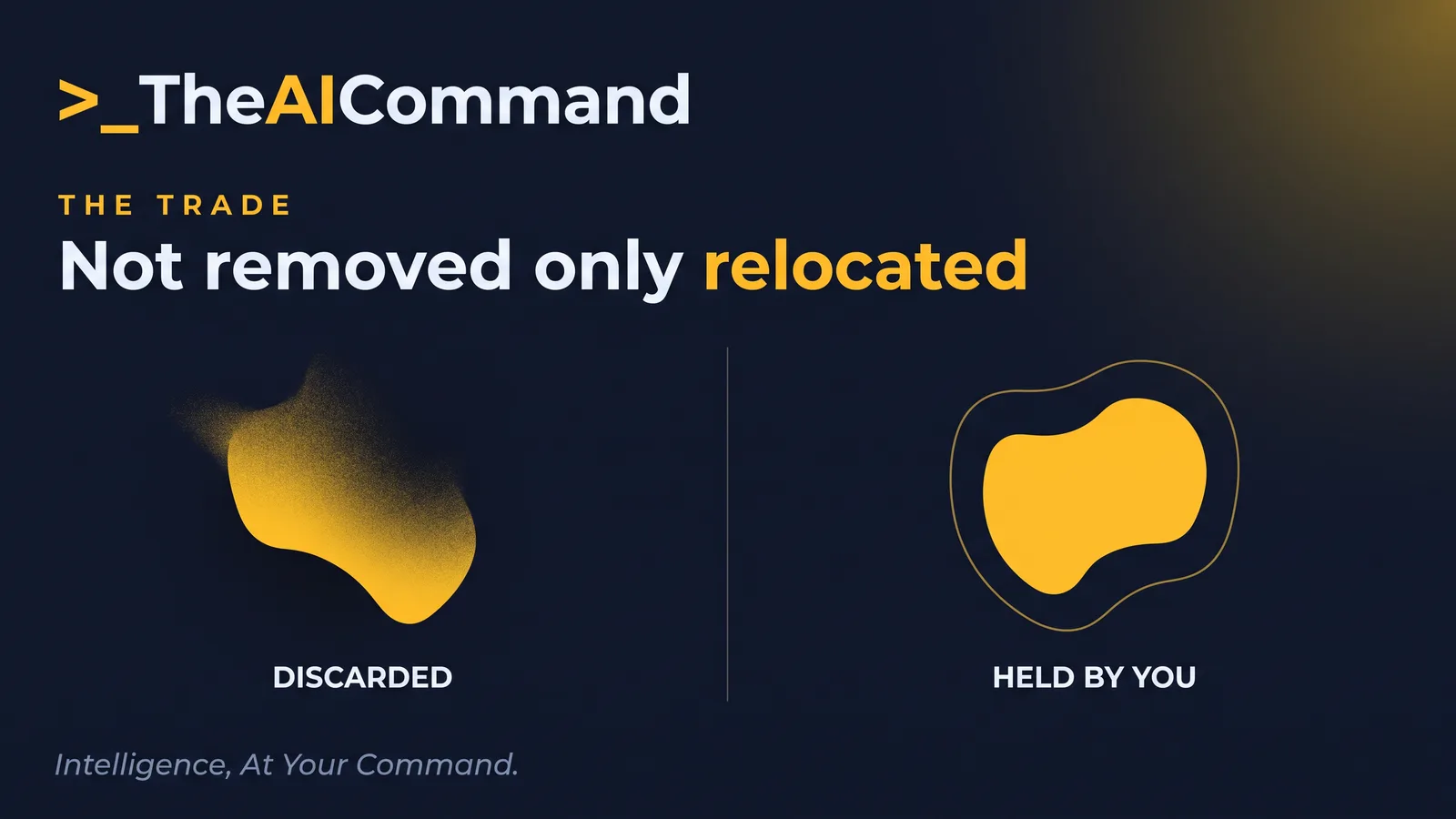
So the design question was not how to detect misuse without data. It was where the data should live.
What actually changes
Three things move, and each one lands somewhere in your organisation.
The storage moves. Activity data used for monitoring "can be stored in the customer's own cloud account (such as Amazon S3, Azure Blob Storage, or Google Cloud Storage)", under, in Anthropic's description of what customers asked for, "their own encryption keys, access policies, and audit logging".
The review moves. This is the sentence that changes the most: "EFS has automated safety monitoring, no Anthropic human review required." Automated systems "analyze a rolling window of traffic for signals of serious misuse, including attempts to develop offensive cyber or biological capabilities and signs of stolen or leaked credentials. Those flags go directly to the customer and their people take it from there."
The cost moves. "Anthropic doesn't charge for Enterprise Frontier Safeguards. If customers elect to store their data in their cloud account, their cloud provider bills them for that storage, as well as reads, writes, and data egress fees."
Anthropic's stated reason for moving the review is not cost-shedding, and it is a good one: regulated customers "operate under rules that tightly govern who may see certain information, privileged legal material, non-public information, drug-safety reports", and their own people "are already trained and cleared for that work". Fair. It is still your people doing it.
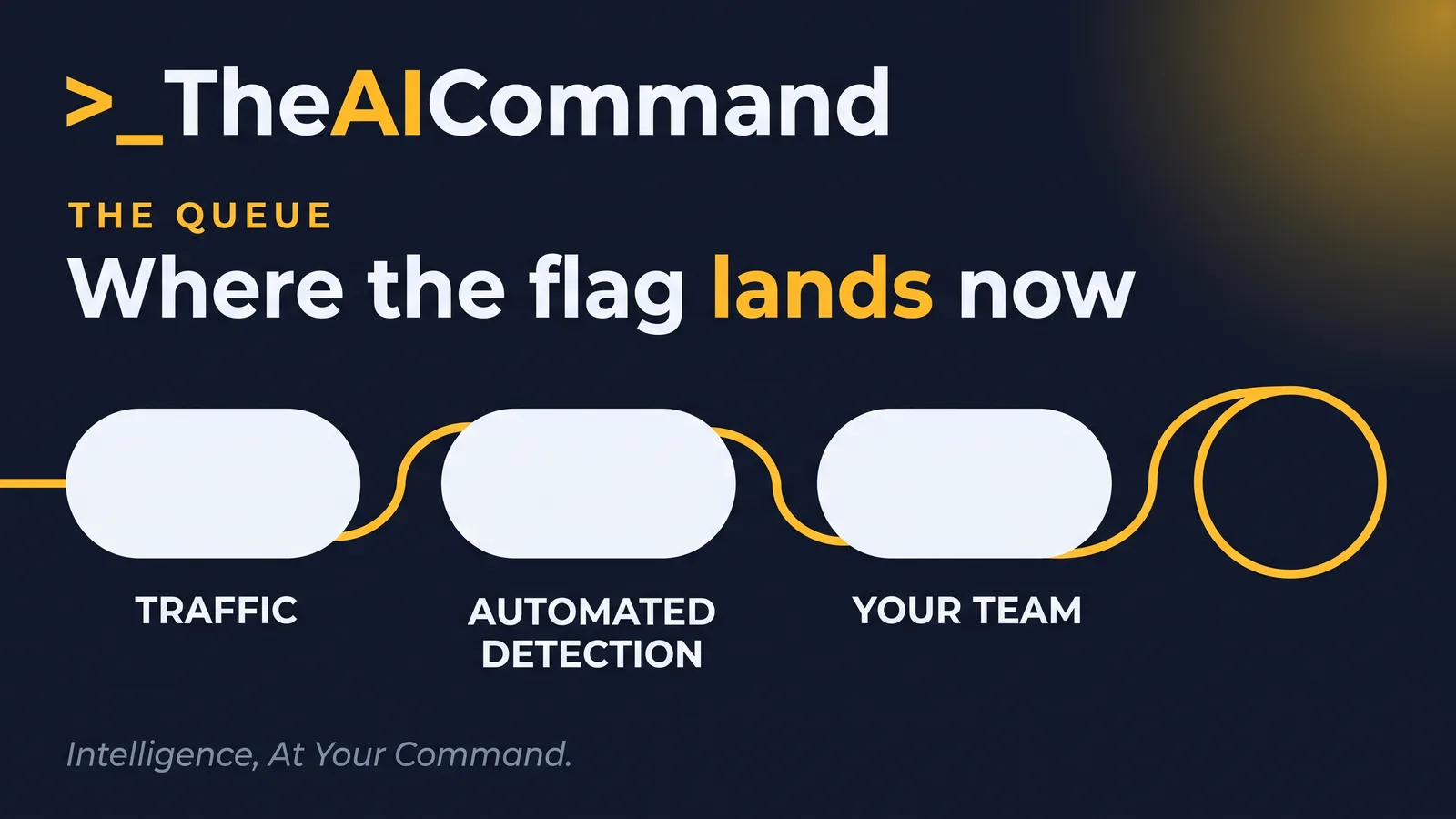
Who now owns the queue?
Somebody has to. That is the operational consequence hiding inside a privacy improvement.
A flag arriving from EFS is not a helpdesk ticket. Anthropic names the signal types: attempts to develop offensive cyber or biological capabilities, and signs of stolen or leaked credentials. An organisation receiving that alert needs a person who is rostered to see it, competent to interpret it, authorised to act on it, and clear about what happens next when the answer is that a real employee did a real thing.
Ask the questions in order. Which team receives it, and at what hours. What is the response time. Who confirms a real detection and who clears a false positive, given that Anthropic itself notes "a person looking at a flag still adds value by confirming real misuse and clearing false positives". What is the escalation path when the flag concerns a person rather than an account. Does an EFS flag meet your definition of a security incident, and does raising it start any clock.
None of these are hard. All of them are unanswered by default, and the default is what you will have on the day the first flag arrives.
What does this mean for Australian regulated work?
Two obligations already on the books get sharper, and neither is a consequence of the product.
Custody. Once activity logs sit in your cloud account, they are records you hold. That reaches your retention schedule, your access controls, your discovery obligations and, where the traffic contains personal information, Australian Privacy Principle 11 and its destruction limb. The site has covered the same custody problem from the opposite direction, where turning on your own AI telemetry converts an observability backend into a personal-information repository. EFS is that problem arriving by a different route, with the difference that the record is created for a safety purpose you did not design.
Incident handling. For APRA-regulated entities, CPS 230 requires operational incidents to be managed and escalated, and a misuse detection concerning a material service arrangement is precisely the kind of event a mature process should already be able to absorb. The question to test is not whether EFS creates a new obligation. It is whether your existing incident definitions and notification triggers were written with a vendor-generated safety flag in mind. They almost certainly were not.
Worth stating plainly: as at 17 September 2026, no Australian regulator had said anything about EFS. This is an implication to test against your own framework, not a published expectation.
Is this being oversold?
Not by Anthropic, which is unusually precise about scope. But three limits are easy to miss.
It is not available yet. EFS "will be rolling out to customers in phases, starting later this fall", with eligible customers receiving zero data retention on Fable 5 and Fable 5.1 in the meantime. That was still Anthropic's stated position as at 17 September 2026. Nothing here is a control you can point to today.
It is opt-in and partial. Anthropic states that "customer-owned storage, Customer-Managed Encryption Keys, and fully automated review are each opt-in", and that none of them "change model behavior, API pricing, or rate limits". An organisation can therefore end up with some of the architecture and not the rest, which is exactly the configuration that reads as complete on a slide.
It is detection, not prevention. A rolling window of traffic analysed for signals of serious misuse is a monitoring control. It sits downstream of the actions your own permissioning, logging and approval gates should already be governing, which is the layer described in the guardrails you build around the model. It is also worth keeping separate from the question of what your data does inside the model itself, since fine-tuning writes your data into the weights and no retention setting reaches that.
What should you be asking every other AI vendor?
The useful output of a launch like this is not a procurement decision. It is a set of questions that were previously hard to ask because there was no vocabulary for them. There is now.
Where does our activity data physically sit, and for how long? Not the marketing answer. The account, the region, the retention period and what triggers deletion.
Who at the vendor can read it, under what circumstances, and is that logged? The interesting version of this question is whether the vendor can tell you, after the fact, that a human looked.
What monitoring runs over our traffic, and what does it look for? Anthropic names its signal types. A monitoring capability nobody has described is one you cannot reason about.
What happens when it fires? Does anything reach you, on what channel, in what timeframe, and does the vendor act unilaterally on the account in the meantime.
If we take the private option, what do we lose? This is the question EFS exists to answer. Ask it of every vendor offering a privacy tier, because the trade-off does not disappear just because it is not stated. Somewhere, a detection capability was funded by data somebody was keeping.
Take those five to your next vendor review and the conversation changes shape. They are answerable, they are auditable, and the answers belong in the file rather than in a memory of a call.
Why this pattern will repeat
Strip out the vendor and the product name and the shape is general. A capability that used to be performed centrally by the provider, on the provider's data, at the provider's cost, is being pushed to the customer because the customer's regulatory position demands it. The customer gets control, which is what it asked for, and inherits an operating responsibility it did not previously have.
That is a reasonable bargain and a real one. The failure mode is not the bargain. It is accepting the control and never staffing the responsibility, so that a year later the organisation has an alert stream nobody reads and a log store nobody has aged out.
The bottom line
- Enterprise Frontier Safeguards, announced 1 September 2026, combines zero data retention with misuse detection by storing activity data in the customer's own cloud account rather than Anthropic's.
- Detection flags go directly to the customer. Anthropic states that no human review by Anthropic employees is required.
- Zero retention stops meaning no record and starts meaning your record, with the retention, security, discovery and destruction consequences that follow.
- The named signal types, offensive cyber or biological capability attempts and stolen or leaked credentials, need a rostered, competent and authorised recipient inside your organisation.
- It rolls out in phases starting later in the northern autumn, and customer-owned storage, customer-managed keys and fully automated review are each opt-in.
Do this Monday
- Ask whether anyone in your organisation has already requested or been offered zero data retention, and on which platform. The answer is often yes, at a team level, and unrecorded.
- Decide now which function would receive a vendor misuse flag, and write the name down before the capability exists rather than after.
- Test one scenario end to end on paper: a flag arrives naming stolen or leaked credentials in a business unit. Who is called, in what order, and what have they seen before.
- Check whether your incident definitions and notification triggers cover a safety flag generated by a service provider's automated monitoring, and amend them if they do not.
- Add the log store to your records schedule before it exists, including where it lives, who can read it, how long it is kept and what destroys it.
- Confirm which components you would actually enable, since each is opt-in, and record the decision for the ones you decline.
References
- Anthropic, Developing Enterprise Frontier Safeguards with our customers, 1 September 2026
- Anthropic, Introducing Claude Fable 5.1 and Claude Mythos 5.1, 1 September 2026
- Federal Register of Legislation, Banking, Insurance, Life Insurance, Health Insurance and Superannuation (prudential standard) determination No. 1 of 2026 (Prudential Standard CPS 230 Operational Risk Management), F2026L00475
- OAIC, Australian Privacy Principle 11, security of personal information
TheAICommand. Intelligence, At Your Command.