Faster waste is still waste. Before you automate a task with AI, first test whether it should stop, reduce or simplify, then apply AI only to the work that survives.
The easiest AI business case begins with a task people already do. Draft the report faster. Summarise the meeting sooner. Produce more status updates. That sounds sensible because the baseline is visible and the time saving is easy to imagine.
It also skips the best question: why does this work exist?
If nobody uses the report, accelerating it creates more polished waste. If a weekly meeting exists because decision rights are unclear, an AI summary preserves the ambiguity. If three approvals compensate for weak trust, automated routing lets the delay travel faster.
Leadership earns its keep before the prompt is written.
Why doesn't adding AI to every task improve the organisation?
Research has established that generative AI can improve performance in bounded tasks. In an experiment on professional writing published in Science, Shakked Noy and Whitney Zhang found participants with ChatGPT completed tasks 40 per cent faster and produced outputs rated 18 per cent higher in quality. A workplace study of customer support agents by Brynjolfsson, Li and Raymond found AI assistance increased issues resolved per hour by 14 per cent on average, with much larger gains, around 34 per cent, among the least experienced workers.
Those findings are useful and specific. They do not prove that adding AI to every existing task will improve the organisation.
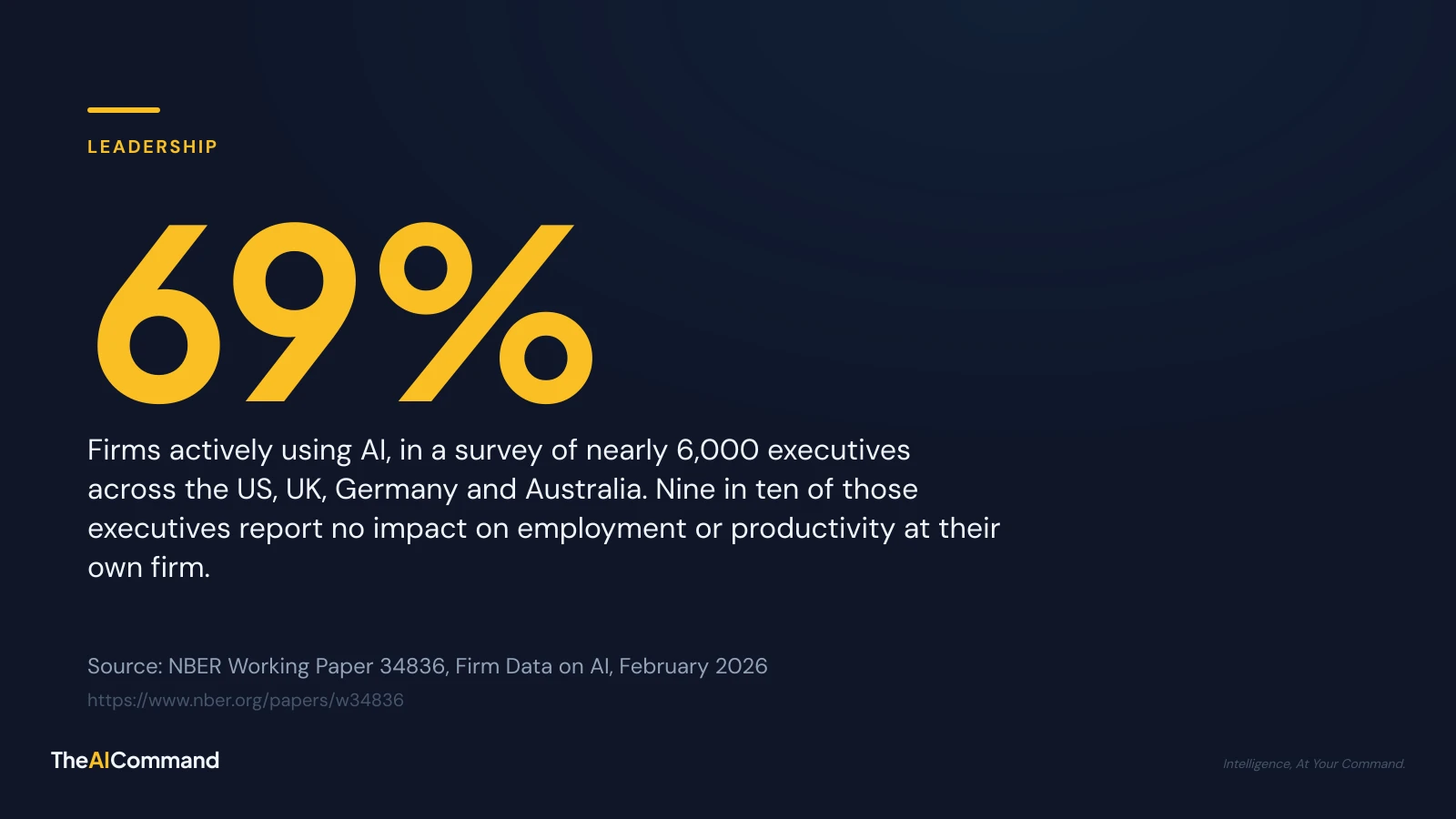
A 2026 NBER working paper by Yotzov and colleagues, based on surveys of nearly 6,000 senior executives across the United States, United Kingdom, Germany and Australia, found 69 per cent of firms were actively using AI, yet roughly nine in ten executives reported no effect on employment or productivity at their own firm over the past three years. The same firms forecast noticeably larger effects over the next three years, including an average productivity boost of 1.4 per cent, as the NBER Digest summarised in May 2026. The contrast matters. Task-level gains can be real while organisation-level results remain hard to see.
One explanation is measurement. Another is adoption time. A leadership explanation is work design: organisations add a faster tool to the same meetings, handoffs, approvals and reporting habits, then wonder why the whole system does not move. That points to the pilot-to-scale gap as an operating model problem.
The shift is from asking "Where can AI save time?" to asking "What outcome is this work meant to create, and what is the smallest reliable system that creates it?"
The operating move: run a work-kill review
Choose one recurring workflow, not an entire function. Good candidates include monthly reporting, project approvals, executive papers, customer escalations, recruitment coordination or policy review.
Step 1: name the outcome
Write the outcome in one sentence from the recipient's perspective. "The executive receives the monthly report" is an activity. "The executive decides whether to intervene in three material risks" is an outcome.
If the team cannot name the decision, customer action or risk change created by the work, pause. AI should not industrialise an activity whose purpose is unclear.
Step 2: trace use, not production
Follow the output after it leaves the creator. Who reads it? What do they do differently? Which section supports that action? How quickly is it used? What happens if it arrives one day late or not at all?
Leaders often discover that the labour sits upstream while the value claim sits downstream and untested. Ten people produce a deck. Two slides inform a decision. The rest protect against hypothetical questions.
Step 3: classify every step
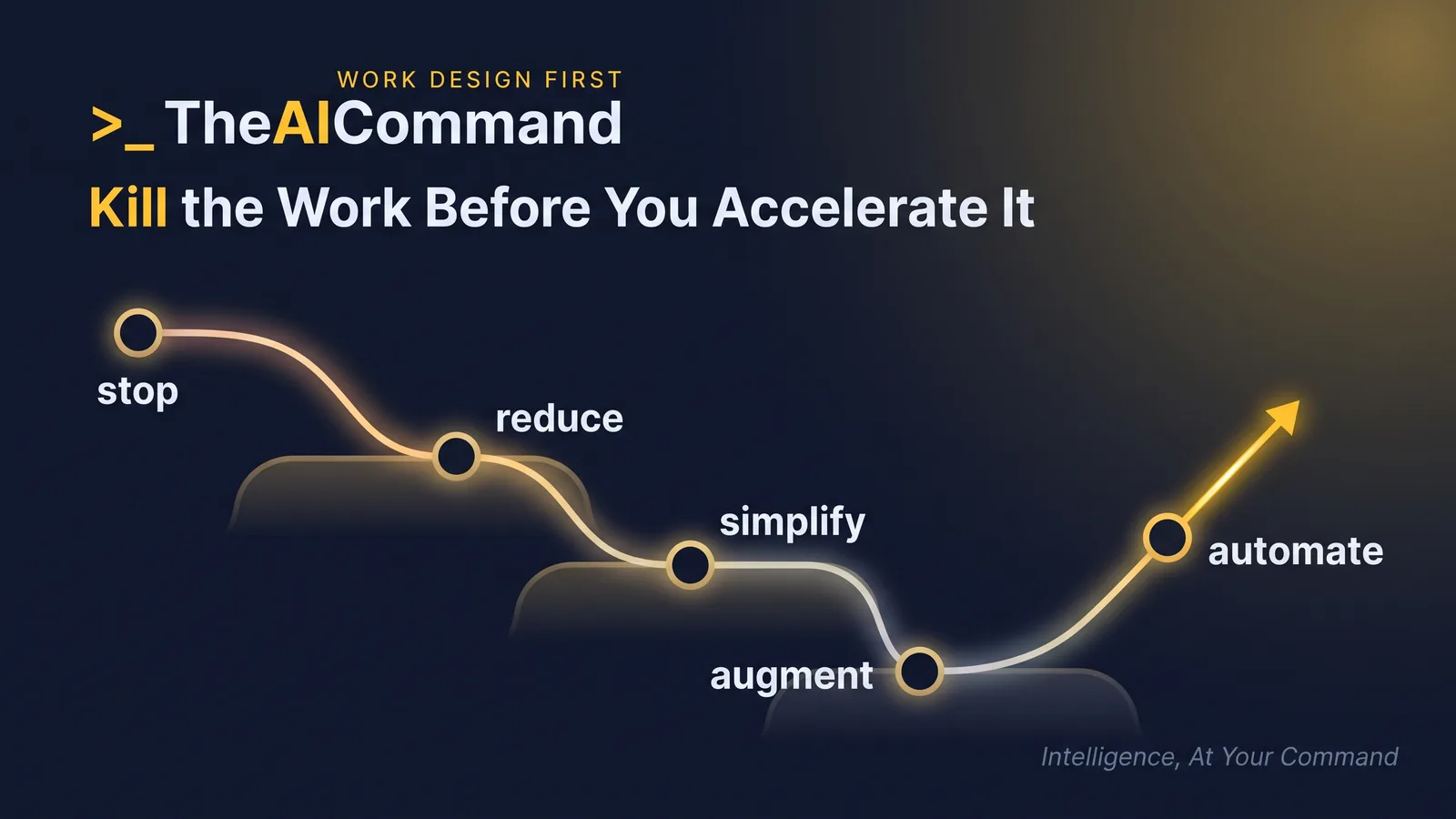
Use five categories:
- Stop: no evidence of use or value.
- Reduce: keep the work but lower frequency, scope or polish.
- Simplify: remove handoffs, approvals or duplicate entry.
- Augment: keep human judgement and use AI for preparation or checking.
- Automate: let the system execute inside defined bounds, with monitoring and an exception path.
This order matters. Stop and reduce come before augment and automate. Otherwise the technology decision quietly protects the current process.
Step 4: expose the hidden controls
Some annoying steps exist for good reasons. A second review may protect a legal, safety, financial or customer outcome. A duplicate record may support audit or recovery. Do not remove it because the team dislikes it.
Ask what risk the step controls, what evidence shows it works and whether a simpler control could achieve the same result. Where the control is regulated or safety-critical, involve the qualified owner. AI can map the control logic. It cannot accept residual risk on the organisation's behalf.
Step 5: redesign the decision path
Many workflows are slow because decision rights are vague. People draft more material to satisfy an unknown approver, then circulate it widely in case someone objects. Clarify who recommends, who decides, who must be consulted and who is simply informed.
The decision-rights guide for AI-enabled teams provides a fuller method. For this review, one rule is enough: every approval must have a named decision and a named owner. "For visibility" is not an approval.
Step 6: apply AI to the remaining constraint
Only now choose the AI intervention. It might draft the two slides that survive, compare an exception with policy, prepare a decision brief, route a low-risk case or identify missing evidence.
Specify the human boundary, data rules, quality standard, failure response and metric. A time saving without an outcome measure is an activity claim.
Step 7: run a reversible trial
Change one workflow for four to six weeks. Keep a baseline. Track elapsed time, human effort, rework, error, decision delay and recipient use. Ask the people doing the work what new burden appeared. AI often moves effort from creation to checking, which is the AI review tax in practical form.
A prompt that challenges the work itself
Do not ask the model to optimise the existing process first. Give it permission to challenge the process, while keeping the decision human.
The prompt is a challenge device. The team provides evidence. The accountable leader decides.
Which judgements must leaders keep?
AI cannot determine whether work is politically necessary, culturally important, legally required or valuable to a customer it has never met. It cannot see the informal coordination a ritual creates unless people describe it. It may call a control redundant because the incidents it prevented never happened.
Leaders therefore own four judgements:
- what outcome matters
- which risk the organisation is willing to accept
- whose work or access changes
- whether the trial evidence justifies making the change permanent
Consult people affected by the redesign. Removing work can be welcome, but it can also redistribute load, narrow a role or remove a channel where problems surfaced. In regulated or employment contexts, obtain the appropriate specialist advice.
Do not use AI to produce a predetermined headcount answer. Work elimination is process design. Workforce decisions carry separate legal, ethical and human obligations.
Watch for four false efficiencies
The first is local optimisation. One team saves time while another absorbs more checking, exception handling or customer follow-up. Measure across the handoff, not only inside the team buying the tool.
The second is volume inflation. When drafts become cheap, people request more of them. A leader who once received one decision paper may receive five AI-generated options, each requiring review. Put a demand rule around the workflow so cheaper production does not create unlimited consumption.
The third is control displacement. A workflow removes an explicit approval but introduces an opaque model recommendation that nobody can challenge. Simplification should make accountability clearer. If the team cannot explain who now decides and what evidence they see, the process is not simpler.
The fourth is capability erosion. Automating the routine cases may leave people handling only difficult exceptions without enough practice to maintain the underlying skill. Decide which tasks need rotation, sampling or manual rehearsal. Track whether staff can still recognise when the model is wrong.
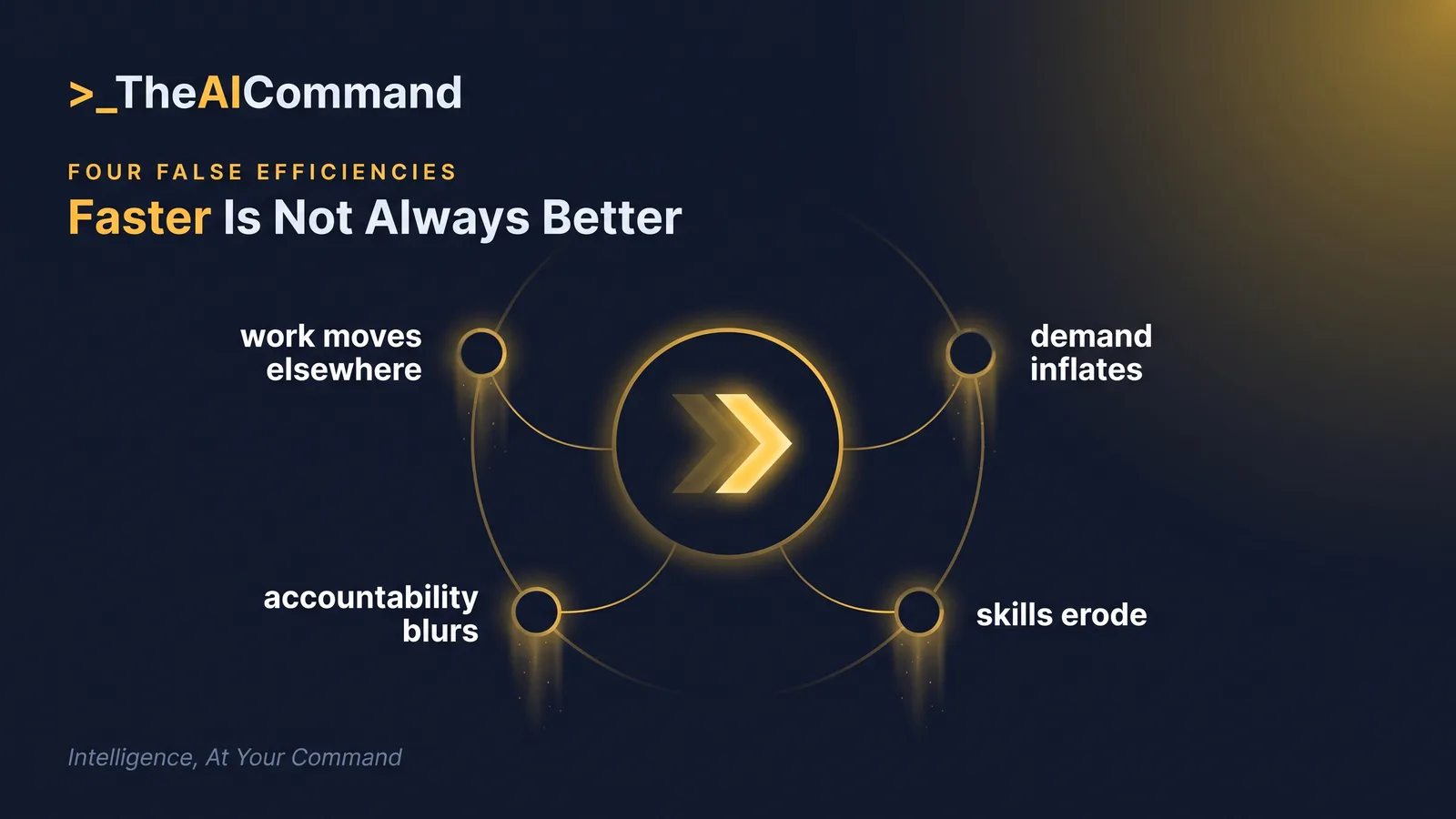
Add these four questions to the trial review: Did work move elsewhere? Did demand rise? Did accountability become less visible? Did the team lose practice in a critical skill? The answers may support scaling, redesign or stopping the AI use case.
Record the abandoned options as well as the chosen design. A short decision log should show which steps were kept, changed or removed, the evidence considered, the risk owner consulted and the date for review. This prevents the old process returning by habit and gives future leaders a reasoned starting point when conditions change.
Reopen that decision when the risk, customer need or workflow changes.
A worked example
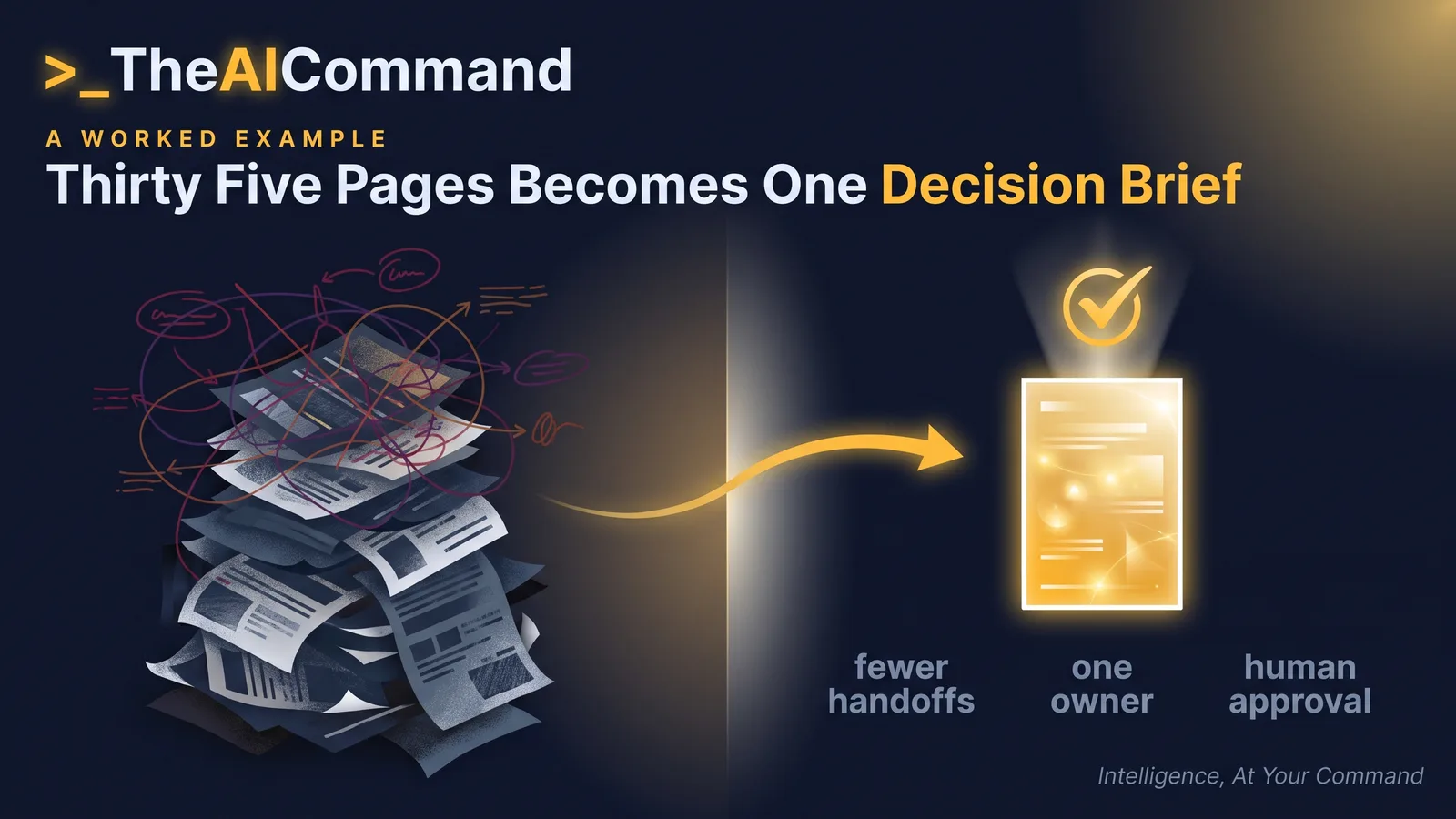
[TEAM] produces a 35-page monthly operations report. Seven people contribute. Two managers review. An executive forum receives it three days before the meeting.
The work-kill review traces actual use. The forum discusses three pages: service failures, material risks and decisions overdue. Twelve pages repeat dashboard data available elsewhere. Eight pages explain variances below any action threshold. The remainder provides detailed project status that project sponsors already receive weekly.
The team classifies the work:
- stop the duplicated dashboard appendix
- reduce project reporting to exceptions
- simplify review from two sequential managers to one accountable owner
- augment the three decision pages with AI-assisted evidence checks and first-draft commentary
- automate distribution only after the owner approves the final brief
The new product is eight pages. The first trial tracks preparation hours, corrections, late decisions and questions raised at the forum. It also asks contributors whether hidden coordination was lost.
The result may show a real gain. It may show that one removed section supported another decision. The trial can restore it. Reversibility is a control, not indecision.
What should you measure after the review?
Do not count deleted pages as value, the same way you would not treat prompt counts as adoption. Measure the changed system:
- elapsed time from source data to decision
- human hours by role
- number of handoffs and approvals
- rework after review
- exceptions or errors missed
- decisions made, deferred or reopened
- recipient use
- worker experience and redistributed load
Add the workflow to the team's AI operating rhythm. Review whether the process is still needed, not just whether the model is still accurate.
Bottom line
Accelerating work that nobody needs only produces faster waste. Run a work-kill review first: name the outcome, trace where the output is actually used, and classify each step to stop, reduce, simplify, augment or automate, so AI lands on the constraint that remains. Leaders stay accountable for what is removed, changed and measured.
Do this Monday:
- Pick one recurring workflow, such as monthly reporting or project approvals.
- Write the outcome in one sentence from the recipient's perspective.
- Trace where the output is actually used, then classify every step.
- Expose the hidden controls and involve the qualified risk owner before removing any.
- Run a reversible four to six week trial with a baseline, and measure the changed system rather than deleted pages.
TheAICommand. Intelligence, At Your Command.