
Machinery moved on 15 July. Obligations did not.
On 15 July 2026 the Prime Minister, the Minister for Industry and Innovation and Minister for Science, and the Assistant Minister for Science, Technology and the Digital Economy issued a joint media release announcing that "Effective today, the Office of AI will be established within the Department of Prime Minister and Cabinet to accelerate implementation of the Australian Standards on a national level". Much of the commentary that followed read this as Australia regulating AI. It is not. It is machinery, a standards process and one concrete first target. Nothing announced creates an obligation today on how a regulated business uses AI.
That distinction is the whole compliance job this week. A function that reports the announcement accurately, adds the right entries to its watch list and carries on mapping AI uses to the law that already applies has done the work. A function that tells its board "AI is now regulated in Australia" has created a problem it will have to unwind.
What did the 15 July announcement actually create?
Four things, and each is worth stating precisely.
An office. The Office of AI sits inside the Department of the Prime Minister and Cabinet, effective 15 July 2026. Its stated purpose is to accelerate implementation of a set of Australian Standards for AI at a national level. It is a coordinating body inside a central agency, the release names no enforcement powers, and it does not issue binding rules.
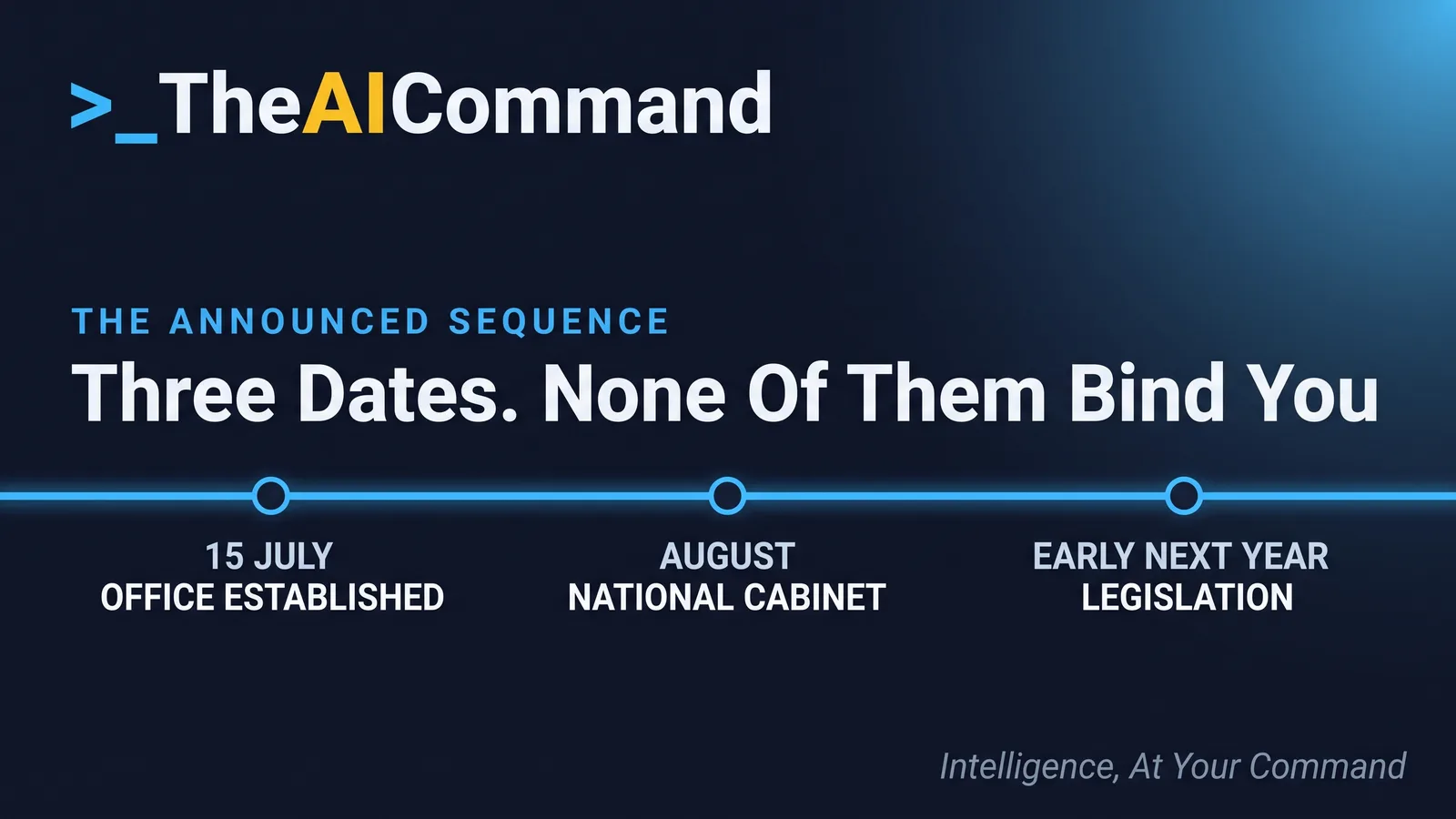
A standards process, not a standard. The release says the government will introduce a set of Australian Standards for AI, "building on the Data Centre Expectations". No text has been published. What the release gives instead is a sequence: "The Government's approach will be considered by National Cabinet in August, with standards expected to be legislated early next year."
A first concrete target. The initial standards are aimed at large data centres. The release describes clear rules for them, including a legal obligation to underwrite their own new power supply, pay their full share of connection costs so energy bills are not impacted, reduce power when needed to strengthen the grid, and be as water efficient as possible. That is where the first hard edges land, and it is an energy and infrastructure question, not a question about how anyone uses a model. The electricity and grid side of this is covered separately in AI's next constraint is power.
Two commitments with no instrument attached. The government said its approach "will ensure Australian writers, artists and journalists retain ownership over their work, meaning no company should use Australian creative works to train AI without the artist's control", and that it "will also outline its whole-of-government AI consumer safety priorities in coming weeks, building on the recent establishment of the AI Safety Institute". Note the wording on creative works. An artist's control is not the same phrase as a consent requirement written into the Copyright Act, and the National AI Plan had already ruled out a text and data mining exception. That is a restatement of a settled position, not a new rule.
Which of your obligations changed?
None. The government's own documents make the point better than any commentary can.
Start with the instrument the standards build on. The Expectations of data centres and AI infrastructure developers, published by the Department of Industry, Science and Resources on 23 March 2026, states plainly that "The expectations work alongside existing national, state and territory laws. They do not alter any obligations to comply with Australian law or to engage in good faith with regulators". A standards process that builds on that base starts from the same premise.
The National AI Plan, launched on 2 December 2025, said the same thing at the level of policy: "The government's regulatory approach to AI will continue to build on Australia's robust existing legal and regulatory frameworks, ensuring that established laws remain the foundation for addressing and mitigating AI-related risks." Agencies and regulators, the plan adds, retain responsibility for AI harms in their own domains. Our standing piece on that settlement, Australia will not pass an AI Act, remains the position, and the 15 July announcement does not disturb it.
So the obligations that bite on your AI are the ones that bit last month.
- The Privacy Act, including the automated decision-making transparency obligation in APP 1.7, which commences on 10 December 2026 and requires a privacy policy to disclose computer-program decision making that could reasonably be expected to significantly affect an individual's rights or interests. That is the fixed near-term AI date with a legal consequence attached, and it has nothing to do with 15 July.
- The misleading and deceptive conduct prohibitions in the ASIC Act, which are indifferent to whether a misleading representation was drafted by a person or generated by a model.
- APRA's prudential standards for regulated entities, including CPS 230 and CPS 234. APRA's 30 April 2026 letter to industry put it in one line: "APRA's principle-based prudential framework is technology and vendor agnostic."
- The Australian Consumer Law. Treasury's final report on its Review of AI and the Australian Consumer Law, published on 3 October 2025, concluded that the ACL, combined with other laws, "can generally handle challenges that come with AI products and services".
- The AML/CTF regime, wherever AI touches monitoring, screening or reporting.
Telling a board that AI is now regulated is a risk in its own right. It is inaccurate, and inaccuracy in a compliance brief is precisely the thing a board is least equipped to detect. It invites deferral, because a board told a framework is arriving will reasonably ask to see it before funding anything. It spends credibility you will want when something genuinely does bind. And it can push a decision, on a procurement, a pause or a control build, that you then own.
What did change, then?
The venue. That is not nothing.
Until 15 July, AI standards work in Australia sat with portfolio departments and their regulators, exactly as the National AI Plan described. An Office of AI inside the Department of the Prime Minister and Cabinet moves coordination into a central agency, and the release frames implementation as happening at a national level, with National Cabinet as the forum in August and states and territories involved in decisions about where large data centres are built.
Three practical consequences follow for a compliance function.
Who consults you changes. Standards developed through a central agency and a National Cabinet process consult differently from a regulator running a portfolio consultation. If your organisation has a policy or government-relations function, this is a different door, and the runway is short.
Where a signal appears changes. A watch list built only from APRA, ASIC, OAIC and AUSTRAC feeds will not surface a National Cabinet communique or a release from the Office of AI. Add the source, not just the topic.
Scope may not stay put. A standards office inside a central agency, with a legislative vehicle already flagged, is the kind of structure that acquires scope. That is a reason to watch it closely and a reason not to build controls for it yet.
How do you update a watch list for a machinery announcement?
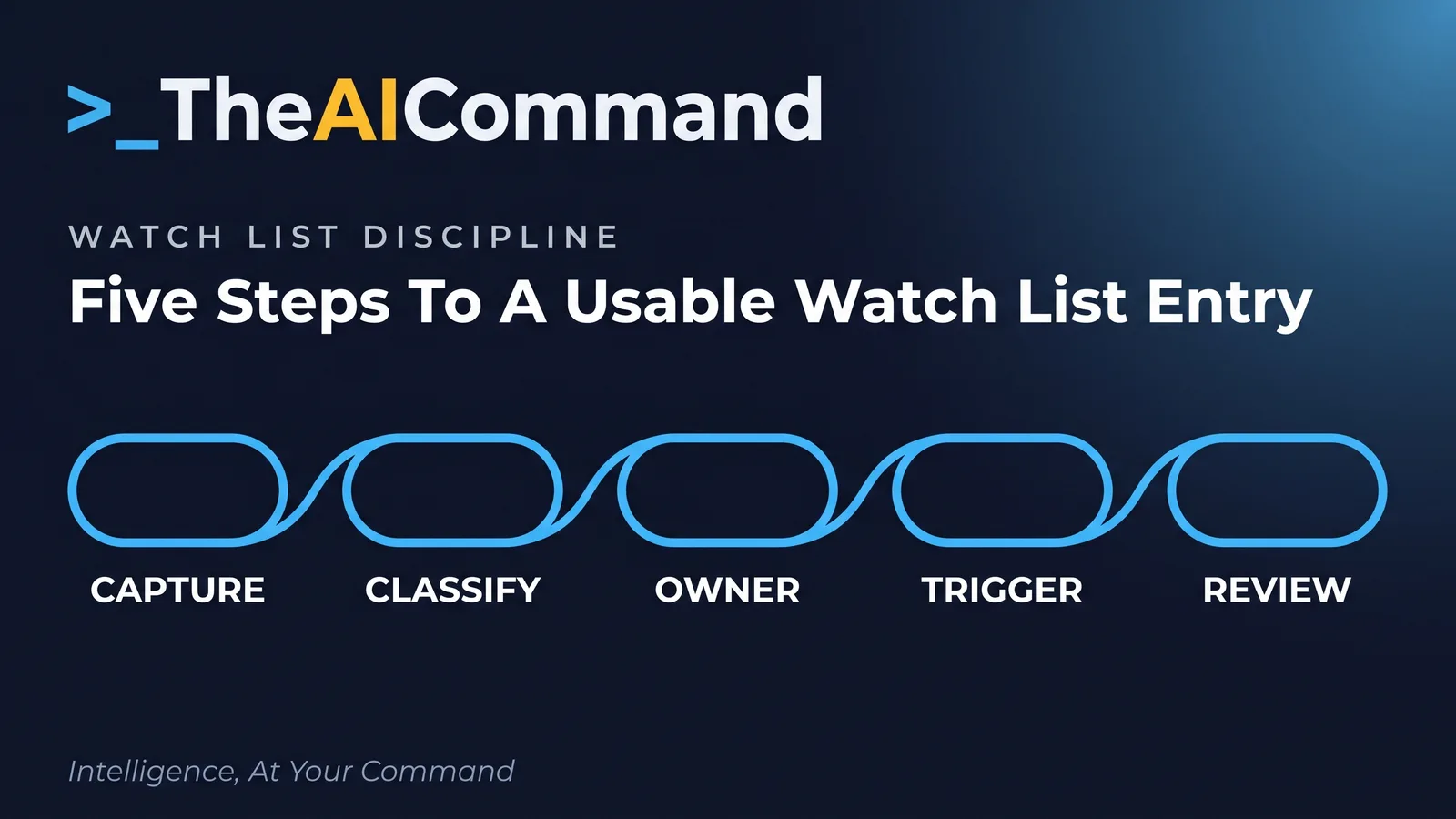
The failure mode with machinery news is that it enters the register as a topic marked "monitoring" and is never looked at again. Run it through six steps instead.
- Separate the announcement from the instrument. Write down what exists today: a media release, an office, and a stated sequence. Write down what does not: any published standard, draft, bill or commencement date.
- Classify it. Three categories are enough. Obligation means something binds. Signal means direction of travel with no instrument. Machinery means institutional change only. This announcement is machinery with a signal attached.
- Record the trigger, not the topic. The trigger is the specific, observable event that would move the entry into a different class. Here that is publication of draft standards text.
- Name an owner. One person, by role. Not a committee, and not "Compliance".
- Set a review date rather than a status. A date forces a decision. A status of "monitoring" never does.
- Write the board line at the same time. If you cannot write two accurate sentences now, you will not write them under pressure later.
Four entries go on the list today.
- National Cabinet consideration, August 2026. Owner: head of regulatory affairs. Trigger: a National Cabinet communique or a release referring to the Australian Standards for AI. Review date: 4 September 2026.
- The Australian Standards for AI text. Owner: head of compliance. Trigger: release of draft standards or a consultation paper. Review date: 31 October 2026, then quarterly.
- Legislation flagged for early next year. Owner: general counsel or company secretary. Trigger: a bill introduced into Parliament. Review date: 1 February 2027.
- Whole-of-government AI consumer safety priorities. Owner: head of conduct or consumer compliance. Trigger: publication by the Commonwealth. Review date: 30 September 2026, because "coming weeks" is the nearest of the four and the most likely to reach customer-facing AI.
Each entry carries the same assessment line: no current obligation, no control change, no spend. Record it explicitly, because an empty assessment field reads as work not done.
What does the board note look like?
Two lines, no adjectives.
On 15 July 2026 the Commonwealth established an Office of AI within the Department of the Prime Minister and Cabinet and announced Australian Standards for AI, initially targeting large data centres, to be considered by National Cabinet in August and legislated early next year. No obligation on [ORGANISATION] changes today, four watch-list entries have been raised with named owners and review dates, and our AI compliance mapping under the Privacy Act, the ASIC Act and APRA's prudential standards is unaffected.
If a director asks whether the organisation should be doing anything, the honest answer is that the work that matters was already on the plan, and the 10 December 2026 automated decision-making obligation is the deadline worth asking about.
In the next 30 days:
- Raise the four entries with owners, triggers and review dates, and record the "no obligation today" assessment against each.
- Add the Office of AI and National Cabinet to the regulatory-change feed alongside the portfolio regulators.
- Ask your policy or government-relations contact whether the organisation will make a submission if a consultation opens.
- Re-confirm the APP 1.7 automated-decision inventory, the near-term obligation that actually carries a date.
Where compliance functions get this wrong
Two failure modes, in opposite directions.
The first is pre-building. A team drafting a data-centre standards control framework in July 2026 is designing against a document that does not exist, treating a media release as a specification. When the draft appears, that work is rebuilt or abandoned, and the credibility cost lands on the next genuine warning.
The second is under-reporting. A team that reads "no new obligation" as "nothing to say" misses that a consultation window is the one moment when a regulated entity can influence a standard rather than comply with it. National Cabinet in August and a legislative vehicle early next year is a short runway. Silence is a legitimate choice, but it should be a recorded decision rather than a default.
Bottom line
The Office of AI is institutional capacity, not a duty. It coordinates a standards process whose first concrete rules are aimed at the power and water footprint of large data centres, with National Cabinet consideration in August and legislation expected early next year. Nothing announced on 15 July 2026 changes what your organisation must do with AI, because the government's own documents keep saying existing law remains the foundation. Brief it accurately, put four dated entries on the watch list, and keep mapping AI uses to the obligations that already apply.
Do this Monday:
- Classify the announcement as machinery, with the assessment recorded as no current obligation
- Raise the four watch-list entries with owners, triggers and review dates
- Add the Office of AI and National Cabinet to your regulatory-change sources
- Correct any internal paper describing AI as newly regulated in Australia
- Confirm the APP 1.7 automated-decision inventory is on track for 10 December 2026
Content disclaimer: This article is for general educational and informational purposes only. It does not constitute legal advice, regulatory guidance, or a substitute for professional compliance judgement. Regulatory obligations vary by entity type, licence, and circumstance. Always refer to primary source guidance from APRA, ASIC, the OAIC or the relevant regulatory authority.
Primary sources
- Prime Minister of Australia, Minister for Industry and Innovation and Minister for Science, and Assistant Minister for Science, Technology and the Digital Economy, AI in Australia's interests, joint media release, 15 July 2026. https://www.pm.gov.au/media/ai-australias-interests
- Department of Industry, Science and Resources, National AI Plan, Keep Australians safe, 2 December 2025. https://www.industry.gov.au/publications/national-ai-plan/keep-australians-safe
- Department of Industry, Science and Resources, Expectations of data centres and AI infrastructure developers, 23 March 2026. https://www.industry.gov.au/publications/expectations-data-centres-and-ai-infrastructure-developers
- APRA, Letter to Industry on Artificial Intelligence (AI), 30 April 2026. https://www.apra.gov.au/news-and-publications/apra-letter-industry-artificial-intelligence-ai
- The Treasury, Final report, Review of AI and the Australian Consumer Law, 3 October 2025. https://treasury.gov.au/publication/p2025-702329
- OAIC, Australian Privacy Principles guidelines, Chapter 1, APP 1, automated decision-making transparency obligation commencing 10 December 2026. https://www.oaic.gov.au/privacy/australian-privacy-principles/australian-privacy-principles-guidelines/chapter-1-app-1-open-and-transparent-management-of-personal-information
TheAICommand. Intelligence, At Your Command.