
You can redraft a document. You cannot un-pipette a sample.
That sentence is the whole of this article, and it explains why a robotics announcement from late August is a governance story rather than a hardware one. On 27 August 2026, Anthropic opened a research preview of the Model Hardware Standard, a specification that lets AI agents operate physical devices over the same protocols they already use to reach software. Laboratory instruments, robotic arms, liquid handlers, lasers.
Nearly every AI governance position written in the last three years rests on an assumption that nobody stated because nobody had to: the output is a document, and a human can look at it before it does anything. Approval gates, review workflows, sampling, quality assurance, the four-eyes rule. All of them are forms of look before it counts.
When the output is a movement, there is no before.
What was actually announced?
A specification and a research preview, not a product.
The Model Hardware Standard standardises communication between models and hardware, described by preview partner Genentech as eliminating the need to write custom robotic code. It supplies standardised drivers that translate between operating systems and devices, simple read and write command primitives, device discoverability in a standard format, and natural language tagging of device characteristics. Agents reach it three ways: through the Model Context Protocol, through a command line interface, or through code APIs.
The preview partners are named. On the scientific side, Genentech, the University of Washington Baker and Pinglay labs, Carnegie Mellon University, HHMI Janelia Research Campus, QuEra Computing and Tetsuwan Scientific. On the industry side, Amazon Web Services, Automata, Danaher, Doosan Robotics, MBF Bioscience, QIAGEN, Tecan, Universal Robots, Hugging Face and Raspberry Pi.
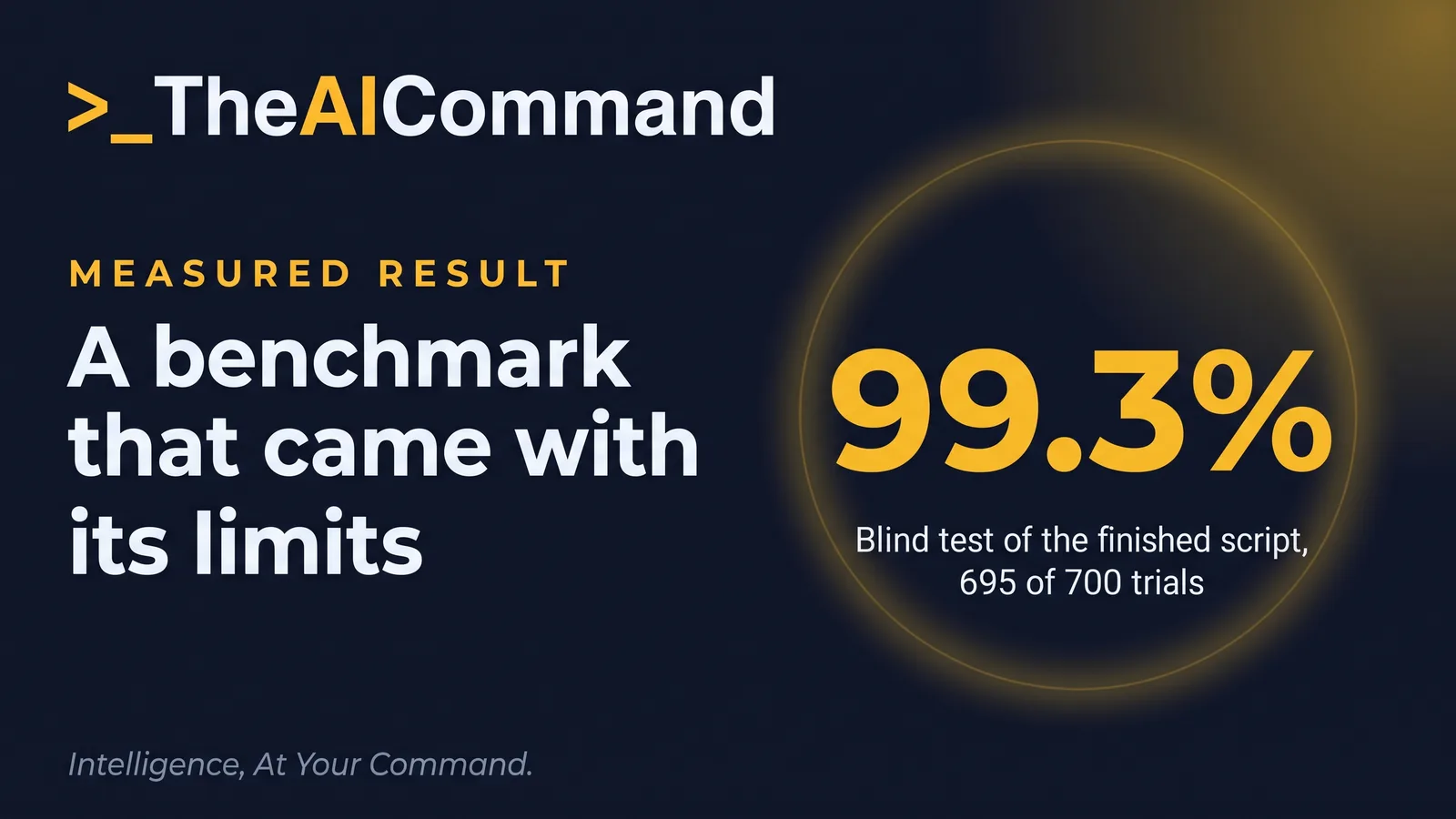
The results Anthropic published are specific enough to be checkable, which is worth noting in a field where most claims are not. At QuEra, a previous laser stabilisation script took around 150 seconds per attempt and worked about 58 percent of the time. An overnight agent loop brought recovery down to about six seconds at 96 percent, and a later blind test of the finished script, run with no agent involved, recovered the lock 695 times out of 700, a 99.3 percent success rate. Tuning the 12 PID parameters cut residual error from 15.7 mV to 1.55 mV. Over a 19-hour run the laser lock did not drop once, against about 1.6 unlocks an hour under the expert tune. At Carnegie Mellon, dose-response experiments ran roughly three times faster, and building the drivers and orchestration layer took about eight hours against the several weeks a vendor-built setup typically takes. Tetsuwan tested 9,143 dispenses across 300 transfer types and reported roughly a 12 percent improvement in precision prediction over the manufacturer's technical specification on held-out experiments.
Integration times are the part that will move fastest. The University of Washington connected six instruments in under a week. HHMI Janelia added new hardware in a few minutes.
As at 17 September 2026, Anthropic said it was building safety evaluations during the preview, that a physical safety roadmap would strengthen safeguards before open-sourcing, and that findings would be released as guidance for deploying the standard safely. It was not generally available on that date, and nothing here suggests an Australian organisation can adopt it in the near term.
The limitations are the most useful part
Anthropic published a list of things that did not work, and it is unusually candid. It is also the best available description of the failure surface, so it deserves more attention than the benchmark numbers.
Claude struggles with physical, chemical and biological constraints, particularly when troubleshooting errors. In a Genentech example it did not recognise bubble formation as a physical problem calling for gentler handling, and instead applied retry logic. That is a precise and instructive failure: the correct response was to change how the thing was being done, and the model reached for doing it again.
The stated reason matters more than the example. As a large language model, Claude learns about the physical world through text and images, so its spatial and physical reasoning have limitations that still require expert oversight. When hardware failed, it did not know how to troubleshoot, because its understanding of the rig was programmatic rather than physical.
Read that as a general principle rather than a temporary gap. A system whose model of a machine is the machine's API will reason well about the API and badly about the machine. The distance between those two is where physical accidents live, and no amount of capability improvement in text closes it directly.
There are operational notes too. Anthropic says the standard does not yet work with hardware lacking a programming interface. Long-term monitoring carries compute costs to be weighed against researcher time saved. And in a detail that should reassure anyone who has watched an agent barrel through a task, agents sometimes required human confirmation for even slightly risky actions and paused overnight waiting for approval.
Why after-the-fact review stops working
Because review is a control only when it sits between the decision and the consequence.
In a document workflow, the model drafts, a person reads, and only then does the artefact do anything: it gets sent, filed, relied on. The review is load-bearing because the gap exists. Nearly every AI policy in circulation is built in that gap.
Physical action collapses it. The consequence is simultaneous with the act. A reviewer looking at a log of what the agent did is not exercising a control, they are conducting an investigation. Those are different activities with different names, and confusing them is how an organisation ends up believing it has oversight it does not have.
This is not only a robotics problem, which is why it is worth reading now. The same collapse has already happened in software wherever an agent has write access. An agent that sends an email, updates a ledger, closes a ticket, provisions an account or pays an invoice has produced a consequence at the moment of action. The site has covered pieces of this in governing where long-running agents run and in least agency against tool poisoning. Hardware simply makes the point impossible to argue with, because nobody claims you can roll back a centrifuge.
Reversibility as the design question
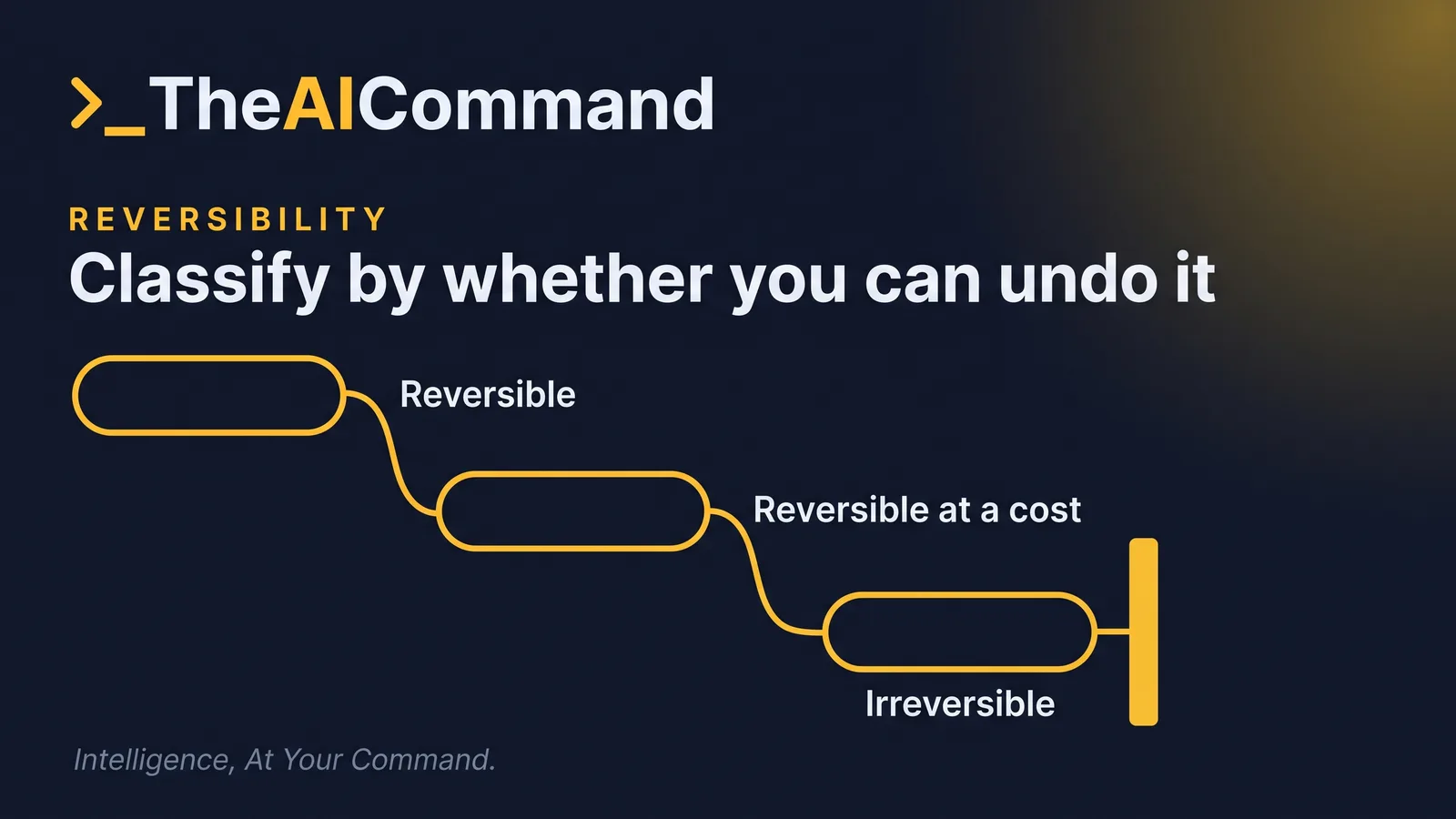
The useful reframe is to stop classifying agent actions by how risky they feel and start classifying them by whether you can undo them.
Risk classification is subjective, contested and gets negotiated downward by whoever wants the automation. Reversibility is a property of the action. It is close to binary, it is decidable in advance, and it does not care about anyone's confidence in the model.
Three tiers do most of the work.
Reversible. Drafting, reading, querying, generating a proposal, writing to a scratch space. Review after the fact is a genuine control here, because nothing has landed. Let these run.
Reversible at a cost. Writing to a system with an audit trail and a rollback path, sending an internal message, creating a record that can be voided. The control is not approval, it is that the rollback path is tested and someone owns it. An untested rollback is not a rollback.
Irreversible. Physical movement, anything that dispenses, heats, cuts or moves. External communication. Payment. Deletion. Anything that touches a person outside the organisation. These need a human before, and the gate has to be real rather than a confirmation dialogue that everyone clicks through.
Anthropic's own design supports the shape of this. The standard enforces device-level safety limits an agent cannot override, described by one partner as the reason they did not have to worry about the agent using excess laser power. That is the right instinct: put the boundary in the device, not in the instruction, because instructions are negotiable and device limits are not. The software equivalent is a permission the agent's credential does not carry, rather than a policy telling the agent not to.
The site's framing for the gate itself is in approval gates for AI agents, and the connector-level version of the same problem is in governing the connectors.
What the record has to capture
One more thing changes, and it is easy to miss.
In a document workflow, the record is the document. It contains the output and, if you have been careful, its sources. That is enough to reconstruct what happened.
With a physical or write-capable agent, the output does not persist in a reviewable form. The sample was consumed. The email was sent. What survives is the action log, so the log becomes the record rather than a supplement to it. It has to carry what was commanded, what the device reported back, what the agent did next, and where a human confirmation sat in the sequence.
Anyone designing this in an Australian regulated setting should treat it as an evidence problem first. Your existing duties around plant, work systems and critical operations do not change because the operator is a model, and none of them were drafted with an agent in mind. This article does not assert that any regulator has addressed the Model Hardware Standard, because as at 17 September 2026 none had. It reasons from duties that already exist, and says so.
TheAICommand works to the Verified Draft Method: de-identify the inputs, ground the model in your own source material, keep a person at the decision point, verify against the primary source, and log what happened. The last two clauses were always the hardest to operationalise. Physical action makes them the only ones that matter.
Do this Monday
- List every action your agents can currently take, not the tasks they perform. Actions, one line each.
- Mark each one reversible, reversible at a cost, or irreversible. Do not use a risk rating.
- For every irreversible action, find the gate. If there is not one, that is the highest-value control your organisation can add now.
- For every reversible-at-a-cost action, ask when the rollback path was last tested and who owns it. An untested rollback belongs in the irreversible tier until proven otherwise.
- Check whether your action logs capture what the agent did, or only what it produced. If only the output, your record is incomplete for anything with write access.
Bottom line
A specification that lets agents drive laboratory and factory hardware is not yet an operational concern for most organisations, and it is already a governance one. It puts a hard edge on something that has been true for a while in software: once an agent can act, review after the fact is an investigation rather than a control. Classify actions by reversibility, put the boundary in the system rather than the instruction, gate the irreversible ones with a person before rather than a reviewer after, and make the action log the record. The equipment is optional. The reasoning is not.
References
- Anthropic, Previewing the Model Hardware Standard, 27 August 2026. https://www.anthropic.com/news/model-hardware-standard-research-preview
- Anthropic, newsroom index, accessed 17 September 2026. https://www.anthropic.com/news
TheAICommand. Intelligence, At Your Command.