LM-W01 · Workers Comp · Practitioner tier
AI for SRC Act Claims Practice
De-identification discipline, the liability architecture, determination drafting support and return to work planning under the SRC Act 1988
What you'll be able to do
- 1.Explain the Comcare scheme liability architecture under sections 5A, 5B and 14 of the SRC Act 1988, including the reasonable administrative action carve-out
- 2.Apply the three-limb reasoning order to structure claim evidence before any liability judgement is formed
- 3.Construct a de-identification workflow that keeps claimant identifiers out of AI tools at every step, with placeholders preserved from source to final draft
- 4.Design a determination-drafting project space with locked custom instructions, a reference file library and four reusable prompt chains
- 5.Evaluate AI-assisted drafts against the human-in-the-loop gate so the statutory decision always remains the delegate's own
- 6.Distinguish defensible AI support in rehabilitation and return to work planning under sections 36, 37 and 40 from the tasks that must stay human
4 lessons · read straight through, or use lesson view once the page loads.
Workers compensation claims practice is the sharpest test of AI discipline anywhere in professional work. The raw material is sensitive personal injury information: medical reports, psychiatric narratives, incapacity certificates, claim histories. The outputs are statutory decisions that change what an injured person is paid and how their recovery is managed. Get the discipline right and AI removes hours of collation and drafting from every determination. Get it wrong and you have a privacy breach, a hallucinated section reference in a legal document, or a determination that quietly outsourced its reasoning to a language model.
This module builds the disciplined version for practitioners working under the Safety, Rehabilitation and Compensation Act 1988, the legislation behind the Comcare scheme. It runs in four parts. Part 1 walks the liability architecture: sections 5A, 5B and 14, and the reasoning order a case manager actually follows. Part 2 installs the de-identification toolkit, the non-negotiable control that makes everything else permissible. Part 3 builds a determination-drafting project space: locked instructions, a reference file library, and four prompt chains that draft without deciding. Part 4 applies the same discipline to rehabilitation and return to work under sections 36, 37 and 40.
One rule governs all four parts. AI organises evidence, structures analysis and drafts working documents. The delegate reads every source document, forms every finding, and makes every decision. The SRC Act was written for accountable human decision makers, and nothing in this module moves that line by a millimetre.
Part 1: The scheme and the liability architecture
This part maps the statutory architecture that every later workflow rests on. Before any of it touches a live file, one control from the de-identification toolkit in Part 2 (lesson 2) applies today: 'No real names, claim numbers or dates of birth ever enter an AI tool.' Read this lesson with that rule already in place, because the three-limb evidence sort at the end of this part only ever runs on de-identified material.
The Comcare scheme in one page
The SRC Act 1988 (Cth) runs the Commonwealth workers compensation scheme. It covers employees of the Australian Government and its agencies, the ACT public sector, and the staff of corporations that hold a self-insurance licence under the Act. Comcare administers claims for many Commonwealth agencies; licensed self-insurers determine their own claims under the same legislation. Determinations are made by authorised decision makers, called delegates, applying the Act to the evidence on file. A claimant who disagrees can seek reconsideration, and then merits review in the Administrative Review Tribunal. Every workflow in this module is built to survive that review chain.
State schemes run on entirely separate legislation. The first question on any claim is which scheme applies, and the first rule of using AI on claims is that a model trained on the general internet will happily blend state and Commonwealth concepts into one confident paragraph. Your project space, built in Part 3, exists partly to stop that.
The liability architecture: sections 5A, 5B and 14
Section 5A defines injury. It covers a physical or mental injury arising out of, or in the course of, the employee's employment, a disease, and an aggravation of an injury or disease. The definition then takes away with one hand what it gave with the other: under section 5A(1), a condition is not an injury if it was suffered as a result of reasonable administrative action taken in a reasonable manner in respect of the employee's employment. That carve-out is the most contested territory in the scheme, because it frequently decides psychological claims arising from performance management.
Section 5A(2) gives the carve-out its content. It lists, without limiting the concept, the actions that count as administrative action: a reasonable appraisal of the employee's performance; reasonable counselling action, formal or informal; reasonable suspension action; reasonable disciplinary action, formal or informal; anything reasonable done in connection with any of those actions; and anything reasonable done in connection with the employee's failure to obtain a promotion, reclassification, transfer or benefit, or to retain a benefit. Two distinct reasonableness questions attach to each action: was the decision to take it reasonable, and was it taken in a reasonable manner. Both are evaluative judgements on the evidence, and both belong to the delegate alone.
Section 5B defines disease. A disease is an ailment, or an aggravation of an ailment, that was contributed to, to a significant degree, by the employee's employment. Section 5B(3) sets the bar: significant degree means a degree that is substantially more than material. Most psychological conditions travel through this disease pathway, which means the employment contribution question is answered before the section 5A carve-out is ever reached. For disease claims, timing also follows the Act's own rules rather than a single incident date, which is why the chronology work in Part 3 matters so much.
Section 14 is the liability provision. It makes the relevant authority liable to pay compensation in respect of an injury suffered by an employee if the injury results in death, incapacity for work, or impairment. Section 14 is where liability lives, and only there. It is a common drafting error, in human and AI drafts alike, to attribute the reasonable administrative action carve-out to section 14. It sits in section 5A(1). A determination that cites the wrong provision for the operative exclusion invites reconsideration on the spot.
The provisions that follow do the entitlement work once liability is accepted: section 16 covers compensation for medical treatment that was reasonable for the employee to obtain in the circumstances, and section 19 covers weekly incapacity payments, calculated against normal weekly earnings as defined in section 8, with the section 19 reduction logic applied to hours worked and ability to earn. Sections 36, 37 and 40, covered in Part 4, carry the rehabilitation and suitable employment machinery.
The three-limb reasoning order
On the page, the Act reads as definitions followed by a liability rule. At the desk, a case manager works through three limbs in a fixed order, and the order is what keeps the reasoning defensible:
- Limb 1: Is there a compensable condition? Characterise what is claimed. A physical or mental injury under section 5A, or a disease under section 5B? If disease, does the evidence show employment contributed to a significant degree, substantially more than material? This limb is medical-evidence heavy and turns on what the reports actually say.
- Limb 2: Is the employment connection made out? For an injury, did it arise out of or in the course of employment? For a disease, the contribution question from limb 1 carries the connection. This limb turns on the factual matrix: what happened, when, where, and what records it.
- Limb 3: Does an exclusion apply? Chiefly, for psychological claims, was the condition suffered as a result of reasonable administrative action taken in a reasonable manner under section 5A(1), tested against the section 5A(2) categories and both reasonableness limbs. Only if the condition survives all three limbs does section 14 liability attach.
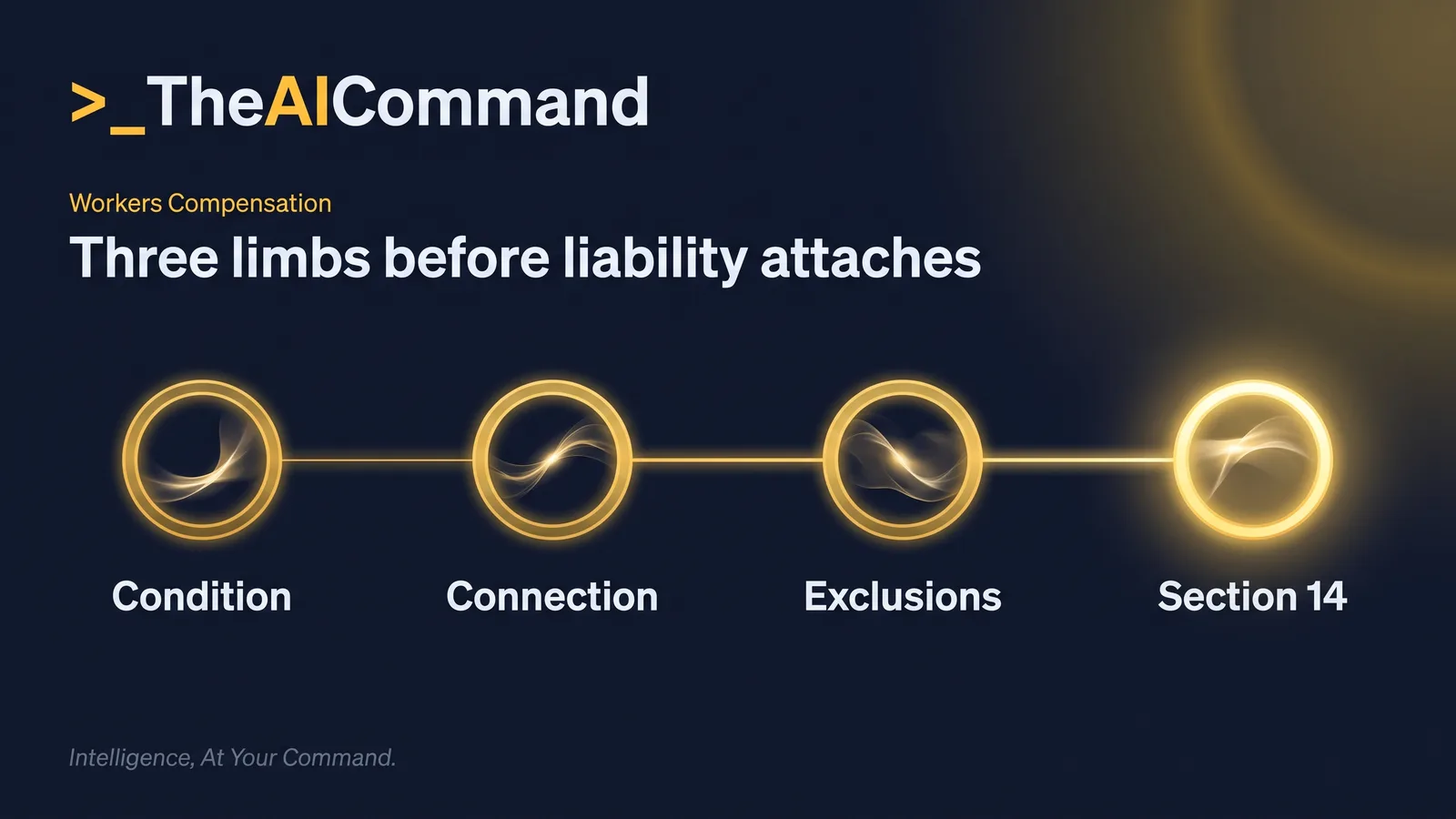
The three-limb order is also the map of where AI helps. Every limb rests on evidence that arrives as an unstructured pile: certificates, reports, emails, file notes, statements. AI is genuinely good at converting that pile into structure that matches the legal test: a document-by-document evidence map, a dated chronology, a table of employer actions tagged against the section 5A(2) categories, a list of gaps and conflicts. That work is collation, and collation is where the hours go.
What AI must never do is answer any limb. Whether employment contributed to a significant degree is a weighing of medical evidence. Whether an action was reasonable and reasonably taken is a contextual judgement about what the employer knew and did. Whether liability is accepted is the statutory decision itself. A model that appears to answer these questions produces a confident conclusion with no accountable reasoning behind it, and a delegate who adopts that conclusion has not made the decision the Act requires them to make. The dividing line, held everywhere in this module: AI organises the evidence and frames the questions. The delegate answers them.
Determinations state outcomes
One drafting rule sits above all others in this practice, and it needs to be installed before any AI drafting begins, because language models default to hedged, advisory prose. Determinations are decisions, not recommendations. They state outcomes in deterministic language: what is decided, under which provision, on what evidence. They never say what the decision maker thinks the outcome ought to be.
Part 2: The de-identification toolkit
Everything else in this module is conditional on this part. Claim files hold sensitive personal and health information, and most AI tools, including the major commercial ones, process input on infrastructure that sits outside your scheme operator's privacy boundary. The control is not a policy statement. It is a desk habit, run the same way on every document, every time.
The placeholder set
A shared placeholder convention is what makes de-identified work usable at team scale: square brackets, capital letters, underscores instead of spaces, so any colleague can read the working copy and any output can be re-personalised with a controlled find and replace. The core set for claims work:
- [CLAIMANT_NAME] for the claimant, everywhere their name appears, including possessives and email addresses.
- [CLAIM_NUMBER] for the claim number and any scheme reference or employee identifier.
- [DATE_OF_BIRTH] for the date of birth, which never has a legitimate reason to enter a drafting tool.
- [EMPLOYER_UNIT] for the agency, branch, team or worksite, wherever the unit is small enough to identify the person.
- [TREATING_PRACTITIONER] for the treating practitioner, with [PRACTICE], [IME_PROVIDER], [REHAB_PROVIDER], [SUPERVISOR] and [WITNESS_1] built on the same pattern as needed.
Extend the set rather than improvising. An ad hoc placeholder like "the doctor" or "Ms X" defeats the find-and-replace step at the end and breeds inconsistency across a team. The convention is covered in more depth in the de-identification toolkit for case managers on TheAICommand, which pairs the placeholder set with a five-category identifier sweep.
The workflow, step by step
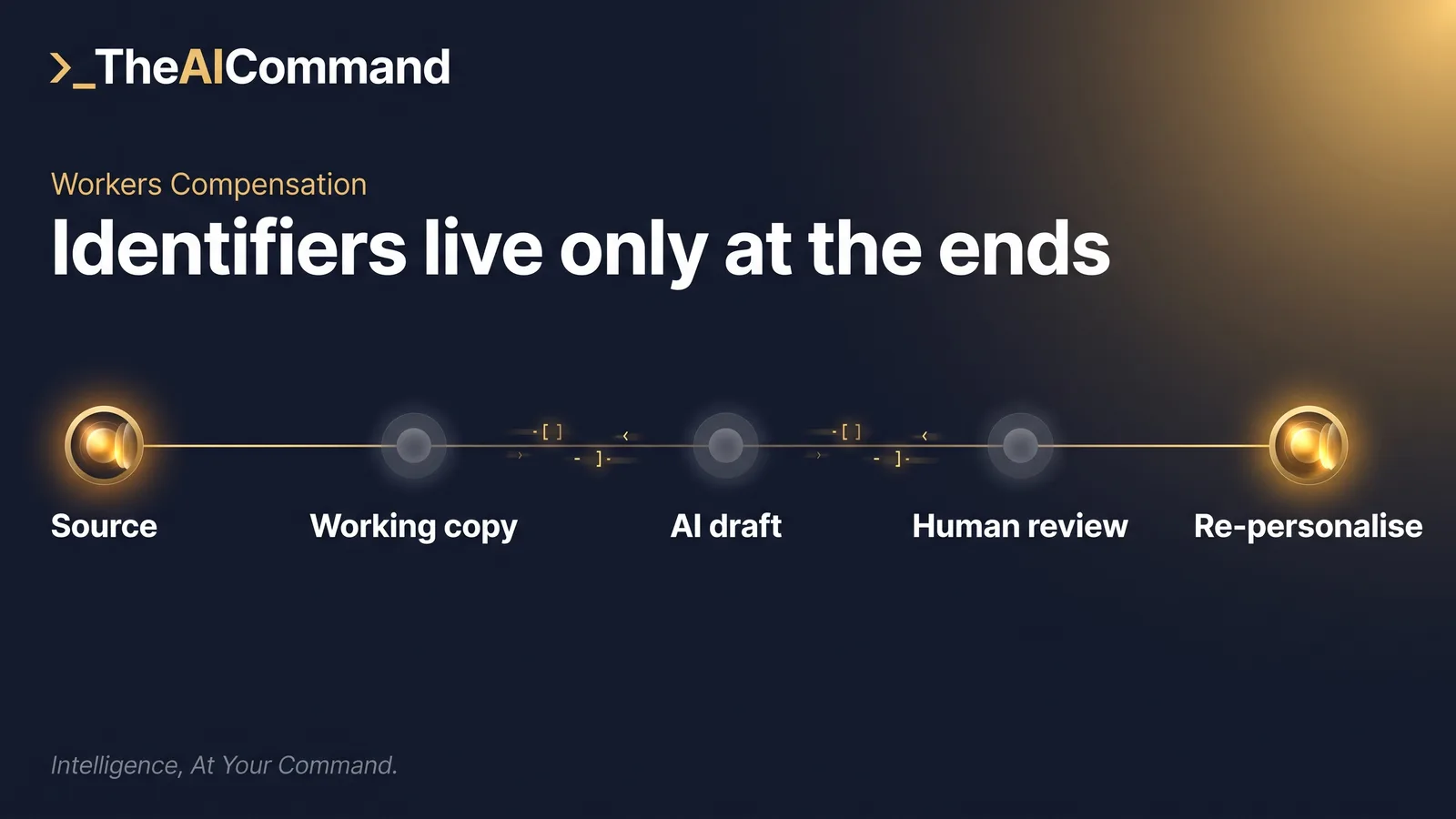
The de-identification workflow has five stages, and the order is the control. Each stage has one job, and the real identifiers exist only at the two ends, inside controlled systems:
- Source document. The original stays untouched in the case management system. It is never edited, never pasted anywhere, never attached to anything outside the controlled environment.
- De-identified working copy. Save a clearly marked copy, run a find-and-replace sweep for names, numbers, dates of birth, units and practitioners, then visually scan paragraph by paragraph for leakage: signature blocks, letterheads, email subject lines, file names, distinctive phrases. Only the clean working copy travels.
- AI-assisted draft. The working copy enters the approved tool. All prompting, structuring and drafting happens in placeholder form. If a real identifier surfaces mid-conversation, stop, delete the conversation, and start again from a clean copy.
- Human review. The delegate reviews and edits the output with placeholders intact. Discussion with colleagues happens in placeholder form too, which keeps every intermediate artefact privacy-safe.
- Re-personalisation, in controlled systems only. The final, human-approved text is re-identified with a controlled find and replace inside the case management system. This is the last step, never an intermediate one, and it never happens inside the AI tool.
What never enters an AI tool, even de-identified
De-identification removes direct identifiers. It does not make every document safe, because some material identifies a person through the shape of its facts rather than the name on its cover, and some material carries legal sensitivities that no redaction cures. Three categories stay out of AI tools entirely:
- Psychiatric report narratives with unique identifying fact patterns. A psychiatric history often reads like a fingerprint: a specific sequence of workplaces, family events, treatments and incidents that could identify the person to anyone who knows them, with every name removed. Summarise what you need by hand; the narrative itself does not travel.
- Third-party medical opinions under dispute. Where an IME opinion or a treating practitioner report is actively contested, the document is potential evidence in a review. Feeding it through an external tool creates handling questions you do not want to answer at the Administrative Review Tribunal. Work from your own hand-written summary of the competing positions instead.
- Anything subject to a legal hold. Material preserved for litigation, a review, or an investigation is under a preservation obligation. It is not working material, and it does not enter any tool outside the controlled environment, de-identified or not.

A worked example: the de-identified incapacity summary
Here is what a working copy looks like in practice: a fictional incapacity summary prepared for AI-assisted drafting, every identifier replaced, every fact preserved. Notice that the placeholders keep the document fully workable: the structure, the dates pattern, the restrictions and the section references all survive, and nothing in it could identify a person.
The checklist prompt
The final control is a gate you install inside the AI tool itself. Run this checklist prompt at the top of any claims conversation, and the tool becomes the last line of defence against its own misuse:
Part 3: The determination-drafting project space
Why a project space beats ad hoc chats
A loose chat window is the wrong tool for determination support, for three reasons. It carries no standing rules, so the de-identification gate and the never-decide boundary have to be retyped, and eventually are not. It carries no reference material, so the model free-associates about workers compensation from its training data, blending state schemes, superseded provisions and other countries' law into plausible prose. And it leaves no consistent structure for a team to review, so every AI-assisted determination looks different at audit.
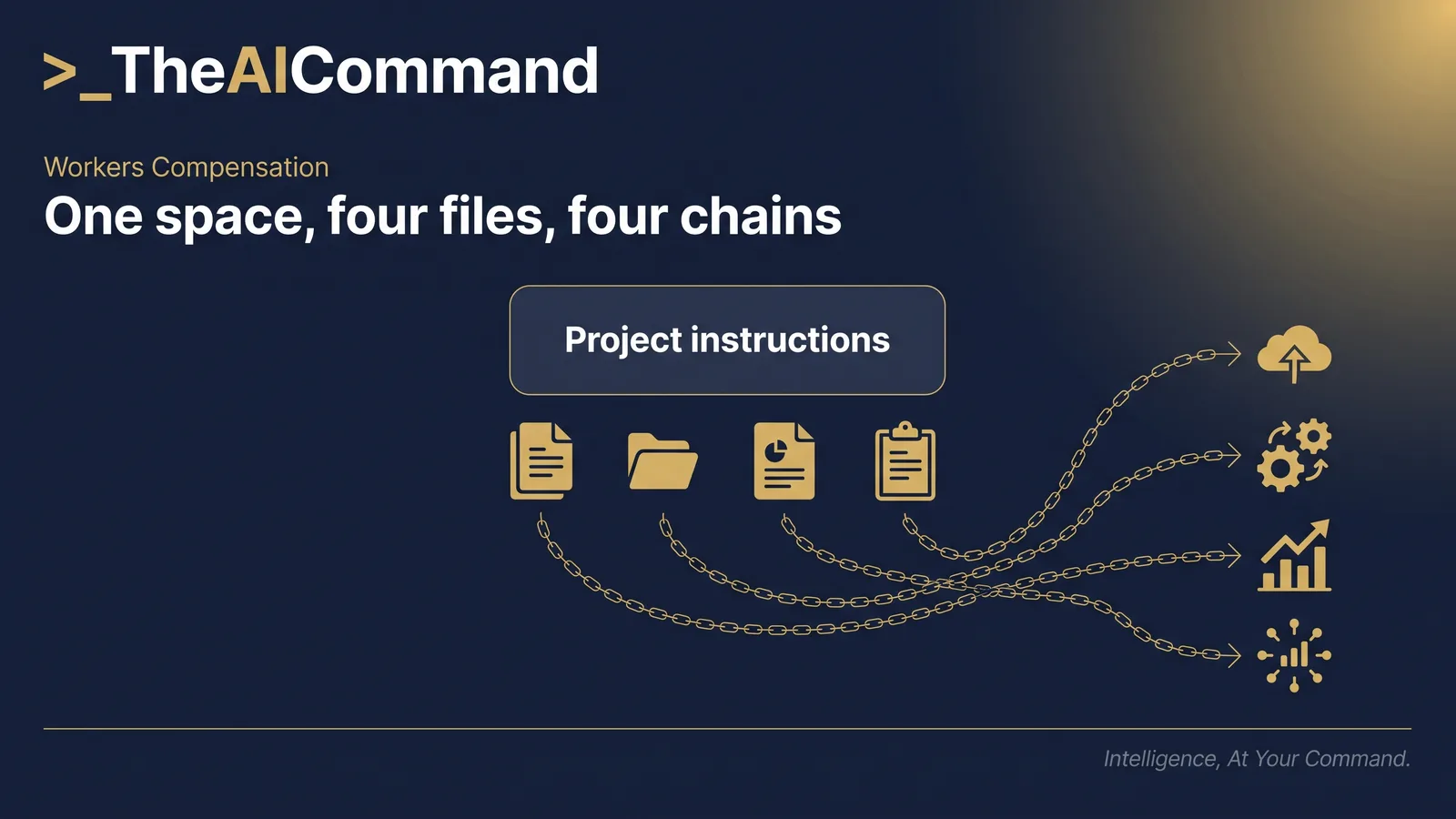
A dedicated project space fixes all three. In ChatGPT, create a Project; on Claude, a Project on claude.ai or a Cowork project pointed at a folder. Either way the architecture is identical: one set of locked custom instructions that governs every conversation, a small library of reference files the model consults instead of its imagination, and a set of prompt chains for the artefacts claims work actually produces. Set it up once, in under an hour, and every determination conversation starts inside the guardrails instead of outside them.
The custom instructions
The instructions are the contract. They encode the de-identification gate, the never-decide boundary, the section-referencing discipline and the deterministic language rule, so no individual prompt has to remember them. Paste this text as the project instructions and treat it as locked: changes go through whoever owns your team's AI governance, not through individual edits mid-claim.
The file library
Four small markdown files give the model verified reference material and your team's actual formats. Keep them short, current, and owned: each file has one person responsible for updates, and every entry in the key-sections file is verified against the current compilation on the Federal Register of Legislation before it goes in.
- src-act-key-sections.md: the sections your team works with daily, each with a verified plain-language summary and the test it sets. This is the file that stops the model inventing or blending provisions.
- determination-templates.md: your team's determination structures for section 14, 16, 19 and 24 decisions, including the standard review rights wording, so drafts land in the format reviewers expect.
- evidence-summary-template.md: the evidence map and chronology table formats from Chain A below, so every claim's working documents look the same at audit.
- de-identification-rules.md: the placeholder set, the five-stage workflow and the excluded-material list from Part 2, so the tool can enforce the gate from its own reference file.
The four prompt chains
Chains are the working end of the project space: fixed sequences that produce the four artefacts determination work needs, in a shape a delegate can review fast. Each chain waits for approval between steps, which is where your judgement enters, and each ends with the "For human review:" list the instructions demand.
Chain A: evidence map and chronology builder
Chain B: the section 5A walkthrough
Chain C: the determination skeleton
Chain D: the plain-English claimant letter
The human-in-the-loop gate
The project space produces working drafts faster than any process it replaces, which is exactly why the gate at the end matters more, not less. Three commitments make an AI-assisted determination defensible, and all three are the delegate's personal work. The delegate reads every source document: the evidence map is an index for that reading, never a substitute for it. The delegate treats AI output as a working draft only: every factual assertion is walked back to the document that records it, every section reference is checked against the Act, every finding space is completed in the delegate's own reasoning and words. And the statutory decision is the delegate's: the outcome, the findings and the reasons belong to the person the Act makes accountable, who signs knowing the reasoning will be read at reconsideration and, if it comes to it, at the Administrative Review Tribunal.
Part 4: Return to work and rehabilitation with AI
The rehabilitation provisions: sections 36, 37 and 40
Liability is half the scheme. The other half is recovery, and it runs on three provisions. Section 36 allows the rehabilitation authority to arrange an assessment of an employee's capability of undertaking a rehabilitation program where an injury results in incapacity for work or impairment. Section 37 allows the authority to determine that an employee should undertake a rehabilitation program, in the statute's own words, and sets out the matters to consider, including any written assessment, cost, the likely improvement in employment opportunity, the likely psychological effect on the employee of not providing the program, the employee's attitude to the program, and alternative programs. Section 40 places the duty on the employer's side: where an employee is undertaking, or has completed, a rehabilitation program, the employer takes all reasonable steps to provide suitable employment or to assist the employee to find it, with suitable employment defined in section 4 by reference to the employee's age, experience, training, language and other skills, and their suitability for rehabilitation or vocational retraining.
Notice what kind of decisions these are. The section 36 assessment is a clinical and vocational evaluation. The section 37 determination weighs statutory considerations, including a psychological one. The section 40 duty is a judgement about what is reasonable for a particular employer and a particular employee. Every one of them is a human decision resting on professional assessment. AI's role in this part is narrower than in Part 3, and the boundary is brighter.
Where AI helps in RTW planning
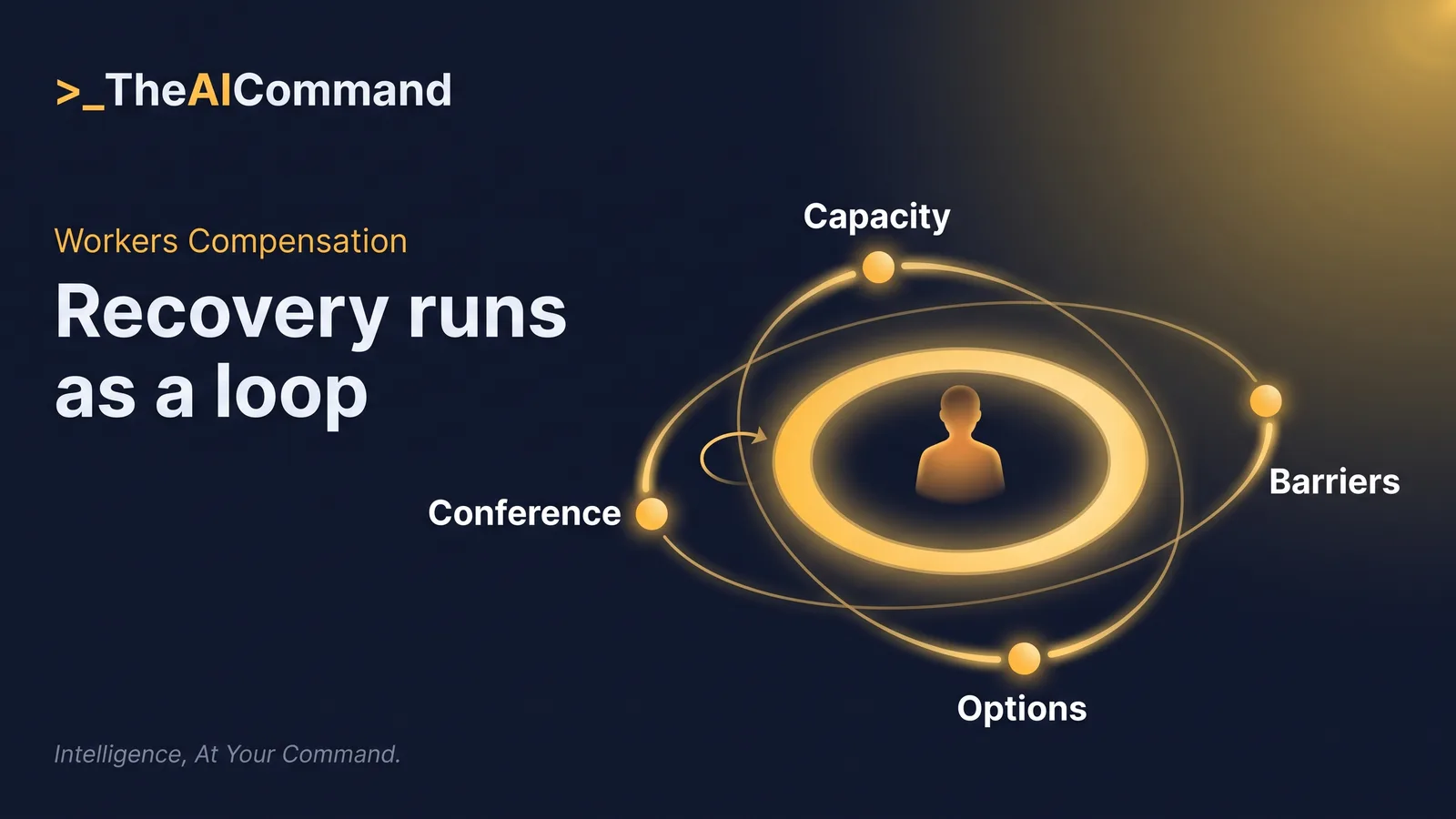
Return to work planning is coordination work: capacity information from certificates, role demands from the workplace, barriers from the employee's circumstances, and a plan that has to be agreed between the treating practitioner, the employee, the employer and the rehabilitation provider. The coordination artefacts, barrier analyses, plan options, case conference agendas, progress summaries, are structured documents built from information others have provided, which makes them good AI drafting material, always from de-identified inputs, always as drafts for the humans who own the plan.
What never to do in RTW work
The RTW boundary has three hard edges, and each one exists because the underlying judgement belongs to a clinician or a statutory decision maker:
- Never let AI infer diagnosis or capacity. The certificate says what it says. A model that extrapolates from "no lifting above [LIFT_LIMIT]" to a view about what the employee can really manage is generating a medical opinion without a clinician, and any plan built on it is built on nothing.
- Never generate medical conclusions. Summarising what a report states is support work. Concluding what the reports mean clinically, reconciling conflicting certificates, or predicting recovery timeframes is medical judgement, and it stays with the practitioners who carry it.
- Never draft section 37 program requirements without the rehabilitation authority's own assessment. A rehabilitation program is determined under section 37 on the statutory considerations, informed by the section 36 assessment. AI can format and structure a program document after those judgements are made. It cannot supply them, and a program drafted from a model's assumptions rather than an actual assessment is indefensible at review.
Psychological claims sharpen every edge. Section 37 expressly includes the likely psychological effect on the employee of not providing a program among its considerations, and RTW planning for psychological injury turns on trust, pacing and consultation. AI must never be used to characterise an employee's language as resistance, reluctance or non-compliance. Draft neutral questions, quote certificates, and leave the reading of people to the people in the room.
Practical takeaways
Do this Monday
- Print the placeholder set, tape it to your monitor, and run the five-stage de-identification workflow on one real document as a practice pass: source, working copy, sweep, visual scan, and stop there. The habit forms at the desk, not in a policy document.
- Create the determination-drafting project space: one Project in your approved tool, the locked custom instructions pasted in, and empty stubs for the four reference files. Twenty minutes, once.
- Draft src-act-key-sections.md for the five sections your team touches most, verifying every summary against the current compilation on the Federal Register of Legislation before it enters the file.
- Run Chain A on one closed, de-identified claim file and compare the evidence map against how the claim was actually worked. A closed file is a risk-free test bed, and the gaps it exposes calibrate your trust in the tool.
- Write the four-line AI file note for that practice run, and agree the note format with your team lead so every AI-assisted document from here carries one.
The claims-practice checklist
- No real names, claim numbers or dates of birth ever enter an AI tool. Placeholders only, every time.
- The excluded list is respected: unique psychiatric narratives, disputed third-party opinions and legal hold material never travel, even de-identified.
- Every claims conversation starts inside the project space, under the locked instructions, never in an ad hoc chat.
- Every section reference in every AI draft is verified against the Act before the draft goes anywhere.
- AI output is structured as questions and drafts. Any output that states or implies an outcome is discarded, and the prompt is tightened.
- The delegate reads every source document. The evidence map is an index, not a substitute.
- Determination text uses deterministic language: outcomes are stated, never recommended, and "should" never appears in outcome wording.
- Every finding and every outcome is completed by the delegate, in the delegate's own words.
- RTW drafting quotes certificates exactly and never infers diagnosis, capacity or motivation.
- A four-line file note records tool, purpose, de-identification and human review on every AI-assisted document.
Your prompt library
The prompts in this module are the working library: the three-limb evidence sort and de-identification gate from Parts 1 and 2, the locked instructions and Chains A to D from Part 3, and the three RTW prompts from Part 4. Save them into the project space and refine the wording as your team's formats evolve. One bonus prompt earns a permanent slot, as the final pass before any determination text leaves your desk:
The assessment below tests whether you can run this practice, not just describe it: the liability architecture and the three-limb order, the de-identification discipline and its hard exclusions, the project space and its chains, and the RTW boundaries. Work through it before the next live claim lands on your desk.
Test your knowledge
LM-W01 assessment. 30 questions
25-30 minutes. One question per screen. Your progress is saved locally for 30 days, so you can pick up where you left off. Submit anytime to see your score, tier, and per-question rationale.
Related tool
Benchmark yourself with the WC Self-Assessment
This module teaches the practice; the WC Self-Assessment measures it. Map your SRC Act practice capability across your dimensions, with AI leverage woven through. 15-25 minutes, free, anonymous, with a personalised PDF report.
Start the self-assessmentRead next

Corporations Act 2001 (Cth)
The Corporations Act 2001 (Cth) is the consolidated statute governing companies, financial product issuers and distributors, and the directors who oversee them. The Act sits at the apex of the Australian financial services regulatory hierarchy. The Australian Securities and Investments Commission (ASIC) is the lead reg
Read article
Privacy Act 1988 (Cth) and the Australian Privacy Principles
The Privacy Act 1988 (Cth) is the principal Commonwealth statute governing personal information handling in Australia. It binds APP entities, including all Australian financial services providers because of the financial services carve-out from the small business exemption. The 13 Australian Privacy Principles (APPs) s
Read articleHow do I draft a determination with de-identification controls?
A fixed-format procedure built from this article: trigger, inputs, steps, prompts, checks and the governance controls, on one page.
General information and education only. Not legal, compliance, financial, or professional advice. Verify any time-sensitive obligation against the primary source.
TheAICommand. Intelligence, At Your Command.