
Australia's AI governance market is shifting from principle-setting towards assurance, so the scarce 2026 hire is the practitioner who can move from principle to proof. AI governance used to be a committee, a policy and a list of principles. In 2026, the hard work sits one layer lower. Regulated entities need people who can turn an AI use case into a risk tier, a control objective into test steps, a vendor claim into evidence and a board question into a defensible record.
That changes the talent market. A strong candidate is no longer simply a compliance professional who has read an AI framework, or a data scientist who can explain a model. The scarce profile can move between regulation, technology, operating process and assurance without pretending those disciplines are interchangeable.
This analysis uses sources available to 10 July 2026. All 3, 12 and 24 month statements below are labelled editorial forecasts, not reported facts.
What is driving demand for AI governance skills?
APRA supplied the clearest Australian demand signal on 30 April 2026. Following targeted engagement with a group of selected large banks, insurers and superannuation trustees in late 2025, the regulator said governance, risk management, assurance and operational resilience practices were not keeping pace with AI adoption. It observed that many internal-audit and risk functions lacked the specialist skills and tools required to engage in AI assessment or audit, especially where agentic behaviour, automated decision-making and AI-assisted code generation were involved (APRA letter to industry).
That is not a recruitment forecast. It is a statement of control weakness. The hiring implication is an inference: regulated entities that respond seriously will need to build, buy or borrow capability in AI risk assessment and assurance.
The broader labour market points the same way. The National AI Centre and CSIRO reported in June 2025 that requirements for technical AI-related skills rose from 0.2% of Australian job postings in 2015 to 0.9% in 2024. Inner Sydney, Melbourne, Brisbane and Perth accounted for 64% of AI position locations, and postings frequently combined technical capabilities with communication, management and leadership (National AI Centre).
PwC Australia's 2026 AI Jobs Barometer, released 18 June 2026, found Australian job advertisements seeking AI skills increased from 20,000 in 2024 to 41,000 in 2025. It also reported that recruiters are placing greater value on candidates who combine technical capability with human skills, and that critical thought and judgement will be highly regarded as AI adoption spreads (PwC Australia). This is broad AI-market evidence, not a count of governance vacancies. It supports the hybrid-skills thesis but should not be misread as direct demand for AI assurance specialists.
Robert Half's 2026 Australia Financial Services Salary Guide lists senior operational risk manager and senior compliance manager among its in-demand roles. Its in-demand skills list includes technology risk and controls, operational risk and controls, CPS 230 and third-party risk management, FAR, AML Tranche 2 readiness and risk in change. AI assurance sits naturally across that cluster.
Assurance moves to the core
Governance establishes authority and rules. Assurance asks whether those rules work. The live talent gap sits in the second sentence.
An assurance-capable practitioner can:
- define the population of AI use cases and test whether the AI use case register is complete
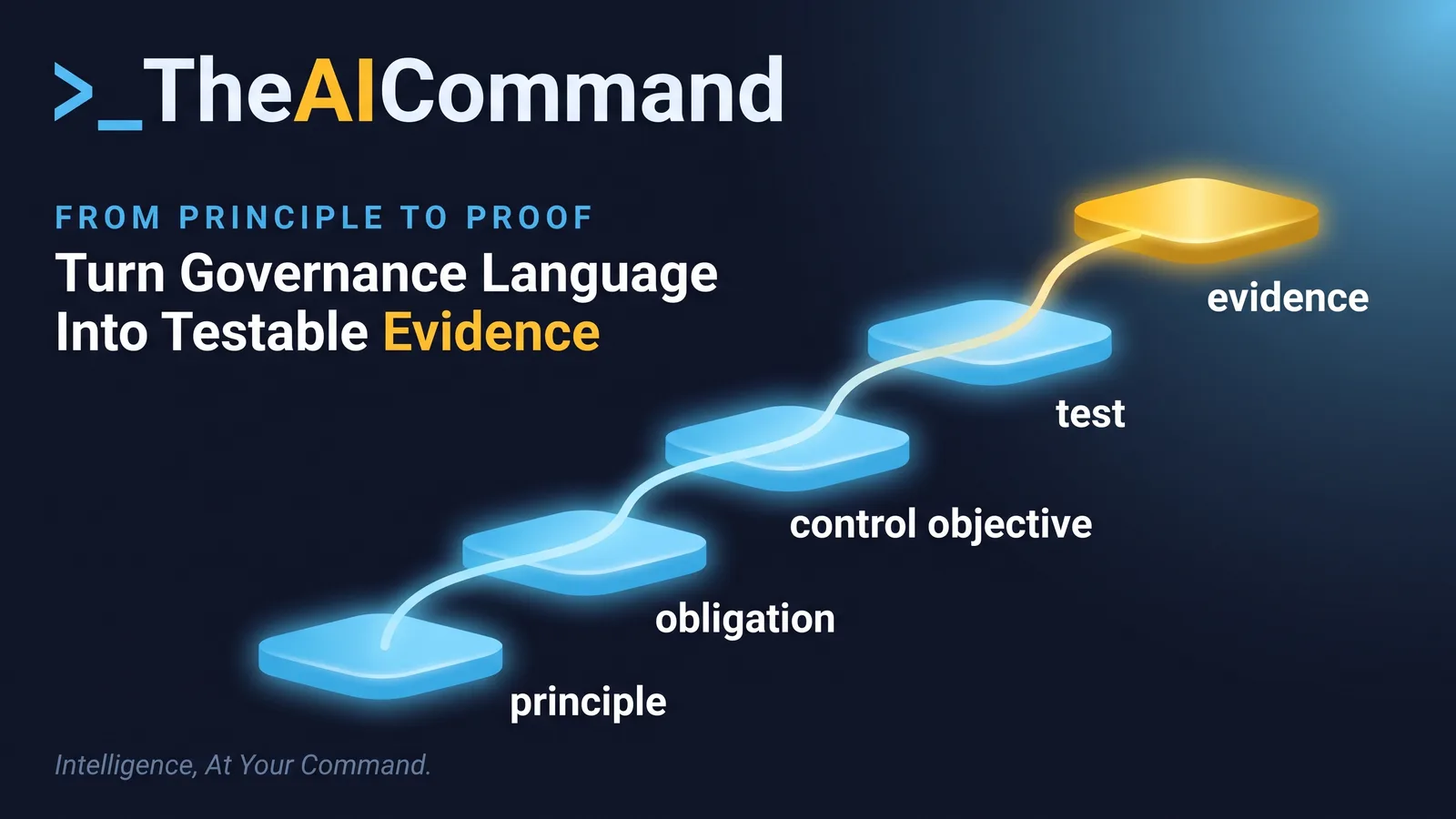
- translate a principle into a control objective and an observable control activity
- assess evidence quality, not just evidence presence
- trace data, model, prompt, tool and vendor dependencies
- design tests for accuracy, bias, robustness, security and human oversight that fit the use case
- distinguish model performance from business-process effectiveness
- document limitations and residual risk without smoothing over uncertainty
- communicate findings to executives without removing the technical substance
This is why AI in internal audit is becoming a talent question. An auditor does not need to train a frontier model. The auditor does need enough model and system literacy to challenge scope, obtain the right artefacts and recognise when a vendor benchmark does not answer the control question.
The same shift is visible at board level. APRA expects boards to maintain sufficient understanding and literacy with respect to AI to set strategic direction and provide effective challenge and oversight. The relevant capability is not general awareness. It is the ability to ask whether management's evidence supports the claim, a boundary explored in board AI literacy as a control expectation.
How do you benchmark an AI governance salary?
There is no reliable national salary series for "AI governance professional" in Australia. Titles are inconsistent and the work is distributed across functions. A defensible benchmark therefore starts with adjacent GRC roles, then adjusts for scope, scarcity, technical depth and accountability.
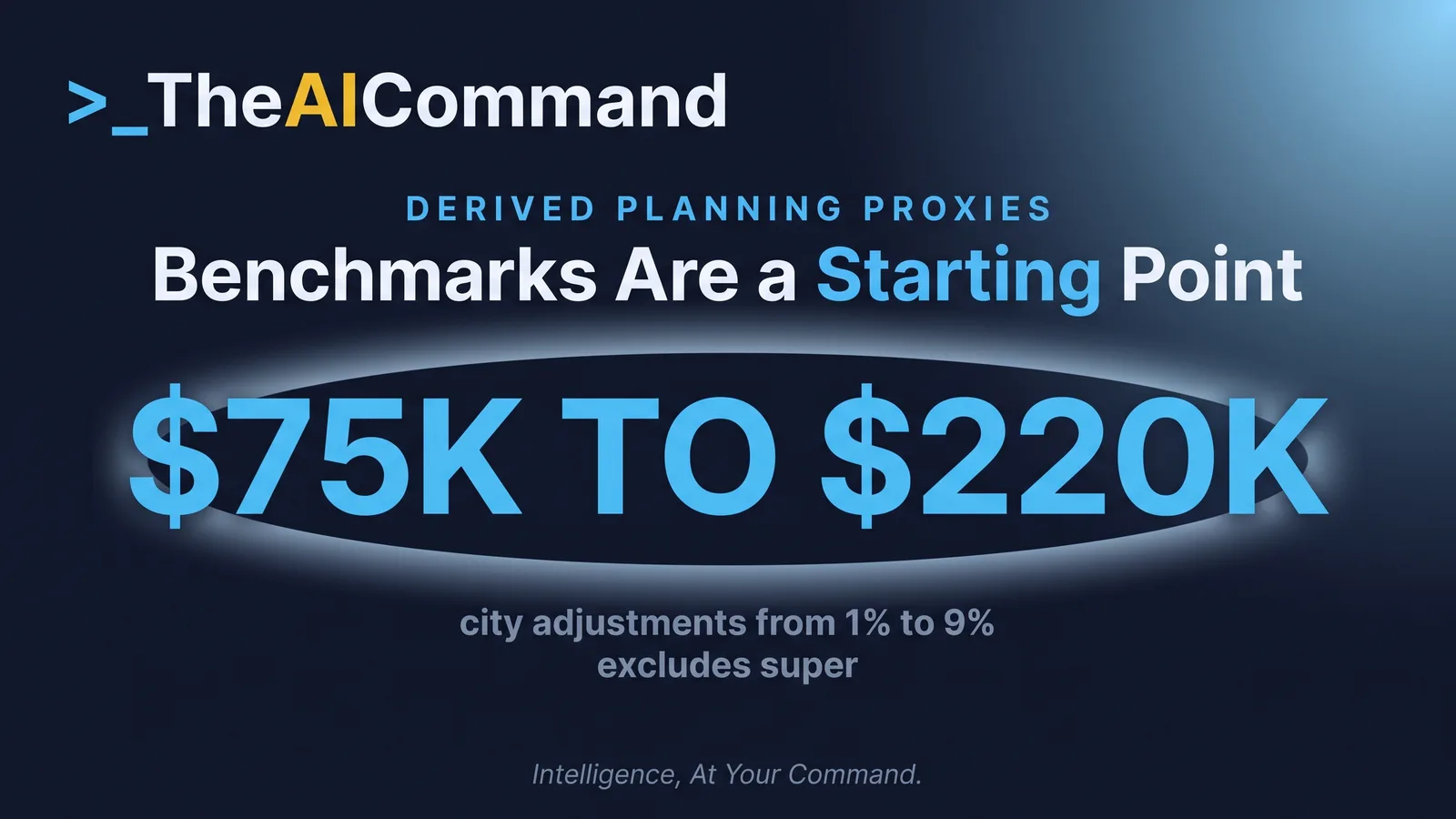
Robert Half's 2026 guide publishes national starting-salary percentiles that exclude bonuses, benefits and superannuation. Relevant 50th-percentile proxies include Credit Risk Analyst at $75,000, Financial Crime/AML Manager at $145,000, Senior Operational Risk Manager at $170,000, Senior Compliance Manager at $170,000 and Head of Financial Crime/AML at $220,000. Robert Half's published city figures for the same roles apply consistent uplifts to those national medians: Sydney and Perth 9%, Melbourne 3% and Brisbane 1%. A senior operational risk manager's national $170,000, for example, is published as $185,300 in Sydney and Perth, $175,100 in Melbourne and $171,700 in Brisbane.
The table below applies those city uplifts to four national median proxies and rounds to the nearest $1,000. These are derived planning figures, not observed salaries for named AI governance jobs.
Use the analyst row for a practitioner working inside an established framework with close supervision. Use the manager row for someone owning assessments and stakeholder delivery. Use the senior-manager row where the role designs the control framework, challenges first-line executives and leads assurance. Use the head row only where there is genuine enterprise accountability, budget, board exposure and ownership across multiple risk disciplines.
Do not add an automatic "AI premium" to every role. PwC reports an average wage premium of 62% for AI-skilled work in Australia, up from 57% a year earlier, but that statistic spans occupations and does not establish the correct uplift for a particular GRC hire. Test scarcity through actual candidate flow, interview quality and competing offers. Then record why the organisation departed from the adjacent-role benchmark.
Hays' FY26/27 salary guide research adds a retention warning. Based on insights from more than 7,000 hiring managers and professionals across Australia and New Zealand, it reported that half of Australian workers felt underpaid while only one in five had changed employer in the previous year (Hays). Low movement should not be mistaken for a deep available talent pool.
Five candidate archetypes
1. The regulatory translator
Usually from compliance, legal or prudential risk. Strong at reading APRA, ASIC, privacy and competition requirements, then mapping them to obligations. The development gap is often test design and system architecture. Pair this person with a technical assurance lead until they can challenge evidence independently.
2. The model-risk connector
Usually from credit, market or model risk. Comfortable with validation, limitations, performance monitoring and change control. The gap may be generative and agentic systems, consumer outcomes or non-model controls. This profile is valuable where organisations need to extend existing model-risk discipline without pretending every AI system is a traditional model.
3. The technology control specialist
Usually from cyber, technology risk, data governance or IT audit. Strong on access, change, logging, resilience, third parties and evidence. The gap may be conduct, fairness, accountability and regulatory interpretation. This is often the fastest route to assurance capability for tool-using and agentic systems.
4. The internal-audit builder
Understands independence, sampling, evidence and reporting. Can design an assurance program and explain why a policy is not a control. The gap may be technical depth. Give this person access to model, data and security specialists without outsourcing the audit judgement.
5. The AI-native domain practitioner
Comes from a regulated business function and has built real AI workflows. Understands where human review fails, what records operations actually keep and how vendor features change the process. The gap may be formal risk and assurance methodology. This candidate can become powerful with disciplined control-design training.
The strongest teams combine archetypes. Hiring one "AI governance lead" to cover law, model validation, cyber, data, product risk, audit and change management is usually a job-design failure disguised as ambition.
What should hiring managers test for?
Replace generic questions about "responsible AI passion" with a work sample. Give the candidate a fictional, de-identified use case and a small evidence pack. Ask them to:
- identify the most material uncertainties
- draft three control objectives
- distinguish design evidence from operating-effectiveness evidence
- propose two tests and explain their limitations
- write a 150-word executive finding without overstating the conclusion
The exercise reveals whether the candidate can move from principle to proof. It also exposes weak job design. If the panel cannot agree what a good response looks like, the organisation may not yet know what it is hiring the person to do.
Demand outlook
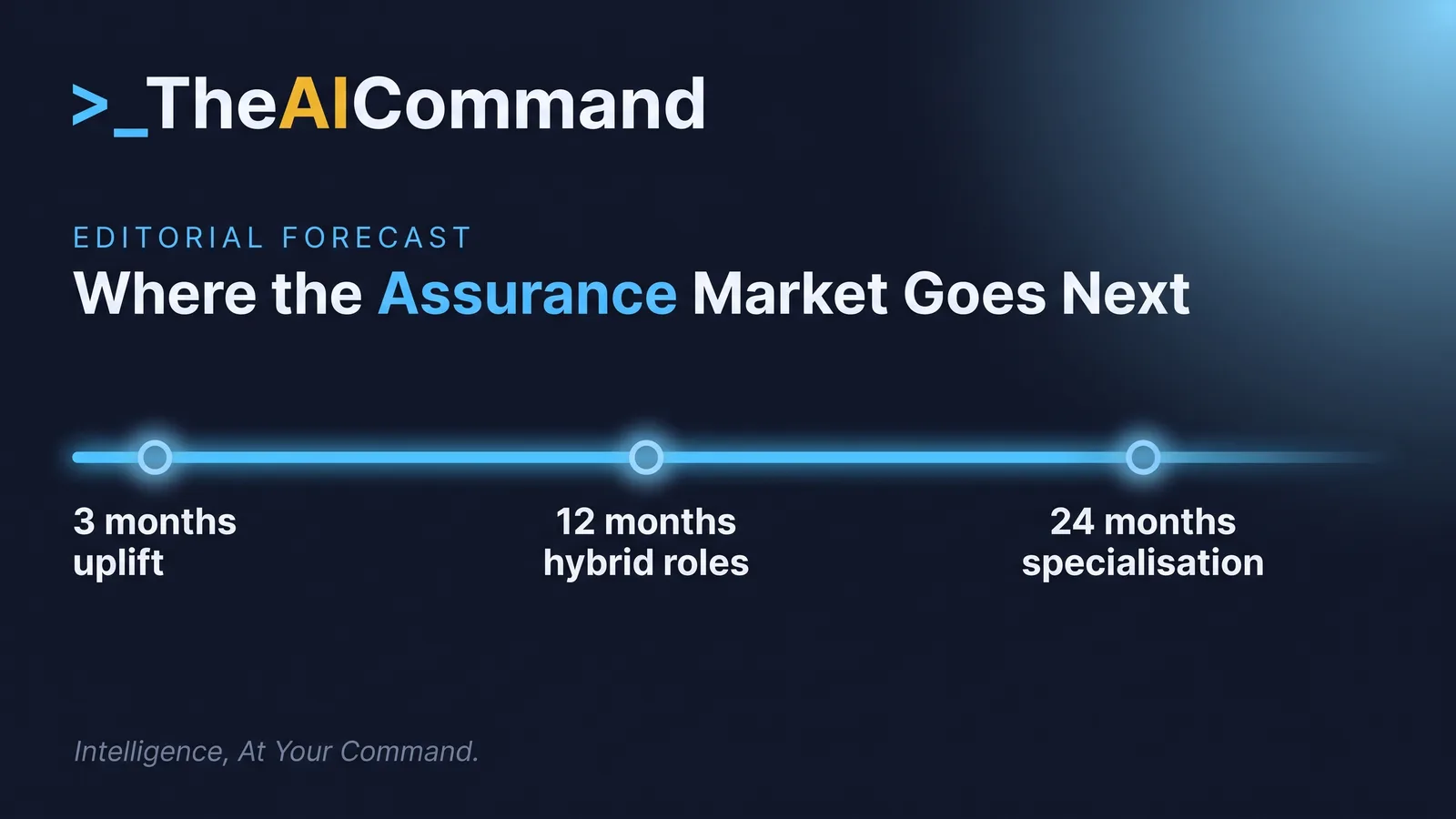
Three months: to October 2026
Editorial forecast, not reported fact. Demand is likely to remain concentrated in uplift work rather than large permanent AI-governance teams. Expected briefs include AI use-case inventory, board reporting, policy-to-control translation, third-party AI review and internal-audit scoping. APRA-regulated employers are likely to favour candidates who can connect AI work to CPS 230, CPS 234, CPS 220 and existing assurance plans.
The hiring bottleneck will be role clarity. Employers advertising for an AI ethicist when they need a technology-risk assurance manager will attract the wrong market.
Twelve months: to July 2027
Editorial forecast, not reported fact. Hybrid specifications should become more standard. "AI governance" will appear less often as a standalone policy role and more often as a required capability inside operational risk, compliance, internal audit, privacy, cyber and data positions. Work samples and evidence-based interviews should become more common as employers learn that framework vocabulary does not predict assurance performance.
Contract and advisory demand may soften where initial framework builds finish, while permanent demand grows for monitoring, control testing and issue remediation. The valuable candidate will be the person who can operate the system after launch.
Twenty-four months: to July 2028
Editorial forecast, not reported fact. The market should split into clearer specialisations: AI risk ownership in the first line, framework and challenge in the second line, technical assurance in internal audit, and deep model or security specialists supporting all three. Career ladders should begin to distinguish practitioner, assurance lead and enterprise accountable executive.
Salary differentiation is likely to follow decision scope and evidence capability more than tool fluency. Prompt skill will be assumed. The premium will sit with people who can challenge systems, defend conclusions and improve controls without blocking useful adoption.
Practical implications
- Define the work before choosing the title. State which decisions, artefacts and assurance outcomes the role owns.
- Benchmark against adjacent GRC roles. Apply a documented scarcity adjustment only after testing the market.
- Hire teams by capability mix. Cover regulation, technical controls, model behaviour, business process and assurance judgement.
- Use work samples. Test control design and evidence reasoning, not AI vocabulary.
- Build internal pathways. Strong candidates may already sit in audit, cyber, privacy, data or regulated operations.
The practical opportunity is to turn voluntary AI guardrails into audit evidence. That is also the market's dividing line. Principle fluency gets a candidate into the conversation. Assurance skill makes the work usable.
Bottom line
AI governance work in 2026 has moved from principle-setting to assurance, and the scarce, valuable hire is the practitioner who can turn a principle into a testable control and defend the evidence to a board or an auditor. There is no clean national salary series, so adjacent risk, compliance and audit benchmarks are the honest starting point, adjusted for scope and for scarcity you have actually tested. Most organisations get further with a capability mix than with one impossible all-in-one AI governance lead.
Do this Monday:
- Write down which decisions, artefacts and assurance outcomes the role owns before choosing a title.
- Benchmark against adjacent GRC roles, from analyst to function head, and document any scarcity adjustment only after testing the market.
- Design a de-identified work sample that asks candidates to move from a use case to control objectives, tests and a short executive finding.
- Map the capability you already hold in audit, cyber, privacy, data and regulated operations before hiring externally.
- Connect AI assurance briefs to existing CPS 230, CPS 234 and internal-audit plans rather than standing up a separate framework.
References
- APRA, Letter to industry on artificial intelligence, 30 April 2026. https://www.apra.gov.au/apra-letter-to-industry-on-artificial-intelligence-ai
- National AI Centre and CSIRO, Australia's artificial intelligence ecosystem: growth and opportunities, June 2025. https://www.ai.gov.au/news-and-insights/reports/australias-artificial-intelligence-ecosystem-growth-and-opportunities
- PwC Australia, 2026 AI Jobs Barometer media release, 18 June 2026. https://www.pwc.com.au/media/2026/2026-AI-Jobs-Barometer.html
- Robert Half, 2026 Australia Financial Services Salary Guide. https://www.roberthalf.com/au/en/insights/salary-guide/financial-services
- Robert Half, 2026 national and city salary figures for senior operational risk manager. https://www.roberthalf.com/au/en/job-details/senior-operational-risk-manager
- Hays, Salary Guide FY26/27, Australian market findings. https://www.hays.com.au/salary-guide
Content disclaimer: This article is for general educational and informational purposes only. It does not constitute legal advice, regulatory guidance, careers advice, or a substitute for professional compliance judgement. Regulatory obligations vary by entity type, licence and circumstance. Always refer to primary source guidance from APRA, ASIC, or the relevant regulatory authority.
Salary-data note: Salary data are adjacent-role market proxies and derived planning figures, not recruitment or remuneration advice, offers or guarantees. Refresh the market evidence before relying on it and obtain qualified advice for a specific role.
TheAICommand. Intelligence, At Your Command.