
ASIC has published the gap in its own enforcement model.
On 30 June 2026 ASIC released REP 835, a landscape review of innovation in financial markets and financial market infrastructure that it commissioned from the Digital Finance Cooperative Research Centre, the second instalment of a series whose first, REP 834, covered financial technology and RegTech in May 2026. Most of REP 835 is about tokenisation, settlement and infrastructure. The fourth stream is about AI in trading, and it carries a paragraph no regulator writes casually.
Agentic AI, increasingly autonomous trading systems and trading systems with limited explainability, the report says, are "hard to assess through traditional notions of trader intent or fixed algorithm design", placing pressure on ASIC's surveillance capability. Such systems "also raise legal/enforcement questions about how to define and prove misconduct that is distinguished by intent, such as market manipulation" (p.8). At the market level it is blunter still: "Concepts such as intent, causation, and individual accountability become harder to apply when significant trading decisions are made by adaptive systems rather than humans" (p.5).
That is a report ASIC commissioned and chose to publish, describing the seam in the regulator's own case theory.
The so what is not that enforcement stops. A regulator naming the limits of its current model is a leading indicator of where supervision goes next, and REP 835 says where. ASIC's recent work, it observes at p.71, "shows awareness of governance and control issues in AI deployment, but future pressure may fall more heavily on surveillance capability: detecting emergent behaviour, model-driven coordination, and risks arising from increasingly complex automated trading environments." The AI governance programme most firms have spent two years building is not the thing that gets tested first. The surveillance function is.
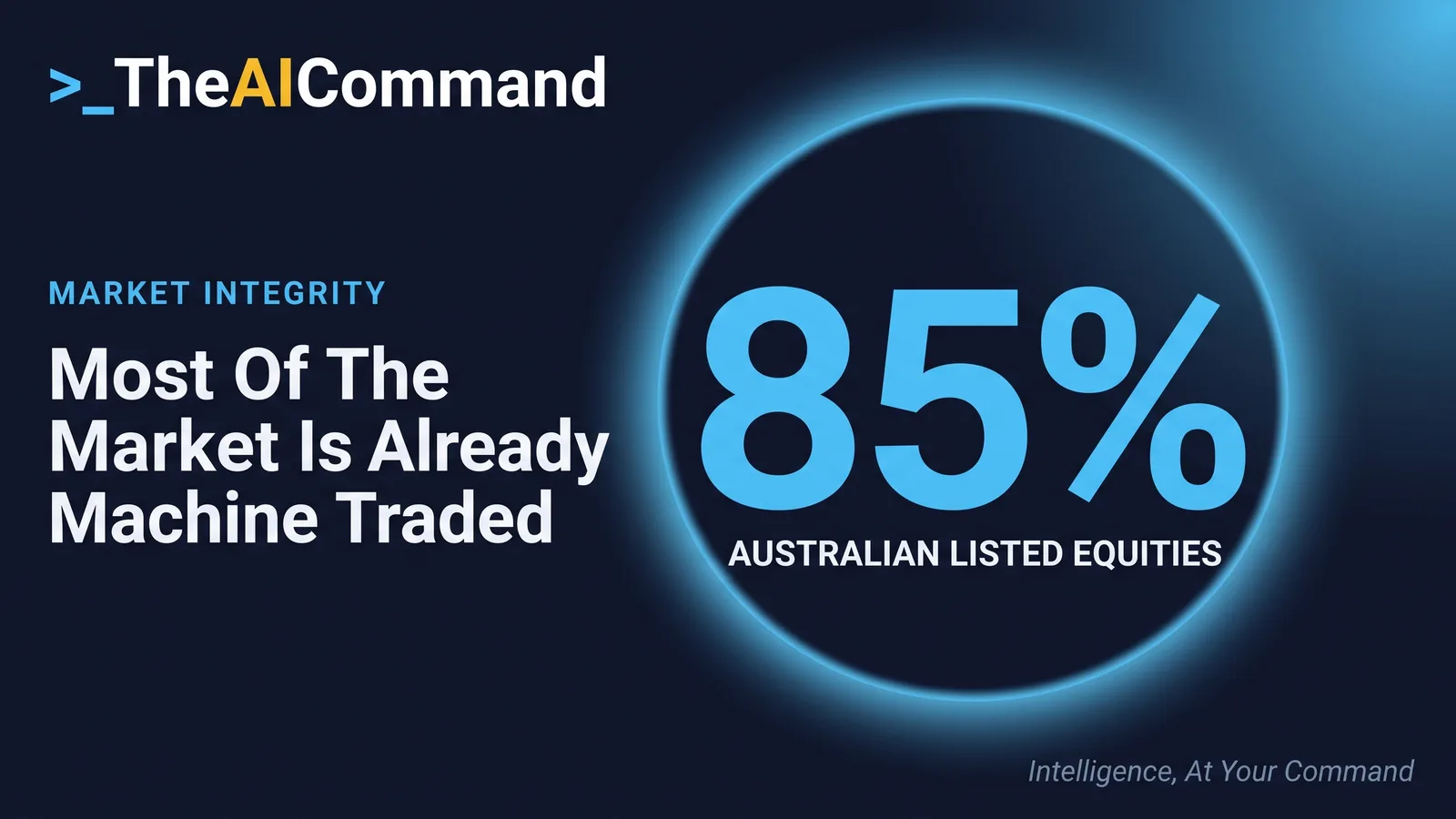
The scale is not speculative. When ASIC opened consultation on its trading system rules in August 2025, it put algorithmic trading at approximately 85% of Australian listed equities, 94% of SPI 200 futures and 46% of three-year Treasury bond futures. The market this problem lands in is already overwhelmingly machine-driven.
<!-- style: data-halo -->
Australia drafted this on effect, not intent
REP 835 states the enforcement problem generally at p.61: "existing enforcement frameworks often rely heavily on concepts such as intent and causation." Read that as a description of Australian law and you will send a compliance function looking for the wrong gap.
The core prohibitions sit in sections 1041A and 1041B of the Corporations Act. Justice Ashley Black, in a paper published by the Supreme Court of NSW, describes section 1041B as prohibiting an act or omission that has or is likely to have the effect of creating, or causing the creation of, a false or misleading appearance of active trading in financial products, or a false or misleading appearance with respect to the market for, or the price for trading in, financial products. The operative concept is effect.
On section 1041A, Black J records the High Court's decision in Director of Public Prosecutions (Cth) v JM [2013] HCA 30; (2013) 94 ACSR 1; 298 ALR 615, where the Court "took a broad view of that section". The Court expressed the view at [72] that the section is contravened if a person creates an artificial price for entering into a transaction, and noted that "a sole or dominant purpose of creating or maintaining an artificial price is not necessary to such a contravention but can provide evidence that a transaction is likely to have the prohibited effect".
Read that carefully, because a shorthand circulates that treats this as a sole or dominant purpose test. A Clayton Utz note from August 2018 frames it that way. Black J's account of JM does not. Purpose is evidence of the prohibited effect, not an element the prosecution must establish.
Then comes the limit. Black J continues that a contravention "should not be established merely because the sale or purchase of financial products on a financial market leads to a change in the price" if the trader's purpose in undertaking that transaction was a legitimate one. Purpose is not the element, but it is still what separates a genuine trade that moved the price from an artificial price.
One more piece matters for the machine case. Black J notes that JM confirms a significant degree of overlap between sections 1041A and 1041B, and that other conduct with a price effect, including the placing of orders that did not give rise to transactions, would typically fall within the scope of section 1041B. Orders placed and pulled without ever transacting, which is precisely the pattern an execution model can learn, land there.
For a compliance function this is not an academic distinction. It changes where you look. If the exposure ran through intent, the inquiry would be what a trader was thinking, and an autonomous system would simply have no answer to give. Because the exposure runs through effect, the inquiry is what the system did to the market, and whether anyone in the firm can explain why it did it. The first question has no defendant. The second has you.
So the drafting holds up better against adaptive systems than a frame built on intent would. Purpose has not disappeared from the analysis. It has moved.
The only purpose left to interrogate is yours
REP 835 puts the mechanism plainly at p.61: "an AI system may learn that certain order-placement and cancellation patterns improve execution or profitability, even if no human explicitly programmed a manipulative strategy."
Sit with that. No trader formed a plan. No developer wrote a manipulative rule. The behaviour is emergent, discovered by a system optimising the objective it was given. There is no mental state at the moment of the conduct, because there is no mind there.
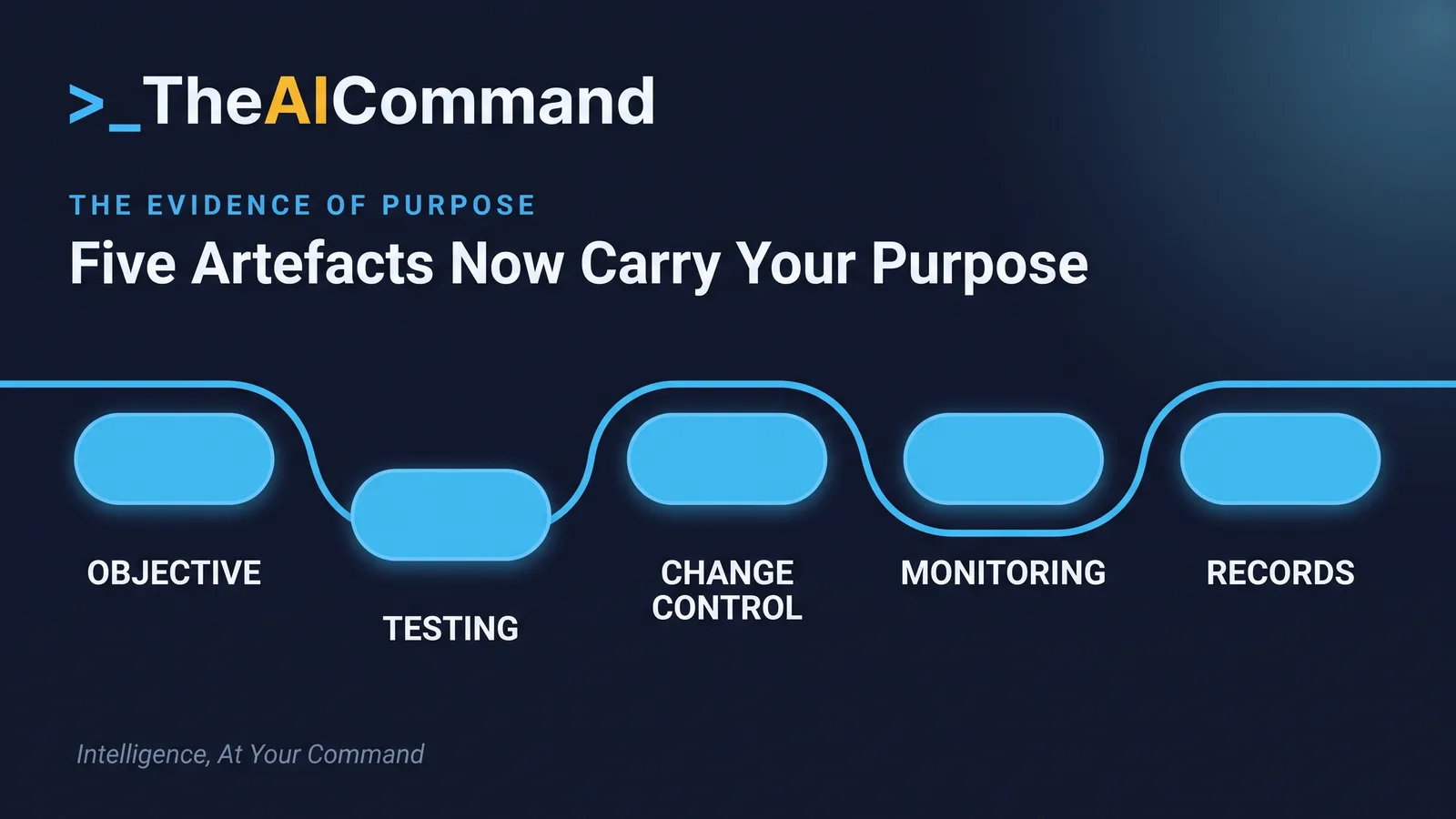
The enforceable surface does not vanish. It relocates. If purpose cannot be found in the model, it is found in the people who deployed it, and it is found in artefacts your function either holds or does not: the objective function someone chose and someone approved, the testing that did or did not probe for order-and-cancel behaviour, the change control record showing what the model was permitted to learn, the monitoring that ran, and the contemporaneous records of what the firm intended the system to do. Those documents become the evidence of purpose. They will be read by people looking backwards at behaviour nobody predicted.
REP 835 adds a second, sharper point on the same page. Adaptive systems may adapt "their behaviour to avoid triggering participant-level pre-trade filters and post-trade surveillance alerts, raising the question of whether gatekeepers' compliance infrastructure is evolving at the same pace as the trading systems it is meant to oversee."
That reframes surveillance from a detective control into an attack surface. A threshold is a rule. A rule inside the environment of a system optimising for profitability is a constraint to be learned around, and nothing in the alert log tells you it happened. A quiet surveillance dashboard is now genuinely ambiguous evidence. It can mean clean trading, or it can mean the model found the edges of your filters and stayed inside them.
REP 835 poses that question rather than answering it. Answer it for your own function. Look at where the reinvestment cycle for the trading models sits, look at where the reinvestment cycle for surveillance sits, and see whether the two are on the same clock.
The report also passes on academic work suggesting reinforcement learning traders can sustain supra-competitive outcomes without agreement, communication or intent, which is REP 835's characterisation rather than a finding of ours.

<!-- style: split -->
Five things this changes in your control environment
Write the objective function down, and have it approved. If purpose migrates to the deployer, the objective a model optimises is the closest thing to a stated intention your firm owns. It should be documented in plain language, approved by someone accountable, and reviewed when it changes. An objective expressed only in code, understood only by the team that wrote it, is not a governance artefact.
Track the CP 386 proposals as design requirements, not obligations. In CP 386, released on 27 August 2025 with comments closing on 22 October 2025, ASIC proposed to require kill switches enabling immediate suspension of aberrant trading algorithm activity, and to extend the principles-based trading system rules to participants' development, testing, use and monitoring of their algorithms. As at the time of writing the amended rules had not been made. The direction of travel is unambiguous, and building to it early is cheaper than retrofitting.
Test whether your surveillance thresholds are learnable. Ask the question directly: could a system optimising for execution quality discover where our alerts fire and stay under them? Then record the calibration rationale. Why these thresholds, on what evidence, reviewed how often. When the alert log is quiet, that rationale is the only thing standing between you and an unanswerable question.
Treat model change control as an evidentiary record. Version history, retraining triggers, approval gates and rollback decisions are the timeline someone will reconstruct if behaviour is ever questioned. Keep it to the standard of a document that will be read adversarially, because that is the only circumstance in which it will be read closely.
Watch concentration and convergence. REP 835 warns at p.5 that reliance on a concentrated set of model providers, data vendors and cloud platforms raises the prospect that AI-related risks may become systemic, and at p.61 that AI may produce convergence rather than diversity of behaviour, increasing the risk of herding and procyclical liquidity withdrawal. Your model is not the only one of its kind, and correlation is a risk you cannot see from inside your own firm.
<!-- style: process-flow -->
Context: REP 835 observes at p.61 that "existing enforcement frameworks often rely heavily on concepts such as intent and causation." Australia's core prohibitions are not drafted that way. They turn on effect, sharpened by DPP (Cth) v JM, and that frame may age better against adaptive systems than one built on intent. It is not a reason for comfort, because it moves the evidentiary burden onto the firm's own records of what it built the system to do.
The AI angle: from governance to surveillance
REP 835 describes the qualitative shift precisely. The emergence of agentic AI, "being systems that autonomously design and execute trading strategies with limited human intervention, blurs the boundary between a sophisticated execution algorithm and an autonomously acting market participant" (p.4). An execution algorithm is a tool with a user. A market participant is something with conduct of its own. Our regulatory architecture assumes the first.
That is why the report's line at p.71 is the whole story compressed: pressure moves from governance to surveillance. Governance asks whether you had the right policy. Surveillance asks whether you can see what your systems actually did. The second question is harder, and it is the one being asked next.
The street runs both ways. REP 835 notes a shift "away from periodic, document-based oversight toward more continuous, data-driven supervision" (p.65), and that "the informational gap between what businesses observe about their own activity and what regulators can see is progressively narrowing" (p.71). ASIC, it says, may need to continue building its own supervisory technology while weighing the risks created by vendor concentration, cloud dependence and common model infrastructure (p.72).
In the media release accompanying the report and roundtable, ASIC Commissioner Simone Constant said "Geographic moats look like a thing of the past" and that ASIC's role "is to provide the clarity necessary for responsible innovation". Read alongside REP 835, the clarity on offer is uncomfortable rather than reassuring. Australia's prohibitions will hold up. The question is whether your records will explain what your systems chose to do, at the moment someone asks.
Bottom line
ASIC has published a review saying that agentic and adaptive trading systems are hard to assess through traditional notions of trader intent, which is a regulator describing the seam in its own case theory. Australian law is better placed than that framing suggests, because the core prohibitions turn on effect, and the High Court has held that a sole or dominant purpose of creating or maintaining an artificial price is not necessary to a contravention. Purpose has not disappeared though, because a legitimate trader purpose is still what separates a price-moving trade from an artificial price. When the system optimises its way into behaviour nobody specified, there is no mental state to find at the moment of the conduct, so the purpose left to interrogate is the deployer's: the objective function someone chose and approved, the testing, the change control record, the monitoring and the contemporaneous records of what the firm built the system to do. That is also why a quiet surveillance dashboard is now ambiguous evidence rather than comfort.
Do this Monday
- Pull the objective function for every automated trading and execution model you run, and check whether it is written in plain language, approved by someone accountable and reviewed when it changes.
- Where the objective exists only in code and only in the heads of the team that wrote it, write it down this week and put it in front of the person who would have to defend it.
- Put the direct question to your surveillance team: could a system optimising for execution quality discover where our alerts fire and stay under them.
- Record the calibration rationale behind your thresholds. Why these levels, on what evidence, reviewed how often. When the alert log is quiet, that rationale is the only answer you have.
- Read the change control record for one live model the way an adversary would: version history, retraining triggers, approval gates, rollback decisions, and whether the timeline actually reconstructs.
- Check whether your testing has ever probed for order-and-cancel patterns that move a price without transacting, and add that scenario if it has not.
- Compare the reinvestment cycle for the trading models against the reinvestment cycle for surveillance, and take the gap to your risk committee rather than to the model owners.
- Track ASIC's proposed kill switch and trading system rule changes as design requirements now, on the clear understanding that they remain proposals rather than obligations.
Content disclaimer: This article is for general educational and informational purposes only. It does not constitute legal advice, regulatory guidance, or a substitute for professional compliance judgement. Regulatory obligations vary by entity type, licence, and circumstance. Always refer to primary source guidance from APRA, ASIC, or the relevant regulatory authority.
Primary sources
- ASIC, REP 835, Innovation in Financial Markets and Financial Market Infrastructure: A Landscape Review, 30 June 2026 (prepared by the Digital Finance Cooperative Research Centre). https://www.asic.gov.au/regulatory-resources/find-a-document/reports/rep-835-innovation-in-financial-markets-and-financial-market-infrastructure-a-landscape-review
- ASIC, media release 26-138MR, ASIC pushes for coordinated action to strengthen competitiveness of Australian markets, 30 June 2026. https://www.asic.gov.au/about-asic/news-centre/find-a-media-release/2026-releases/26-138mr-asic-pushes-for-coordinated-action-to-strengthen-competitiveness-of-australian-markets/
- ASIC, CP 386 Proposed amendments to the ASIC market integrity rules: Trading systems and automated trading, released 27 August 2025, comments closed 22 October 2025. https://www.asic.gov.au/regulatory-resources/find-a-document/consultations/cp-386-proposed-amendments-to-the-asic-market-integrity-rules-trading-systems-and-automated-trading/
- ASIC, ASIC moves to modernise trading system rules to keep pace with technology and AI (news item for CP 386), 27 August 2025. https://www.asic.gov.au/about-asic/news-centre/news-items/asic-moves-to-modernise-trading-system-rules-to-keep-pace-with-technology-and-ai/
- Justice Ashley Black, Market Manipulation: Incentives and Enforcement, Ross Parsons Law and Business Seminar Series, 20 February 2014, published by the Supreme Court of NSW. https://supremecourt.nsw.gov.au/documents/Publications/Speeches/Pre-2015-Speeches/Black/black_20140220(2).pdf
- ASIC, REP 834, Innovation in Financial Technology and RegTech: A Landscape Review, 21 May 2026. https://www.asic.gov.au/regulatory-resources/find-a-document/reports/rep-834-innovation-in-financial-technology-and-regtech-a-landscape-review/
TheAICommand. Intelligence, At Your Command.