
On 22 June 2026, OpenAI made its largest defensive cybersecurity push so far. Under a programme it calls Daybreak, it launched the full version of GPT-5.5-Cyber, its most capable security model, and a second initiative, Patch the Planet, that points that model at the open-source software the rest of the world quietly runs on (OpenAI, "Daybreak: Tools for securing every organization in the world", 22 June 2026). For Australian professionals the headline is not a model number. It is that artificial intelligence is now demonstrably good at finding, and helping to fix, real flaws in widely used software at machine speed, and that the same capability cuts both ways.
Two facts from the announcement deserve your attention. First, OpenAI is gating its strongest cyber model rather than shipping it to everyone, and Australia is already named as a partner in the access scheme. Second, the early results are not a demo. Working with a specialist firm and a roster of well-known open-source projects, the effort surfaced hundreds of genuine security issues and merged dozens of fixes in days. This piece sets out what shipped, why it is a real shift rather than a press release, and the practical moves it asks of anyone who depends on software, which is everyone.
What did OpenAI actually ship?
The umbrella announcement did two things.
It released the full GPT-5.5-Cyber. On CyberGym, a benchmark OpenAI describes as measuring "whether an agent can reproduce known vulnerabilities in software environments", the model reached 85.6 per cent, up from 81.8 per cent for the general-purpose GPT-5.5, which OpenAI calls "the highest CyberGym score we have measured from a single model". A benchmark is not the territory, but the direction is clear. The model can work through realistic, multi-step vulnerability tasks, not just answer quiz questions about security.
It also confirmed who can use it. GPT-5.5-Cyber is not on general release. It is distributed through what OpenAI calls Trusted Access for Cyber, described in its earlier post as "an identity and trust-based framework designed to help ensure enhanced cyber capabilities are being placed in the right hands... while continuing to restrict requests that could enable real-world harm" (OpenAI, 7 May 2026). The framework runs three access levels: standard GPT-5.5 for everyone, GPT-5.5 with Trusted Access for vetted defenders doing routine security work, and GPT-5.5-Cyber, the most permissive tier, for authorised red teaming and penetration testing. Vetted defenders get fewer refusals on legitimate tasks such as vulnerability triage, malware analysis and patch validation, while the model keeps blocking malicious activity such as credential theft, persistence, malware deployment and "exploitation of third-party systems". OpenAI's stated reason for the gate is plain: "Frontier defensive capabilities should not be concentrated in the hands of a few", and, by the same logic, neither should the offensive ones.
The gate is easier to picture from OpenAI's own examples, which show the same request handled three ways. Ask a standard account to build a working exploit for a published vulnerability and it refuses, offering a safe defensive alternative instead. A vetted defender on Trusted Access can get a proof-of-concept to confirm that a patch actually closes the hole in an environment they control. Only the most permissive tier, GPT-5.5-Cyber, will go further into live validation against a target, and only for authorised work. The underlying capability is the same; what changes is who is trusted to point it, and where.
The second initiative is the one to read closely. Patch the Planet is, in OpenAI's words, an effort "built with Trail of Bits to help maintainers strengthen the critical open-source software the world relies on", pairing "AI-assisted security research using our most cyber-capable models with expert human review to not only identify vulnerabilities, but help patch them" (OpenAI, "Patch the Planet", 22 June 2026). The security firm Trail of Bits committed its entire research organisation to the initial surge, with HackerOne and Calif assisting on triage and coordinated disclosure. The first cohort of projects reads like a list of the internet's plumbing: cURL, Python and python.org, the Go project, the cryptography library pyca/cryptography, the software-signing project Sigstore, the web servers freenginx and NATS Server, and the async library aiohttp.
The early numbers are concrete. OpenAI reports that Trail of Bits engineers worked full-time with its Codex tool and GPT-5.5-Cyber "across 19 open-source projects, and has already identified hundreds of security issues and merged dozens of patches". The team built a fuzzing lab "in less than a day", work it estimates "would ordinarily take at least several weeks" by hand, and ran differential testing "within days, compressing work that has historically taken weeks or months". Across the broader Daybreak research, OpenAI lists findings at every layer of the stack: proof-of-concept exploits generated against the Linux kernel, a 23-year-old use-after-free flaw in OpenBSD that could let a local user escalate to root, 34 confirmed vulnerabilities in FreeBSD, security-relevant patterns matching four of six recently fixed bugs in the dnsmasq networking tool, and an HTTP/2 denial-of-service technique that the firm Calif estimated affected more than 880,000 internet-facing websites running NGINX, Apache, IIS or Pingora. Browser engines were not spared either: five exploitable vulnerabilities in Chrome's V8, more than ten in Safari's WebKit in about a week, and one in Firefox patched two days before a major hacking competition.
Why is this a genuine shift, not just a press release?
Strip away the model branding and three things have changed.
Discovery has stopped being the bottleneck. Finding vulnerabilities in large codebases used to be slow, expensive, expert labour. A model that can do a credible first pass changes the economics of both defence and attack. OpenAI is candid that this is both the point and the problem: "AI is accelerating vulnerability discovery, but discovery alone does not protect users." The hard work moves downstream, to validating which findings are real, prioritising them, and shipping fixes that do not break the software they protect.
It is worth being precise about what is new here, because AI surfacing software bugs is not itself a headline; researchers have been pointing models at code for a while. Two things are different. The fixes landed: dozens of patches were merged into real projects, not just filed as reports for someone else to action. And the work compounded, leaving behind reusable fuzzing harnesses, historical-vulnerability analysis pipelines and differential-testing systems that keep finding issues after the first sprint ends. Discovery, patching and durable tooling in a single motion, at this scale, is the step that is genuinely new.
The capability is dual-use and asymmetric. The same skill that helps a defender find a flaw in their own software helps an attacker find it in yours. That is precisely why OpenAI gates GPT-5.5-Cyber, keeps blocking offensive workflows, and is signing government partnerships rather than open-sourcing the model. You do not have to agree the gate is the right design to take the lesson from it. The people who built this capability treat unrestricted access to it as a hazard, and they have priced that judgement into how they ship.
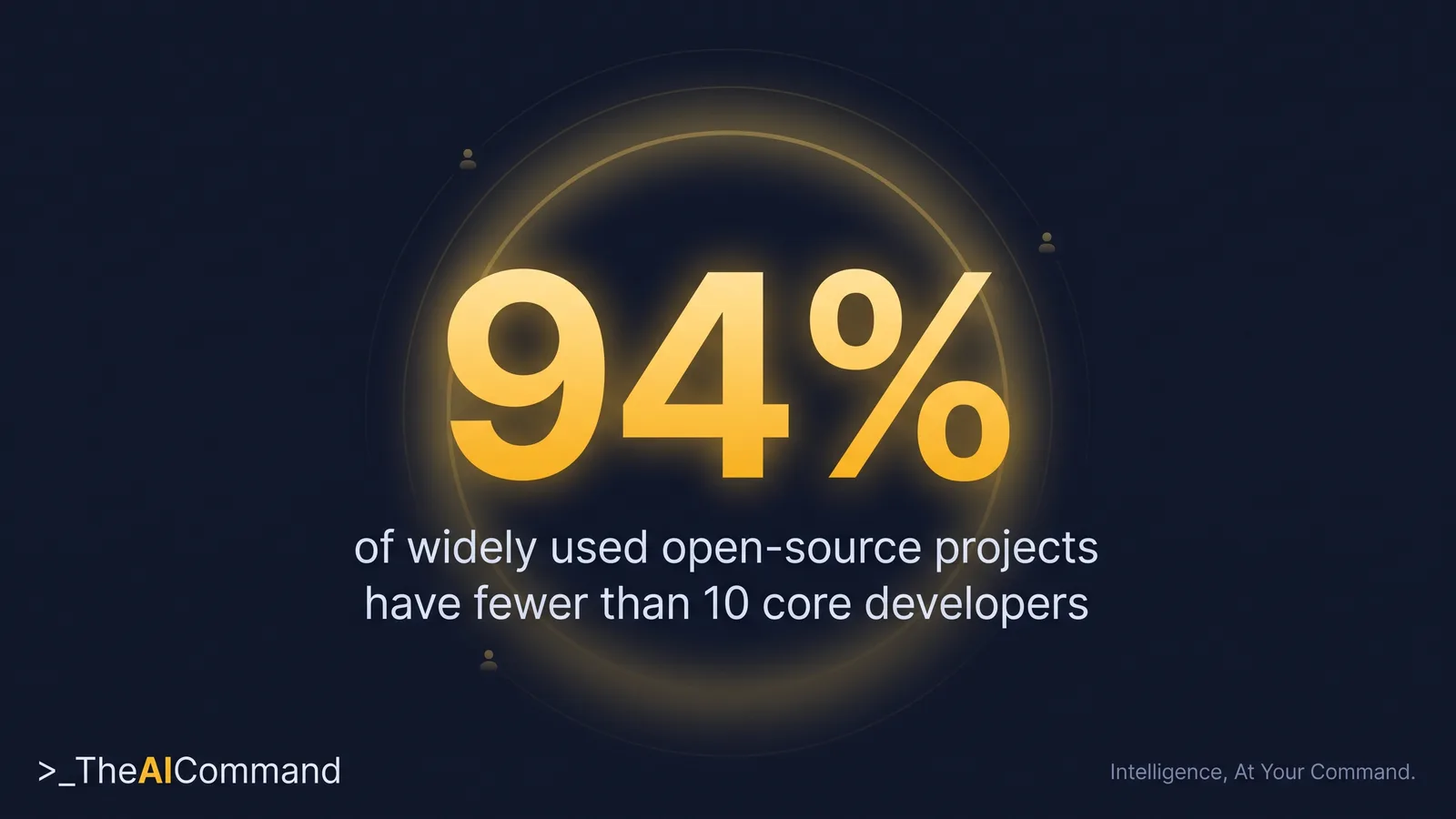
The ground underneath is thinner than most leaders assume. Open-source software is shared infrastructure, and much of it is sustained by tiny teams. OpenAI cites the Linux Foundation and Harvard Census II of Free and Open Source Software, which found that "94 percent of the widely used projects it studied had fewer than ten developers responsible for more than 90 percent of the code added in a year". Your organisation, your bank, your payroll provider and your favourite software vendor all sit on top of this code, usually without a clear inventory of which pieces and which versions.
The fourth change is the one TheAICommand cares about most, and it is a governance lesson rather than a capability one. The single most repeated point in OpenAI's own write-up is that humans reviewed everything. "Security engineers reviewed every finding before it reached a maintainer", because "while frontier AI models are highly capable of finding vulnerabilities and patching them, they also produce a high volume of false positives that can contribute to the already overwhelming backlog maintainers are facing". And the people who own the software stayed in charge: "Maintainers remain in control of what patches are deployed and how disclosure is handled." That is the template for any serious use of AI in security work, and it echoes why AI agents need approval gates before they need autonomy. The model is a force multiplier on a loop that humans still own.
What does this mean for Australian professionals?
Australia is not a spectator. OpenAI states it has "already established Trusted Access for Cyber partnerships with Australia, Canada, France, Germany, Japan, Republic of Korea, and EU institutions like ENISA". Even if you never touch GPT-5.5-Cyber, the second-order effects reach every organisation that runs software. Five moves follow.
Know what open-source you depend on. You cannot patch, or even reason about, what you cannot see. A current inventory of your software dependencies, often called a software bill of materials, is the unglamorous prerequisite for everything else. Ask the same of your suppliers: what open-source components sit inside the products you buy.
Treat patch velocity as a frontline control, not housekeeping. Expect a faster cadence of AI-discovered vulnerabilities and the patches that follow them. The Australian Signals Directorate's Essential Eight, the country's baseline set of mitigations, lists "patch applications" and "patch operating systems" among its eight strategies for exactly this reason (Australian Signals Directorate, Essential Eight maturity model). The window between a fix becoming public and an attacker weaponising the same AI-found flaw is shrinking. Know your patching maturity, then lift it.
If you use AI in security work, copy the gate. The practitioner pattern is already written for you. Expert human review before any AI finding is acted on or disclosed. Authorisation discipline, meaning you test only systems you own or are explicitly permitted to test, the same line OpenAI's safeguards draw when they block "exploitation of third-party systems". And a standing rule that the model proposes while a qualified person decides.
Read your AI and security vendors as material relationships. The capability is moving into commercial security products through OpenAI's new Daybreak Cyber Partner Program, and competitors will follow. Ask vendors which models sit behind their AI security features, what human review stands behind an AI-generated finding, and how they handle disclosure when their tool surfaces a flaw in something you run. If you are an APRA-regulated entity, this sits squarely inside your CPS 234 information-security obligations for third parties.
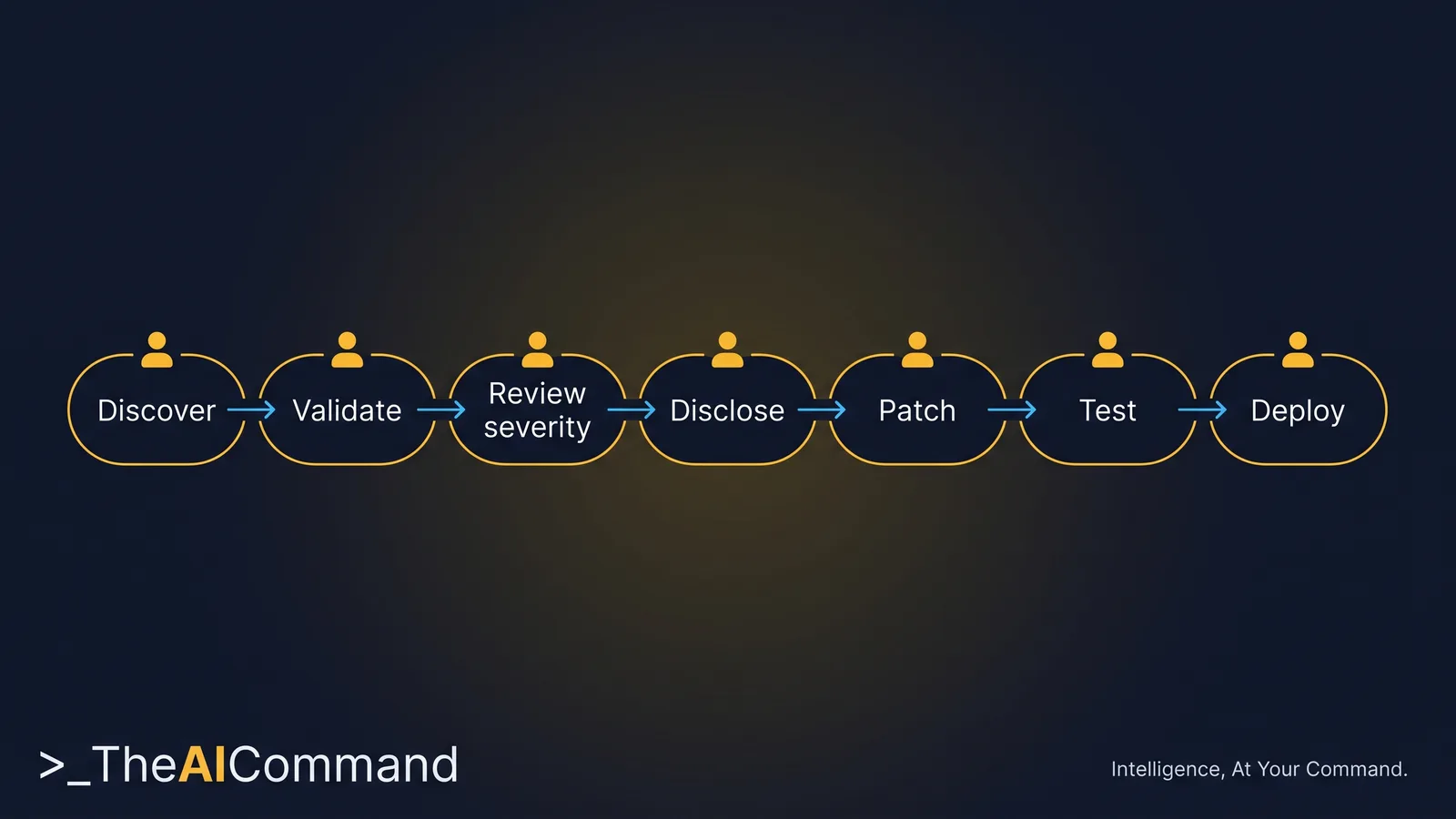
Do not over-rotate on the model. Models will keep changing, and a new record will land within months. The durable thing is the defensive loop OpenAI describes: discover, validate, review severity, disclose, patch, test, deploy, with a person owning judgement at each handover. Invest in that loop and the people who run it, and the next model becomes an upgrade rather than a scramble.
The uncomfortable symmetry is that this same week's news reads, to an attacker, as an opportunity. The defenders have a head start: a gated model, named government partnerships and a human-reviewed process. The work for everyone else is to make that head start count. See your dependencies, patch faster than the people probing you, and keep a person in the seat where the consequential calls get made. The technology has moved. The accountability has not.
Try this: turn a dependency list into a patch plan
Paste the following into ChatGPT or Claude to turn a dependency list into a prioritised, human-checkable patch plan. It is a triage aid, not an authority.
How to run it: create a ChatGPT or Claude Project, paste the prompt into the project's custom instructions so every chat starts as the reviewer, and keep your dependency lists in the project files. Paste each service's manifest in turn and ask the model to append results to a single running master patch-priority table. Then sharpen it with one adversarial pass, "Critique this as an attacker. Which High items would you target first, and which Low items have we underrated given they are internet-facing?", before you hand the High rows to a qualified person to verify against the official advisories. The model does the sorting; the person still makes the call.
Bottom line
AI can now find and help fix real flaws in widely used software at machine speed, and the same capability that arms defenders arms attackers. The durable response is not chasing the model but owning the loop around it: know your dependencies, patch faster, and keep a qualified person deciding what any AI finding means. Australia is a named partner in the access scheme, so this reaches every organisation that runs software, which is everyone.
Do this Monday:
- Start a software bill of materials: list the open-source components and versions you depend on, and ask your suppliers for theirs.
- Check your patching maturity against the Essential Eight, then lift patch velocity as a frontline control.
- Put expert human review before any AI security finding is acted on or disclosed, and test only systems you own or are permitted to test.
- Ask your AI and security vendors which models sit behind their features and how they handle disclosure, and if you are APRA-regulated, log it under CPS 234.
- Invest in the defensive loop and the people who run it, so the next model becomes an upgrade rather than a scramble.
References
- OpenAI, "Daybreak: Tools for securing every organization in the world", 22 June 2026. https://openai.com/index/daybreak-securing-the-world/
- OpenAI, "Patch the Planet: a Daybreak initiative to support open source maintainers", 22 June 2026. https://openai.com/index/patch-the-planet/
- OpenAI, "Scaling Trusted Access for Cyber with GPT-5.5 and GPT-5.5-Cyber", 7 May 2026. https://openai.com/index/gpt-5-5-with-trusted-access-for-cyber/
- Australian Signals Directorate (Australian Cyber Security Centre), "Essential Eight maturity model", first published June 2017, updated regularly. https://www.cyber.gov.au/resources-business-and-government/essential-cyber-security/essential-eight/essential-eight-maturity-model
General information only. Not legal, compliance, financial, or professional advice.
TheAICommand. Intelligence, At Your Command.