
A critical vulnerability that lets attackers take over a server with a single web request has been found in Langflow, and the detail that matters is where it sat: not in a model, but in the low-code tool teams use to build AI agents. The model was never the weak point here. The plumbing around it was.
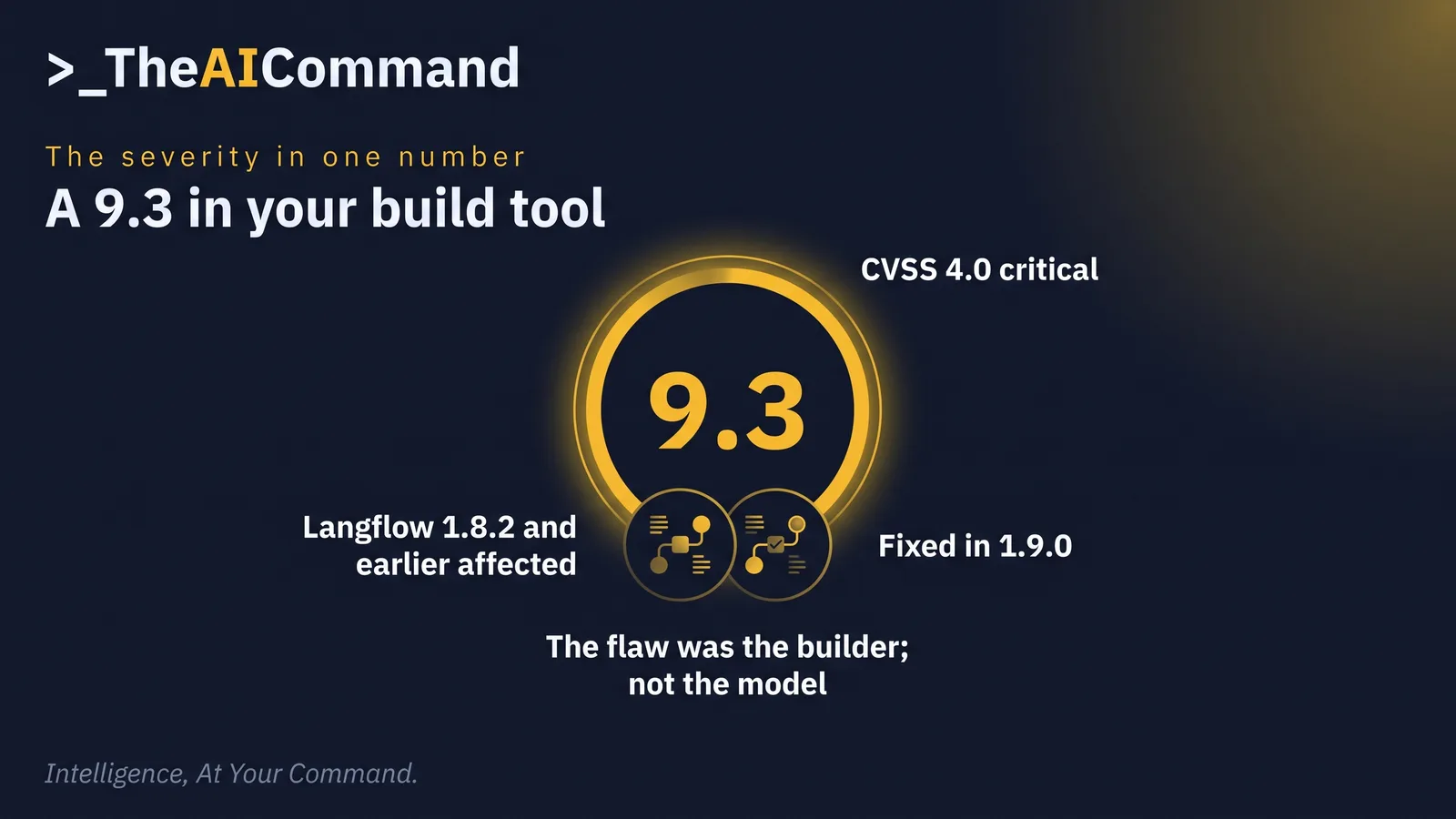
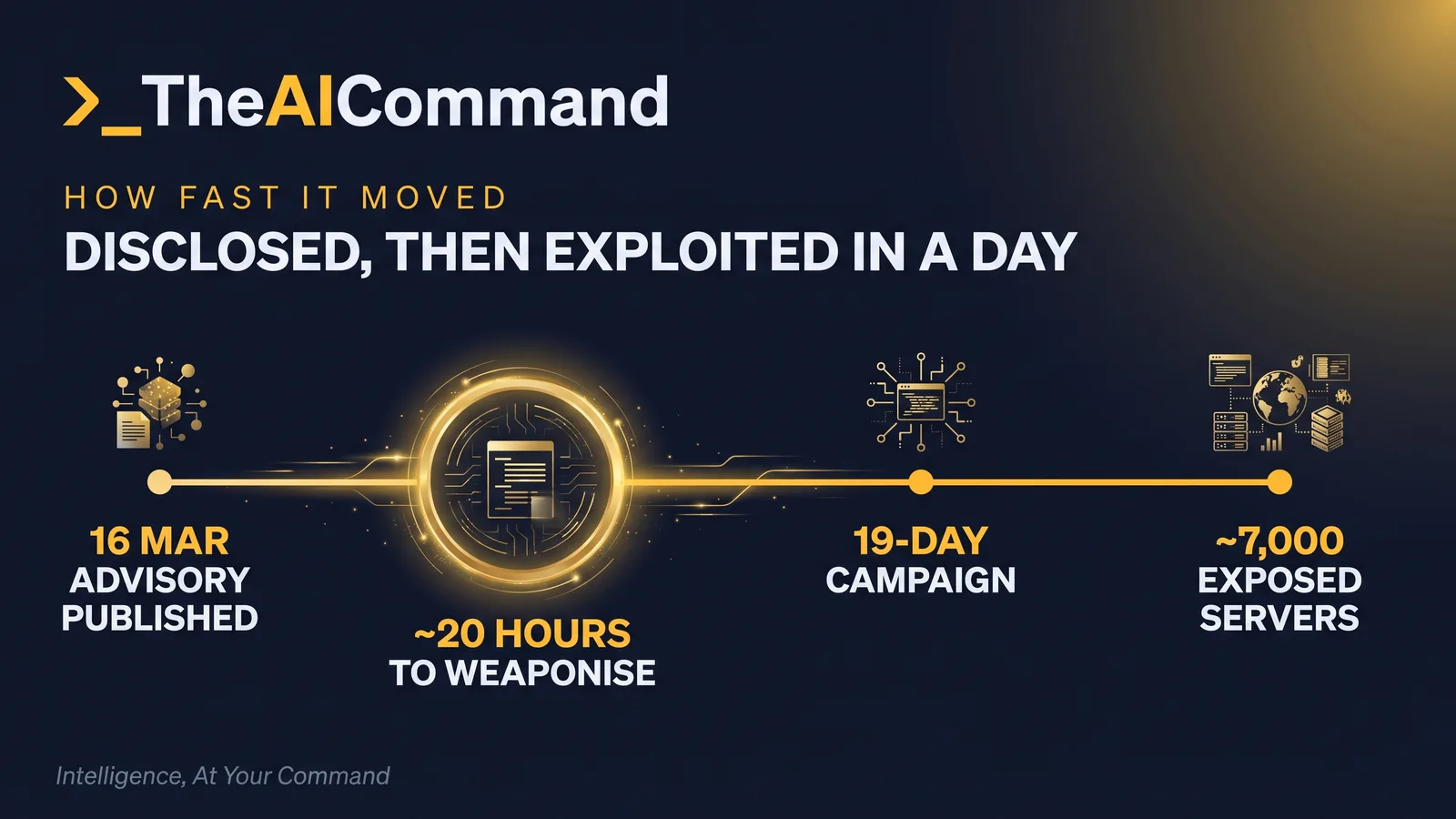
Tracked as CVE-2026-33017, the flaw is an unauthenticated remote code execution bug in Langflow, a popular open-source platform for assembling AI agents and workflows by dragging and connecting blocks. GitHub's security advisory rates it 9.3 out of 10 under CVSS 4.0, a critical score. It affects every version up to and including 1.8.2 and is fixed in 1.9.0. The advisory was published on 16 March 2026. What happened next is the part every team building with these tools should read.
What actually broke
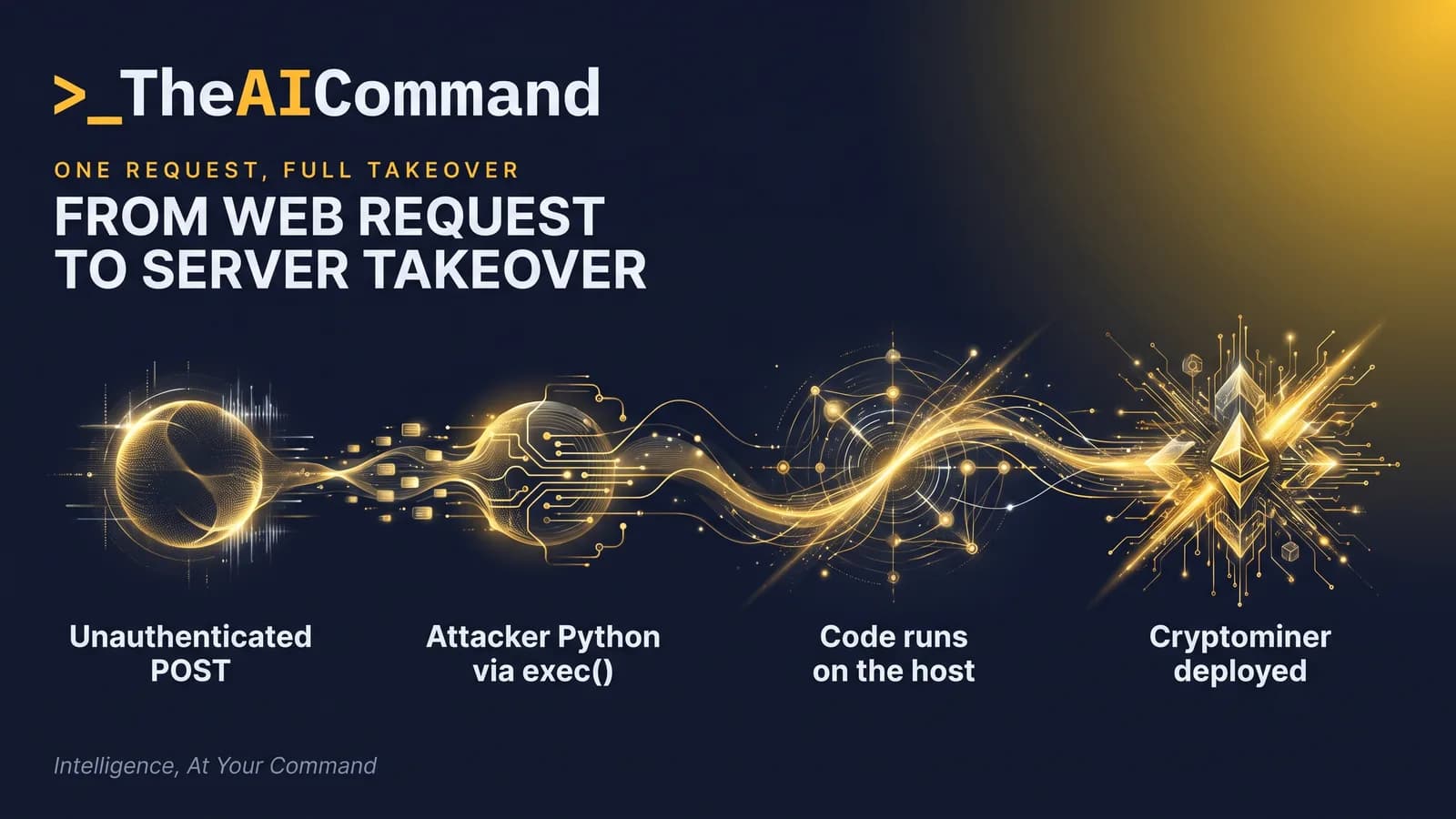
The vulnerable code is a single endpoint. Langflow exposes a public flow-building route, POST /api/v1/build_public_tmp/{flow_id}/flow, that does not require authentication. When a request includes an optional data field, the endpoint accepts attacker-controlled Python inside the flow's node definitions and passes it straight to Python's exec() function with no sandboxing. In plain terms, anyone who can reach the server can send a web request that runs their code on it, with the privileges of the Langflow process.
The advisory attributes the flaw to three well-known weakness classes at once: code injection, evaluation of untrusted input, and missing authentication. There is no clever exploit chain to admire here. The endpoint was built to let the public run flows, and it ran attacker-supplied code as written. That is the whole vulnerability.
The part that matters: the builder, not the model
It is tempting to file this under AI risk and move on. It is more useful to notice what class of software actually failed. Langflow is not a model. It is the workbench, the low-code canvas where a team wires prompts, tools and data sources into a working agent. The failure was an ordinary web-application bug, an unauthenticated endpoint running untrusted code, in the tool used to build the AI, not in the AI itself.
That distinction changes where you look. Teams have spent a year learning to worry about prompt injection, jailbreaks and model misuse. Those are real. But the tools used to assemble agents are ordinary internet-facing software, and they carry ordinary internet-facing risk. A drag-and-drop builder that feels like a toy is, once it is exposed to a network, a server that runs code. The convenience that makes low-code attractive, running flows without writing much code, is exactly what turned a missing authentication check into full server takeover.
How fast it was exploited
The speed is the warning. According to research published by Trend Micro and reported across multiple security outlets, attackers weaponised the flaw within roughly 20 hours of the advisory going public, before any proof-of-concept exploit had been shared. Trend Micro observed an active campaign over a 19-day window, and found on the order of 7,000 Langflow instances reachable from the public internet at the time.
The payload was mundane and greedy. The attack installed a Go-based loader the researchers named lambsys, which cleared the field by killing dozens of rival cryptominer processes, switched off local defences such as AppArmor, SELinux and the host firewall, wiped logs to cover its tracks, and then ran a customised XMRig miner to mine Monero on someone else's hardware. It could also spread to other machines using SSH keys it found on the box. A cryptominer is the polite version of this outcome. The same access that installs a miner can read data, pivot to other systems, or sit quietly and wait.
Where it lands on the agentic risk map
On the site's OWASP Top 10 for Agentic Applications playbook, this is ASI05 Unexpected Code Execution: externally influenced code running when it should not. The useful part of naming it is that the control is not exotic. The framework's standing advice, scope tools tightly and do not let a system execute or load things at runtime without review, is the same advice that would have blunted this.
Patching to 1.9.0 closes this specific hole, and you should do it today. But the patch is the narrow fix, not the lesson. The durable control is architectural: an agent-building tool should never be reachable from the public internet, should run with the least privilege it can, and should be treated as production infrastructure with an owner, a patch schedule and monitoring, not as a sandbox someone spun up to experiment. Roughly 7,000 exposed instances says a lot of teams treated it as the latter.
A worked example
Picture a mid-sized Australian services firm. A team in operations, keen and capable, stands up a low-code agent builder on a cloud virtual machine to prototype an internal assistant. It works, so it stays. To make it easy to demonstrate to colleagues, someone opens the machine's web port to the internet and shares a link. No one tells security, because it is just a prototype.
Under this CVE, that prototype is a public server that runs anyone's code. There are no real customer names or records in a prototype, and that feels reassuring, but the credentials stored on that machine are real, the network it sits on is real, and the cloud role it runs under is real. The fix is not only to patch. It is to notice that a build tool became exposed infrastructure without anyone deciding it should.
Prompts you can use today
Run an exposure inventory across the agent-building tools your teams actually use:
Then turn the findings into an enforceable rule:
Do this Monday
- List every low-code or no-code agent-building tool your teams use, including prototypes on personal cloud accounts. Shadow tooling is the point of failure here.
- For each one, answer a single question first: is it reachable from the public internet? Anything that is, and that runs flows or code, is your priority.
- Patch Langflow to 1.9.0 or later wherever it runs. If you cannot patch immediately, take the instance off the public internet now.
- Put internet-facing builders behind authentication and a private network, so they are reachable only by the people who need them, not by the whole internet.
- Rotate credentials and keys on any host that was exposed, and check cloud audit logs for unexpected processes, outbound traffic or new SSH keys.
- Give each tool an owner responsible for its version, its exposure and its shutdown once the prototype is done.
- Write the short governance rule from the second prompt above, so the next prototype does not repeat the pattern.
Vet any agent-building platform against this list
- Network exposure: it is not reachable from the public internet unless a named person has approved it after a security review.
- Code execution: you know whether the tool runs or evaluates user-supplied code, and if it does, that path is locked down.
- Least privilege: the identity the tool runs under can reach only what it needs, not the whole environment.
- Supported version: it is on a current, vendor-supported release with a patch process, not a forgotten install.
- Ownership: someone is accountable for the tool's security, not just its output.
- Logging: actions and access are logged well enough that you could reconstruct what happened after an incident.
- End of life: prototypes have a decommissioning step, so nothing lingers as exposed infrastructure.
Hype check
This is not an AI-model apocalypse, and it is not evidence that building agents is inherently dangerous. It is a plain web-application vulnerability in one popular tool, now patched. Equally, do not wave it away as one project's bug. The interesting number is not the CVSS score, it is the roughly 7,000 exposed servers and the 20-hour exploitation. That gap, between a fix being available and teams actually being safe, is where the real risk lives. The tool got patched quickly. The habit of exposing build tooling to the internet is the thing that needs fixing.
Bottom line
CVE-2026-33017 handed full server control to anyone who could reach a vulnerable Langflow instance, and attackers took it within a day to mine cryptocurrency on thousands of exposed machines. The flaw was not in a model. It was in the low-code tool teams use to build agents, an ordinary internet-facing application carrying ordinary internet-facing risk. Patch to 1.9.0, get your builders off the public internet, and govern them like the production infrastructure they quietly became.
TheAICommand. Intelligence, At Your Command.