LM-H06 · HR · Practitioner tier
Right to Disconnect (s333M Fair Work Act)
Reasonableness factors, dispute pathway, manager guidance
What you'll be able to do
- 1.Explain how sections 333M and 333N of the Fair Work Act 2009 (Cth) operate, including that the right now covers employers of all sizes following the 26 August 2025 small business commencement
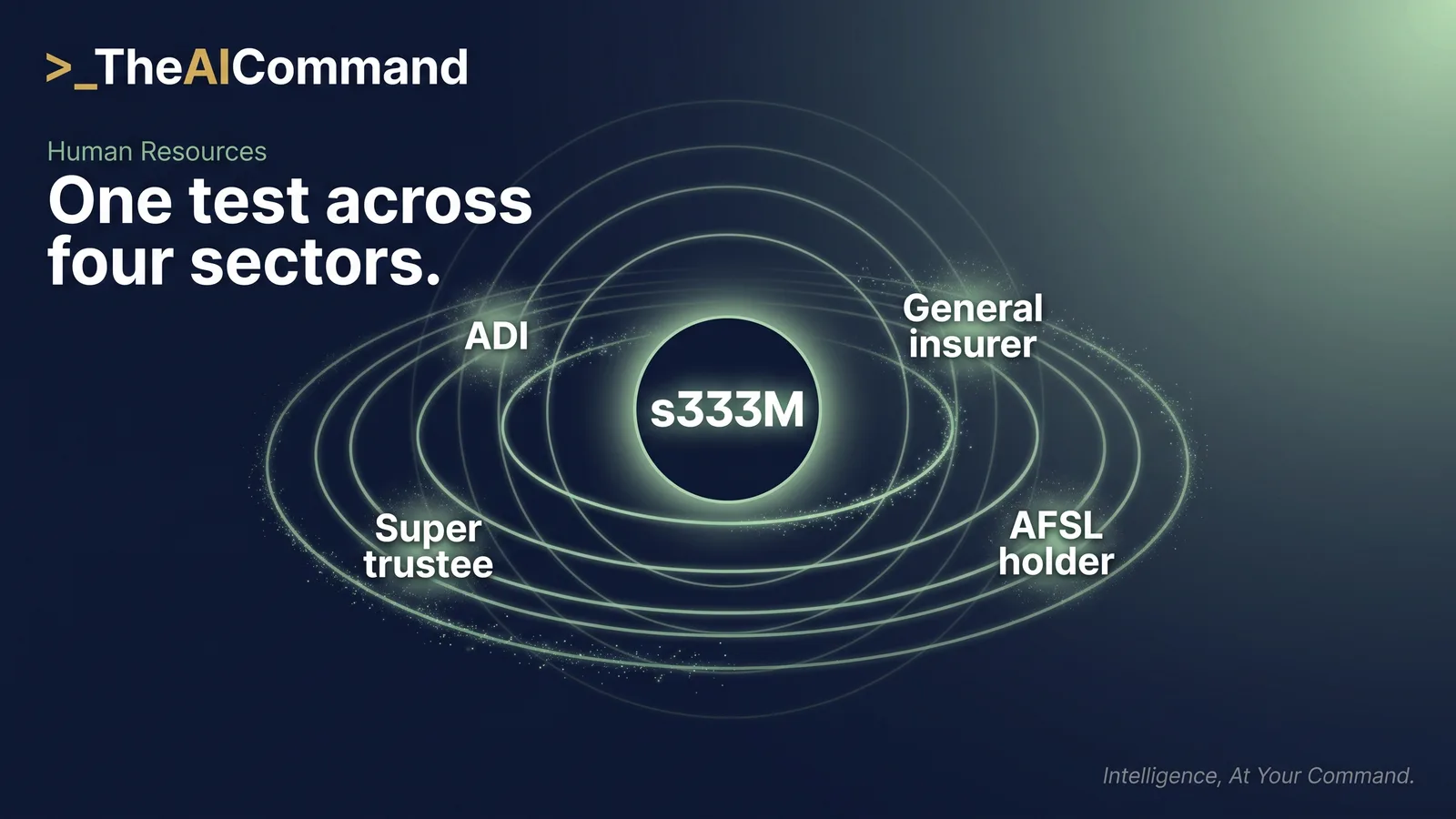
- 2.Apply the five reasonableness factors in section 333M(3) to after-hours contact scenarios across ADIs, insurers, superannuation trustees and AFSL holders
- 3.Analyse the interaction between the right to disconnect, the NES reasonable additional hours test, psychosocial hazard duties and CPS 230 critical operations obligations
- 4.Evaluate AI-assisted policy, manager guidance and dispute response drafts using a structured quality assurance rubric
- 5.Create a governed AI project space for right to disconnect work with mandatory de-identification, prohibited inputs and human-in-the-loop checkpoints
6 lessons · read straight through, or use lesson view once the page loads.
TheAICommand Learning Library
LM-H06
Right to Disconnect
Section 333M of the Fair Work Act 2009 (Cth)
Practitioner-tier module for HR, People Experience, Employee Relations, and operational managers across Australian financial services.
Learning outcomes (mapped to Bloom's revised taxonomy):
- Recall (Remember) the structure of s333M and s333N FW Act, including the differential commencement dates for non-small and small business employers.
- Explain (Understand) the five reasonableness factors and how they interact with the National Employment Standards reasonable additional hours test.
- Apply the dispute resolution pathway to realistic financial services scenarios across ADIs, insurers, super trustees, and AFSL holders.
- Analyse the interplay between the right to disconnect, modern award terms, working from home arrangements, and CPS 230 critical operations obligations.
- Evaluate AI-assisted drafting outputs for policy, manager guidance, and dispute response artefacts using a structured quality assurance rubric.
- Create (Generate) a Right to Disconnect project space in ChatGPT and Claude with privacy-by-design controls, prohibited-input rules, and human-in-the-loop checkpoints.
1. Executive Summary
This module builds towards one concrete tool: the reasonableness assessment prompt in section 3, which turns a live after-hours contact event into a documented section 333M(3) factor assessment. That prompt is the single thing to try today: run one recent after-hours contact event through it and keep the output as part of the audit trail. The lessons that follow cover the statutory context, the five reasonableness factors, four financial services scenarios and the governed AI project space.
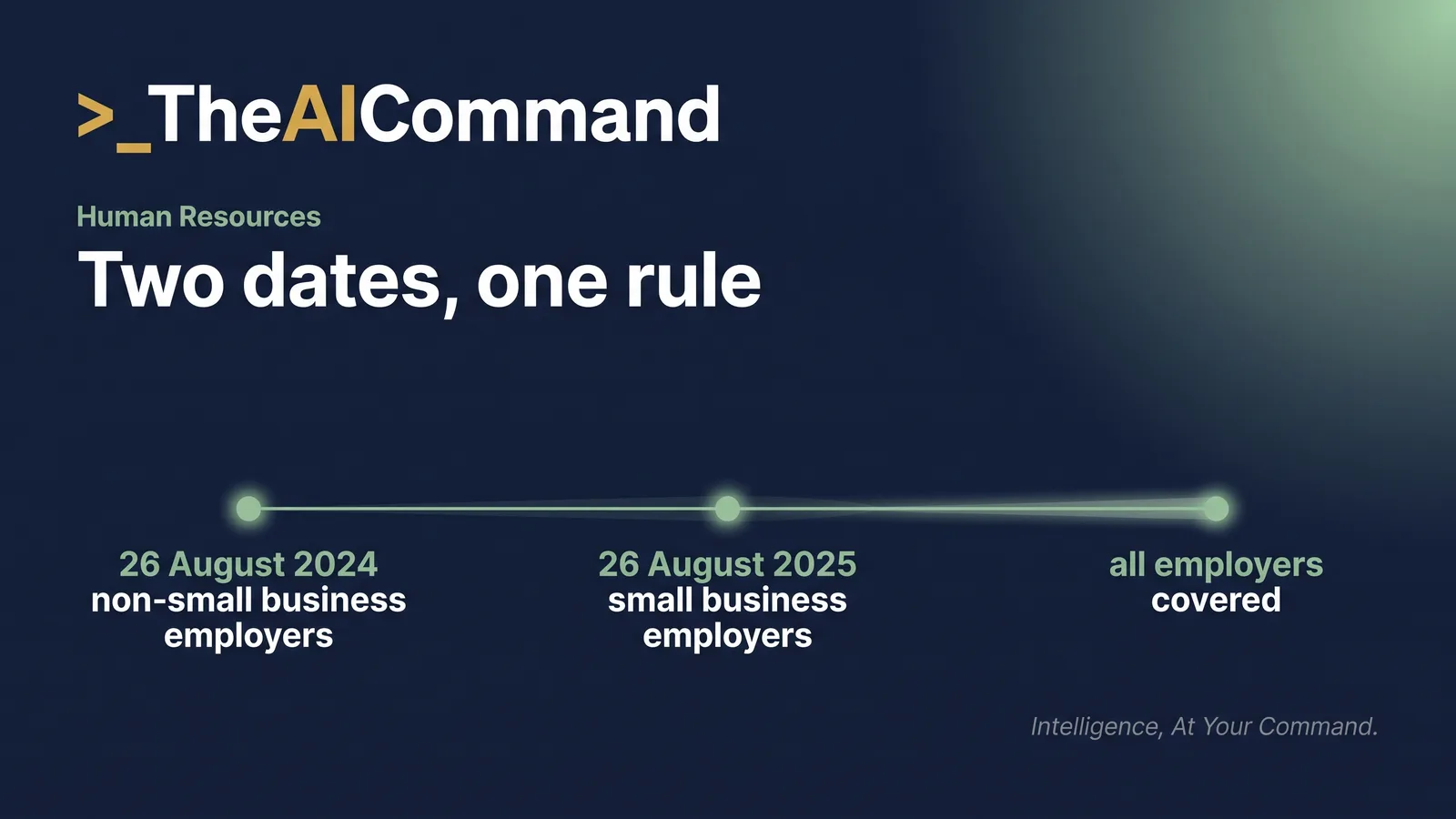
The Right to Disconnect was inserted into the Fair Work Act 2009 (Cth) by the Fair Work Legislation Amendment (Closing Loopholes No. 2) Act 2024, creating a new workplace right at section 333M and a dispute resolution mechanism at section 333N. The right commenced for non-small business employers on 26 August 2024 and for small business employers on 26 August 2025. In substance, an employee may refuse to monitor, read or respond to contact (or attempted contact) from their employer, or from a third party where the contact relates to their work, outside the employee's working hours, unless that refusal is unreasonable.
Why this matters for Australian financial services. The sector runs on always-on rhythms. Markets desks coordinate across Sydney, London, and New York. Operations run end-of-day and end-of-month batch cycles. Compliance teams answer regulator requests with clock-running notification timelines under APRA Prudential Standard CPS 230 Operational Risk Management, AUSTRAC suspicious matter reporting under the AML/CTF Act, and ASIC reportable situations under section 912DAA of the Corporations Act 2001. Customer-facing teams are pulled into incident response after hours. The right to disconnect does not switch any of this off, but it does require employers to articulate, document, and operate clear arrangements for after-hours contact, with manager judgement that survives scrutiny by the Fair Work Commission.
What you will be able to do after completing this module:
- Apply the five reasonableness factors in section 333M(3) to a real after-hours contact scenario and produce a defensible written assessment.
- Map the workplace-level then Fair Work Commission dispute pathway, including the parallel stop order powers under section 333N.
- Draft a Right to Disconnect policy, manager FAQ, and Board people risk paper using a structured AI project space with built-in governance.
- Identify the financial services-specific exceptions and scenarios where reasonable refusal is unlikely (for example, accountable persons under the Financial Accountability Regime responding to a CPS 230 critical operation incident).
- Operate AI-assisted drafting with mandatory de-identification, human-in-the-loop checkpoints, and Australian Privacy Principles alignment.
2. Regulatory and Strategic Context
Statutory authority and scope
The right to disconnect is a Commonwealth statutory right that sits inside the Fair Work Act 2009 (Cth). It is a workplace right for the purposes of Part 3-1 (general protections), so adverse action because an employee exercises the right is itself a contravention of section 340. The right is a permanent feature of the federal industrial relations framework and applies to all national system employees. The Closing Loopholes No. 2 Act 2024 also amended section 149E so that every modern award must include a right to disconnect term, and the Fair Work Commission has incorporated a model term across all modern awards. Enterprise agreements may provide additional or supplementary terms but cannot displace the statutory right.
Issuer and oversight body
Policy ownership sits with the Department of Employment and Workplace Relations. The Fair Work Commission administers the dispute pathway under section 333N, including making stop orders. The Fair Work Ombudsman publishes guidance and educates employers and employees. Outcomes have downstream consequences for adjacent regulators: Safe Work Australia and state work health and safety regulators treat persistent unreasonable after-hours contact as a psychosocial hazard under the model WHS regulations and Code of Practice; APRA expects regulated entities to manage operational risk, including key person and conduct risks, under CPS 230 and CPS 511 (Remuneration); and ASIC observes accountable person obligations under the Financial Accountability Regime (FAR) framework that commenced in March 2024 for ADIs and 2025 for insurance and superannuation.
Key dates and transitional periods
Cross-references to adjacent learning modules
- LM-H01 Fair Work Act 2009 overview: foundational framework, general protections (Part 3-1), and modern awards system.
- LM-H02 National Employment Standards: section 62 reasonable additional hours, the standard against which compensation arrangements are tested.
- LM-H03 Modern Awards: structure of award terms, the FWC model right to disconnect term, and award coverage in financial services.
- LM-G02 Privacy Act 1988: collection and storage of contact attempt logs, monitoring data, and complaint records in line with the Australian Privacy Principles.
- LM-G05 CPS 230 Operational Risk Management: critical operations, on-call rosters, and incident response designs that withstand reasonableness scrutiny.
Interplay with adjacent frameworks
Three frameworks interact directly. First, the National Employment Standards: section 62 already prohibits employers from requiring employees to work more than 38 hours per week unless the additional hours are reasonable, which incorporates a similar multifactor test. The right to disconnect overlays this with a specific right to refuse contact even within the bounds of section 62, where the contact itself is unreasonable.
Second, work health and safety. The model WHS regulations and the Safe Work Australia Code of Practice on managing psychosocial hazards (effective in most jurisdictions during 2023 and 2024) classify persistent or excessive after-hours contact as a recognised psychosocial hazard. Failing to manage it is a primary duty of care breach for officers and persons conducting a business or undertaking.
Third, the Financial Accountability Regime. Accountable persons (as registered with APRA and ASIC) carry continuing obligations under the accountability statements and accountability maps registered with the regulators. After-hours contact relating to those accountabilities is far more likely to be reasonable for accountable persons than for general staff. The FAR does not override the right but informs the section 333M(3)(d) analysis (nature of role and level of responsibility).
3. Core Concepts and Defined Terms
Defined terms
The right itself, in plain English
Section 333M(1) gives an employee the right to refuse to monitor, read or respond to contact (or attempted contact) from their employer outside the employee's working hours, unless the refusal is unreasonable. Section 333M(2) extends the right to contact from third parties where the contact relates to the employee's work. The construction is deliberately framed as a right to refuse, not a duty to disconnect. The default position remains the contract of employment. The right activates when the employee chooses to exercise it.
The reasonableness test (s333M(3))
Use the prompt below whenever a manager or ER advisor needs a structured written assessment of a live after-hours contact event. De-identify every input before pasting, and keep the output as part of the audit trail.
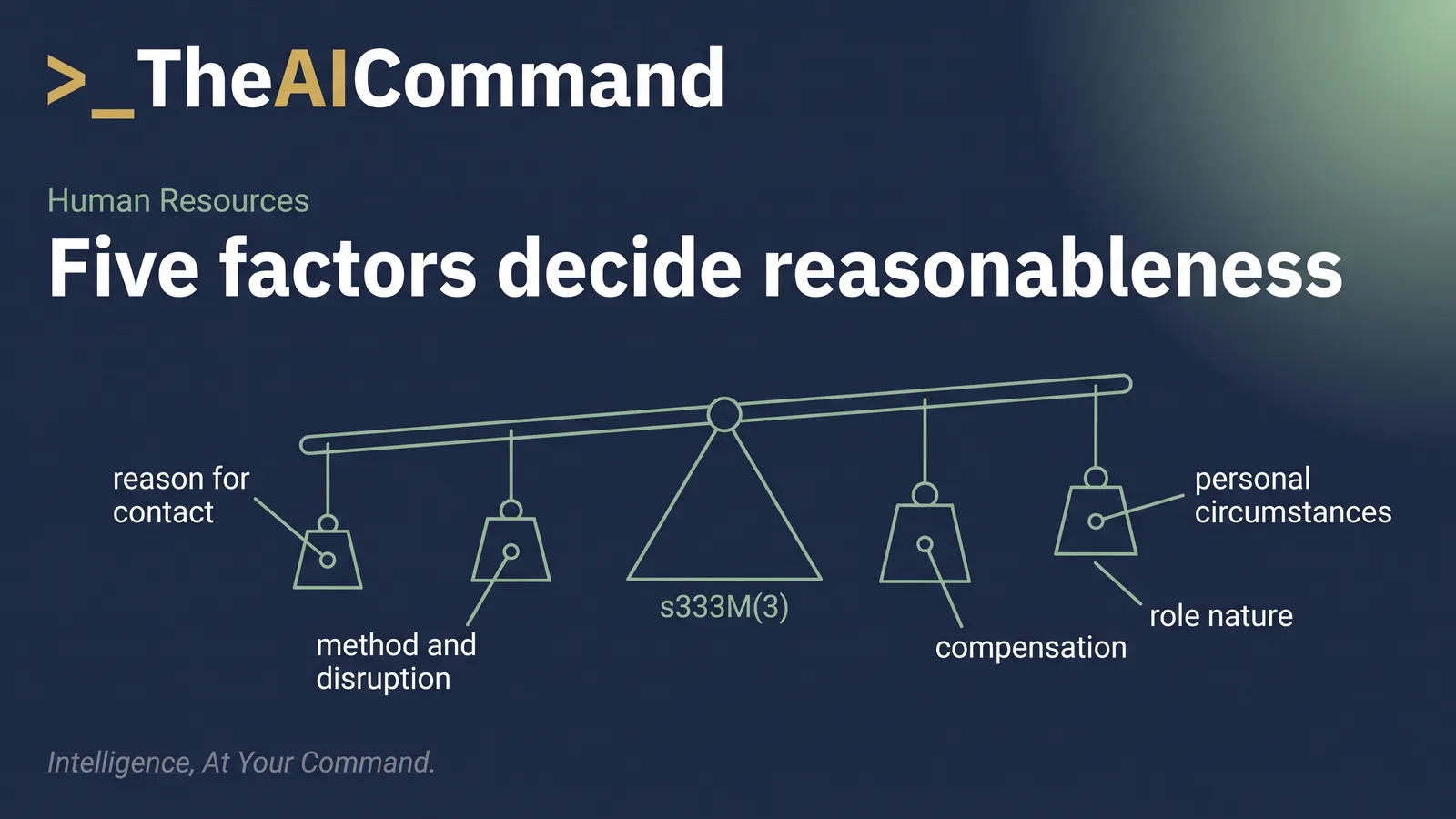
Five factors must be considered when determining whether a refusal is unreasonable:
- (a) Reason for the contact. Routine non-urgent updates lean toward reasonable refusal. Genuine emergencies, regulatory deadlines, or critical incident response lean against.
- (b) Method and disruption. A single email at 6 pm Sunday for review on Monday is low disruption. A run of phone calls on a public holiday is high disruption.
- (c) Compensation for availability. Where the employee is paid an on-call allowance, recall payment, availability loading, or built-in flexibility through annualised salary arrangements that explicitly contemplate after-hours availability, the calculus shifts toward reasonable contact.
- (d) Nature of role and level of responsibility. Accountable persons under FAR, executives, on-call clinicians, treasury front office, market makers, and incident commanders carry an inherent expectation of escalation availability that informs but does not extinguish the right.
- (e) Personal circumstances. Family and caring responsibilities, second jobs (where lawful), study commitments, religious observance, and health conditions all factor in.
Section 333M(5) provides a hard exception. Where contact, monitoring, reading, or responding is required by a law of the Commonwealth, a State or a Territory, refusal is unreasonable. Mandatory reportable situation submissions, suspicious matter reports, breach reporting, and APRA notifications fall here.
4. Practical Application in Australian Financial Services
Scenario A. Authorised deposit-taking institution (ADI)
Trigger event. A retail branch manager at a major bank receives an email at 7.30 pm on a Saturday from her area lead asking her to draft a customer complaint response by Monday morning. The branch manager has standard banking-hours coverage and no on-call arrangement.
Obligation activated. Section 333M(1) right to refuse. Section 333M(3) factors weigh as follows: routine non-urgent task (factor a, leans refusal), single email with no follow-up (factor b, leans refusal), no on-call allowance and award-covered role (factor c, leans refusal), branch manager grade with operational accountability (factor d, neutral), no specific personal circumstances disclosed (factor e, neutral). On balance, refusal is reasonable.
Artefact produced. A documented policy that confirms branch managers may decline weekend complaint drafting; an escalation roster that diverts urgent complaints to a duty officer with a recall allowance; a manager guidance card that scripts the response.
Audit trail expected. Email logged in the bank's case management system. Weekend response policy version-controlled in the policy library. Escalation roster maintained in the operations system. ER team notified of any refusal pattern that suggests a systemic resourcing gap.
Scenario B. General insurer
Trigger event. Cyclone makes landfall on the east coast on a public holiday. The claims team is asked to mobilise the catastrophe response. Three claims managers are on a published catastrophe stand-by roster with a 25 per cent availability allowance; six others are not.
Obligation activated. For the three rostered staff, contact is reasonable: factor (a) critical event, factor (c) explicit compensation, factor (d) role nature includes catastrophe response. For the six non-rostered staff, contact is more borderline. The employer must consider whether voluntary mobilisation with recall payment is feasible before mandating contact, and whether refusal by an individual is unreasonable in the circumstances.
Artefact produced. Catastrophe response stand-by roster and allowance schedule; a voluntary mobilisation request template; a refusal log.
Audit trail expected. Catastrophe declaration timestamp; stand-by allowance register; voluntary mobilisation responses logged; refusal reasons recorded without disciplinary inference.
Scenario C. Superannuation trustee
Trigger event. A market-moving central bank decision is announced at 4 am Sydney time on a weekday. An offshore investment manager messages the internal investment operations team requesting same-day rebalancing instructions.
Obligation activated. Investment operations leads with portfolio responsibilities and an annualised salary that explicitly contemplates market-hours availability are likely to find that contact is reasonable (factors c and d). A junior analyst with no on-call arrangement and a fixed shift pattern is not. The trustee should design rosters that map availability to known time-zone events, rather than relying on individual after-hours contact.
Artefact produced. Market-hours roster covering Sydney, Tokyo, London, and New York events; on-call allowance arrangements for selected roles; an availability matrix included in position descriptions.
Audit trail expected. Time-stamped contact logs; call-out compensation records; trustee board operational risk reporting that references right to disconnect compliance under CPS 230.
Scenario D. AFSL holder (financial advice practice)
Trigger event. A high-net-worth client texts their adviser at 9 pm Sunday asking for advice on a tax strategy with a 30 June deadline. The adviser is an authorised representative of a small AFSL.
Obligation activated. Adviser autonomy and client service expectations interact with the right. Where the AFSL has not articulated client communication windows in its client agreements and adviser remuneration arrangements, the adviser may reasonably refuse. The AFSL should set client expectations through the engagement letter, set after-hours response service standards, and provide cover via a delegated colleague where after-hours coverage is part of the proposition.
Artefact produced. A client communication policy embedded in the engagement letter; after-hours contact protocol with delegation; a manager FAQ for the practice principal.
Audit trail expected. Client communication log in the practice management system; response time service-level records; adviser delegation register.
5. Visual Pack
The visuals below are inline specifications. Each includes a description detailed enough for a designer to render in Lucidchart, Whimsical, Figma, or PowerPoint. Sample data is illustrative only.
Visual 5.1 Reasonableness factor map (concept diagram)
A radial map with the question 'Is the refusal unreasonable?' at the centre. Five spokes radiate outward to one factor each (a to e). Each spoke ends in a two-column comparison: Indicators of reasonable refusal versus Indicators of unreasonable refusal.
Visual 5.2 Dispute resolution pathway (process flowchart)
A horizontal swim-lane flowchart with three lanes (Employee, Employer, Fair Work Commission). The flow proceeds in five stages.
- Stage 1 Trigger. Disputed contact event occurs. Employee refuses or employer believes refusal is unreasonable.
- Stage 2 Workplace-level resolution. Parties attempt resolution at the workplace using the dispute procedure in the modern award, enterprise agreement, or written policy. Time-bound. Documented.
- Stage 3 Application to Fair Work Commission. If unresolved, either party may apply under section 333N. Standard application form, filing fee, response timeline.
- Stage 4 Conciliation and conference. Member-led conciliation. Most matters resolve here. Where they do not, formal hearing follows.
- Stage 5 Stop order. The Commission may order an employee to stop refusing contact where refusal is unreasonable, or order the employer to stop taking action against the employee where the refusal is reasonable. Breach of order is a civil penalty contravention.
Visual 5.3 Comparative table (FW Act and adjacent frameworks)
Visual 5.4 RACI for an after-hours contact incident
Visual 5.5 Quantitative chart (illustrative figures only)
Stacked column chart. X-axis: financial services sub-sectors (ADI, General Insurer, Life Insurer, Super Trustee, AFSL). Y-axis: reported after-hours contact incidents per 1,000 employees per quarter. Stack bands: routine non-urgent, regulatory deadline, critical incident, customer-driven.
Source: illustrative figures for instructional use only. Replace with internal data when published.
Visual 5.6 Five things to remember (callout infographic)
- 1. It is a right to refuse, not an absolute right to be unreachable.
- 2. Reasonableness is multifactor and document-driven. No single factor determines the outcome.
- 3. Compensation matters. On-call allowances, recall payments, and annualised salary architecture change the calculus.
- 4. Workplace-level resolution comes first. The Fair Work Commission is the second forum, not the first.
- 5. Statutory exceptions exist. Where another law requires the contact, refusal is unreasonable.
6. Operating This Framework With AI
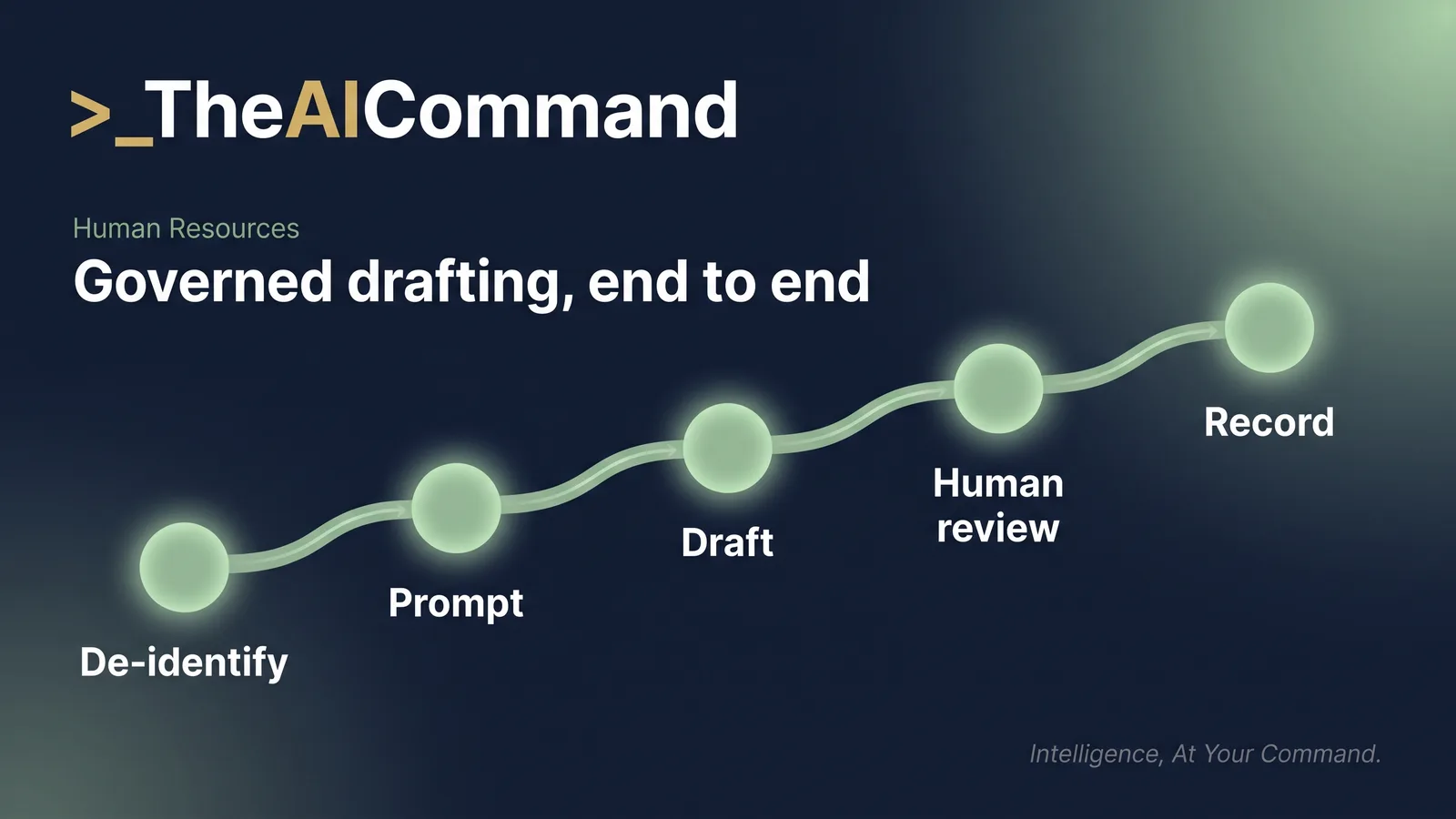
The right to disconnect generates a steady stream of policy, manager guidance, dispute response, and Board reporting work. This section builds a project space that scales the work without compromising privacy, accuracy, or audit trail.
6.1 Use cases at scale
- Policy drafting and refresh. Convert section 333M and the FWC model award term into a tailored employer policy with role-specific overlays.
- Manager FAQ generation. Build manager-facing question banks that decode the five factors into operational guidance.
- Dispute response memos. Draft structured responses to employee complaints, Fair Work Ombudsman queries, and FWC applications.
- Board people risk papers. Distil quarterly KRI movement, complaint volumes, and emerging-issue narrative into a one-page paper.
- Award and EBA cross-walk. Map the model award term against role coverage, on-call clauses, and existing dispute procedures.
- Manager training scenarios. Generate plausible after-hours contact scenarios with model answers for use in workshops.
- Investigation timeline reconstruction. Sequence de-identified events for an internal review or FWC hearing brief.
- KRI dashboard narrative. Translate raw metrics into a Board-ready commentary with clear control implications.
6.2 Project space setup
ChatGPT (Enterprise or Team tier; never personal):
- Create a Project named ER-RTD-Advisory. Restrict member access to Employee Relations, HR Business Partners, and approved People Leaders.
- Add a Custom GPT named RTD Advisor with the system prompt scaffold below. Disable Code Interpreter and external tool access by default.
- Upload a structured knowledge folder. Recommended structure: 01-Source-Law (FW Act extracts), 02-FWC-Model-Term, 03-Internal-Policy, 04-Templates (policy, FAQ, memo, Board paper), 05-FWC-Decisions-Index, 06-Glossary.
- Set the file naming convention RTD-{ArtefactType}-{YYYYMMDD}-{Version}. Example: RTD-Policy-20260115-v1.2.docx.
- Enable conversation logging at the workspace level for audit purposes.
Claude (Team or Enterprise tier; never personal):
- Create a Project named ER-RTD-Advisory with a curated Skill. The Skill encodes the system prompt, output style, and quality bar.
- Define the Skill in five parts: persona (senior ER advisor), context (Australian FS sector, FW Act framework), task scaffolds (policy, FAQ, memo, Board paper), constraints (de-identification, prohibited inputs), and quality bar (the rubric in section 6.5).
- Attach the same source material set as ChatGPT, version-controlled in SharePoint or Git, with a single source of truth.
- Restrict access to nominated ER team members and the People Director. No client or candidate data sets.
- Configure the project to refuse outputs that quote the model verbatim from any uploaded document where copyright is unclear.
System prompt scaffold (copy and adapt):
You are a senior Employee Relations advisor at an Australian financial services organisation. Your task is to draft accurate, practical, plain-English artefacts under the Right to Disconnect framework (Fair Work Act 2009 (Cth) ss 333M-333N). Apply the five reasonableness factors. Use Australian English. Never use em dashes. Use merge field placeholders for any personal data. Flag any input that looks like personal information, market sensitive data, or active dispute evidence and refuse to proceed until the input is sanitised. Default tone: precise, professional, neutral. Cite the relevant section of the FW Act and the FWC model term where applicable. Always close with a one-line manager-action recommendation.
6.3 Prompt library
Before adapting the six prompt patterns below, run your current policy through this gap review so the drafting effort targets real weaknesses rather than restyling sound clauses.
Each prompt below follows the Role / Context / Task / Constraints / Output Format / Quality Bar pattern. Substitute merge fields before use. Run all outputs through the section 6.5 quality assurance loop before release.
Prompt 1. Right to Disconnect Policy Draft
Role: Senior Employee Relations advisor. Context: {ORGANISATION} is a {ADI/INSURER/SUPER/AFSL} subject to the Fair Work Act 2009 (Cth) ss 333M-333N. The policy must apply across {STATE/TERRITORY} workforces, including {AWARD-COVERED} and {AGREEMENT-COVERED} roles. Task: Draft a Right to Disconnect policy with sections for purpose, scope, the right, the five reasonableness factors, exemptions where required by law, dispute resolution, manager responsibilities, and review cycle. Constraints: Use plain English. No em dashes. Australian English. Cross-reference s333M(3)(a)-(e) and the FWC model award term. Use merge fields for entity-specific items. Output format: Word-document-ready text, level 1 to level 3 headings, no inline citations except section references. Quality bar: Legal accuracy verified by ER lead. Plain English readability score Year 10 or below. No personal data.
Prompt 2. Manager FAQ
Role: Senior ER advisor preparing field-ready guidance for people leaders. Context: People leaders manage roles spanning {ROLE_FAMILIES} with {ON-CALL/AVAILABILITY/NIL} compensation arrangements. Task: Produce a 12-question manager FAQ that decodes the five reasonableness factors, the workplace-level dispute step, and how to record outcomes. Constraints: Each answer 60 to 90 words. Use Australian English. No em dashes. No legal jargon without a one-line explanation. Output format: numbered Q and A list. Add a manager script for difficult conversations at the end. Quality bar: Manager test panel of three confirms language clarity. ER lead sign-off on legal accuracy.
Prompt 3. Dispute Response Memo
Role: ER advisor preparing an internal memo in response to an employee complaint about after-hours contact. Context: De-identified employee {EMPLOYEE_REF} works in {ROLE} at {SITE}. Allegation summary {DEIDENTIFIED_ALLEGATION}. Compensation arrangements {COMPENSATION_SUMMARY}. Task: Draft a memo that summarises the allegation, applies the s333M(3) factors, recommends a workplace-level outcome, and identifies any escalation triggers. Constraints: Privileged and confidential header. No personal identifiers. Use Australian English. No em dashes. Length 600 to 800 words. Output format: structured memo with sections for facts, factor analysis, recommendation, escalation criteria, and follow-up actions. Quality bar: Legal review before release. Senior People Lead sign-off.
Prompt 4. Board People Risk Paper
Role: HR Director preparing a Board people risk committee paper. Context: Quarterly cycle. KRIs include {RTD_COMPLAINT_VOLUME}, {MANAGER_TRAINING_COMPLETION}, {AVERAGE_RESOLUTION_DAYS}. Task: Produce a one-page Board paper summarising RTD trends, compliance posture, emerging risks, and recommended Board action. Constraints: No personal data. Australian English. No em dashes. KRI movements expressed as illustrative percentages and absolute counts. 600 words maximum. Output format: Board paper template with executive summary, KRI movement, narrative, recommended Board decision, and CHRO sign-off block. Quality bar: Risk function verifies KRI accuracy. Company secretariat confirms format compliance.
Prompt 5. Reasonableness Factor Decision Aid
Role: ER advisor producing a manager decision aid. Context: A manager faces a real-time after-hours contact decision. They need a structured walk-through. Task: Generate a five-step decision aid that walks the manager through s333M(3)(a)-(e), with prompts for evidence and a recommended outcome. Constraints: Decision tree format. Plain English. Australian English. No em dashes. No personal data. Output format: numbered decision aid with Yes / No branches and a final recommended action. Quality bar: Field-tested by a panel of three managers. ER lead sign-off.
Prompt 6. Regulator Notification Triage
Role: ER advisor triaging whether an RTD-related event requires external notification. Context: Internal dispute meets criteria suggesting potential systemic risk, accountable person involvement, or WHS notifiable event. Task: Produce a triage note covering Fair Work Commission application risk, FAR accountability person disclosure, WHS notifiable incident criteria, and the recommended internal escalation path. Constraints: No personal data. No market sensitive information. Australian English. No em dashes. Length 400 to 600 words. Output format: triage note with regulator-by-regulator analysis and a single-page summary. Quality bar: Legal review and Risk sign-off before any external action.
6.4 Governance, audit, privacy, and risk appetite controls
The first control listed below is mandatory de-identification. This sweep prompt is a final check before any content enters the project space. It supplements, and never replaces, sanitising at the source.
These controls are non-negotiable. Operate them as conditions of use rather than as advisory.
- De-identification mandatory. Every input must be sanitised before paste. Employee identifiers, claim numbers, third-party identifiers, account numbers, and free-text complaint quotes are stripped or replaced with merge fields.
- Prohibited inputs. Personal information (per APP 1 and APP 6 of the Privacy Act 1988), market sensitive data, sanctions data, claimant data, FOI documents not yet released, and active dispute evidence. If detected, the model refuses to proceed.
- Human-in-the-loop checkpoints. Every artefact requires an ER lead review for legal accuracy, a Senior People Lead review for tone and operational fit, and a Risk or Legal sign-off where the artefact is regulator-facing or Board-facing.
- Retention and logging. Prompt logs and model outputs retained for a minimum seven years aligned with Privacy Act and APRA record-keeping standards. Logs stored in the organisation's records system, not in the model provider tenancy beyond the operational retention setting.
- Model selection guidance. Use enterprise-tier models with contractual zero-retention or short-retention assurance (ChatGPT Enterprise or Team, Claude Team or Enterprise, Microsoft Copilot for Microsoft 365 with the appropriate tenancy). Consumer-tier models are prohibited. On-prem or VPC-deployed models are permitted where data sensitivity warrants.
- CPS 230 critical operation considerations. Where the Right to Disconnect workflow supports incident response (an explicit critical operation under CPS 230), document the AI dependency, set a manual fallback, and rehearse the fallback in scenario testing.
- Australian Privacy Principles alignment. Map the workflow against APP 1 (open and transparent management), APP 3 (collection), APP 5 (notification), APP 6 (use), APP 11 (security), and APP 12 (access). Update the privacy collection notice if employee data is processed by an AI tool for the first time.
6.5 Quality assurance loop
- Step 1 Legal accuracy. Verify every section reference, model term reference, and case reference. Flag anything not directly traceable to the source.
- Step 2 Reasonableness application. Confirm the output applies all five factors and explicitly addresses compensation, role nature, and personal circumstances.
- Step 3 Tone and clarity. Read aloud. Plain English target Year 10. Remove jargon. Australian English throughout. No em dashes.
- Step 4 Privacy and de-identification. Search for any residual personal data, claim numbers, or third-party identifiers. Replace with merge fields.
- Step 5 Audit trail. Save the final artefact, the prompt, the model version, and the reviewer sign-off in the records system. Tag with the case or matter reference.
6.6 Scaling pattern
- Templates. Centralise the policy, FAQ, memo, and Board paper templates in a single document library. Version-control with semantic numbering (vMAJOR.MINOR).
- Change logs. Each template carries a change log of model version, reviewer, date, and rationale. ER lead approves every change.
- Model evaluation cadence. Quarterly comparison run. Generate the same five outputs across two model versions, score against the rubric, and select the production model for the next quarter.
- Roles and access. ER team and HR Business Partners are the operators. People Director is the accountable owner. Risk and Legal are the assurance partners.
- Key risk indicators. RTD complaint volume per quarter; manager training completion rate; average days to workplace-level resolution; FWC applications filed; stop orders issued; psychosocial KRI link to AHRI or APRA reporting.
- Continuous improvement. Each quarter capture two operator improvements and two governance improvements. Track to closure.
7. Common Pitfalls and Watch-outs
Treating the right as a no-contact rule.
Corrective action: Communicate clearly that the right is to refuse, not a duty to disconnect. Position the policy as the framework that protects both contact and refusal.
Assuming all senior roles are exempt.
Corrective action: Apply factor (d) carefully. Even accountable persons keep the right. Document why specific contact was reasonable on the day.
Failing to update working from home and flexible work arrangements.
Corrective action: Refresh hybrid and WFH policies. Anchor expectations to working hours, not physical location.
Manager retaliation after a refusal.
Corrective action: Train managers that adverse action is unlawful under section 340. Build a one-line check into performance review templates.
Ignoring third-party contact.
Corrective action: Audit client communication channels, vendor portals, and partner systems. Update client engagement letters and supplier contracts to reflect contact windows.
No documentation of compensation arrangements.
Corrective action: Maintain an availability matrix that maps roles to on-call, recall, and annualised salary architecture. Refresh annually with Reward.
Skipping the workplace-level resolution step.
Corrective action: Build a workplace-level resolution process with named ER contacts, response time, and escalation triggers before the Fair Work Commission becomes the first point of call.
Confusing reasonable refusal with reasonable contact.
Corrective action: Two questions are at play. Was the contact reasonable? Was the refusal reasonable? Document both separately.
8. Decision Frameworks and Tools
Decision tree (manager-facing)
Managers can run the tree interactively rather than from a laminated card. This prompt turns the seven questions into a guided walkthrough that ends with a documented decision note.
- Q1. Is the contact required by a Commonwealth, State or Territory law? If yes, contact is reasonable; refusal is unreasonable. Stop.
- Q2. Is the contact made within the employee's working hours (including agreed on-call)? If yes, the right does not apply. Stop.
- Q3. Is the contact a critical incident, regulatory deadline, or genuine emergency? If yes, lean toward reasonable contact. Document.
- Q4. Is the employee compensated for availability or additional hours? If yes, lean toward reasonable contact. Document compensation.
- Q5. Does the role nature carry inherent escalation responsibility (FAR accountable person, treasury front office, on-call lead)? If yes, lean toward reasonable contact, with documented evidence.
- Q6. Are there personal circumstances raised? If yes, factor into the balance. Document.
- Q7. Outcome. On balance, is the refusal reasonable? Document the decision, communicate it, and update arrangements where indicated.
Maturity ladder
Self-check questionnaire
- Do all of our after-hours contact arrangements have documented compensation or annualised salary clauses that explicitly contemplate availability?
- Have we trained every people leader on the five reasonableness factors and the workplace-level dispute step?
- Have we updated hybrid, WFH, and flexibility policies to define working hours independent of physical location?
- Do we record after-hours contact attempts, refusal events, and workplace-level resolutions in a single system?
- Do we report a Right to Disconnect KRI set to the People Risk committee at least quarterly?
- Has Legal reviewed our policy in the last 12 months for alignment with FWC model term updates?
- Have we mapped the AI tools we use for RTD artefacts against APP 1, 6, and 11 and against CPS 230 critical operation criteria?
9. Further Reading and Authoritative Sources
- Fair Work Act 2009 (Cth), sections 23, 62, 149E, 333M, 333N, and 340 (general protections). Available on the Federal Register of Legislation.
- Fair Work Legislation Amendment (Closing Loopholes No. 2) Act 2024 (Cth). Explanatory Memorandum.
- Fair Work Commission. Right to Disconnect information sheet, model award term, dispute process. Available on fwc.gov.au.
- Fair Work Ombudsman. Right to Disconnect employer and employee guidance pages.
- Safe Work Australia. Code of Practice on managing psychosocial hazards at work (2022, with state and territory adoptions in 2023 and 2024).
- Office of the Australian Information Commissioner. Australian Privacy Principles guidelines (current edition).
- APRA Prudential Standard CPS 230 Operational Risk Management (effective 1 July 2025) and CPS 511 Remuneration.
- ASIC. Financial Accountability Regime guidance (Information Sheet 270 and accompanying materials).
- Australian HR Institute (AHRI). Right to Disconnect employer toolkit.
- Ai Group. Right to Disconnect employer guidance.
- Recruitment, Consulting and Staffing Association (RCSA). Sector commentary on after-hours contact for contingent workforces.
- Anglican Care v Sirota [2018] FWC 5117 (anti-bullying jurisprudence relevant by analogy to s333N).
- Modern award model right to disconnect term, as inserted into the Banking Finance and Insurance Award 2020 and other relevant FS awards.
10. Closing Sign-off
This module provides general information and education only. It does not constitute legal advice. Apply professional judgement, consult internal Legal, ER, and Risk advisors, and tailor to your organisation's circumstances. Update policy, training, and AI workflows as the Fair Work Commission and APRA refresh their guidance.
Practical takeaways
Do this Monday
- Pull your current right to disconnect policy and check it against the key dates table in section 2. Remove any language that treats the 26 August 2025 small business commencement as upcoming; every national system employer is now covered.
- Ask Reward for the availability matrix: which roles carry on-call allowances, recall payments or annualised salary clauses that contemplate after-hours availability. If no matrix exists, start one this week.
- Run one recent after-hours contact event through the reasonableness assessment prompt in section 3 and file the output as your first documented factor assessment.
- Book 30 minutes with your ER lead to agree the de-identification rules and prohibited inputs for the project space described in section 6.2.
- Add a right to disconnect complaint count and a manager training completion rate to the next People Risk committee pack, even if the first numbers are rough.
The HR practice checklist
- Policy cites sections 333M and 333N and reflects coverage of all employers, including small business employers, since 26 August 2025.
- The FWC model award term is cross-walked against every modern award covering your workforce.
- An availability matrix maps each role family to its compensation arrangement for after-hours availability.
- Every people leader has completed training on the five reasonableness factors and the workplace-level dispute step.
- Hybrid and working from home policies define working hours independently of location.
- After-hours contact attempts, refusals and workplace-level resolutions are logged in a single system.
- Adverse action risk under section 340 is addressed in manager guidance and performance review templates.
- AI-assisted drafting runs only inside the governed project space, with de-identified inputs and human-in-the-loop review.
- A quarterly KRI set reaches the People Risk committee, and Legal reviews the policy at least annually.
Your prompt library
The four gold prompt boxes in this module cover the highest-volume work: the factor assessment in section 3, the policy gap review and the de-identification sweep in section 6, and the manager decision walkthrough in section 8. Save them into your project space as controlled templates and version them like any other governed document. Here is one more for the reporting cycle.
Test your knowledge
LM-H06 assessment. 30 questions
25-30 minutes. One question per screen. Your progress is saved locally for 30 days, so you can pick up where you left off. Submit anytime to see your score, tier, and per-question rationale.
Read next

Corporations Act 2001 (Cth)
The Corporations Act 2001 (Cth) is the consolidated statute governing companies, financial product issuers and distributors, and the directors who oversee them. The Act sits at the apex of the Australian financial services regulatory hierarchy. The Australian Securities and Investments Commission (ASIC) is the lead reg
Read article
Privacy Act 1988 (Cth) and the Australian Privacy Principles
The Privacy Act 1988 (Cth) is the principal Commonwealth statute governing personal information handling in Australia. It binds APP entities, including all Australian financial services providers because of the financial services carve-out from the small business exemption. The 13 Australian Privacy Principles (APPs) s
Read article
Anti-Money Laundering and Counter-Terrorism Financing Act 2006 (Cth)
The Anti-Money Laundering and Counter-Terrorism Financing Act 2006 (Cth) (the AML/CTF Act) is the Commonwealth statute that obliges Australian reporting entities to detect, deter, and disrupt the movement of illicit funds and the financing of terrorism. The Act is administered by the Australian Transaction Reports and
Read articleGeneral information and education only. Not legal, compliance, financial, or professional advice. Verify any time-sensitive obligation against the primary source.
TheAICommand. Intelligence, At Your Command.