LM-H03 · HR · Practitioner tier
Modern Awards
BFI Award, NES interplay, annual wage review, payroll risk
What you'll be able to do
- 1.Identify the modern award and classification that covers a given role in an Australian financial services business, including where the high income threshold or an enterprise agreement changes the answer.
- 2.Interpret core Banking, Finance and Insurance Award 2020 terms, including ordinary hours, penalty rates, allowances, annualised salary arrangements, and leave loading.
- 3.Apply award entitlements to common scenarios across banking, insurance, superannuation, and AFSL businesses, producing the artefacts and audit trails each scenario demands.
- 4.Analyse the interaction between modern awards, the National Employment Standards, and enterprise agreements, including the better off overall test.
- 5.Evaluate underpayment exposure and remediation obligations, including the criminal wage theft offence and CPS 230 operational risk consequences.
- 6.Construct governed AI workflows for award interpretation, payroll audit, and manager briefing, with de-identification, human sign-off, and quality assurance controls.
6 lessons · read straight through, or use lesson view once the page loads.
TheAICommand Learning Module
TAIC-LM-H03
Modern Awards in Australian Financial Services
Coverage, classification, and compliance under the Fair Work Act 2009 (Cth)
Accuracy Note
Executive Summary
This module builds towards a working prompt kit for award compliance, and one prompt is worth trying today: Prompt 1, the award interpretation memo in section 4.3 (lesson 5), described there as the workhorse prompt to use whenever a manager asks what an award provision actually requires. The lessons before it cover the coverage, classification and rate rules that make that prompt safe to rely on.
Modern awards are the legal floor for pay and conditions in the Australian national workplace relations system. They sit alongside the National Employment Standards (NES) and any applicable enterprise agreement, and they apply by industry or occupation. For Australian financial services employers and HR teams, the central instrument is the Banking, Finance and Insurance Award 2020 (MA000019), supplemented by the General Retail Industry Award 2020 (MA000004) for branch retail roles and a small number of other awards covering specialist functions such as cleaning, security, and clerical work outside banking. The Fair Work Commission (FWC) makes and varies awards. The Fair Work Ombudsman (FWO) enforces them.
Why this matters for Australian financial services. Award compliance is a board-level operational and reputational risk. Recent enforcement activity has produced multi-million dollar back-payment programs, infringement notices, and adverse public reporting for major banks and insurers. CPS 230 brings additional pressure: payroll is widely treated as a critical operation, and award misclassification or rate misapplication can trigger material operational risk events. The introduction of wage theft as a federal criminal offence under the Fair Work Legislation Amendment (Closing Loopholes) Act 2023 (Cth) from 1 January 2025 has elevated the personal accountability of senior managers, particularly in payroll, HR, and finance.
What you will be able to do after this module:
- Determine the correct modern award and classification for any role in your business.
- Interpret penalty rates, overtime, allowances, and leave entitlements under the Banking, Finance and Insurance Award 2020 with confidence.
- Distinguish between award conditions, NES entitlements, and enterprise agreement variations, including the better off overall test (BOOT).
- Run an AI-assisted award compliance review using a properly governed Claude or ChatGPT project space.
- Brief executives, line managers, and the Audit and Risk Committee on award compliance posture, underpayment exposure, and remediation status.
1. Regulatory and Strategic Context
Statutory authority
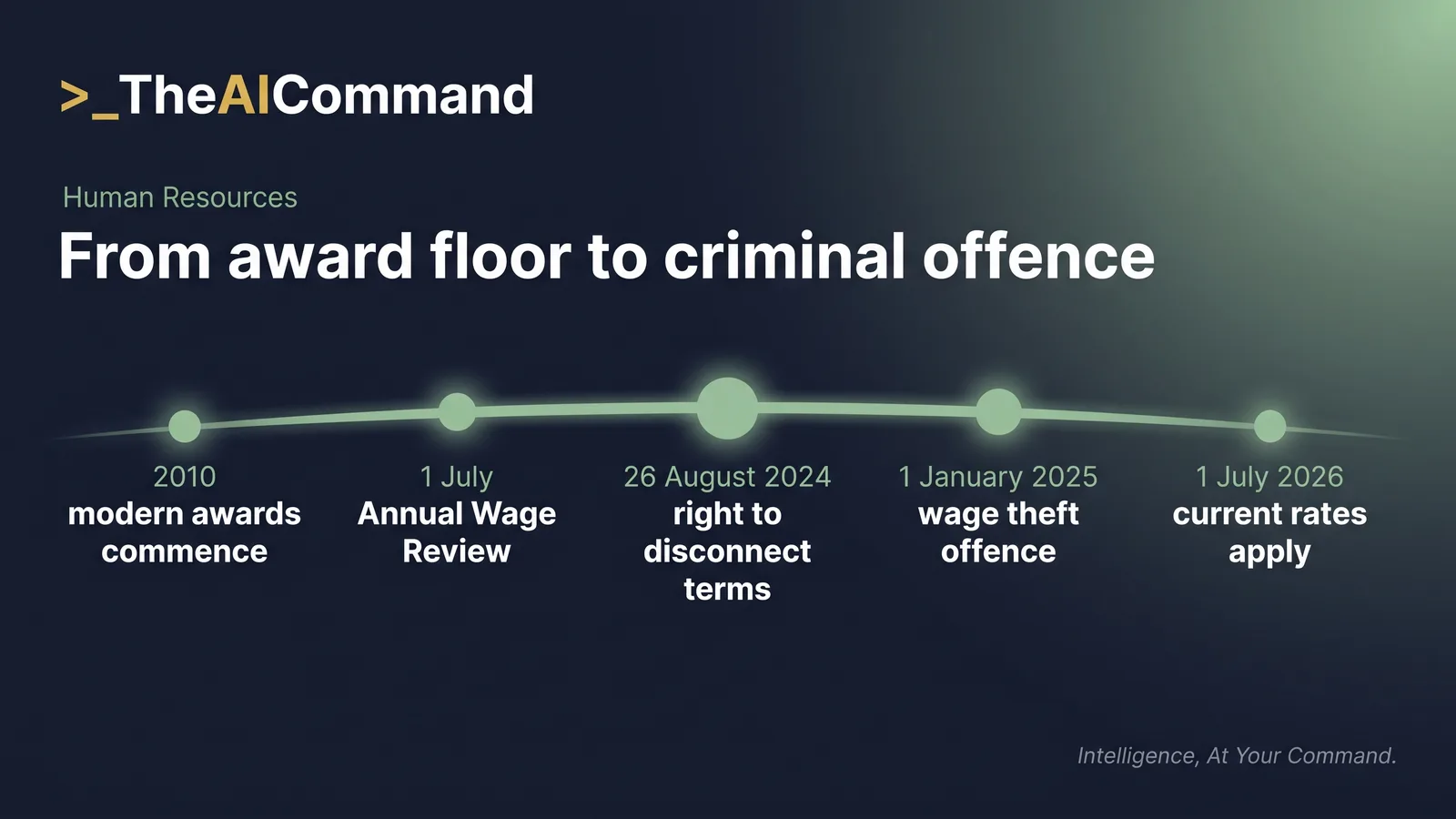
Modern awards are made and varied by the Fair Work Commission under Part 2-3 of the Fair Work Act 2009 (Cth) (FW Act). They are legal instruments. They have the force of law for employees and employers in the national workplace relations system. The current modern award system was established on 1 January 2010 following the award modernisation process under the Workplace Relations Act 1996 (Cth) and was preserved into the FW Act regime. As at April 2026, there are approximately 121 modern industry and occupational awards on the FWC register. Note: where adjacent learning content references 155 awards, that figure reflects a counting basis that includes superseded instruments and pre-modernisation awards. The currently operative count is approximately 121.
Issuer and regulator interplay
Three agencies share the regulatory work. The Fair Work Commission (FWC) is the independent national workplace relations tribunal. It makes, varies, and reviews modern awards, conducts the Annual Wage Review, approves enterprise agreements, and resolves disputes referred under award dispute resolution clauses. The Fair Work Ombudsman (FWO) educates, investigates, and enforces compliance. The FWO has compulsory information-gathering powers and can issue compliance notices, infringement notices, and pursue civil penalty proceedings in the Federal Court or Federal Circuit and Family Court. The Department of Employment and Workplace Relations administers the FW Act framework and supports policy reform.
Scope of application
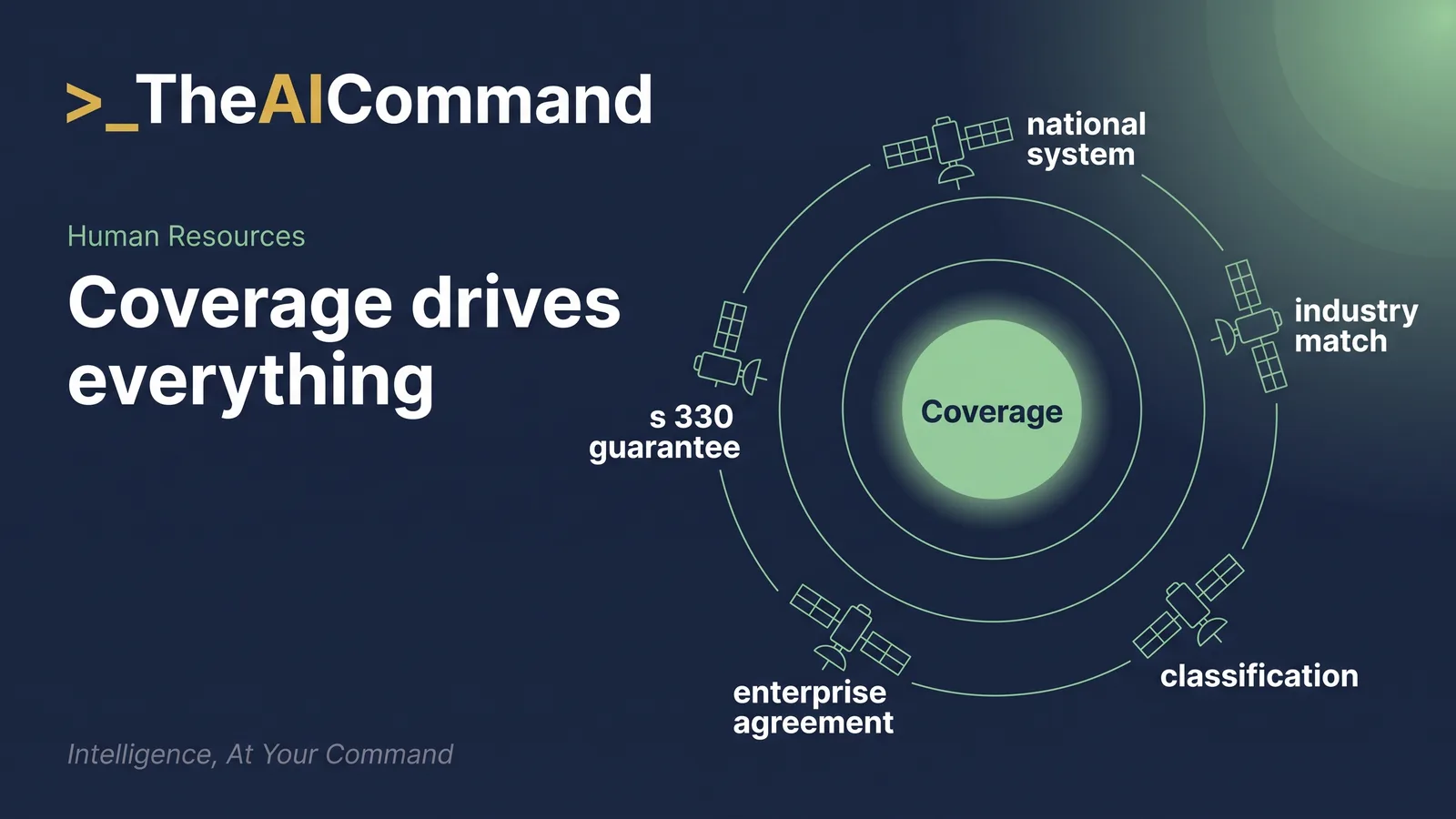
Modern awards apply to national system employers and employees. Almost all Australian financial services employers are constitutional corporations and are therefore in the national system. An award covers an employee where the employee is in a classification that the award expressly covers and the award applies to the employer by industry or occupation. Employees who are paid above the high income threshold and have a guarantee of annual earnings under section 330 of the FW Act may have award coverage suspended for the duration of the guarantee, but the award still covers them for redundancy, unfair dismissal, and other purposes. The high income threshold is indexed annually on 1 July. For the 1 July 2025 to 30 June 2026 cycle it is reported as approximately $183,100, but the operative figure should be confirmed against the FWO and FWC publications for the relevant cycle before reliance.
A practical implication for HR teams in financial services is that senior banker, senior treasurer, and senior actuary roles often sit above the threshold. Care is required to capture the s 330 guarantee in writing for each cycle. A guarantee that lapses by oversight reactivates full award coverage, including penalty rate exposure and overtime. The classification register and HR information system should both flag these roles for annual renewal.
Key dates and transitional periods
The dates below drive the annual compliance calendar. When the next Annual Wage Review determination lands, paste it into this prompt to turn the decision into an implementation plan anchored to the correct operative date.
- 1 January 2010. Modern awards commenced. Transitional pay arrangements ran until 1 July 2014.
- 1 July annually. Annual Wage Review (s 285 FW Act) takes effect. Modern award minimum wages and the National Minimum Wage are adjusted in the first full pay period on or after 1 July.
- 2014 to 2019. Four-yearly review of modern awards under s 156 (now historical). Awards have since been varied through targeted reviews, ad hoc applications under s 157, and case law-driven amendments.
- 1 January 2025. Wage underpayment criminal offence commenced for intentional underpayments at the federal level.
- 26 August 2024. Right to disconnect provisions inserted as award terms (s 333M FW Act) for non-small business employers. Small business employers from 26 August 2025.
- Late 2025 to early 2026. FWC ongoing modern awards review process examining classifications, work value, and gendered undervaluation across multiple awards including those touching financial services support functions.
Interplay with adjacent frameworks
Modern awards do not operate in isolation. The interaction with three adjacent frameworks shapes day-to-day HR decisions and is reinforced across the TheAICommand learning library.
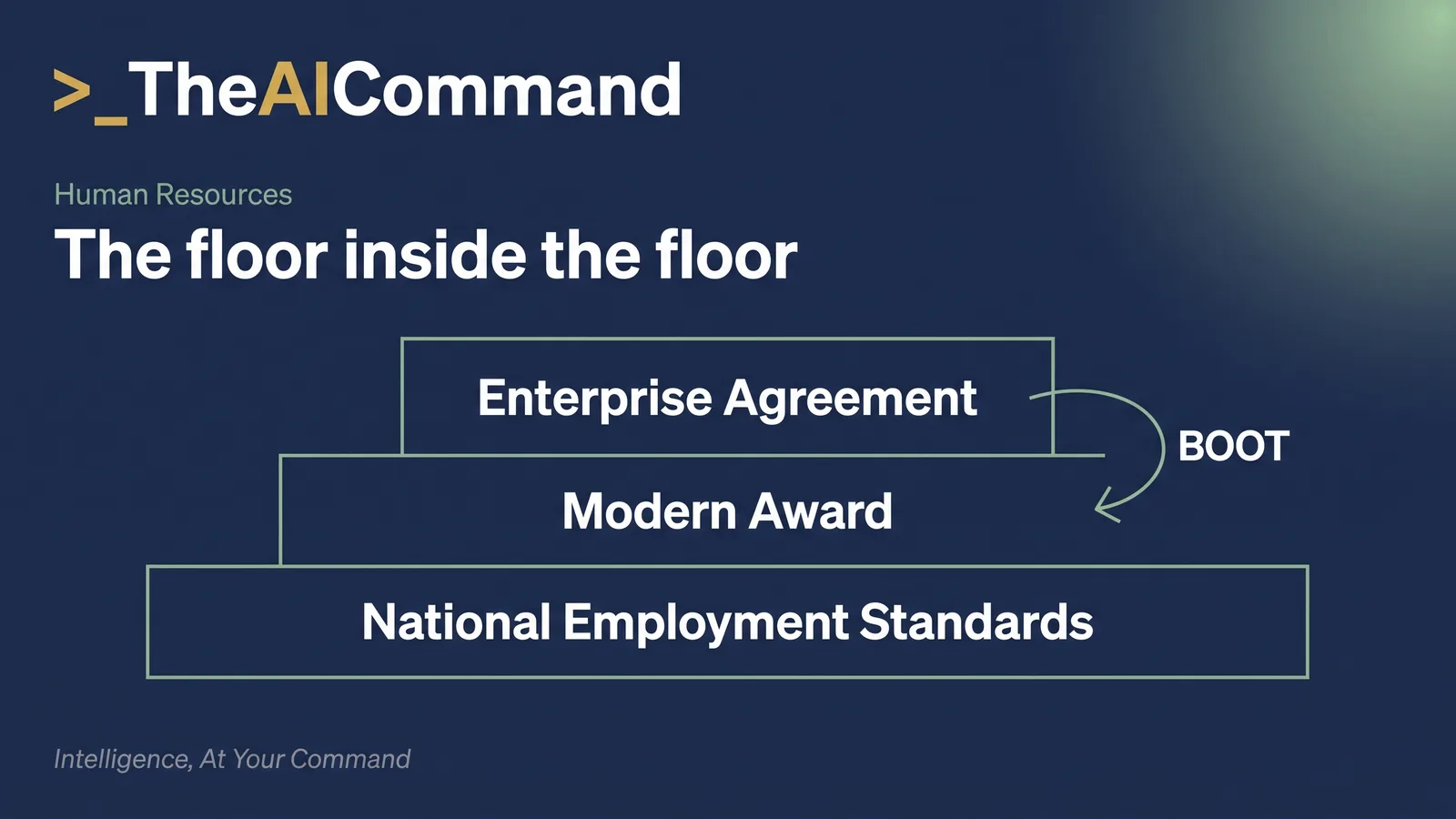
- National Employment Standards (TAIC-LM-H02). Sections 61 to 131 of the FW Act establish ten minimum standards. Section 55 makes clear that modern awards cannot exclude the NES and that, where an award and the NES interact, the more beneficial entitlement applies.
- Enterprise agreements (TAIC-LM-H08). Where an enterprise agreement is in force, the agreement applies in place of the award for the matters it covers, but the agreement must pass the better off overall test (BOOT) under section 193, assessed against the relevant award.
- APRA CPS 230 Operational Risk Management (TAIC-LM-G05). Payroll is typically a critical operation for ADIs, insurers, and superannuation trustees. Award misapplication that produces a material payroll incident is a CPS 230 reportable event and must be incorporated into business continuity planning and tolerance levels.
This module assumes you understand the FW Act framework at a Foundation level (TAIC-LM-H01). Where deep technical detail on the NES, BOOT, or right to disconnect is needed, refer to the linked modules.
Visual 1. Modern Awards regulatory authority map
Specification ready for Lucidchart or Whimsical. Render as a horizontal swimlane diagram with three lanes (Government, Independent Tribunal, Enforcement) and arrows showing instrument flow.
2. Core Concepts and Defined Terms
Defined terms table
Central obligations under a modern award
Classification is duties-based, not title-based. Before working through the obligations below, use this prompt to build the mapping artefact that survives a classification dispute or an FWO records request.
Coverage and classification
Coverage is the threshold question. A modern award covers an employee where the employee is employed by an employer in the industry or occupation specified in the award and the employee is in a classification covered by the award. The Banking, Finance and Insurance Award 2020 covers employers in the banking, finance, building society, credit union, finance broking, mortgage broking, insurance, superannuation, life insurance, and stockbroking industries. It also covers employers in clerical, administrative, and call centre operations connected with those industries. Some specialist roles such as IT, marketing, and legal staff may fall within or outside award coverage depending on the specific role.
Minimum rates and rate composition
Each classification in a modern award has a weekly minimum rate. The rate is the floor. Total remuneration includes the minimum rate, applicable allowances, penalty rates, overtime, and casual loading where relevant. Annualised salary arrangements are permitted under the BFI Award (cl 18) but they require an explicit written agreement, an annual reconciliation against what would have been payable on a clause-by-clause basis, and back-payment where the salary fell short. The 2020 Annualised Wages decision and subsequent variation determinations have tightened these obligations significantly.
Hours and penalty rates
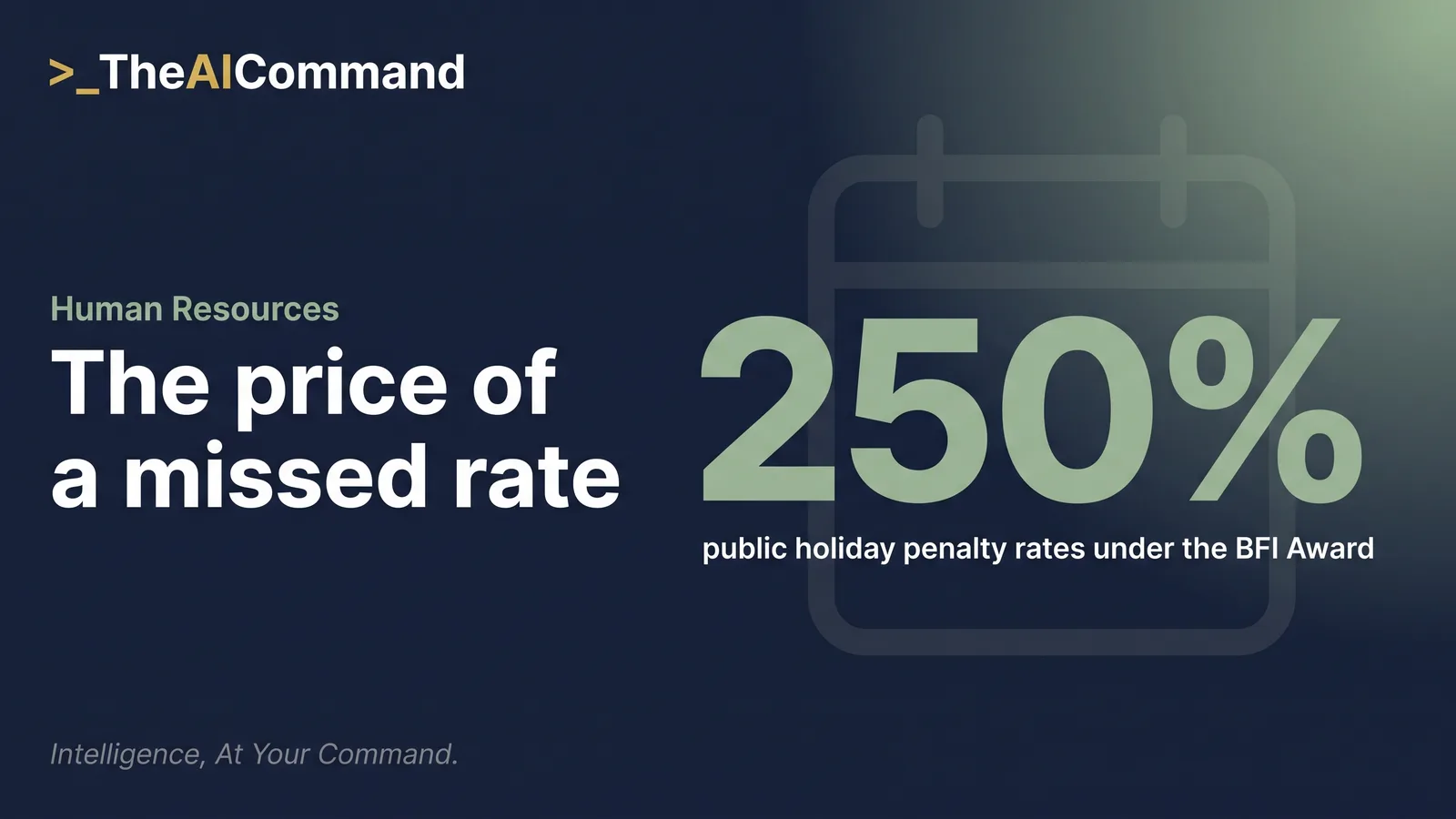
Ordinary hours under the BFI Award are 38 per week, with span clauses defining when ordinary hours can be worked without penalty. Work outside the span attracts overtime. Saturday work attracts time-and-a-half for the first three hours and double time thereafter. Sunday work attracts double time. Public holiday work attracts 250%. Shift workers receive specific shift loadings. The right to disconnect operates as a workplace right, with disputes ultimately resolved by the FWC.
Allowances and leave entitlements
Allowances under the BFI Award include first aid (cl 17.2), motor vehicle (cl 17.3), meal (cl 17.4), and language (cl 17.5). Annual leave is the NES entitlement of four weeks, supplemented by the 17.5% leave loading where applicable. Personal and carers leave, parental leave, compassionate leave, family and domestic violence leave, community service leave, and long service leave (under State and Territory laws) all interact with award terms.
Visual 2. Award compliance lifecycle
Specification: render as a six-step circular flow with feedback arrows from step 6 back to step 1.
3. Practical Application in Australian Financial Services

The four worked examples below illustrate how modern awards bite in different financial services settings. Each example identifies the trigger event, the obligation activated, the artefact produced, and the audit trail expected. All names, employee numbers, and figures are illustrative.
(a) ADI: branch retail banking restructure
Trigger event. A major bank restructures its retail branch network, redeploying [TELLER_NAME] from a customer service officer role on a Level 3 BFI Award classification to a regional contact centre operating extended hours from 7am to 9pm.
Obligations activated. Coverage remains under the BFI Award 2020. The role classification needs reassessment under Schedule B. Extended hours engage the span of hours and afternoon shift loading provisions. Annual leave loading continues. The change in regular roster triggers consultation under cl 8.2. If the redeployment includes redundancy, NES redundancy entitlements under s 119 apply, with award notice provisions stacking on top under cl 35.
Artefact produced. A consultation paper covering the reasons for change, the new roster, the impact on penalty rates, and the proposed implementation date. A reclassification letter signed by the HR Business Partner. An updated payroll configuration request to add the afternoon shift loading. A merge field template letter is illustrated below.
Audit trail expected. Consultation evidence and meeting minutes; the reclassification letter; payroll system change record with maker-checker approval; classification register update; first three pay cycles spot-checked by HR and Payroll; outcome captured in the operational risk system.
(b) General insurer: claims assessor classification dispute
Trigger event. A claims assessor [CLAIMS_NAME] alleges that the duties performed are at BFI Award Level 4 rather than Level 3. The assessor is responsible for handling complex claims under delegation, mentoring junior staff, and contributing to procedure design.
Obligations activated. Classification under Schedule B is duty-based, not title-based. The assessor's actual duties drive the level, not the position description. Cl 9 dispute resolution is invoked. The FWC has jurisdiction under s 739 to deal with the matter where internal steps fail.
Artefact produced. A duties-to-classification mapping document. A response letter setting out the employer's view, the comparison against Schedule B descriptors, and the outcome of the internal review. Where the dispute proceeds, an FWC hearing brief.
Audit trail expected. The original PD; the duties-to-classification mapping; HR notes on each consultation; payroll back-payment calculation if the dispute resolves in favour of the employee; classification register updated; lessons learned captured. Where the dispute proceeds to the FWC, retain copies of the dispute notification, the position outline, conciliator briefs, and any FWC correspondence. The FWC's powers under section 595 of the FW Act allow the Commission to deal with the dispute by mediation, conciliation, recommendation, or expression of opinion. Arbitration requires the parties' agreement. Classification disputes that resolve in favour of the employee typically attract back-payment for the period the duties were performed at the higher level, plus interest where applicable. Personal accessorial liability under section 550 of the FW Act may be relevant where managers were knowingly involved in repeated misclassification.
(c) Superannuation trustee: annualised salary reconciliation
Trigger event. A superannuation trustee operates an annualised salary arrangement under cl 18 of the BFI Award for its member services team. The annual reconciliation as at 30 June reveals that nine employees fell short of what they would have received on a clause-by-clause basis, by amounts ranging from $312 to $4,840.
Obligations activated. Cl 18 requires written agreement, identification of the award provisions satisfied, an outer limit on overtime hours, and a yearly reconciliation. Section 323 of the FW Act requires payment in full and within timeframes. Section 90 of the FW Act applies to leave loading on accrued leave. Failure to back-pay within a reasonable period may trigger consideration under the wage theft offence inserted by the Fair Work Legislation Amendment (Closing Loopholes) Act 2023 where intent is established.
Artefact produced. A reconciliation report by employee. A back-payment register with PAYG and superannuation gross-up. Communications to affected employees with merge field letters. A board paper summarising the cause, control gap, remediation, and compliance with sections 323 and 90.
Audit trail expected. Reconciliation evidence; computation methodology peer-reviewed by Internal Audit; payments made and bank statements retained; FWO and OAIC reportability assessments documented; CPS 230 operational risk register updated; root cause analysis on classification or rate set. The reconciliation should also generate a forward-looking control improvement plan addressing why the shortfall arose, whether the controls in place were designed and operating effectively, and what changes are required to the rate set, the classification register, or the payroll system configuration. For a CPS 230 reportable event the trustee should also assess whether tolerance levels were breached and whether the incident requires notification to APRA. Retain all working papers for at least seven years consistent with FW Reg 3.31 and CPS 230 record-keeping expectations.
(d) AFSL holder: small advice firm using General Retail Industry Award for branch reception
Trigger event. A boutique AFSL-holding financial advice firm employs a part-time receptionist whose duties are predominantly retail in nature (front-of-house client greeting, point-of-sale-equivalent system entries) and whose role sits outside the BFI Award. Coverage is assessed under the General Retail Industry Award 2020 (MA000004).
Obligations activated. Determine which award covers the role. The General Retail Industry Award has different penalty rates (Saturday 25%, Sunday 50% for permanent retail employees), different classifications (Level 1 to 8), and different allowances. If the role evolves to include substantial financial services support, coverage may shift to BFI.
Artefact produced. A coverage assessment memo; a payroll configuration request specifying the General Retail Industry Award rate and penalty schedule; a quarterly review note to confirm coverage continues to be appropriate.
Audit trail expected. Coverage memo signed off by HR with input from external workplace relations counsel where contested; payroll change request with maker-checker; quarterly review note; classification register update.
Visual 3. Award versus enterprise agreement comparison
This benchmarking table compares the modern award framework against enterprise agreements and individual flexibility arrangements (IFAs).
Visual 4. RACI for modern award compliance
R = Responsible, A = Accountable, C = Consulted, I = Informed. Render as a colour-coded grid in Lucidchart with traffic-light shading: R = gold, A = navy, C = sky, I = grey.
Visual 5. Annual Wage Review timeline (illustrative)
Render as a horizontal Gantt timeline. Years are illustrative for cycle 2025-2026.
Visual 6. BFI Award penalty rates snapshot (illustrative)
Render as a horizontal bar chart, x-axis showing percentage of base hourly rate. Values reflect the BFI Award 2020 as at April 2026 for permanent employees. Verify the operative figures against the current consolidated award before relying.
Visual 7. The 5 things to remember
4. AI Workflow: Operating Modern Awards With AI
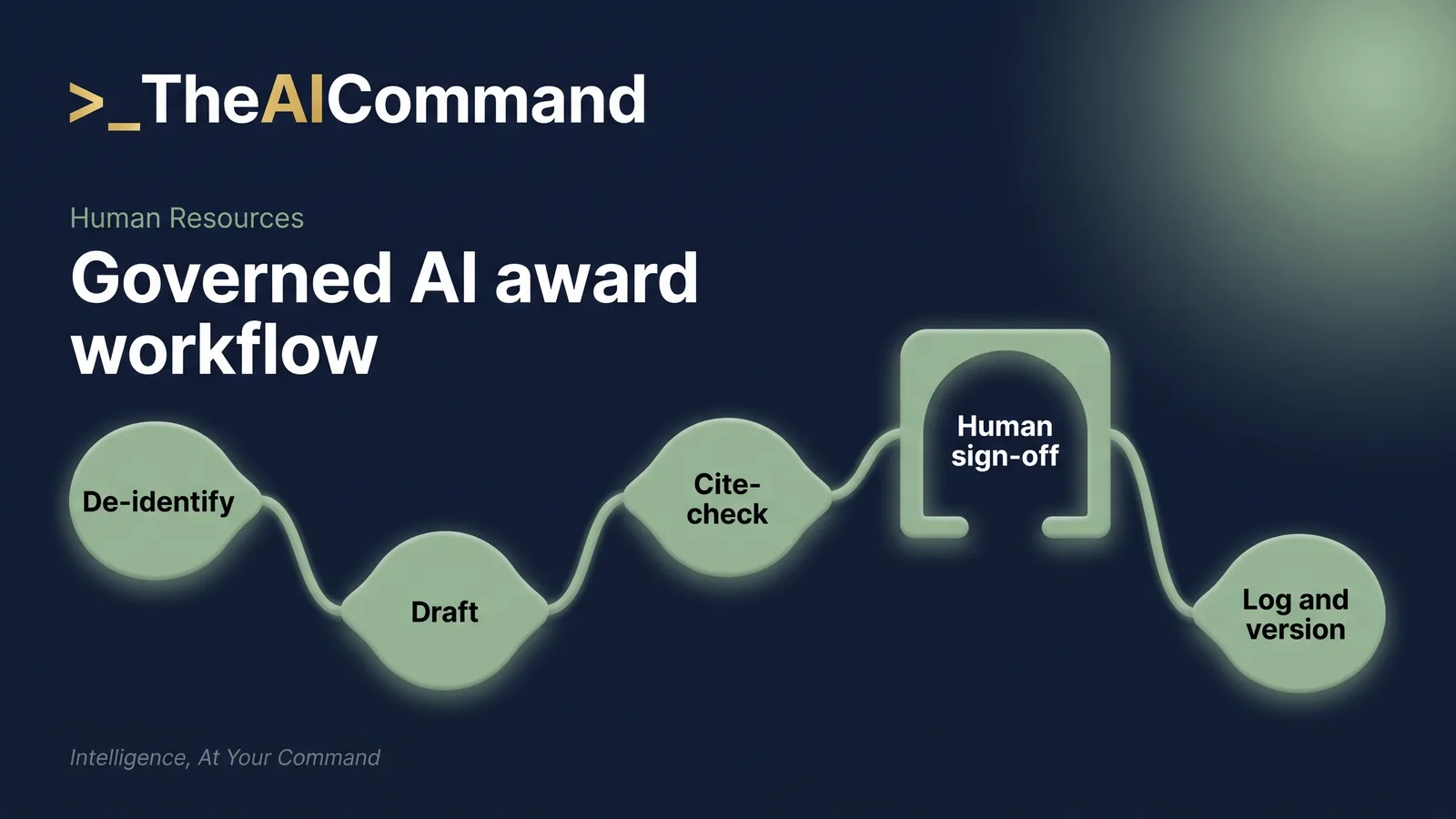
This section operationalises modern award compliance through a properly governed AI workflow. The objective is to scale interpretation, audit, and communication tasks while maintaining strict guardrails on personal information, payroll data, and final accountability.
4.1 Use cases at scale
AI tooling can compress timelines and improve consistency on the following tasks. Each use case must be paired with the governance controls in section 4.4.
- Award interpretation memos. Translating award provisions and FWC decisions into plain-English manager-ready briefings.
- Payroll audit checklists. Generating tailored audit checklists by award, classification, and pay cycle.
- Underpayment risk assessments. Scenario modelling of where misclassification, allowance gaps, or shift loading errors are most likely to occur.
- Coverage opinions. Drafting first-cut coverage memos comparing role duties to award classification descriptors, with explicit flagging of where legal sign-off is needed.
- Manager briefings on penalty rates. Preparing concise, scenario-based penalty rate briefings for branch and contact centre line managers.
- Annualised salary reconciliation narratives. Drafting board-ready narratives explaining the cause, scale, and remediation of reconciliation shortfalls.
- Award variation impact triage. Summarising FWC variation determinations and their operational impact on the business within 48 hours of release.
- Regulator response drafting. Building first-cut responses to FWO compliance notices, requests for information, and audits, gated by ER / IR and Legal sign-off before sending.
4.2 Project space setup
Claude Project (or Claude Skill)
- Create a Claude Project named 'Modern Awards Compliance Workspace' for your business unit (HR, Payroll, ER and IR).
- Upload knowledge sources: the consolidated BFI Award 2020 (MA000019); General Retail Industry Award 2020 (MA000004); FW Act 2009 extracts (Pt 2-3, ss 134, 139, 142, 146, 285, 333M); FWO best-practice guides; the latest AWR decision; your internal classification matrix in de-identified form.
- Set the system prompt scaffold below as the project instructions.
- File and content naming convention: TAIC-AWARDS-{TASK}-{YYYY-MM-DD}-{INITIALS}.md.
- Naming convention for prompts: P-{TASK_CODE}-v{VERSION}.md.
Copy the scaffold below into the project instructions field. It hard-codes the citation discipline, the Annual Wage Review currency check, and the de-identification gate so every conversation starts governed.
ChatGPT Project (or Custom GPT)
- In ChatGPT Enterprise, create a Project named the same and upload the same knowledge sources.
- If your tenancy supports Custom GPTs, build a Custom GPT named 'BFI Award Advisor' with the system prompt scaffold above. Switch off web browsing if the consolidated award is in Knowledge.
- Configure data controls: turn off training on conversations; restrict project to your tenancy; enable audit logging and Conversational Records to your retention policy (suggested 7 years).
- Use file types: .docx, .pdf, .csv (for de-identified rate matrices).
4.3 Prompt library (six prompts)
Prompt 1. Award interpretation memo
The workhorse prompt. Use it whenever a manager asks what an award provision actually requires.
Prompt 2. Payroll audit checklist
Run this each quarter before Payroll closes the audit scope.
Prompt 3. Underpayment risk assessment
For Internal Audit and Line 2 risk partners scoping where misclassification or rate errors are most likely to sit.
Prompt 4. Manager briefing on penalty rates
Use before any extended-hours pilot or roster change lands on line managers.
Prompt 5. Coverage opinion (gap or maturity assessment)
First-cut coverage analysis for a new or changed role, always gated by legal sign-off.
Prompt 6. Regulator response drafting (FWO compliance notice)
The highest-stakes prompt in the library. Nothing generated here leaves the building without ER / IR and external counsel review.
4.4 Governance, audit, privacy, and risk appetite controls
These controls are non-negotiable. Treat them as the operating system for award-related AI use.
- Mandatory de-identification. Inputs to any AI workspace must be free of real names, employee numbers, payroll records, salaries, and customer or member identifiers. Replace with merge field placeholders such as [EMPLOYEE_NAME], [PAY_CYCLE], [GROSS].
- Prohibited inputs. No PII, no individual payroll records, no member or claimant data, no market sensitive data, no sanctions data, no third-party confidential information, no draft regulatory submissions before legal review, no information subject to legal professional privilege without privilege scoping.
- Human-in-the-loop checkpoints. Every AI output is a draft. Reclassification letters require HR Business Partner sign-off. Payroll changes require Payroll Manager sign-off and maker-checker. Regulator responses require ER / IR or external counsel sign-off. Board papers require functional Head sign-off.
- Retention and logging. Conversation logs retained for at least seven years. Outputs versioned in a controlled location (SharePoint, Confluence, Notion) under the naming convention. Maintain a model interaction log for each material output: who, when, prompt version, model, output reference.
- Model selection. Default to enterprise tenancy with no training on conversations. For sensitive or board-grade work, use sovereign cloud or on-prem deployments where available. Document the model chosen and why in the AI Systems mapping.
- CPS 230 alignment. Where payroll is a critical operation, ensure tolerance levels capture material award misapplication. Update the operational risk taxonomy to include AI-assisted award processes. Test the workflow as part of CPS 230 scenario testing.
- Privacy by design. Map AI workflows against APPs 1, 6, 8, 11, and 12. Where automated decision-making is engaged in the broader process, the ADM transparency obligations commencing 10 December 2026 must be considered.
4.5 Quality assurance loop
Run the five-step QA rubric against every AI output before relying on it.
- Provenance check. Are citations to award clauses and FW Act sections present and correct? Spot-check at least three citations against the consolidated award.
- Currency check. Was the consolidated award last verified in the current AWR cycle? Has any FWC variation determination issued since the last update?
- Privacy check. Are merge field placeholders used consistently? Confirm no real PII in the prompt, the output, or the conversation log.
- Logic check. Does the analysis address every element of the issue? Are there any unstated assumptions?
- Sign-off check. Is the human accountable named and engaged? Is the artefact under version control with the correct naming convention?
Then close the loop with an adversarial pass. Paste the draft and this prompt into a fresh model session with no shared context.
4.6 Scaling pattern across the team
- Templates. Maintain a centralised template library of the six prompts above plus locally derived prompts. Review quarterly.
- Version control. Every prompt and output carries a version number. Material updates to the prompt require Head of HR Operations approval.
- Change log. Maintain a change log for the project space: knowledge source updates, prompt revisions, model changes, governance refresh dates.
- Model evaluation cadence. Re-test the 'top 5' use cases against new model releases. Compare on accuracy of citations, faithfulness to the consolidated award, and tone.
- KRI suggestions. (a) Number of award misapplication incidents detected; (b) % of AI-assisted outputs that pass first review without redrafting; (c) average time from FWC variation determination to operational implementation; (d) annualised salary reconciliation shortfalls (count and dollars); (e) number of human sign-off bypasses detected (target: zero).
5. Common Pitfalls and Watch-outs
Six recurring failure patterns and the fast corrective actions that close them.
6. Decision Frameworks and Tools
6.1 Coverage decision tree
Render as a flowchart. Each node is a yes/no question.
- Is the employer in the national workplace relations system? If no, refer to State system advice. If yes, continue.
- Is there an enterprise agreement covering the role? If yes, the agreement applies (subject to BOOT against the award). If no, continue.
- Is the role a high income employee with a written guarantee of annual earnings under s 330? If yes, award coverage is suspended (but applies for redundancy and unfair dismissal). If no, continue.
- Does the BFI Award 2020 cover the employer's industry? If yes, check classification descriptors in Schedule B. If no, continue.
- Does the General Retail Industry Award 2020 or another award cover the role? If yes, apply that award. If no, the role is award-free; common law contract floor applies.
- Document the coverage and classification decision in the classification register with HR Business Partner sign-off.
6.2 Maturity ladder
6.3 Self-check questionnaire
Answer the seven questions below honestly, then paste your answers into this prompt to convert every gap into a prioritised remediation plan.
- Can you produce a current classification register for every employee in your business unit within 24 hours?
- Was your AWR 2025-2026 implementation completed in the first full pay period on or after 1 July 2026, and was any straddling pay cycle back-paid?
- If you operate annualised salary arrangements, when was the last cl 18 reconciliation, and how many employees fell short?
- Do all AI-assisted award outputs carry a named human sign-off and a version number?
- Have you tested the workflow under CPS 230 scenario testing in the last 12 months?
- Do your line managers know when penalty rates apply and where to find the briefing?
- If the FWO sent a compliance notice tomorrow, could your team produce the records under FW Reg 3.32 to 3.46 within 14 days?
7. Further Reading and Authoritative Sources
- Fair Work Act 2009 (Cth), Part 2-3 (Modern Awards), ss 134, 139, 142, 146, 285, 333M. Available at the Federal Register of Legislation.
- Banking, Finance and Insurance Award 2020 (MA000019), consolidated text and current variation determinations on the Fair Work Commission website.
- General Retail Industry Award 2020 (MA000004), consolidated text on the FWC website.
- Fair Work Commission, Annual Wage Review decisions (AWR 2024-2025 and AWR 2025-2026, Expert Panel).
- Fair Work Ombudsman, 'Best Practice Guide: An Employer's Guide to Modern Awards' and 'Compliance and Enforcement Policy'.
- Fair Work Legislation Amendment (Closing Loopholes) Act 2023 (Cth) (wage theft offence, commenced 1 January 2025) and Fair Work Legislation Amendment (Closing Loopholes No. 2) Act 2024 (Cth) (right to disconnect).
- Australian Industrial Relations Commission and FWC, foundational award modernisation decisions ([2008] AIRCFB 550 and following).
- Stewart, Forsyth, Irving, Johnstone and Sappideen, Creighton and Stewart's Labour Law (latest edition, Federation Press), chapters on awards and the National Employment Standards.
- Australian Human Resources Institute (AHRI) and Australian Industry Group, modern awards guidance papers.
- APRA Prudential Standard CPS 230 Operational Risk Management and CPG 230, where payroll is treated as a critical operation.
Closing Sign-off
This module has equipped you to identify the correct modern award, interpret core obligations under the Banking, Finance and Insurance Award 2020, distinguish between award, NES, and enterprise agreement entitlements, audit your business for underpayment risk, and operationalise an AI-assisted compliance workflow under appropriate governance.
The companion 30-question assessment (TAIC-LM-H03 Modern Awards Assessment) tests your competency across foundation knowledge, application, analysis, and AI workflow governance. Aim for the Practitioner band as a minimum before relying on this module to supervise others.
Practical takeaways
Do this Monday
- Open (or create) the classification register: every role, its award, its classification level, and the date coverage was last confirmed.
- Confirm the Annual Wage Review 2025-26 increase of 4.75 per cent to modern award minimum wages reached payroll in the first full pay period on or after 1 July 2026, and back-pay any straddling pay cycle.
- List every employee on an annualised salary under cl 18 of the BFI Award and record the date of the last reconciliation. If there is no date, escalate this week.
- Check every high income guarantee under s 330 of the FW Act has been renewed in writing for the current cycle; a guarantee that lapses reactivates full award coverage.
- Stand up the Modern Awards Compliance Workspace using the scaffold in section 4.2, with the de-identification and sign-off rules in section 4.4 as non-negotiable project instructions.
The HR practice checklist
- Coverage assessed and documented for every role, on hire and on role change.
- Classification driven by actual duties, not position titles, mapped against Schedule B descriptors.
- AWR project plan locked to the first full pay period on or after 1 July, not to 1 July itself.
- Annualised salary arrangements reconciled at least annually under cl 18, with back-payment where the salary fell short.
- NES floor checked (s 55 FW Act) before any award-related change is signed off.
- Records kept per FW Regs 3.32 to 3.46 and retrievable within 14 days of a request.
- All AI inputs de-identified: placeholders only, never real names, employee numbers, or payroll records.
- Every AI output carries a named human sign-off and a version number before it is relied on.
- Material underpayments assessed for wage theft exposure under the Closing Loopholes Act 2023 offence and for CPS 230 reportability.
- Manager briefings on penalty rates and the right to disconnect refreshed after each AWR cycle.
Your prompt library
This module now carries a working prompt kit: the project scaffold in section 4.2, the six-prompt library in section 4.3, the red team check in section 4.5, and the AWR implementation, classification mapping, and self-check remediation prompts placed through the body. Store them under the P-{TASK_CODE}-v{VERSION} convention, review quarterly, and version every material change. Here is one more for the week-to-week grind.
Test your knowledge
LM-H03 assessment. 30 questions
25-30 minutes. One question per screen. Your progress is saved locally for 30 days, so you can pick up where you left off. Submit anytime to see your score, tier, and per-question rationale.
Read next

Corporations Act 2001 (Cth)
The Corporations Act 2001 (Cth) is the consolidated statute governing companies, financial product issuers and distributors, and the directors who oversee them. The Act sits at the apex of the Australian financial services regulatory hierarchy. The Australian Securities and Investments Commission (ASIC) is the lead reg
Read article
Privacy Act 1988 (Cth) and the Australian Privacy Principles
The Privacy Act 1988 (Cth) is the principal Commonwealth statute governing personal information handling in Australia. It binds APP entities, including all Australian financial services providers because of the financial services carve-out from the small business exemption. The 13 Australian Privacy Principles (APPs) s
Read article
Anti-Money Laundering and Counter-Terrorism Financing Act 2006 (Cth)
The Anti-Money Laundering and Counter-Terrorism Financing Act 2006 (Cth) (the AML/CTF Act) is the Commonwealth statute that obliges Australian reporting entities to detect, deter, and disrupt the movement of illicit funds and the financing of terrorism. The Act is administered by the Australian Transaction Reports and
Read articleGeneral information and education only. Not legal, compliance, financial, or professional advice. Verify any time-sensitive obligation against the primary source.
TheAICommand. Intelligence, At Your Command.