LM-H02 · HR · Practitioner tier
National Employment Standards (NES)
The 12 NES entitlements including the Right to Disconnect
What you'll be able to do
- 1.Explain the structure and coverage of the National Employment Standards in Pt 2-2 of the Fair Work Act 2009 (Cth), including the roles of the Fair Work Ombudsman and the Fair Work Commission
- 2.Apply the entitlement rules for parental leave, annual leave, personal and carer's leave, redundancy pay, and the Right to Disconnect to common Australian financial services scenarios
- 3.Analyse a flexible working arrangement request, a redundancy event, and a Right to Disconnect dispute against the statutory tests and produce a defensible, documented determination
- 4.Evaluate AI tooling for NES query handling, policy drafting, and calculation review, and select an appropriate human-in-the-loop control pattern
- 5.Create governed AI workflows for NES work with mandatory de-identification, section-accurate citations, and audit logging
- 6.Justify the interaction between the NES, modern awards, enterprise agreements, and individual contracts in a regulated financial services environment
6 lessons · read straight through, or use lesson view once the page loads.
TheAICommand Learning Library
Module LM-H02
National Employment Standards (NES) and the Right to Disconnect
A practitioner module for Australian financial services. The National Employment Standards under Pt 2-2 of the Fair Work Act 2009 (Cth), the Right to Disconnect (s 333M), the Closing Loopholes amendments, and operating the framework with AI.
Module metadata
Learning outcomes
By the end of this module a learner will be able to:
- Explain (Bloom: Understand) the structure of the National Employment Standards in Pt 2-2 of the Fair Work Act 2009 (Cth) and the role of the Fair Work Ombudsman and Fair Work Commission in administering them.
- Apply (Bloom: Apply) the entitlement rules for parental leave, annual leave, personal/carer's leave, redundancy pay, and the Right to Disconnect to common Australian financial services scenarios.
- Analyse (Bloom: Analyse) a flexible working arrangement request, a redundancy event, and a Right to Disconnect dispute, and produce a defensible determination.
- Evaluate (Bloom: Evaluate) AI tooling against NES query handling, policy update drafting, and case file analysis tasks, and select an appropriate human-in-the-loop control pattern.
- Create (Bloom: Create) NES policy update drafts, redundancy calculation reviews, and Right to Disconnect guidelines using a governed AI workflow with mandatory de-identification.
- Justify (Bloom: Evaluate) the interaction between the NES, modern awards (notably the Banking, Finance and Insurance Award 2020), enterprise agreements, and individual contracts in a regulated FS environment.
1. Executive Summary
The quickest win in this module sits in section 5.2: the ready to paste project instructions block for the NES-HR-Copilot project space, the contract between you and the assistant that goes in before any files are loaded. Standing that project space up is the one thing to try today; the sections below cover the entitlements it will help you answer.
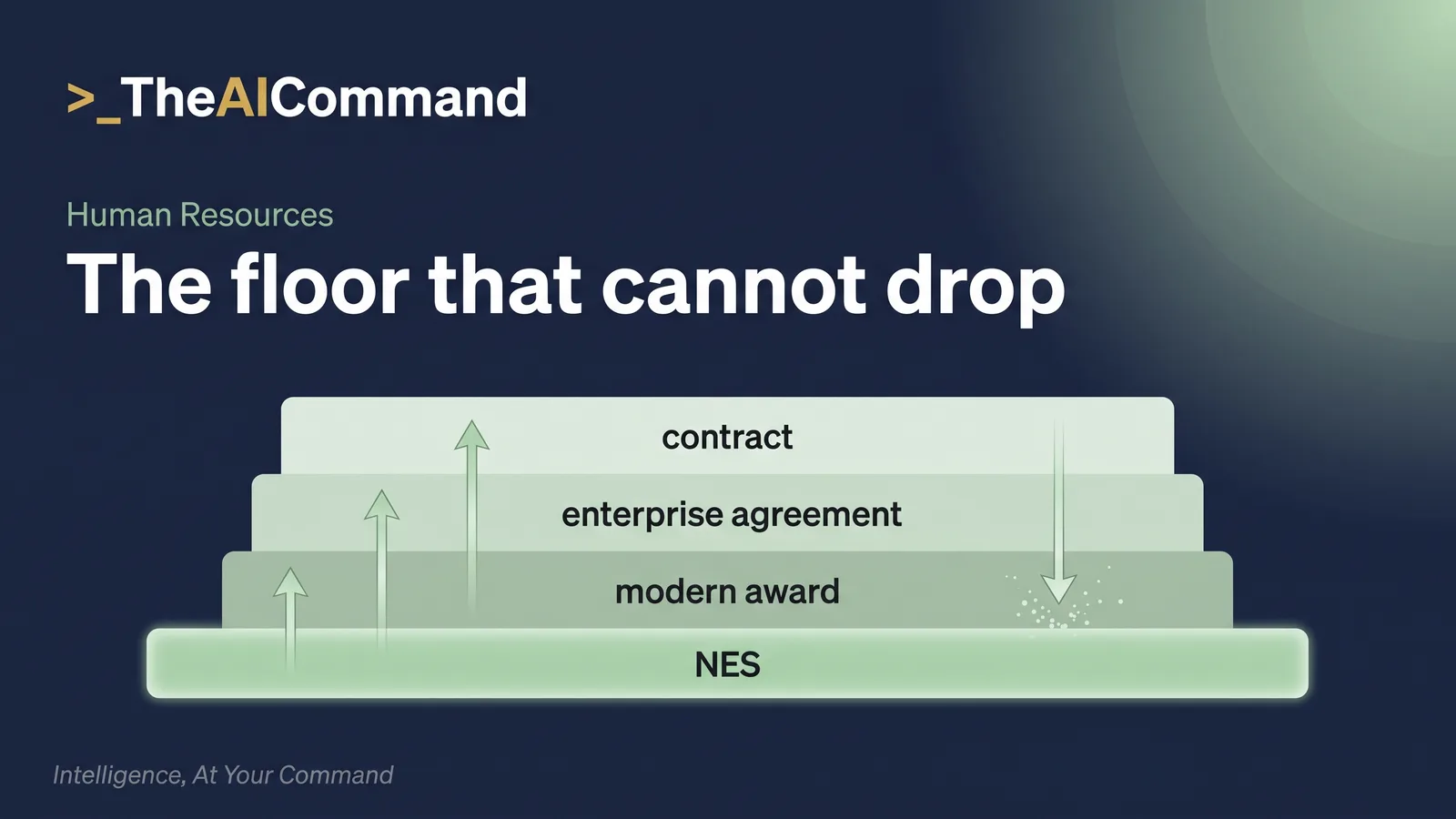
The National Employment Standards (NES) are the minimum entitlements that apply to every national system employee in Australia, set in Pt 2-2 of the Fair Work Act 2009 (Cth). The Fair Work Ombudsman currently lists 12 NES entitlements, including superannuation contributions, which entered the NES on 1 January 2024. This module works through the entitlement areas that drive most day-to-day HR work, together with the Right to Disconnect (s 333M), which sits in Pt 2-9 of the Act and operates alongside the NES. Together they form the base of the safety net. A modern award, enterprise agreement, or contract can build on the NES but cannot reduce it. The Fair Work Ombudsman administers compliance, and the Fair Work Commission resolves disputes. For Australian financial services, where the Banking, Finance and Insurance Award 2020 covers a portion of the workforce and enterprise agreements cover the rest, the NES is the floor that survives every restructure, every reorganisation, and every change of business.
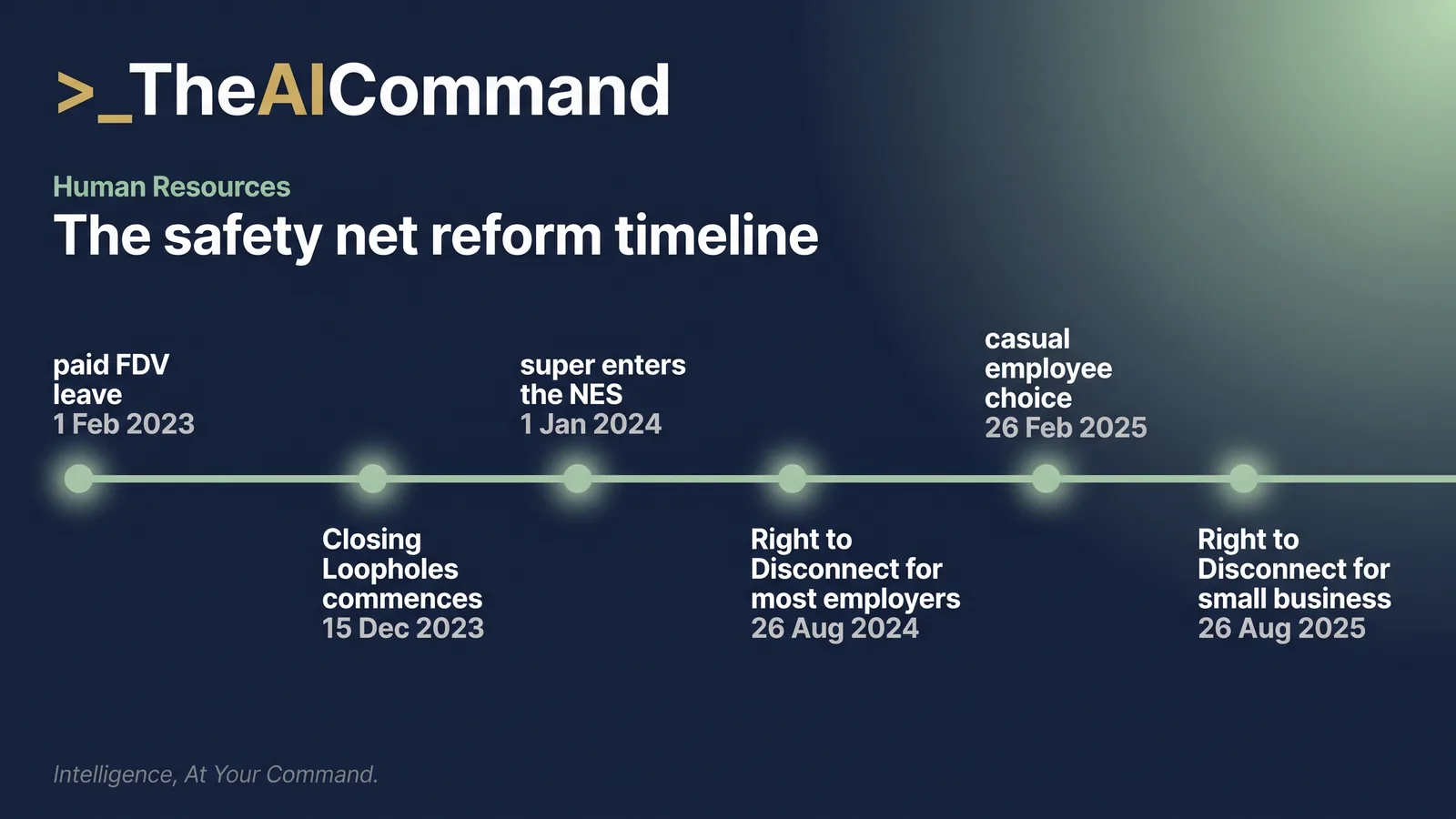
This matters now for three reasons. First, the Closing Loopholes No. 1 and No. 2 Acts have introduced material new obligations including the statutory Right to Disconnect, expanded casual conversion pathways, and stronger anti-discrimination protections. Second, the Right to Disconnect (s 333M) commenced for non-small business employers on 26 August 2024 and for small business employers (fewer than 15 employees) on 26 August 2025, which means every Australian financial services employer is now in scope and disputes can already be brought to the Fair Work Commission. Third, banking and insurance employers have always faced sharper scrutiny on payroll accuracy and entitlement administration, and the past five years have produced multiple high-profile underpayment matters in the sector, with material reputational and remediation costs.
After this module you will be able to: stand up a defensible NES posture across the employee lifecycle without needing legal escalation for routine matters; run an NES-mapped review of a policy or HR practice and identify the safety net controls that must be in place; operate a flexible working arrangement request, a redundancy calculation, and a Right to Disconnect query within statutory timeframes; build a Claude or ChatGPT project space that supports NES query handling, policy drafting, and review with mandatory de-identification, governance logging, and human review; and translate the new Right to Disconnect obligations into operational guidance that managers and employees can use.
2. Regulatory and Strategic Context
Issuer and statutory authority
The Fair Work Act 2009 (Cth) (FW Act) is administered by the Fair Work Ombudsman (FWO) for compliance and education functions and by the Fair Work Commission (FWC) for dispute resolution, modern award variation, enterprise agreement approval, and unfair dismissal jurisdiction. The NES are set in Pt 2-2 of the Act (ss 59 to 131A as currently arranged), while the Right to Disconnect sits in Division 6 of Pt 2-9 (ss 333M to 333N) and operates alongside them as a workplace right. The Fair Work Information Statement is published by the FWO, as is the Casual Employment Information Statement and the Right to Disconnect guidance material that accompanies s 333M.
Scope of application in Australian financial services
The national system covers the overwhelming majority of Australian FS employers and employees. Constitutional corporations (which captures every ADI, general insurer, life insurer, superannuation trustee, AFSL holder, and credit licensee organised as a Pty Ltd or Ltd company) are national system employers. The NES applies to all national system employees, including casuals (with adjusted entitlements where indicated) and excluding only the limited categories defined in s 12. Coverage is independent of award and agreement coverage. An executive on a six-figure individual common law contract is still entitled to the full NES, including 12 months unpaid parental leave, public holiday absence rights, and redundancy pay where applicable.
Key dates and transitional periods
The Fair Work Legislation Amendment (Closing Loopholes) Act 2023 received Royal Assent on 14 December 2023 and the Fair Work Legislation Amendment (Closing Loopholes No. 2) Act 2024 received Royal Assent on 26 February 2024. Together they introduced the Right to Disconnect (s 333M), an updated casual employee definition (s 15A), the employee choice pathway for casual conversion, the franchisee chain of responsibility provisions, and the insolvency exception to the small business redundancy exemption in s 121(4). The Right to Disconnect commenced for non-small business employers on 26 August 2024 and for small business employers on 26 August 2025. Paid family and domestic violence leave (10 days per year for all employees including casuals) commenced on 1 February 2023 for non-small business employers and 1 August 2023 for small business employers. The shutdown direction reforms in modern awards under Schedule X-style clauses were finalised across awards through 2023 and 2024.
Interplay with adjacent frameworks
The NES does not operate in isolation. It interacts with five frameworks every Australian FS HR practitioner must hold in mind.
- Modern awards (LM-H03): the Banking, Finance and Insurance Award 2020 [MA000019], the General Retail Industry Award 2020, and the Clerks Private Sector Award 2020 each build on the NES with sector-specific provisions on overtime, allowances, classifications, and shift work.
- Enterprise agreements: each agreement must satisfy the Better Off Overall Test (BOOT) against the relevant award and cannot reduce any NES entitlement.
- Anti-discrimination law: Sex Discrimination Act 1984 (Cth), Disability Discrimination Act 1992 (Cth), Age Discrimination Act 2004 (Cth), and Australian Human Rights Commission Act 1986 (Cth) overlay flexible work, parental leave, and termination decisions.
- Workers compensation (LM-W01): periods of incapacity intersect with personal leave and notice of termination obligations under s 117 and s 352 of the FW Act.
- Privacy Act 1988 (Cth) (LM-G02): every NES query that involves an identifiable employee, particularly parental leave records, family and domestic violence leave records, and medical certificates, sits inside the privacy perimeter.
Strategically, treat the NES as the audit floor. A bank can offer 18 weeks paid parental leave on top of the unpaid NES entitlement, but it cannot run a policy that requires 18 months continuous service to access unpaid parental leave, because s 67 sets that bar at 12 months.
Visual 1: Regulatory authority map (NES stack)
Specification (designer-ready). Render as a horizontal layered diagram with the Australian Government at the top and operational HR at the bottom. Arrows show statutory authority flowing down and complaints, disputes, and requests flowing up.
3. Core Concepts and Defined Terms
Defined terms
Walk-through of the 11 entitlement areas
Section 61 of the FW Act sets out the NES matters, which the Fair Work Ombudsman currently presents as 12 minimum entitlements, including casual employment (the employee choice pathway, covered in the pitfalls section) and superannuation contributions. This module walks through the ten entitlement areas that generate most HR queries, then the Right to Disconnect, which sits in Pt 2-9 of the Act but belongs in the same safety net conversation. The 11 areas are:
- Maximum weekly hours (s 62): 38 hours per week for full-time employees, plus reasonable additional hours. Reasonableness is assessed on a multi-factor basis including health and safety, personal circumstances, business needs, and the nature of the role. The cap operates per week, not per day, and can be averaged where an averaging arrangement is in place.
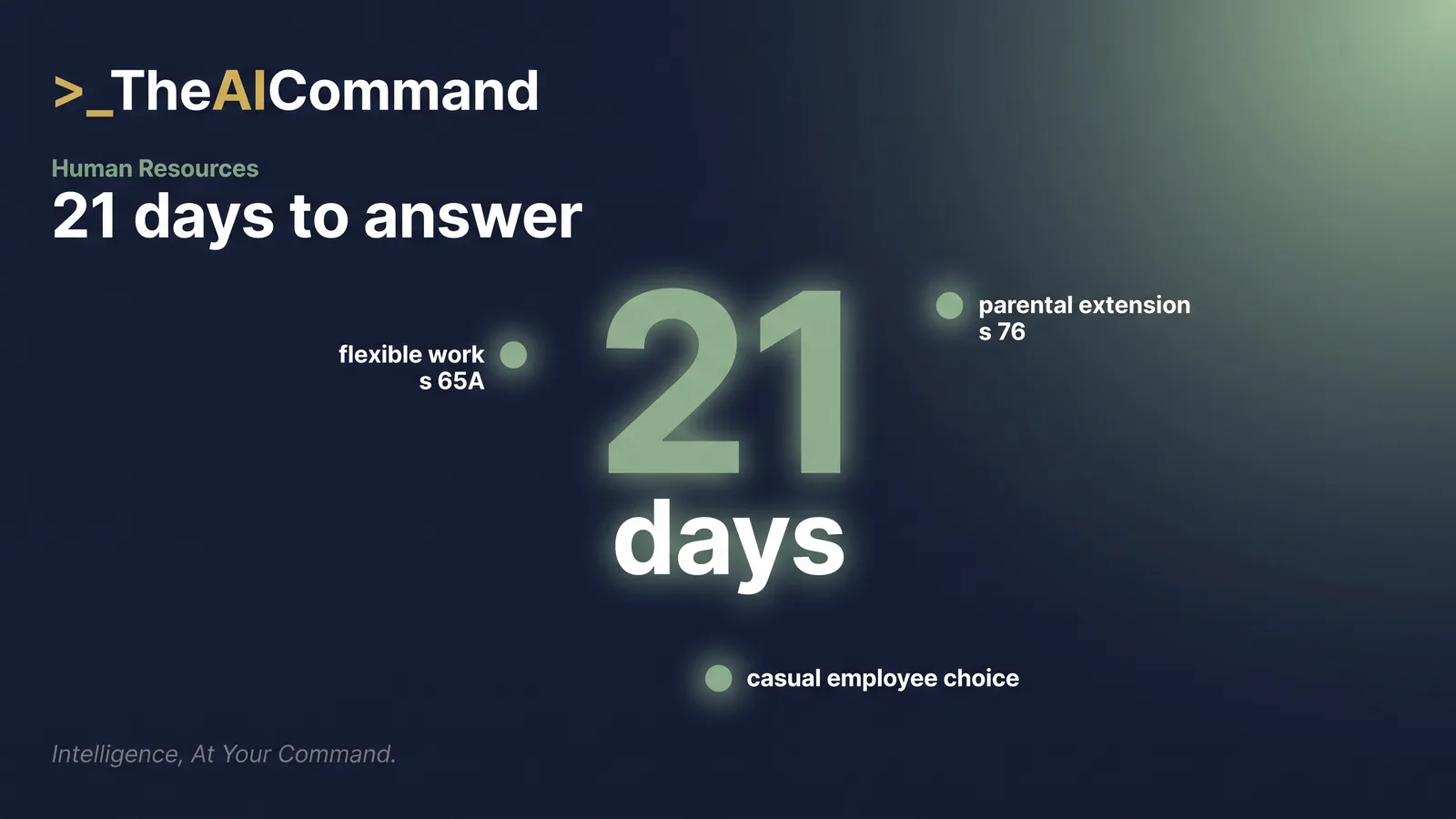
- Requests for flexible working arrangements (s 65 and s 65A): an employee with at least 12 months continuous service can request changes to working arrangements where they meet a defined eligibility ground (parent of a child of school age or younger, carer under the Carer Recognition Act 2010, disability, 55 or older, pregnant, or the employee or a member of their immediate family or household experiencing family and domestic violence). The employer must respond in writing within 21 days. Refusal must be on reasonable business grounds and the employer must first discuss the request with the employee. Disputes are referrable to the FWC for mandatory conciliation and, since June 2023, arbitration.
- Parental leave and related entitlements (ss 70 to 85): up to 12 months unpaid parental leave (s 70), with a right to request a further 12 months (s 76), bringing the maximum to 24 months. Available to employees with at least 12 months continuous service. Parental leave can be shared between two parents (concurrent leave is allowed under s 72). Pre-adoption leave (s 85A), special maternity leave (s 80), and a return-to-work guarantee (s 84) form the broader parental package. The Commonwealth Paid Parental Leave scheme (administered by Services Australia, separate from the NES) currently provides 24 weeks paid parental leave (as at 2026), scaling to 26 weeks from 1 July 2026 under the Paid Parental Leave Amendment (More Support for Working Families) Act 2024.
- Annual leave (s 87): four weeks paid annual leave per year for full-time employees, accruing progressively and pro-rated for part-time. Shift workers (as defined in s 87(3)) accrue an additional week. Annual leave is paid at the employee's base rate including any leave loading where awarded.
- Personal/carer's leave, compassionate leave, and family and domestic violence leave (ss 95 to 106E): 10 days paid personal/carer's leave per year (s 96), accruing progressively. Two days unpaid carer's leave per occasion for casuals (s 102). Two days paid compassionate leave per permissible occasion (s 105). Ten days paid family and domestic violence leave per year for all employees including casuals, available upfront in full at the start of each 12-month service period (s 106B).
- Community service leave (ss 108 to 112): unpaid leave for jury service (with make-up pay obligations on the employer for the first 10 days, s 111) and for emergency management activities with a recognised emergency body.
- Long service leave (s 113): preserves long service leave entitlements under applicable state or territory long service leave legislation, or under a pre-modernisation federal award where one applies. There is no national LSL standard inside the NES; it is a savings provision.
- Public holidays (s 114 and s 116): an employee is entitled to be absent from work on a public holiday and to be paid at the base rate of pay for the ordinary hours that would have been worked. An employer can request that an employee work on a public holiday, but the request must be reasonable and the employee can refuse on reasonable grounds (CFMMEU v OS MCAP Pty Ltd [2023] FCAFC 51 confirmed the request-and-refuse framework).
- Notice of termination and redundancy pay (ss 117 to 123): graduated notice of termination from one week (less than one year service) to four weeks (more than five years service) under s 117(3)(a), plus an additional week under s 117(3)(b) for employees aged 45 or older with at least two years service. Redundancy pay under s 119 scales from four weeks (one to two years service) and peaks at 16 weeks (nine to ten years), then drops back to 12 weeks at 10+ years (a vestigial NES design quirk reflecting expected long service leave entitlements at 10+ years). Small business employers are exempt from redundancy pay (s 121), subject to the insolvency exception in s 121(4) inserted by the Closing Loopholes Act 2023. Section 122 contains the transfer of business carve-out.
- Fair Work Information Statement, Casual Employment Information Statement, and Fixed Term Contract Information Statement (ss 124 to 125B): the FWIS must be given to every new employee on commencement; the CEIS must be given to casuals on commencement and again at six months, 12 months, and every subsequent 12 months for non-small business employers (commencement and 12 months only for small business); the FTCIS must be given when entering into a fixed-term contract.
- Right to Disconnect (s 333M): an employee may refuse to monitor, read, or respond to contact, or attempted contact, from their employer or a third party (such as a customer) outside the employee's working hours unless the refusal is unreasonable. The reasonableness test in s 333M(3) considers six factors: the reason for the contact, how the contact is made and the level of disruption, the extent the employee is compensated for being available, the nature of the role and the level of responsibility, personal circumstances including caring responsibilities, and any other matter the FWC considers relevant. Disputes are referrable to the FWC for resolution.
4. Practical Application in Australian Financial Services

Worked example A: ADI (national bank)
Trigger event. A retail branch employee with three years continuous service requests parental leave starting 1 September 2026 for an expected date of birth on 15 September 2026. She also asks to take 12 months and to access the additional 12 months under s 76.
Obligations activated. Section 70 (entitlement to 12 months unpaid parental leave), s 74 (notice and evidence requirements: at least 10 weeks before the intended start date, with confirmation of dates four weeks beforehand), s 76 (right to request additional 12 months), s 84 (return-to-work guarantee), and the Commonwealth Paid Parental Leave scheme (separate Services Australia entitlement).
Artefact produced. Parental leave acceptance letter confirming the 12 months unpaid period and the return-to-work guarantee. A separate written response to the s 76 additional 12 months request, given within 21 days of the request, either confirming the further period or refusing on reasonable business grounds with reasons. The bank should also issue an enhanced paid parental leave letter where the bank's policy provides paid leave above the NES floor.
Audit trail expected. Workday or HR system record of the request, the acknowledgement, the written response, the s 76 response, and the return-to-work guarantee acknowledgement. Privacy obligations apply: the parental leave file is personal information under the Privacy Act 1988 (Cth) and must be handled per APP 11.
Worked example B: General insurer
Trigger event. A claims assessor with 18 months continuous service is asked to attend a training session at 7:30 pm on a weeknight. She declines and the manager later raises performance concerns based partly on her unwillingness to attend out-of-hours sessions.
Obligations activated. Right to Disconnect (s 333M(1)), maximum weekly hours and reasonable additional hours (s 62), and the general protections under Pt 3-1 (which prohibit adverse action because an employee exercises a workplace right).
Artefact produced. A written response confirming that the employee is entitled to refuse to monitor, read, or respond to contact outside working hours unless the refusal is unreasonable, and that performance management cannot be founded on the exercise of that right. The insurer should review its training and after-hours engagement policy to ensure it documents which roles, if any, have an availability expectation and how that is compensated.
Audit trail expected. HR system note of the request, the refusal, the manager file note, the formal response. If the matter escalates, the FWC dispute file and any conciliation outcome.
Worked example C: Superannuation trustee
Trigger event. A trustee announces a restructure of the member services team, eliminating eight roles. Affected employees have between four and eleven years continuous service.
Obligations activated. Notice of termination (s 117) graduated by service. Redundancy pay (s 119) scaled by service: an employee with five years service is entitled to 10 weeks redundancy pay; an employee with nine years service is entitled to 16 weeks. Section 389 redundancy as a defence to unfair dismissal (consultation under the modern award and reasonable redeployment). The Banking, Finance and Insurance Award 2020 contains a consultation about major workplace change clause.
Artefact produced. Written notice of termination per s 117. Termination payments calculated per s 119 and the contract. Consultation notes per the modern award clause. Redeployment register entries showing roles considered.
Audit trail expected. HR case management entries showing the consultation timeline, the redeployment register, the s 117 notices, the s 119 calculations (including superannuation per the SG Act), and the final separation files.
Worked example D: AFSL holder (boutique advice firm)
Trigger event. The firm has 12 employees and is therefore a small business employer (s 23). It is closing one of its two offices. Three employees will be made redundant.
Obligations activated. Notice of termination (s 117) applies and is unaffected by small business status. Redundancy pay (s 119) does NOT apply because s 121 exempts small business employers (subject to the insolvency exception in s 121(4), inserted by the Closing Loopholes Act 2023, which preserves redundancy pay where the employer became a small business through terminations connected with bankruptcy or liquidation; it does not apply to a solvent downsizing like this one). The FWIS, CEIS, and any contractual redundancy entitlements still apply.
Artefact produced. Written notice of termination per s 117 graduated by service. Final pay including accrued annual leave (s 90) and any contractual redundancy. Statement of service. Outplacement support if available.
Audit trail expected. HR file showing the s 23 head count check at the relevant time, the s 117 notice calculation, the final pay calculation, and the statement that redundancy pay is not statutory under the NES with reasoning.
Visual 2: NES at-a-glance dashboard
Specification. Render as a 4 by 3 grid of tiles (one per NES). Each tile shows the NES name, the FW Act section, the headline entitlement, and a SKY-coloured icon. Right to Disconnect tile uses a GOLD outline to flag its newness.
Visual 3: Parental leave entitlement map
Specification. Render as a horizontal timeline showing pre-leave eligibility, leave taken, and return to work. NAVY band for unpaid NES leave; SKY band for Commonwealth Paid Parental Leave; GOLD band for any employer-funded paid parental leave. Concurrent leave (s 72) shown as a parallel band.
Visual 4: Comparative table (NES vs BFI Award 2020 vs typical big-bank EA)
Specification. Render as a 4-column comparative table with traffic-light shading. GREEN where the instrument exceeds the NES floor, AMBER where it matches, RED where it would attempt to derogate (no example exists in this row set; included only as legend).
Visual 5: Right to Disconnect reasonableness heat map
Specification. Render as a 5x5 heat map. Vertical axis = nature of role and level of responsibility (Junior to Executive). Horizontal axis = nature of the contact (Routine update to Critical incident). Cells coloured GREEN (refusal almost certainly reasonable), AMBER (case-by-case), RED (refusal likely unreasonable).
Visual 6: Quantitative chart (illustrative)
Specification. Render as a clustered column chart titled 'NES-related compliance matters: illustrative volume by category, FY2024 to FY2026'. Y-axis = matters per quarter. X-axis = FY quarters. Series = Underpayment, Parental leave dispute, Flexible work refusal, R2D dispute, Redundancy challenge. All figures clearly labelled illustrative.
5. AI Workflow: Operating the NES with AI
This section is the operational core of the module. It assumes you have access to a governed AI platform (ChatGPT Enterprise, Microsoft 365 Copilot, or Claude for Enterprise) with no consumer data leakage risk. Every workflow below assumes a privacy-by-design and human-in-the-loop control pattern.
5.1 Use cases at scale (where AI helps)
AI reduces time, increases consistency, and strengthens audit trails across the following NES-related tasks.
- Drafting NES policy updates after a legislative amendment (Right to Disconnect, casual conversion, paid family and domestic violence leave).
- Mapping an existing policy or procedure against the NES to identify gaps, inconsistencies, and over-promises.
- Answering manager and employee NES queries from a curated and governed knowledge base, with citations to the FW Act and the relevant policy.
- Drafting flexible working arrangement response letters (acceptance, alternative arrangement, refusal on reasonable business grounds).
- Calculating redundancy pay and notice of termination based on de-identified service data, including the s 121 small business exclusion check and the s 122 transfer of business carve-out.
- Generating an FWC dispute response template for a Right to Disconnect or flexible work matter, including reasonableness analysis.
- Producing a board paper or executive summary on NES-related risk, e.g. an underpayment exposure analysis or a Right to Disconnect implementation update.
- Drafting Fair Work Information Statement cover notes for new starter packs, including localisation by entity (ADI, insurer, AFSL).
5.2 Project space setup
Start with the contract between you and the assistant. Paste this block into your ChatGPT Project instructions or Claude Project instructions before loading any files, then adjust the file names and reviewer roles to match your own operating model.
ChatGPT (Projects or Custom GPT). Create a Project named 'NES-HR-Copilot'. Upload the following knowledge sources as files: the consolidated FW Act (Part 2-2, Part 2-9 Division 6 for the Right to Disconnect), the Fair Work Information Statement, the Casual Employment Information Statement, the relevant modern award (e.g. BFI Award 2020), the current enterprise agreement, and your employer's NES policies. Set Project Instructions to require the model to cite section numbers from the FW Act, to flag uncertainty, to refuse to provide individual legal advice, and to apply Australian English. Disable web browsing inside the Project. Use the GPT-4 class model for production work.
Claude (Projects or Skills). Create a Project named 'NES-HR-Copilot' with the same knowledge sources. Build a Claude Skill called 'NES-Query-Handler' with a SKILL.md that documents the trigger conditions (NES queries, policy drafting, redundancy calculations), required reference files (the uploaded knowledge), and the quality bar. Reference files should include section-by-section summaries of Pt 2-2 and worked examples for the most common queries. Use Sonnet or Opus for production drafting; Haiku for routine query triage.
File structure (both platforms):
- /01-statutes/ FW Act consolidated extracts, Closing Loopholes amendment notes
- /02-instruments/ Modern award, enterprise agreement, FWIS, CEIS, FTCIS
- /03-policy/ Internal NES policy suite (parental, leave, flexibility, redundancy, R2D)
- /04-templates/ Letter templates with merge fields
- /05-decisions/ De-identified case file summaries for analogical reasoning
- /06-guardrails/ Prohibited inputs list, escalation triggers, governance log template
Naming conventions. Files: NES-{topic}-{version}-{date}.md. Conversations: NES-{topic}-{matter ID}. Avoid any identifying information in conversation titles.
5.3 Prompt library (six prompts)
The six prompts below follow the Role / Context / Task / Constraints / Output Format / Quality Bar pattern in prose so you can see the reasoning behind each one. For day-to-day query handling, start from this copy-paste triage prompt and adapt it to the matter in front of you.
Each prompt below follows Role / Context / Task / Constraints / Output Format / Quality Bar.
Prompt 1: NES policy update draft
Role. You are a senior HR policy writer for an Australian financial services employer. Context. The Fair Work Act 2009 (Cth) was amended by the Closing Loopholes No. 2 Act 2024 to introduce the Right to Disconnect (s 333M). Our current Hours of Work and Communication Policy was last updated in March 2023. Task. Draft a policy update insert (300 to 500 words) that integrates the Right to Disconnect into the existing policy without contradicting our on-call regime for treasury and incident response. Constraints. Australian English. Cite s 333M and s 333N. Reflect the six-factor reasonableness test in s 333M(3). Do not provide individual legal advice. No em dashes. Output format. Markdown. Heading, body, definitions appendix update, change log entry. Quality bar. Reviewed against the FW Act sections cited; aligned with FWO guidance; consistent with existing on-call provisions; signed off by HR Policy Lead before publication.
Prompt 2: Right to Disconnect guideline
Role. You are an HR business partner drafting a manager-facing guideline. Context. Following the s 333M commencement on 26 August 2024 (non-small business) and 26 August 2025 (small business), our managers need an operational guideline on what after-hours contact is reasonable. Task. Produce a one-page guideline (250 to 350 words) that walks a manager through the s 333M(3) factors and gives three worked examples (routine update, customer escalation, critical incident). Constraints. Australian English. No reliance on UK or US guidance. Reference our compensation framework for on-call roles. Flag that disputes can be referred to the FWC under s 333N. Output format. One-page document, three columns (situation, reasonableness factors at play, recommended action). Quality bar. Aligned with FW Act and FWO Right to Disconnect guidance; reviewed by Employee Relations; approved by Head of HR before manager release.
Prompt 3: Parental leave query response
Role. You are an HR shared services analyst. Context. An employee has asked how much unpaid parental leave she can take and whether she can extend beyond 12 months. The query is from an employee with two years continuous service. No identifying information should appear in the prompt. Task. Draft a 200-word response that confirms 12 months unpaid leave under s 70, explains the right to request a further 12 months under s 76 and our 21-day response window, references the return-to-work guarantee in s 84, and signposts the Commonwealth Paid Parental Leave scheme (Services Australia). Constraints. De-identified prompt. Plain English. No legal advice. Reference our internal Parental Leave Policy version 4.2. Output format. Email body, no signature block (HR officer signs off). Quality bar. Cites correct sections; uses current policy version; reviewed by HR Officer before sending; recorded in case file.
Prompt 4: Redundancy pay calculation review
Role. You are a senior payroll analyst. Context. We are validating a redundancy pay calculation produced by Workday for a de-identified employee with [SERVICE_YEARS] of continuous service. The employer is a non-small business (>15 employees throughout). Task. Verify the calculation: confirm the s 119 redundancy pay weeks owed, the s 117 notice of termination weeks (including the over-45 add-on if applicable), and any contractual top-up. Identify any gaps. Constraints. De-identified prompt only (employee number masked, no name, no DOB). Australian English. Cite section numbers. Do not produce a final payment instruction (human approves). Output format. Table with columns: component, basis, weeks, calculation, comments. Quality bar. Matches Workday output to the cent or flags variance with reason; section citations correct; signed off by Payroll Manager before action.
Prompt 5: Flexible work refusal letter
Role. You are an HR business partner. Context. An employee with 3 years service has requested a 4-day compressed work week to assist with care of a school-age child. The role requires Friday client coverage and we cannot accommodate the compressed pattern. We can offer a 3-day in-office, 2-day work-from-home pattern as an alternative. Task. Draft a refusal letter under s 65A that confirms the employer has discussed the request, sets out the reasonable business grounds for refusal (s 65A(3)(a)-(e)), proposes the alternative arrangement, and notifies the employee of dispute rights with the FWC under s 65B. Constraints. De-identified prompt. Australian English. Use a respectful tone. Avoid implying the employee was unreasonable. Cite s 65, s 65A, s 65B. Output format. Letter, 350 to 500 words. Quality bar. Section citations correct; alternative offer is genuine; tone respectful; reviewed by Employee Relations before issue.
Prompt 6: Board paper on NES-related risk
Role. You are a Chief People Officer drafting a board paper for the People and Culture Committee. Context. The board has asked for an update on NES compliance posture, including remediation of historical underpayments, Right to Disconnect implementation, and emerging litigation risk. Task. Draft a 1,000-word paper covering scope and methodology, current state, gaps, controls in place, three-year forward view, KRIs and metrics, and recommended decisions for the committee. Constraints. No identifying employee information. Use illustrative figures clearly labelled. Australian English. Reference FWO enforcement priorities and recent banking sector matters at a sector level only. Output format. Board paper structure with executive summary, body, recommended decisions, and appendix. Quality bar. Suitable for committee distribution; reviewed by General Counsel and CRO; references board risk appetite statement; aligns with operational risk reporting cycle.
5.4 Governance, audit, privacy, and risk appetite controls
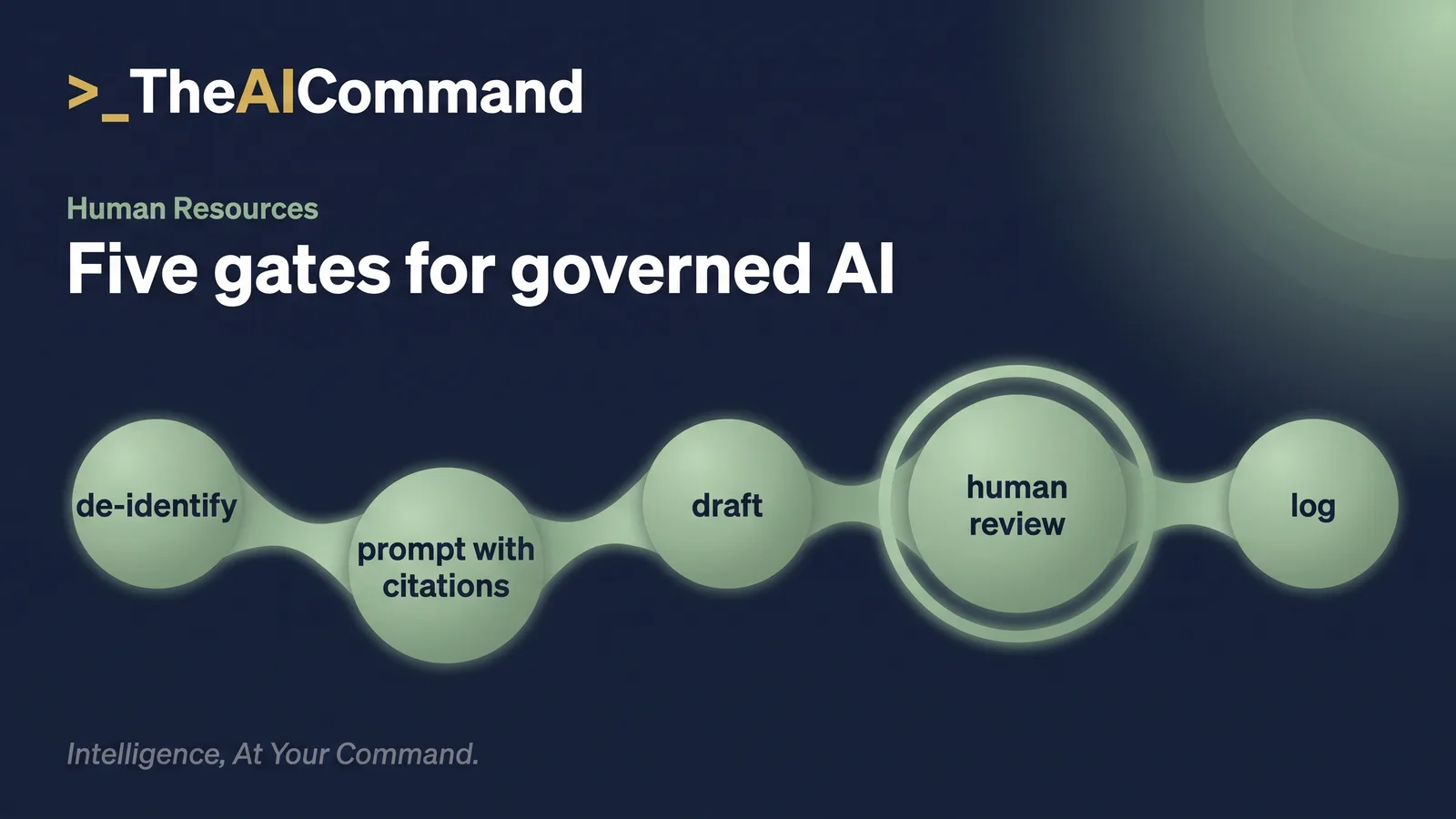
Mandatory de-identification. No identifying employee information should be entered into a generative AI prompt. Replace names with [EMPLOYEE_ID] tokens, dates of birth with age bands, and exact dates with month and year. The Privacy Act 1988 (Cth) and the Australian Privacy Principles apply to every AI interaction that touches personal information; APP 1, APP 6, and APP 11 are most relevant.
Human-in-the-loop checkpoints. Every AI output that affects an employee (letter, calculation, response) must be reviewed and signed off by a competent human (HR Officer for routine queries, Employee Relations for refusals, HR Business Partner for restructures, General Counsel for FWC disputes) before it is sent or actioned.
Prohibited inputs. Personal identifying information, medical information beyond what is operationally necessary, family and domestic violence leave records, mental health information, salary or remuneration figures tied to an identified individual, market sensitive information, and any information that could compromise an active workplace investigation. For ADIs and APRA regulated entities, no inputs that could constitute critical operations data under CPS 230.
Retention and logging. Every AI conversation that supports an HR decision must be logged in the case file. Retain conversation transcripts (or summaries) for the same period as the underlying case file under your records management standard. APRA-regulated entities should align with CPS 230 record-keeping expectations.
Model selection guidance. For routine NES queries, an enterprise-grade cloud LLM (Claude for Enterprise, ChatGPT Enterprise, Microsoft 365 Copilot) is appropriate. For higher-risk drafting (refusal letters, redundancy calculations, board papers), use the highest-capability model in your tenant. For inputs that touch APP 11 sensitive information thresholds, prefer your tenanted enterprise platform with no consumer data sharing. For any matter that could become an FWC proceeding, the AI tool should be treated as a drafting aid only, never as a decision-maker.
Australian Privacy Principles alignment. APP 1 (open and transparent management): publish an AI use statement. APP 3 (collection): only collect what you need. APP 6 (use and disclosure): no secondary use of employee data in AI training. APP 11 (security): apply your enterprise security baseline. APP 12 and APP 13 (access and correction): ensure AI-generated content is correctable.
5.5 Quality assurance loop (5-step rubric)
- Statutory accuracy: every cited section and entitlement matches the current FW Act.
- Policy alignment: the output is consistent with the current internal policy version and any modern award or enterprise agreement clause that applies.
- Tone and clarity: plain English, respectful, free of legal overreach, free of em dashes, Australian English spelling.
- Risk: no individual legal advice, no commitments outside delegated authority, no privacy breach (no identifying inputs).
- Audit trail: prompt and output saved to the case file or governance log; reviewer name and date recorded; version of the AI model used noted.
Red team prompt (run against your own draft)
Run this against every draft letter, guideline, and calculation before it is sent. Nothing exposes a weak refusal letter faster than reading it through the other side's eyes.
5.6 Scaling pattern
Move from one user to a team. Templates: build a shared library of prompt templates with version control. Train all HR staff to use them. Version control: store templates in SharePoint or Confluence with change logs. Change logs: every template change records who, when, what, why. Model evaluation cadence: reassess model selection quarterly; benchmark a sample of outputs against expert review monthly. KRIs to consider: percentage of HR queries handled within target SLA, percentage of AI-generated outputs requiring substantive correction at human review, number of FWC matters where AI involvement is identified, percentage of AI conversations correctly logged. Set tolerances and report to the People and Culture Committee at least annually.
6. Common Pitfalls and Watch-outs
- Treating the BFI Award 2020 as the only relevant instrument. The NES is the floor and applies even where the award does not. A senior executive on a common law contract still gets full NES. Corrective action: confirm NES baseline applies to every employee before applying any award or agreement analysis.
- Counting redundancy pay for small business employers without checking the insolvency exception in s 121(4). Section 121 exempts small business employers from s 119 redundancy pay, but s 121(4), inserted by the Closing Loopholes Act 2023 with effect from 15 December 2023, preserves the entitlement where the employer became a small business because of terminations connected with bankruptcy or liquidation, including terminations in the six months before the insolvency practitioner's appointment. Corrective action: always check the s 23 head count and the s 121(4) exception before processing redundancy pay.
- Flexible work refusal without genuine discussion. Section 65A(3) requires the employer to discuss the request before refusing. A refusal that does not evidence prior discussion is vulnerable to FWC arbitration. Corrective action: log the discussion in writing including date, attendees, options canvassed, and reasons.
- Right to Disconnect treated as a 'no contact' rule. Section 333M permits the contact; it protects the employee's right to refuse to monitor or respond unless the refusal is unreasonable. Corrective action: train managers on the six-factor reasonableness test and document on-call regimes.
- Casual conversion missed. From 26 February 2025 the employee choice pathway introduced by the Closing Loopholes No. 2 Act 2024 replaced the former employer-offer conversion regime for non-small business employers, with small business employers following from 26 August 2025. An eligible casual who believes they no longer meet the s 15A definition notifies the employer in writing, and the employer must respond in writing within 21 days. Corrective action: build the employee choice pathway into your casual workforce monitoring and retire employer-offer conversion templates.
- Public holiday work request without 'reasonableness' check. CFMMEU v OS MCAP Pty Ltd [2023] FCAFC 51 confirmed that an employer must request, not direct, work on a public holiday and the request itself must be reasonable. Corrective action: build the reasonableness check into the rostering system.
- Family and domestic violence leave inadvertently disclosed. The 10 days paid FDV leave (s 106B) is highly sensitive and disclosure on a payslip should be minimised under the Fair Work Regulations 2009. Corrective action: configure payroll to mask FDV leave codes on payslips.
7. Decision Frameworks and Tools
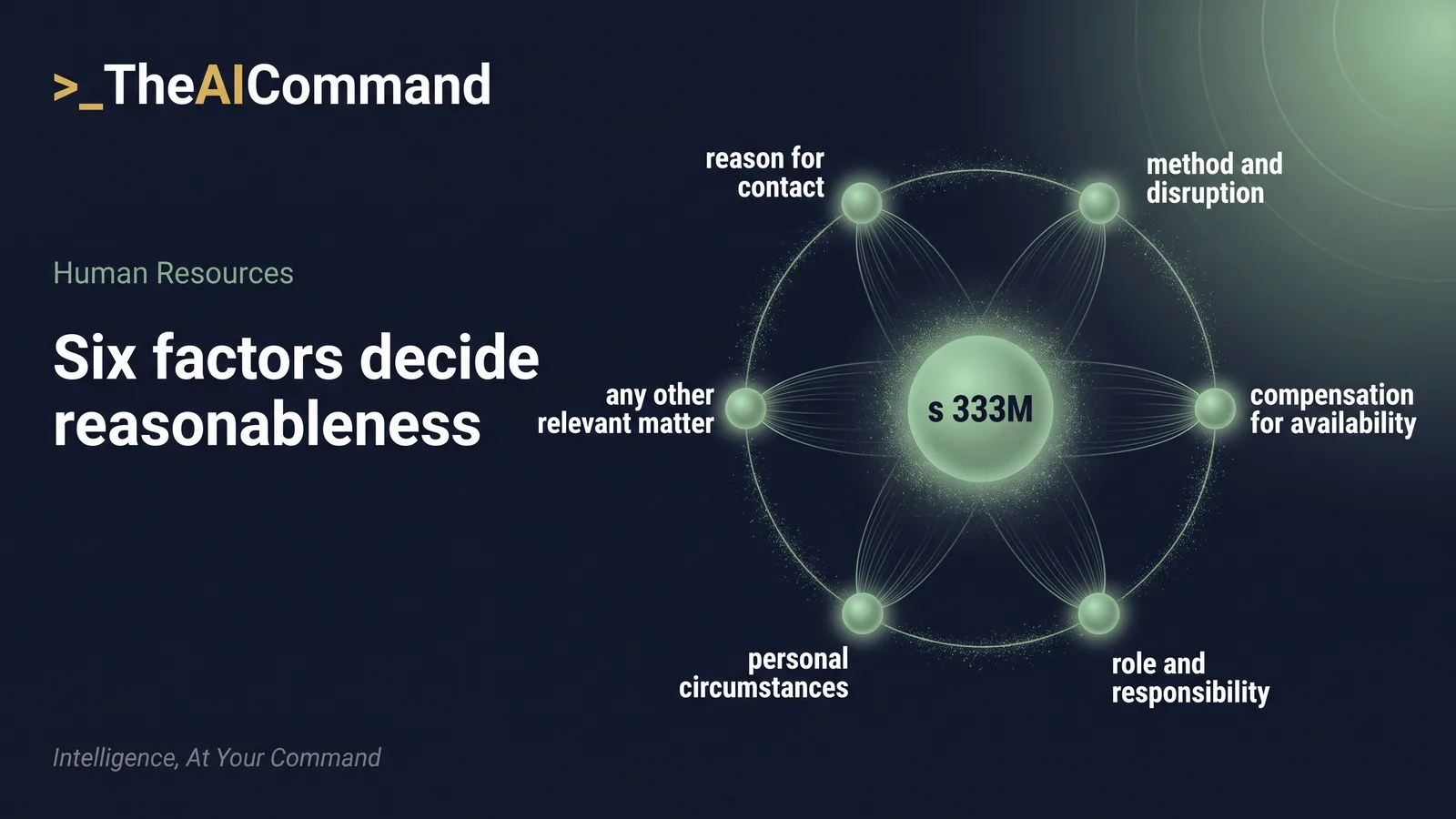
Before you walk the decision tree, run the contact scenario through this structured assessment. It forces every s 333M(3) factor onto the file, which is exactly what the FWC will look for if the dispute travels.
Decision tree: handling a Right to Disconnect refusal
Specification. Render as a decision tree starting at 'Employee refused out-of-hours contact'.
- Was the contact within working hours? If YES: s 333M does not apply; manage as ordinary performance matter. If NO: continue.
- Did the employer apply the s 333M(3) reasonableness factors? If NO: the refusal is presumed reasonable; close out. If YES: continue.
- Is the role a designated on-call role with a paid availability allowance? If YES: refusal more likely unreasonable; document the on-call regime. If NO: continue.
- Was the contact about a critical incident or material customer harm? If YES: refusal more likely unreasonable; consult General Counsel before performance action. If NO: refusal more likely reasonable; close out.
Maturity ladder: NES operational maturity
Self-check questionnaire
- Have you reviewed your Hours of Work and Communication Policy since 26 August 2025 to incorporate the small business Right to Disconnect commencement?
- Does your Workday or HRIS configuration prevent FDV leave from appearing on payslips?
- Has every flexible work request in the past 12 months been answered in writing within 21 days under s 65A(2)?
- Do your redundancy calculations correctly apply the s 121 small business exclusion and the s 121(4) insolvency exception?
- Are AI-generated NES outputs always reviewed by a competent human and logged before being acted upon?
- Has every new starter received the FWIS, the CEIS (if casual), and the FTCIS (if fixed term) within statutory timeframes?
- Do you have a documented on-call regime for the roles where after-hours availability is genuinely required?
Visual 7: The 5 things to remember
Specification. Render as five callout cards in a row, NAVY background, GOLD numerals, COOL WHITE text.
8. Further Reading and Authoritative Sources
Primary statutes and regulations.
- Fair Work Act 2009 (Cth), particularly Pt 2-2 (NES) and Pt 2-9 Div 6 (Right to Disconnect, ss 333M to 333N).
- Fair Work Regulations 2009 (Cth).
- Fair Work Legislation Amendment (Closing Loopholes) Act 2023 (Cth).
- Fair Work Legislation Amendment (Closing Loopholes No. 2) Act 2024 (Cth).
- Banking, Finance and Insurance Award 2020 [MA000019].
Regulator publications.
- Fair Work Ombudsman, 'National Employment Standards' (fairwork.gov.au).
- Fair Work Ombudsman, 'Right to Disconnect' guidance and template policies (2024).
- Fair Work Ombudsman, 'Fair Work Information Statement', 'Casual Employment Information Statement', 'Fixed Term Contract Information Statement'.
- Fair Work Commission, 'Right to Disconnect' Benchbook and approved decisions under s 333M.
Professional and industry bodies.
- Australian HR Institute (AHRI), 'NES update papers'.
- Law Council of Australia, 'Workplace Relations Section' submissions on Closing Loopholes.
- Australian Banking Association, sector guidance on Right to Disconnect implementation (where published).
Case law of note.
- CFMMEU v OS MCAP Pty Ltd [2023] FCAFC 51 (public holiday request and refuse framework).
- FWC s 333N decisions on Right to Disconnect disputes (search Fair Work Commission decisions database).
- FWC s 65B arbitrated decisions on flexible working refusals (post-June 2023).
Practical takeaways
Do this Monday
- Pull the flexible work request register and confirm every request in the past 12 months received a written response within 21 days under s 65A. Log any misses for remediation.
- Ask payroll to show you how family and domestic violence leave appears on a payslip. If the words appear, raise a masking change under regulations 3.47 and 3.48 of the Fair Work Regulations 2009 the same day.
- Open your redundancy calculator and check it references s 117 notice, s 119 redundancy pay, the s 23 head count, and the s 121(4) insolvency exception. Retire anything citing superseded rules.
- Re-read the after-hours contact section of your Hours of Work policy against s 333M. List which roles genuinely carry an on-call expectation and confirm each one is documented and compensated.
- Stand up the NES-HR-Copilot project space using the project instructions block in Section 5, and load the current FWIS, CEIS, FTCIS, award, and enterprise agreement.
The HR practice checklist
- Every new starter receives the current Fair Work Information Statement before or as soon as practicable after starting (s 125).
- Casuals also receive the CEIS on commencement, then at six months, 12 months, and every subsequent 12 months (commencement and 12 months for small business employers).
- Flexible work requests: discussion held before any refusal, written response within 21 days, and reasonable business grounds documented (s 65A).
- Parental leave: eligibility tested at 12 months continuous service immediately before the expected date of birth or placement (s 67), and s 76 extension requests answered in writing within 21 days.
- Redundancy: s 23 head count checked at the relevant time, the s 121(4) insolvency exception considered before applying the small business exemption, and the s 122 transfer of business carve-out checked.
- Notice of termination: the extra week for employees over 45 with at least two years of service is applied on top of the s 117(3) base scale.
- Right to Disconnect: on-call regimes documented and compensated, managers trained on the six s 333M(3) factors, and no performance action grounded in a protected refusal.
- Casual workforce: employee choice notifications monitored and answered in writing within 21 days.
- AI outputs that affect an employee are de-identified at input, reviewed by a named human, and logged in the case file before any action.
Your prompt library
This module gives you four working prompts: the project instructions in Section 5.2, the NES query triage prompt in Section 5.3, the red team prompt in Section 5.5, and the Right to Disconnect reasonableness assessment in Section 7. Save them into your project space as templates and version them like any other controlled document. When you need a fast health check on a policy clause, use this one:
Test your knowledge
LM-H02 assessment. 30 questions
25-30 minutes. One question per screen. Your progress is saved locally for 30 days, so you can pick up where you left off. Submit anytime to see your score, tier, and per-question rationale.
Read next

Corporations Act 2001 (Cth)
The Corporations Act 2001 (Cth) is the consolidated statute governing companies, financial product issuers and distributors, and the directors who oversee them. The Act sits at the apex of the Australian financial services regulatory hierarchy. The Australian Securities and Investments Commission (ASIC) is the lead reg
Read article
Privacy Act 1988 (Cth) and the Australian Privacy Principles
The Privacy Act 1988 (Cth) is the principal Commonwealth statute governing personal information handling in Australia. It binds APP entities, including all Australian financial services providers because of the financial services carve-out from the small business exemption. The 13 Australian Privacy Principles (APPs) s
Read article
Anti-Money Laundering and Counter-Terrorism Financing Act 2006 (Cth)
The Anti-Money Laundering and Counter-Terrorism Financing Act 2006 (Cth) (the AML/CTF Act) is the Commonwealth statute that obliges Australian reporting entities to detect, deter, and disrupt the movement of illicit funds and the financing of terrorism. The Act is administered by the Australian Transaction Reports and
Read articleGeneral information and education only. Not legal, compliance, financial, or professional advice. Verify any time-sensitive obligation against the primary source.
TheAICommand. Intelligence, At Your Command.