LM-H01 · HR · Practitioner tier
Fair Work Act 2009 (Cth)
General protections, unfair dismissal, enterprise bargaining
What you'll be able to do
- 1.Describe the structure of the Fair Work Act 2009 (Cth) and the roles of the Fair Work Commission and the Fair Work Ombudsman.
- 2.Differentiate general protections claims under Part 3-1 from unfair dismissal claims under Part 3-2 and select the correct jurisdictional pathway for a matter.
- 3.Apply the Part 2-4 bargaining framework, including good faith bargaining duties, the post 2023 genuine agreement requirements and the Better Off Overall Test, to a financial services scenario.
- 4.Analyse how the Secure Jobs Better Pay 2022 and Closing Loopholes 2023 and 2024 amendments change day to day HR practice in financial services.
- 5.Evaluate AI-assisted HR drafting workflows against de-identification, privacy, governance and legal sign-off requirements.
6 lessons · read straight through, or use lesson view once the page loads.
TheAICommand Learning Library
LM-H01
Fair Work Act 2009 (Cth)
Practical mastery for Australian financial services HR
Learning outcomes (Bloom verbs)
- Describe (Knowledge) the structure of the Fair Work Act 2009 (Cth) and the role of the Fair Work Commission and Fair Work Ombudsman.
- Differentiate (Comprehension) general protections claims under Part 3-1 from unfair dismissal claims under Part 3-2 and apply the correct jurisdictional pathway.
- Apply (Application) the enterprise bargaining framework in Part 2-4 to a typical Australian financial services bargaining scenario.
- Analyse (Analysis) the impact of the Secure Jobs Better Pay 2022 and Closing Loopholes 2023 to 2024 amendments on financial services HR practice.
- Evaluate (Evaluation) AI-assisted HR drafting workflows for general protections, unfair dismissal, enterprise bargaining and Board people risk reporting against governance, privacy and legal sign-off requirements.
1. Executive Summary
If one tool from this module gets used today, make it Prompt 1 in the section 5 prompt library, which asks the model to produce a one page General Protections Risk Memo before a difficult people decision. Run it with de-identified placeholders such as [EMPLOYEE_ID], then read on for the legal framework that sits behind it.
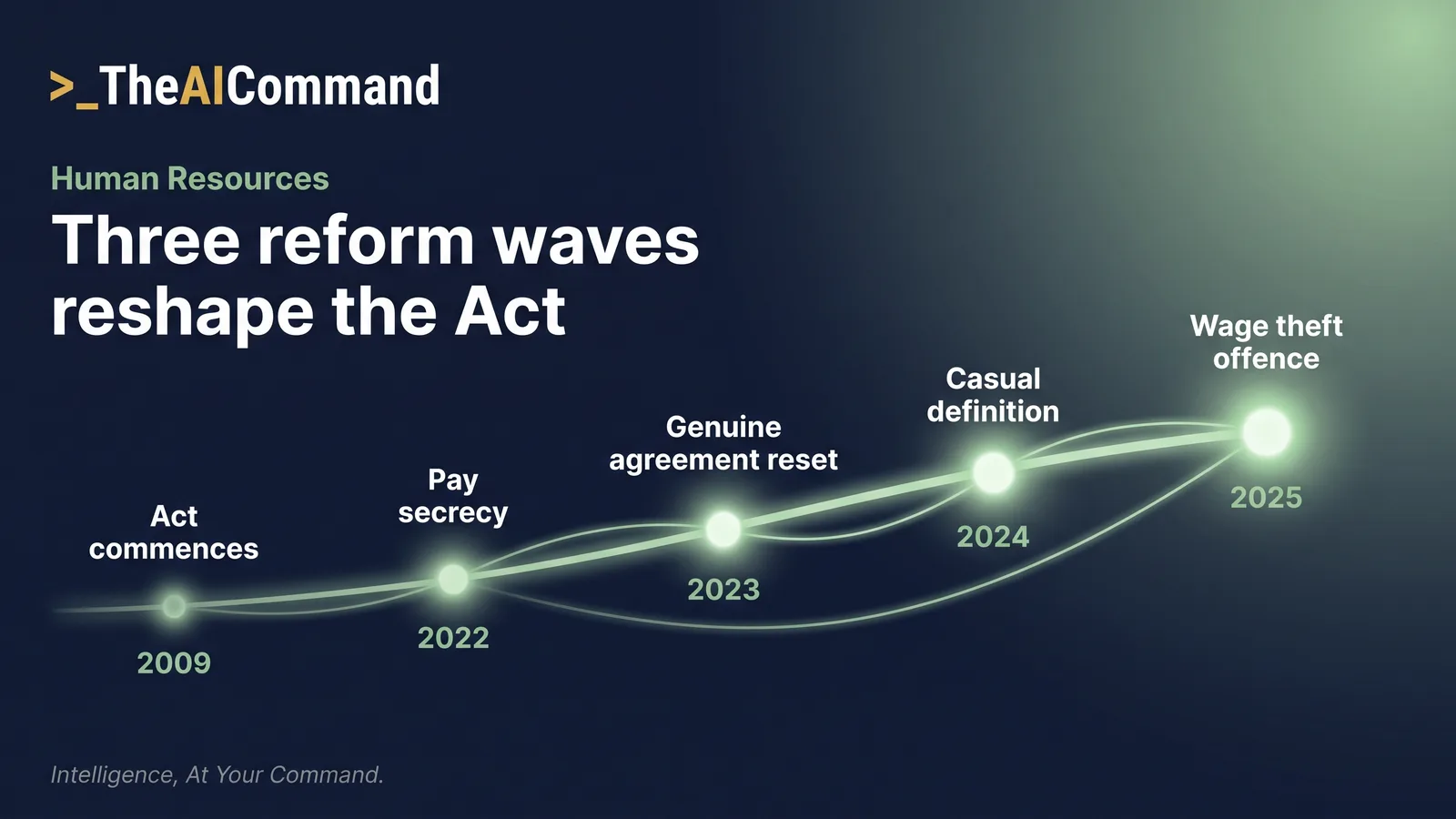
The Fair Work Act 2009 (Cth) is the principal Commonwealth statute governing employment relationships in Australia. It sets out the National Employment Standards (NES), the system of modern awards and enterprise agreements, the general protections regime, the unfair dismissal jurisdiction, and the powers of the Fair Work Commission (FWC) and the Fair Work Ombudsman (FWO). Since 2022, the Act has been substantially reshaped by the Secure Jobs Better Pay Act 2022 (Cth) and the two Closing Loopholes Acts of 2023 and 2024, which expanded multi-employer bargaining, criminalised intentional wage theft, redefined casual employment, introduced a right to disconnect, and clarified the test for distinguishing employees from independent contractors.
Why this matters for Australian financial services. HR teams in banks, insurers, superannuation trustees and AFSL holders carry concurrent obligations under the Fair Work Act, the Banking Executive Accountability framework now subsumed within the Financial Accountability Regime, the Sex Discrimination Act 1984 (Cth), and APRA Prudential Standard CPS 511 (Remuneration). A single people decision, such as a performance exit or restructure, can simultaneously trigger general protections risk, unfair dismissal exposure, accountability impact, and remuneration consequence reporting. Strong working knowledge of the Fair Work Act is therefore a foundational competency for any financial services people leader.
What you will be able to do after completing this module:
- Identify the correct jurisdictional pathway for a given employment dispute.
- Run a defensible general protections risk assessment before a difficult people decision.
- Build an unfair dismissal response pack that meets FWC procedural fairness expectations.
- Compare an enterprise agreement against the relevant award using the Better Off Overall Test.
- Draft Board-ready people risk reporting that integrates general protections, bargaining and amendment-driven exposures.
2. Regulatory and Strategic Context
Issuer and statutory authority
The Fair Work Act 2009 (Cth) is a Commonwealth statute administered through two independent statutory bodies. The Fair Work Commission, constituted under Part 5-1, is the national workplace relations tribunal. It approves enterprise agreements, varies modern awards, sets the national minimum wage, and adjudicates unfair dismissal, general protections, anti-bullying and stop sexual harassment applications. The Fair Work Ombudsman, constituted under Part 5-2, is the regulator and enforcement agency. It investigates underpayments and breaches, issues compliance notices, accepts enforceable undertakings, and litigates civil penalty matters in the Federal Court and the Federal Circuit and Family Court of Australia.
Scope of application
The Act applies to national system employers and employees, which includes all constitutional corporations and Commonwealth and Territory employees. All Australian financial services entities, including ADIs, registrable superannuation entities, insurers, AFSL holders, ACL holders, and the bulk of supporting service providers, are national system employers. The Act sits alongside, not in place of, state work health and safety legislation, the Sex Discrimination Act 1984 (Cth), the Disability Discrimination Act 1992 (Cth), the Age Discrimination Act 2004 (Cth), the Racial Discrimination Act 1975 (Cth), the Privacy Act 1988 (Cth), and APRA prudential standards governing accountability and remuneration.
Key dates and amendment timeline
Interplay with adjacent frameworks (cross-references in this learning library)
Fair Work Act application in financial services rarely happens in isolation. Cross-reference these adjacent learning modules when scoping any people decision.
3. Core Concepts and Defined Terms
Defined terms quick reference
Structure of the Fair Work Act
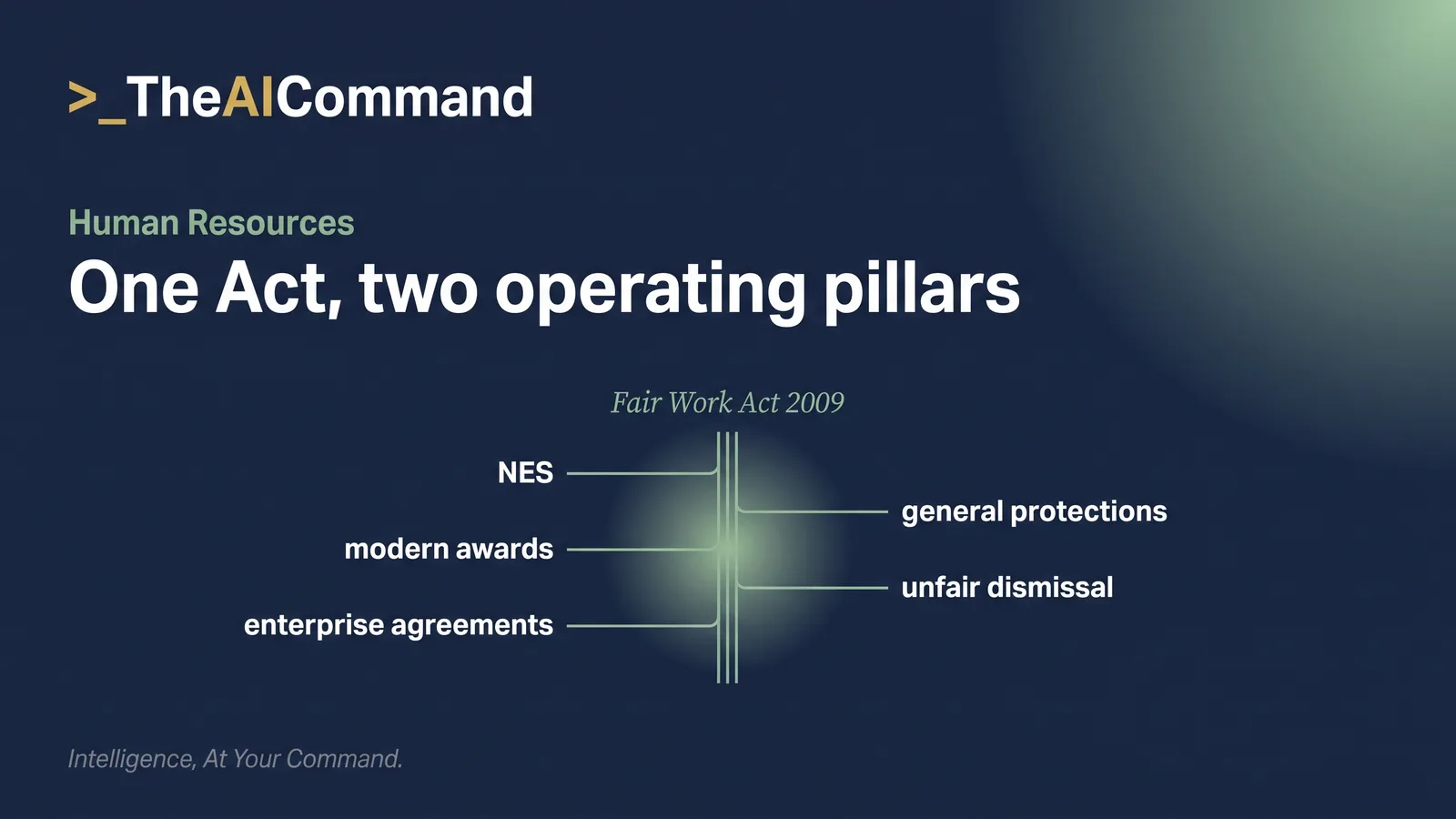
The Act is divided into seven Chapters. The bulk of practitioner work concentrates in Chapters 2 and 3.
Chapter 1 covers introduction and core constitutional concepts.
Chapter 2 contains the substantive employment law content: the NES (Pt 2-2), modern awards (Pt 2-3), enterprise agreements (Pt 2-4), the safety net minimum wage process (Pt 2-6), and the Australian Fair Pay setting framework.
Chapter 3 contains the rights and responsibilities framework: general protections (Pt 3-1), unfair dismissal (Pt 3-2), industrial action (Pt 3-3), right of entry (Pt 3-4), and sexual harassment in connection with work (Pt 3-5A, since 6 March 2023), while anti-bullying orders remain in Pt 6-4B.
Chapter 5 establishes the FWC and FWO and provides for compliance and enforcement.
Chapter 6 contains other matters including transfer of business and accessorial liability under s 550, which can extend personal liability to HR professionals and managers.
General protections at a glance
The fastest way to apply this Part in practice is a structured triage before any adverse action decision. Copy this prompt into your enterprise AI tool, replace the placeholders, and use the output to decide whether a full risk memo is needed.
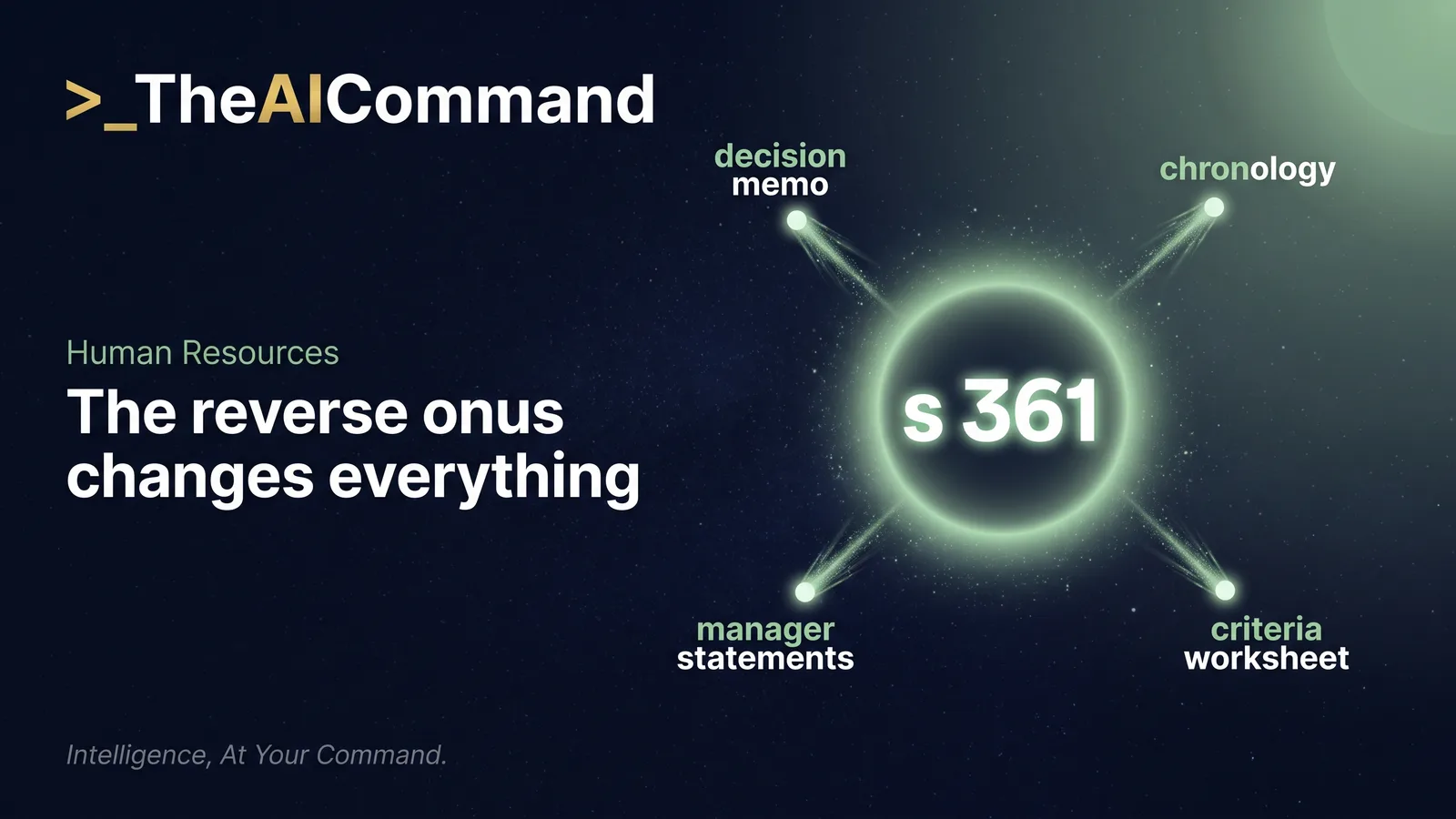
Part 3-1 is the most strategically significant part of the Act for HR practitioners. The two pillars are workplace rights (s 341) and industrial activities (s 346). An employer must not take adverse action (s 342) against a person because that person has, or has exercised, a workplace right or has engaged in lawful industrial activity. The reverse onus in s 361 means once the employee proves the adverse action and identifies the alleged reason, the employer must prove the reason was something else. This is operationally one of the most important sections in the Act.
Unfair dismissal at a glance
When a dismissal is on the table, procedural fairness is where employers most often fail. This prompt turns the s 387 criteria into a pre-decision audit. De-identify everything before you paste.
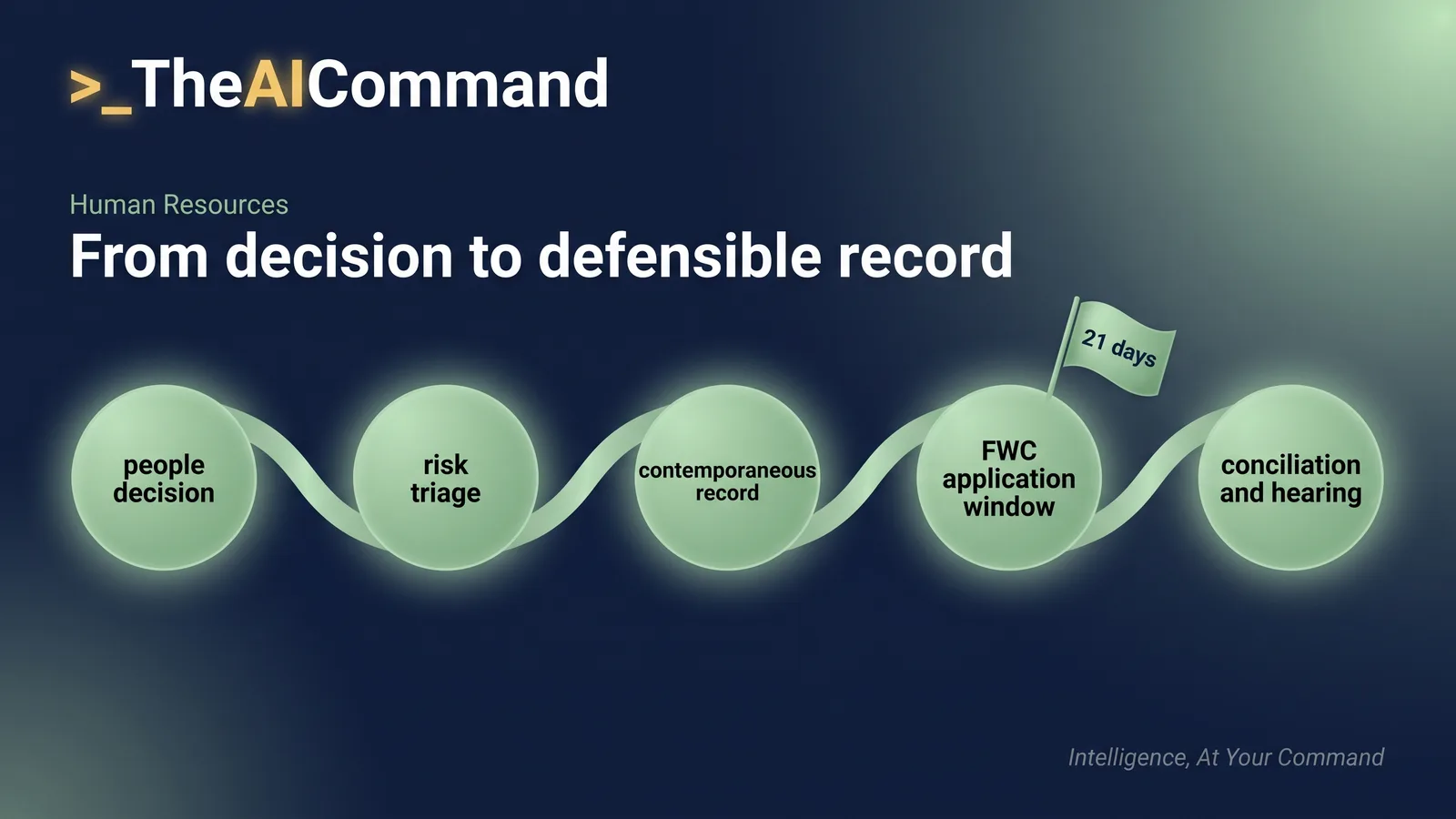
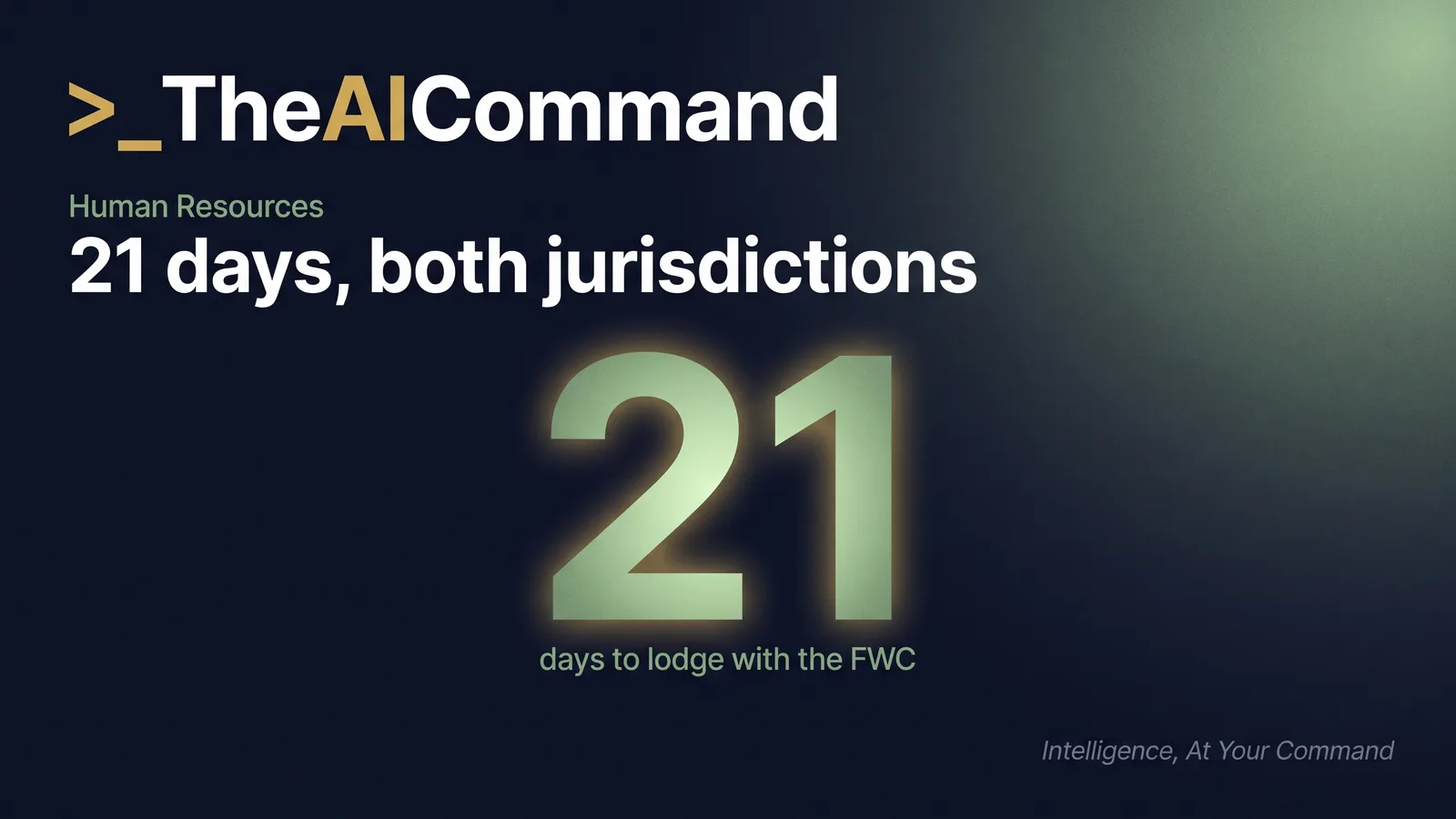
Part 3-2 protects an employee from a dismissal that is harsh, unjust or unreasonable (s 385). The employee must have completed the minimum employment period (six months, or twelve months for a small business employer), be covered by an award or agreement or earn under the high income threshold, and lodge within 21 days of the dismissal taking effect (s 394). The FWC applies the s 387 criteria. Where dismissal is found to be unfair, reinstatement is the primary remedy, with compensation capped at the lesser of 26 weeks pay and one half of the high income threshold.
Enterprise bargaining at a glance
Bargaining support is one of the safest AI use cases in this module: structure and checklists from the model, all modelling and legal calls by humans. This prompt reflects the genuine agreement rules that have applied since 6 June 2023.
Part 2-4 governs the making of enterprise agreements. Bargaining representatives must comply with good faith bargaining requirements in s 228. An agreement must pass the Better Off Overall Test in s 193 against the relevant modern award, must not contain unlawful terms (s 194), and must include a nominal expiry date no more than four years from FWC approval. Since the Secure Jobs Better Pay reforms, multi-employer streams have expanded materially: supported bargaining (s 242), single interest employer authorisations (s 248) and cooperative workplaces stream provisions are now commonly used.
4. Practical Application in Australian Financial Services
Each worked example uses fully de-identified facts. Replace placeholder fields with controlled-access source data inside an enterprise system, never inside an AI prompt.
Example A. ADI (Authorised Deposit-taking Institution) general protections
Trigger event. A retail banker with eight years of service raises a written grievance with the People team alleging that her line manager ridiculed her for taking carer's leave. Three weeks later, she is told her role is being made redundant. She lodges a general protections application with the FWC.
Obligation activated. Section 340 (workplace right not to be subject to adverse action) and s 351 (no discrimination on the basis of family or carer's responsibilities) are both squarely engaged. The reverse onus in s 361 will require the bank to prove the redundancy decision was made for reasons that did not include the protected attributes or workplace right.
Artefact produced. A General Protections Defence Pack: contemporaneous decision documentation including organisational design rationale, role mapping, redundancy criteria, manager statements, and a chronology that demonstrates the redundancy decision was made independently of the grievance. Each statement must be signed and dated. Hearsay should be replaced by primary source artefacts wherever possible.
Audit trail expected. Restructure paper, decision-rights matrix, redundancy criteria worksheet, voluntary redundancy outreach evidence, redeployment search log, FWC application file, conciliation summary, and all internal People team file notes. Retain consistent with the Fair Work Regulations 2009 (Cth) Pt 3-6 and the Privacy Act APP 11.
Example B. General insurer unfair dismissal
Trigger event. A claims handler is dismissed after a third documented breach of a policy on use of customer information. The insurer follows its disciplinary process but issues the dismissal letter the same day as the show cause meeting.
Obligation activated. Part 3-2 unfair dismissal jurisdiction. Even if there is a valid reason for dismissal under s 387(a), the FWC will examine procedural fairness factors (s 387(b) to s 387(h)), particularly notification of the reason, opportunity to respond, and any unreasonable refusal to allow a support person.
Artefact produced. An Unfair Dismissal Response Pack including: position statement, chronology, signed manager statements, the policy and prior training records, prior warnings, the dismissal letter and meeting notes, and a Form F3. The pack should clearly address each of the s 387 limbs.
Audit trail expected. Performance file, policy and training acknowledgements, prior breach evidence, show cause invitation and minutes, dismissal letter, departure checklist, and exit interview record. Note the 21 day filing window from the dismissal taking effect (s 394).
Example C. Superannuation trustee enterprise bargaining
Trigger event. A profit-to-member superannuation trustee enters single-enterprise bargaining for its operations and contact centre population. The unions seek a 16 percent base wage increase over three years.
Obligation activated. Good faith bargaining duties in s 228 (attend and participate in meetings, disclose relevant information not commercially sensitive, give genuine consideration). BOOT under s 193 against the Banking Finance and Insurance Award 2020. Genuine agreement requirements under s 188, guided by the FWC Statement of Principles on Genuine Agreement, including the s 180(5) duty to explain the terms of the agreement and their effect. If bargaining stalls, the new intractable bargaining declaration pathway (s 235) is now available.
Artefact produced. A bargaining strategy paper covering claim assessment, BOOT modelling at percentile cohorts, scenario costing including superannuation guarantee step-ups under the SG (Administration) Act, communication plan, and a BOOT schedule. There is no longer a fixed statutory access period: since 6 June 2023 the FWC must be satisfied the agreement was genuinely agreed under s 188, guided by the Statement of Principles on Genuine Agreement, which treats giving employees the agreement a reasonable time before the vote (seven days remains a common benchmark) as good practice. The s 180(5) duty to explain the terms and their effect still applies.
Audit trail expected. Bargaining log, exchange of claims, meeting minutes, draft and final BOOT analysis, voting evidence, Form F16 application materials, and FWC approval correspondence.
Example D. AFSL holder Closing Loopholes contractor question
Trigger event. A boutique advisory firm engages 12 lead generators on independent contractor agreements. Following the s 15AA reform, the firm reviews the substance of the relationship.
Obligation activated. Section 15AA (Closing Loopholes No. 2) directs that the question of whether a person is an employee or independent contractor is determined by the real substance and totality of the relationship, not the label in the contract. Sham contracting under s 357 carries civil penalties, and accessorial liability under s 550 can extend to managers and HR personnel.
Artefact produced. A worker classification audit report covering control, integration, exclusivity, mode of remuneration, ability to delegate, provision of tools, and the new s 15AA totality assessment. Where misclassification is found, a remediation plan with engagement transition and back-pay calculation.
Audit trail expected. Engagement contracts, role descriptions, day-in-the-life evidence, payment records, and a documented application of the s 15AA test. Retain in line with Fair Work Regulations 2009 (Cth) Pt 3-6 and APRA CPS 220 risk records.
VISUAL 3. Comparative table: General Protections versus Unfair Dismissal versus Anti-Discrimination
5. Operating the Fair Work Act with AI: Project space build for HR Advisory

This section converts the legal framework into a defensible AI workflow for an HR Advisory function. It assumes an enterprise tenancy of either ChatGPT (Enterprise or Team Projects, plus a Custom GPT) or Claude (Projects, plus a Skill). Personal accounts are out of scope. Real personal data must never be uploaded.
Use cases at scale
Project space setup: ChatGPT
Step 1. Create a Project named TAIC HR Advisory FW Act inside the enterprise tenancy.
Step 2. Apply the system prompt scaffold below.
Step 3. Upload a knowledge folder containing: the consolidated Fair Work Act (Cth) PDF from Federal Register of Legislation, the Banking Finance and Insurance Award 2020, your enterprise agreement (where applicable), and your internal HR policy library.
Step 4. File and naming conventions. Project files: FWA_Reference_<topic>.pdf. Drafts: Draft_<MatterID>_<Type>_<YYYYMMDD>.docx. Final outputs: FINAL_<MatterID>_<Type>_<YYYYMMDD>_v<n>.docx. Always store finals back in the system of record, not inside the AI project.
Project space setup: Claude
Step 1. Create a Project named TAIC HR Advisory FW Act inside the Claude enterprise workspace.
Step 2. Apply the same system prompt scaffold above as the Project description.
Step 3. Build a Skill called fw-act-hr-advisor with reference files for: workplace rights checklist, s 387 criteria checklist, s 228 good faith bargaining duties, s 387 procedural fairness factors, accessorial liability scoping, and BOOT scaffolding.
Step 4. Use the same naming convention. Skill triggers should match HR Advisory intake routing.
Prompt library (ready for production use)
Prompt 1. General Protections Risk Memo
Role: Australian HR Advisor with deep knowledge of Fair Work Act 2009 (Cth) Pt 3-1. Context: A people decision affecting [EMPLOYEE_ID], role [ROLE], tenure [TENURE_YEARS] years. Decision under consideration: [DECISION_TYPE]. Recent activity by employee: [WORKPLACE_RIGHT_OR_COMPLAINT_SUMMARY]. Task: produce a one-page General Protections Risk Memo identifying any workplace right (s 341), any industrial activity (s 346), any protected attribute (s 351), the adverse action being considered, the residual risk after mitigations, and the recommended evidentiary record. Constraints: Australian English, de-identified, no real personal data. Cite each section by full reference. Output format: heading > facts > workplace rights identified > protected attributes identified > adverse action analysis > reverse onus assessment under s 361 > recommended action > residual risk rating (Low / Medium / High) > evidentiary checklist. Quality bar: each rating must be supported by at least two evidentiary references.
Prompt 2. Unfair Dismissal Response Brief
Role: Australian employment lawyer drafting an FWC unfair dismissal response. Context: Employer [ENTITY], dismissed employee [EMPLOYEE_ID], dismissal date [DATE], reason [REASON_SUMMARY]. Task: produce a position statement and chronology suitable for filing with a Form F3 Response, addressing each criterion in s 387(a) to s 387(h). Constraints: cite Fair Work Act sections by full reference; flag where evidence gaps require manager statements; use de-identified placeholders. Output format: cover summary > facts > each s 387 criterion with employer position > evidence list > recommended next steps. Quality bar: every position statement claim must reference a specific evidentiary source by document name.
Prompt 3. Enterprise Agreement Comparison
Role: Australian HR remuneration analyst. Context: comparison of draft enterprise agreement clauses against the Banking Finance and Insurance Award 2020. Task: produce a clause-by-clause BOOT comparison schedule, with column headings: Clause / Award position / Agreement position / Net effect / BOOT comment. Constraints: do not produce a quantitative compensation calculation in the AI output; flag the cells where the human modeller must compute. Do not include any individual employee identifiers. Output format: structured table. Quality bar: every Net effect cell must have a directional indicator (better off, equivalent, requires modelling).
Prompt 4. Board People Risk Paper
Role: senior People Risk lead drafting for an HR or Risk subcommittee of the Board. Context: quarterly people risk update covering general protections matters, unfair dismissal trends, bargaining state, FW amendment readiness, and conduct or culture indicators. Task: produce a 1,200 word Board paper with executive summary, key risks (rated likelihood and impact), thematic analysis, regulatory horizon, and recommended actions. Constraints: aggregate de-identified data only; no individual employee references; flag any matter that has external counsel. Output format: heading > executive summary > matrix > narrative > recommendations > appendix references. Quality bar: every rating must reference an underlying data source by name.
Prompt 5. FW Amendment Impact Briefing
Role: Australian Workplace Relations Lead. Context: a recent Fair Work Act amendment [AMENDMENT_REFERENCE]. Task: produce a one-page impact briefing covering the change, the operational impact for an Australian financial services HR team, the policy or process artefact to update, the timeframe for change, and the risk if no action is taken. Constraints: cite the amending Act and section. Provide a one-line plain-English summary suitable for line managers. Output format: change > operational impact > artefacts to update > deadline > risk of inaction. Quality bar: a line manager with no legal training must be able to read and act.
Prompt 6. Performance Management Documentation Quality Review
Role: Australian HR Business Partner reviewing a draft performance documentation file. Context: draft performance counselling note prepared by [MANAGER_ID] for [EMPLOYEE_ID]. Task: review against the procedural fairness criteria in Fair Work Act 2009 (Cth) s 387(b) to s 387(h) and against any internal Performance Management Procedure. Constraints: do not rewrite the manager's words; identify gaps and recommend additions. Output format: criterion > current draft status > gap > recommended addition > urgency. Quality bar: every gap must reference the underlying section or policy clause.
Governance, audit, privacy, and risk appetite controls
Mandatory de-identification rules. Replace all personal identifiers in prompts and uploaded materials with placeholder fields. Examples: [EMPLOYEE_ID], [MANAGER_ID], [BUSINESS_UNIT], [DATE], [SALARY_BAND]. The substitution map lives in a controlled spreadsheet in the system of record.
Human-in-the-loop checkpoints. No AI output may be relied upon for a contested HR decision without: (a) sign-off by an accountable HR Business Partner, and (b) for any matter likely to attract a tribunal application, sign-off by Legal or Employment Counsel. Dismissal letters, settlement deeds, formal show cause letters and external regulator correspondence require legal sign-off without exception.
Prohibited inputs. Real personal information of identifiable employees, customer PII, market sensitive data, sanctions data, claimant data from any other regulatory regime (for example workers compensation), confidential settlement terms, and any whistleblower disclosure that engages Pt 9.4AAA Corporations Act protections.
Retention and logging. Prompt logs and generated drafts are records under the Fair Work Regulations 2009 (Cth) Pt 3-6 and APRA CPS 220 record-keeping expectations. Configure the AI tenancy to log every interaction and write to a controlled archive. Do not retain personal information beyond the operational need.
Model selection. For HR Advisory, the default position is enterprise tenancy with explicit no-training-on-data terms. For Board paper distillation that may include market sensitive data, consider sovereign cloud or on-prem deployment. Validate against your CPS 234 and CPS 230 controls library before adoption.
CPS 230 critical operations. HR Advisory may not be a critical operation in the formal CPS 230 sense, but elements such as payroll and accountable person management interact with critical operations. Map the AI workflow against the operational risk register and document residual risk.
Australian Privacy Principles alignment. APP 1 (transparency: include AI-assistance disclosure in HR notices), APP 5 (notification at the point of collection), APP 6 (use and disclosure: do not reuse HR data for unrelated purposes), APP 11 (security: ensure tenancy meets APRA-aligned controls), APP 12 (access requests apply to AI-generated records as personal information).
Quality assurance loop: 5 step rubric
Scaling pattern across an HR team
Templates. Hold a single source-of-truth template library inside the system of record, not inside the AI project. The AI project receives the latest version on intake. Version control. Every output carries a version stamp and references the template version used. Change logs sit in the system of record. Model evaluation cadence. Run a quarterly model evaluation against a sealed test bank of 10 de-identified scenarios. Track quality metrics over time. Key risk indicators. Suggested KRIs for HR Advisory: percent of AI drafts amended on legal review, percent of FWC matters with AI-assisted artefacts, mean time from intake to final brief, and number of Privacy Impact Assessment reviews completed.
VISUAL 4. RACI for an AI-assisted HR Advisory matter
VISUAL 5. Illustrative FWC application volumes (designer brief)
Stacked bar chart, FY2021 to FY2025. Stacks: General Protections, Unfair Dismissal, Anti-bullying, Stop Sexual Harassment. Approximate values for designer (clearly label as illustrative; verify against the FWC Annual Report before publication): FY2021 GP 4,200 / UD 14,500 / Bullying 700 / SH 0; FY2022 GP 4,800 / UD 12,800 / Bullying 750 / SH 0; FY2023 GP 5,500 / UD 12,200 / Bullying 800 / SH 350 (commenced March 2023); FY2024 GP 6,200 / UD 13,000 / Bullying 800 / SH 1,400; FY2025 GP 6,800 / UD 13,500 / Bullying 850 / SH 1,800. Style: navy bars, gold for SH segment, sky for GP, slate for UD. Annotate the SH series start with a small flag.
6. Common Pitfalls and Watch-outs
Treating a general protections claim as just another unfair dismissal.
Corrective action. Different jurisdiction, different onus, different remedy ceiling. Run both pathways through the risk lens before responding.
Issuing a dismissal letter the same day as the show cause meeting.
Corrective action. Procedural fairness under s 387(c) requires a genuine opportunity to respond. Allow at least one clear business day between response and decision unless safety risk demands immediacy.
Forgetting accessorial liability under s 550.
Corrective action. Managers and HR personnel can be personally liable for civil penalties where they knowingly involved in a contravention. Document independent decision-making.
Misclassifying an employee as a contractor on contract wording alone.
Corrective action. Section 15AA requires the totality of the relationship. Run the Worker Classification Audit prompt and document the assessment.
Underestimating the new positive duty under the Sex Discrimination Act 1984 (Cth).
Corrective action. The duty is anticipatory. Reactive complaint handling is not enough. Demonstrate proactive measures: training, policy, reporting, and culture metrics.
Using AI to draft a dismissal letter without legal sign-off.
Corrective action. An unfair dismissal hearing will scrutinise the letter line by line. Final dismissal letters always require Employment Counsel sign-off.
Failing the BOOT modelling at percentile cohorts.
Corrective action. BOOT is each-employee. A whole-of-population net positive is not enough. Model at low-cohort percentiles and at typical employees.
Treating pay secrecy clauses as still enforceable.
Corrective action. Pay secrecy clauses in employment contracts entered into or varied after 7 December 2022 are unenforceable, and prohibition is backed by civil penalty.
7. Decision Frameworks and Tools
Decision tree: choosing the correct jurisdictional pathway
Before you commit resources to a pathway, pressure test the call. This prompt mirrors the decision tree that follows.
Q1. Is the matter a dismissal? If no, go to Q4. If yes, Q2. Q2. Is the alleged reason a workplace right, industrial activity or protected attribute? If yes, consider general protections involving dismissal under Pt 3-1. The employee can elect either pathway but not both. If no, Q3. Q3. Has the employee completed the minimum employment period and is below the high income threshold (or covered by an award or agreement)? If yes, the unfair dismissal pathway under Pt 3-2 is available. Q4. Is the matter ongoing employment with alleged adverse action? If yes, a general protections non-dismissal dispute can go to the FWC under s 372. Q5. Is the conduct alleged to be sexual harassment? If yes, the FWC can deal with a sexual harassment dispute under Pt 3-5A, including stop sexual harassment orders, alongside any anti-discrimination pathway.
Maturity ladder: HR Advisory AI capability
Self-check questionnaire
- Can you state the difference between Pt 3-1 and Pt 3-2 of the Fair Work Act in one sentence?
- Can you identify the three workplace rights that most often arise in your business unit?
- Has your manager toolkit been updated since the Closing Loopholes No. 2 reforms?
- Do your AI prompts contain placeholder fields rather than employee identifiers?
- Is there an Employment Counsel sign-off step on every final dismissal letter?
- Do you record the AI prompt version and template version on every output?
- Have you tested your latest BOOT analysis at the lowest paid cohort?
8. Further Reading and Authoritative Sources
Primary instruments. Fair Work Act 2009 (Cth) consolidated text, Federal Register of Legislation. Fair Work Regulations 2009 (Cth). Secure Jobs Better Pay Act 2022 (Cth). Fair Work Legislation Amendment (Closing Loopholes) Act 2023 (Cth). Fair Work Legislation Amendment (Closing Loopholes No. 2) Act 2024 (Cth).
Regulator publications. Fair Work Commission Annual Report (current edition). Fair Work Commission Practice Notes (general protections, unfair dismissal, agreements). Fair Work Ombudsman Compliance and Enforcement Policy. Fair Work Ombudsman guidance on the right to disconnect. Fair Work Information Statement and Casual Employment Information Statement (mandatory issue under s 125).
Adjacent regulator publications. APRA Prudential Standard CPS 511 Remuneration. APRA Prudential Standard CPS 220 Risk Management. APRA Prudential Standard CPS 230 Operational Risk Management. ASIC Regulatory Guide 270 Whistleblower Policies. AHRC Respect at Work guidance and Positive Duty resources.
Case law to know. Board of Bendigo Regional Institute of Technical and Further Education v Barclay (2012) 248 CLR 500 on the operation of the reverse onus and the role of the decision-maker's reasons. Construction, Forestry, Maritime, Mining and Energy Union v Personnel Contracting Pty Ltd [2022] HCA 1 and ZG Operations Australia Pty Ltd v Jamsek [2022] HCA 2 on contract-as-source approach. Note that legislative change since these decisions, particularly s 15AA and s 15AB inserted by the Fair Work Legislation Amendment (Closing Loopholes No. 2) Act 2024 (Cth), has restored the multi-factor totality approach for the statutory test.
Professional bodies. Australian HR Institute (AHRI) for HR practice resources. Law Council of Australia Workplace Relations Section. Industrial Relations Society in your jurisdiction.
9. Closing Sign-off
This module is general information for Australian HR practitioners, not legal advice. Fair Work settings move quickly: verify the current high income threshold, lodgement windows and amendment commencements on legislation.gov.au and fwc.gov.au before relying on any figure, and involve Employment Counsel on any contested matter.
Practical takeaways
Do this Monday
- Pull your dismissal letter template and check it against the s 387 criteria. Build in a gap of at least one clear business day between the show cause response and the decision.
- List every matter where an employee has raised a complaint or grievance in the last six months, and note any people decisions planned for the same group. That is your general protections watch list.
- Confirm your bargaining playbook no longer relies on the repealed seven day access period in s 180(2) and instead follows the FWC Statement of Principles on Genuine Agreement.
- Check that every AI prompt used in HR Advisory carries placeholder fields such as [EMPLOYEE_ID] rather than real names, and that legal sign-off is logged for every dismissal letter.
- Diarise the 1 July high income threshold indexation and update your unfair dismissal eligibility screening figures.
The HR practice checklist
- Jurisdictional pathway identified and documented before responding to any FWC application.
- General protections risk memo completed before every restructure, exit or formal warning.
- Reverse onus evidence pack built at decision time: decision memo, criteria, chronology, manager statements.
- Procedural fairness steps under s 387 followed and minuted for every dismissal.
- 21 day lodgement windows tracked from the date a dismissal takes effect.
- BOOT modelling run at the lowest paid cohorts, not just population averages.
- Genuine agreement steps mapped to the FWC Statement of Principles before any vote.
- Contractor engagements reviewed against the s 15AA totality test.
- De-identification, logging and legal sign-off controls applied to every AI-assisted artefact.
Your prompt library
The four prompt boxes in this module cover general protections triage, s 387 procedural fairness, genuine agreement planning and jurisdictional pathway selection, and section 5 adds six production prompts for the full HR Advisory workflow. Store the approved versions in your system of record and version them like any other template. Here is one more for the task every practitioner faces: keeping the toolkit current.
Test your knowledge
LM-H01 assessment. 30 questions
25-30 minutes. One question per screen. Your progress is saved locally for 30 days, so you can pick up where you left off. Submit anytime to see your score, tier, and per-question rationale.
Read next

Corporations Act 2001 (Cth)
The Corporations Act 2001 (Cth) is the consolidated statute governing companies, financial product issuers and distributors, and the directors who oversee them. The Act sits at the apex of the Australian financial services regulatory hierarchy. The Australian Securities and Investments Commission (ASIC) is the lead reg
Read article
Privacy Act 1988 (Cth) and the Australian Privacy Principles
The Privacy Act 1988 (Cth) is the principal Commonwealth statute governing personal information handling in Australia. It binds APP entities, including all Australian financial services providers because of the financial services carve-out from the small business exemption. The 13 Australian Privacy Principles (APPs) s
Read article
Anti-Money Laundering and Counter-Terrorism Financing Act 2006 (Cth)
The Anti-Money Laundering and Counter-Terrorism Financing Act 2006 (Cth) (the AML/CTF Act) is the Commonwealth statute that obliges Australian reporting entities to detect, deter, and disrupt the movement of illicit funds and the financing of terrorism. The Act is administered by the Australian Transaction Reports and
Read articleGeneral information and education only. Not legal, compliance, financial, or professional advice. Verify any time-sensitive obligation against the primary source.
TheAICommand. Intelligence, At Your Command.