LM-G05 · GRC · Practitioner tier
APRA CPS 230: Operational Risk Management
Critical operations, tolerance levels, service providers, BCM
What you'll be able to do
- 1.Describe the four pillars of CPS 230 and explain how the standard applies now that the 2025 to 2026 transitional arrangements have ended
- 2.Identify critical operations and construct Board defensible tolerance levels supported by documented evidence
- 3.Apply the material service provider requirements, including tiering, contractual content and fourth party visibility, to live vendor scenarios
- 4.Evaluate the maturity of an operational risk management framework against CPS 230 and prioritise remediation actions
- 5.Design an AI assisted CPS 230 workflow with de-identification, human-in-the-loop approval and audit logging controls
- 6.Construct a Board attestation pack that links framework artefacts, testing evidence and incident learnings to traceable assurance
6 lessons · read straight through, or use lesson view once the page loads.
TheAICommand Learning Library
Module TAIC-LM-G05
APRA CPS 230
Operational Risk Management
A learning module for Australian financial services practitioners
Foundation, Practitioner, Leader
Learning outcomes
On completing this module learners will be able to:
- Describe the four pillars of CPS 230 and the in-force and transitional dates that apply to APRA regulated entities.
- Identify a critical operation, document a tolerance level, and explain the rationale that supports each.
- Apply the service provider risk management requirements, including tiering and contractual content, to a vendor scenario.
- Evaluate the maturity of an operational risk framework against the standard and prioritise improvement actions.
- Design an AI assisted workflow that supports CPS 230 obligations under appropriate governance and privacy controls.
- Construct a Board ready attestation pack that links framework artefacts, testing evidence, and incident learnings.
1. Executive summary
If one action comes out of this module today, make it the service provider register gap sweep under Pillar 3 in the core concepts lesson. The legacy contract transition ended on 1 July 2026, and the module supplies a prompt to run over a de-identified extract of your service provider register to build the gap list. Read the summary below for the four pillars, then run that sweep against your own register.

APRA Prudential Standard CPS 230 Operational Risk Management is the most consequential operational risk reform for Australian financial services in a generation. It consolidates and strengthens previous expectations on operational risk, business continuity, and outsourcing, and it elevates Board accountability for resilience. The standard came into force on 1 July 2025, with transitional arrangements that allowed legacy material service provider contracts and smaller entity business continuity requirements to run to 1 July 2026. Those windows have now closed, and the full standard applies to every APRA regulated entity. Practitioners now operate under a single, integrated set of obligations covering operational risk management, critical operations and tolerance levels, the management of material service providers, and Board oversight.
This matters because Australian financial services firms increasingly run on networks of cloud platforms, fintech partners, and shared service centres that sit outside the regulated entity. When any of these fail, customers and members lose access to payments, claims, advice, or savings. APRA expects regulated entities to identify what truly cannot fail, define the maximum disruption that members and customers can tolerate, prove that the operation can recover within that tolerance, and hold the Board accountable when it cannot.
By the end of this module you will be able to read the standard, identify a critical operation, set and justify a tolerance level, build a service provider tier, draft a Board attestation, and design an AI assisted workflow that strengthens these activities without creating new privacy or model risk exposures. You will be able to:
- Map your entity to the four pillars of CPS 230 and identify the practical artefacts each pillar requires.
- Run an operational resilience self-assessment that is defensible against APRA review.
- Operate a documented, audit-ready CPS 230 working rhythm using AI assistance and clearly defined human-in-the-loop controls.
2. Regulatory and strategic context
Issuer and statutory authority
CPS 230 is issued by the Australian Prudential Regulation Authority under section 11AF of the Banking Act 1959, section 32 of the Insurance Act 1973, section 230A of the Life Insurance Act 1995, and section 34C of the Superannuation Industry (Supervision) Act 1993. It applies to authorised deposit-taking institutions, general insurers, life insurers, private health insurers, registrable superannuation entity licensees, and the authorised non-operating holding companies above them. Foreign branch operations and subsidiary structures are captured in the consolidated application of the standard.
Scope, key dates, and transitional arrangements
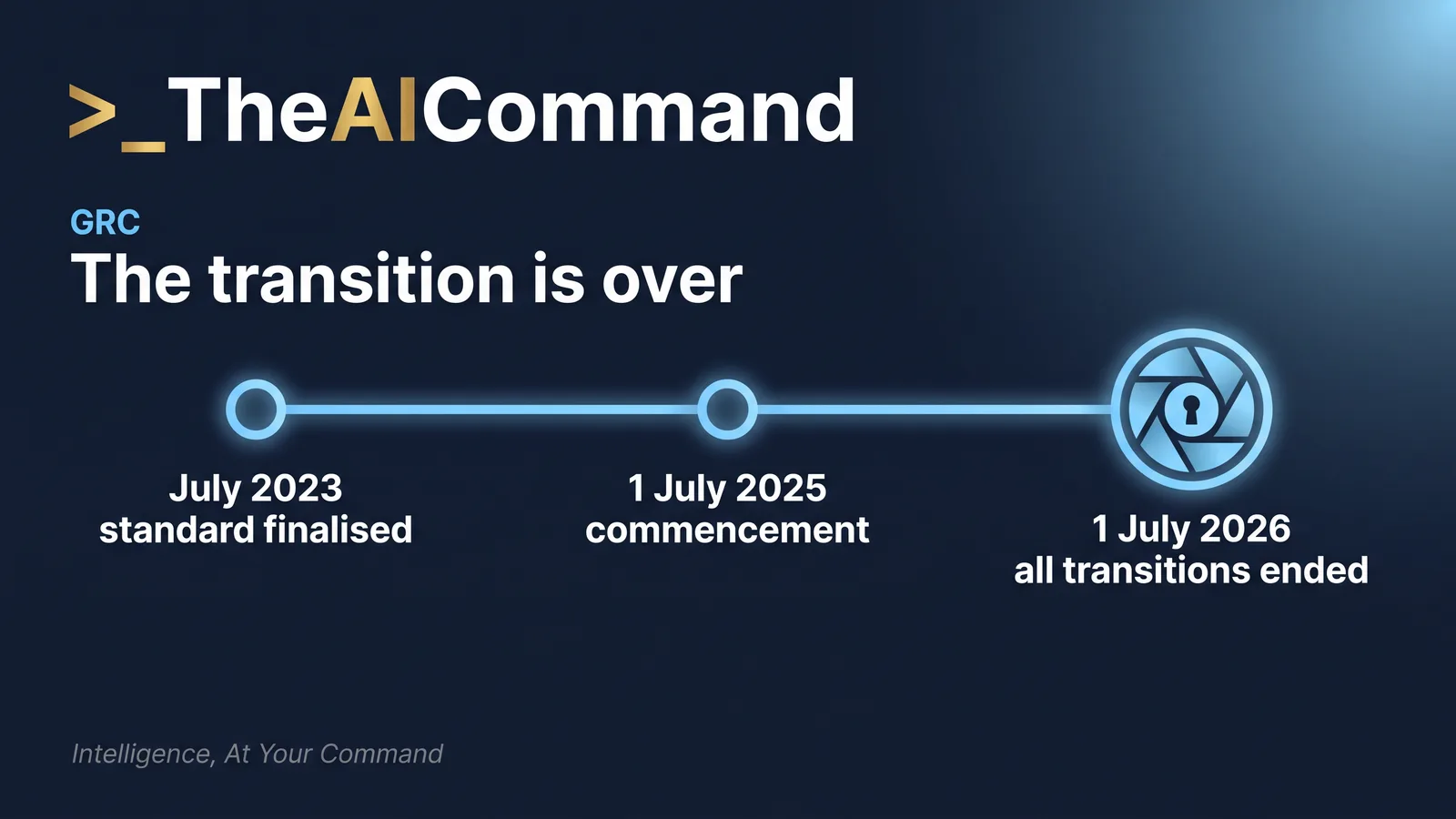
The standard came into effect on 1 July 2025 for all APRA regulated entities. Two transitional arrangements ran alongside commencement, and both ended on 1 July 2026. First, APRA gave entities that are not significant financial institutions an additional 12 months to meet the business continuity and scenario analysis requirements, with the predecessor standards CPS 232 and SPS 232 applying in the interim. Second, material service provider contracts entered into before 1 July 2025 had to comply from the earlier of the next contract renewal date or 1 July 2026, so a renewal inside the window brought the deadline forward.
As at July 2026, both windows have closed. Every regulated entity, regardless of size, is now subject to the full standard, and every material service provider arrangement must comply with CPS 230 no matter when the contract was signed. An entity still operating on legacy contract terms does not hold a remediation runway. It holds a live compliance gap that belongs on the operational risk profile and, where material, in front of the Board.
The core obligations were never deferred for the broader population. The operational risk management framework, critical operations identification, tolerance levels and Board accountability requirements have applied to every regulated entity since 1 July 2025.
Interplay with adjacent prudential standards
CPS 230 does not stand alone. It replaces CPS 231 Outsourcing and CPS 232 Business Continuity Management and consolidates parts of CPS 220 Risk Management, while reinforcing CPS 234 Information Security and CPS 511 Remuneration. Practitioners should treat the prudential standards as a connected operating model, not a stack of independent obligations.
Strategic implications
The strategic shift in CPS 230 is the move from compliance based business continuity to outcome based operational resilience. APRA expects entities to demonstrate, with evidence, that critical operations can keep running within stated tolerances even when severe but plausible events occur. Boards must own the resilience agenda, including the choice of tolerance levels and the residual risk that follows. Heads of Operational Risk, Heads of Resilience, and Chief Risk Officers should expect direct engagement with APRA supervisors on the credibility of tolerance levels, the realism of scenario testing, and the depth of fourth party visibility. The reform also creates new requirements for incident notification to APRA and for end to end accountability over service provider performance, both of which carry reputational and supervisory consequences when missed.
Visual 1: Regulatory authority map for CPS 230
The diagram below shows the layered authority structure that produces CPS 230 and the actors that operate under it. It is rendered in descriptive table form for readability, and is also suitable for designer rendering in Lucidchart or Whimsical.
3. Core concepts and defined terms
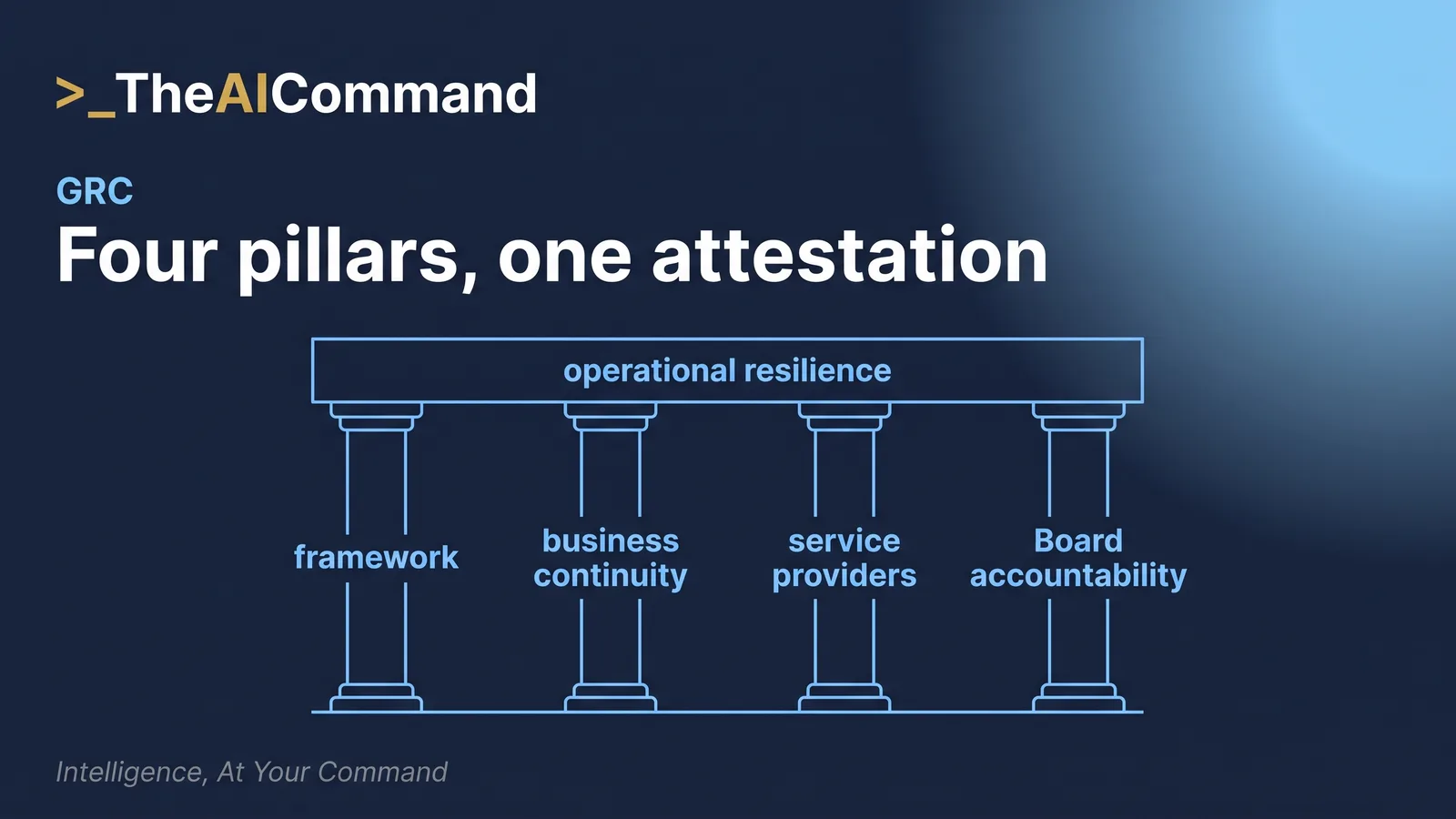
CPS 230 introduces a tightly defined vocabulary. Practitioners must use these terms exactly as APRA does. Slippage in language often signals slippage in control.
Defined terms
Pillar 1: Operational risk management framework
The operational risk management framework must include risk identification and assessment, controls and mitigation, monitoring and reporting, internal controls testing, change management, and lessons learned from incidents and near misses. APRA expects the framework to be embedded in business as usual, refreshed at least annually, and stress tested through scenario analysis. The framework must connect to the broader risk management framework under CPS 220 and to the information security framework under CPS 234.
Pillar 2: Business continuity, critical operations, and tolerance levels
Scenario design is where testing programs most often go soft, with every scenario a mild variation of a server outage. Before the annual exercise, use this prompt to build a scenario set that genuinely stresses the tolerance level.
Entities must identify critical operations, set tolerance levels, and maintain a business continuity plan that can deliver continuity within the tolerance. The plan must be tested at least annually using severe but plausible scenarios, and it must be refreshed when material changes occur. Tolerance levels are not aspirations. They are commitments that the Board must be able to defend with evidence and that the executive must be able to deliver against.
Pillar 3: Management of material service providers
The legacy contract transition ended on 1 July 2026, so any contract signed before 1 July 2025 that was never uplifted is now a live compliance gap. Run this prompt over a de-identified extract of your service provider register to build the gap list.
Entities must maintain a current register of material service providers, perform pre-contract due diligence, embed minimum contractual terms, manage concentration risk, and notify APRA of material developments. Material service providers cover the full scope of providers relied on for critical operations, not only legacy outsourcing arrangements. Fourth parties must be visible to the entity.
Pillar 4: Roles, responsibilities, and Board accountability
The Board is ultimately accountable for the operational risk management framework, including approval of risk appetite, tolerance levels, and material outsourcing decisions. Senior management is accountable for execution. The three lines model applies, with assurance over the framework provided by the second and third lines and reported to the Board at a defined cadence.
Visual 2: Business continuity lifecycle under CPS 230
The lifecycle below shows how a critical operation moves from identification to closure of an event and back into improvement. It is rendered as a structured table specification that a designer can convert directly to Lucidchart or Whimsical.
4. Practical application in Australian financial services
CPS 230 reads similarly across regulated entities, but the practical implementation differs by sector. The four worked examples below illustrate how the same standard plays out for an ADI, an insurer, a superannuation trustee, and an AFSL holder operating under a regulated parent. Each example follows the same structure: trigger event, obligation activated, artefact produced, and audit trail expected.
Example A: ADI, retail payments outage
Trigger event. The card scheme switch operated by a material service provider degrades for ninety minutes during peak retail hours, blocking authorisations on a major card portfolio.
Obligation activated. Retail card authorisations are a critical operation with a Board approved tolerance of forty five minutes of full unavailability in any twenty four hour period. The disruption breaches tolerance and triggers the operational risk event policy, the retail payments BCP, and the APRA notification protocol.
Artefact and audit trail. The event is logged with severity, customer impact estimate, and recovery timeline. The Board receives same day notification, APRA receives notice consistent with reporting requirements, and the post incident review updates the service provider risk assessment, refreshes the tolerance rationale, and adjusts joint scenario testing. APRA review will look for the Board approved tolerance, the BCP, the live decision log, customer communications, the regulator notice, and traceable post incident actions.
Example B: General insurer, catastrophe claims surge
Trigger event. A severe weather event in Queensland generates a tenfold increase in claims volume over four days, with the third party claims platform showing intermittent latency.
Obligation activated. Catastrophe claims handling is a critical operation with a tolerance set on claims throughput per hour, not on availability alone. The BCP surge plan pre-positions internal claims teams to support the third party platform. The service provider register tiers the platform as Tier 1. The event triggers the surge plan and the material service provider escalation protocol.
Artefact and audit trail. The surge activation log, daily Board update, throughput monitoring report, service provider performance log, and post event tolerance review. APRA review tests whether the tolerance reflects what matters to policyholders, whether the surge plan was tested in the prior twelve months, whether fourth party dependencies were mapped, and whether lessons converted into framework updates.
Example C: Superannuation trustee, administrator unit pricing failure
Trigger event. The fund administrator publishes incorrect unit prices for two trading days. Some members switch investment options on the basis of the incorrect prices.
Obligation activated. Accurate unit pricing and member transactions are critical operations. The administrator is a Tier 1 material service provider. The event triggers the operational risk event policy, member remediation protocols, APRA notification, and a materiality assessment under the trustee's breach reporting framework.
Artefact and audit trail. Member impact register, remediation methodology, member communications, APRA notification, administrator root cause report, and updated joint testing schedule. APRA review tests the trustee's independent challenge of the administrator's root cause and evidence of remediation. ASIC interest is likely because of the conduct dimension.
Example D: AFSL holder, advice platform technology incident
Trigger event. An advice platform used by financial advisers within an AFSL holder loses access to client risk profiling for an afternoon during a volatile market session.
Obligation and audit trail. Where the AFSL holder sits within an APRA regulated group, CPS 230 applies through the group framework. Adviser access to risk profiling supports a critical operation tied to advice quality and best interests obligations. The artefact set covers adviser advisory note, manual workaround procedure, client impact assessment, post incident review with a conduct lens, and updated control test plan. APRA review will focus on the framework while ASIC may engage on the conduct outcome.
Visual 3: CPS 230 benchmarked against adjacent operational resilience frameworks
Practitioners frequently encounter a question from Boards and offshore parents: how does CPS 230 compare to other operational resilience regimes? The table below sets out the principal points of comparison.
Visual 4: Material service provider tiering matrix and RACI
The matrix below combines the tiering rule with the RACI for ongoing oversight. It is the artefact most often requested by APRA during a thematic review.
R = Responsible, A = Accountable for the framework rests with the Board, C = Consulted, I = Informed.
Visual 5: Illustrative operational resilience indicators
The figures below are illustrative only and are not drawn from any single regulated entity. They are intended to show the cadence and shape of metrics that an Operational Resilience function should be reporting to the Board.
Visualise as a stacked column chart with quarters on the x axis and the four metrics layered. Confirm the illustrative label is on every export.
5. AI workflow: operating CPS 230 with AI
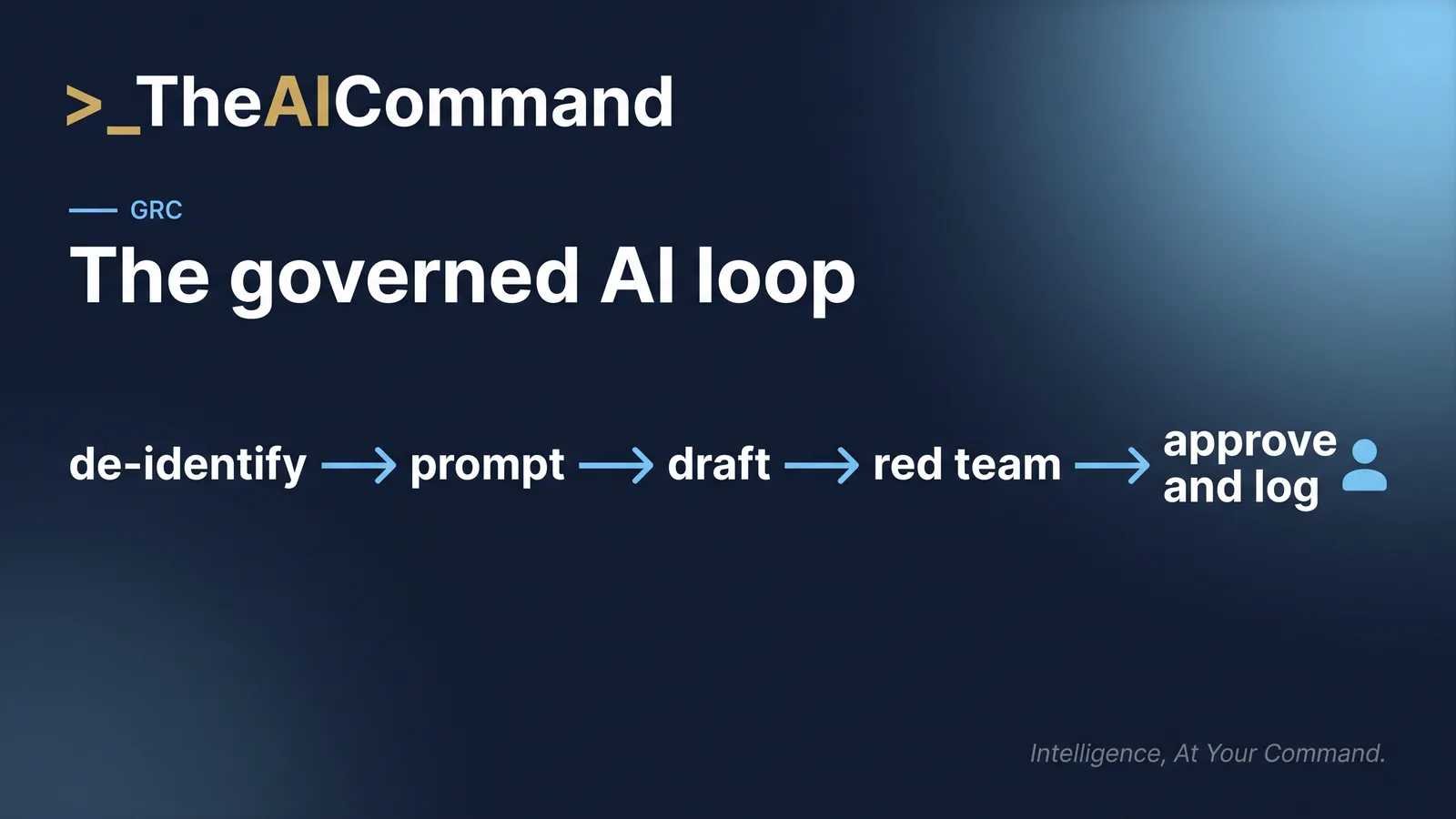
AI is most useful in CPS 230 work when it accelerates document heavy, pattern matching tasks under firm human-in-the-loop control. The workflow below is built for an Operational Resilience function. It assumes an enterprise grade AI environment, de-identified inputs, and documented governance.
5.1 Use cases at scale
AI can compress effort and improve consistency across the following CPS 230 tasks:
- Mapping operational processes to critical operations and identifying candidate inclusions and omissions for human review.
- Drafting tolerance level rationale memos using a structured template, evidence base, and Board ready language.
- Generating control narratives and gap analyses from RCSA outputs and incident data.
- Distilling Board pack content from raw working documents while preserving cited evidence.
- Triaging regulator queries to the correct artefact, owner, and response template.
- Producing first draft service provider risk assessments from due diligence inputs and threat intelligence.
- Building scenario test scripts and tabletop facilitator notes from severe but plausible scenarios.
- Maintaining a living glossary that aligns CPS 230, CPS 234, CPS 220, and CPS 511 vocabulary across the entity.
5.2 Project space setup
ChatGPT (Projects and Custom GPT)
- Create a Project named CPS 230 Operational Resilience and apply enterprise tenancy controls so that data does not train a foundation model.
- Configure a system prompt scaffold that includes the entity name, the regulator, the four pillars, the controlled vocabulary, and the human-in-the-loop rule.
- Upload reference files: the public CPS 230 standard, your operational risk management framework, your critical operations register, your tolerance level statements, your service provider register, the BCP, and the most recent Board operational resilience report (de-identified).
- Create file naming conventions: CPS230-ART-{ArtefactType}-{Owner}-{YYYYMMDD}-v{##}.
- Build a Custom GPT for repeatable artefacts, for example a Tolerance Memo Drafter that always returns Role, Context, Evidence, Recommendation, and Open Questions.
Claude (Projects and Skills)
- Create a Claude Project named CPS 230 Operational Resilience with file based memory, retention disabled where the entity's policy requires it.
- Add the system prompt scaffold and the controlled vocabulary as a project document.
- Upload the same reference files as above. Add the post incident review template, the regulator response playbook, and the joint testing methodology.
- Build a Claude Skill named cps230-resilience-architect with reference files for tolerance memos, control narratives, and Board attestations. Include a quality rubric and a pushy trigger description.
- Add a companion red team Skill named cps230-red-team that stress tests draft outputs against APRA review questions before the human approves them.
5.3 Prompt library
Each prompt below follows the Role, Context, Task, Constraints, Output, Quality Bar pattern. Use them as starting points and adapt to your entity vocabulary.
Prompt 1: Critical operation identification workshop
Prompt 2: Tolerance level rationale memo
Prompt 3: Service provider risk assessment
Prompt 4: Maturity assessment and gap analysis
Prompt 5: Board attestation pack distillation
Prompt 6: Regulator response drafter
5.4 Governance, audit, privacy, and risk appetite controls
Every new AI use case that touches CPS 230 artefacts should pass a documented screen before it goes anywhere near live data. This prompt drafts the screening memo for your risk forum.
AI assistance must be operated under documented controls. The minimum control set for a CPS 230 workflow includes:
- Mandatory de-identification rules. Personal data, market sensitive information, sanctions data, and active claimant or member data must be removed before any input is sent to a model. Use placeholder fields such as {ENTITY_NAME}, {VENDOR}, and {INCIDENT_REF}.
- Human-in-the-loop checkpoints. AI outputs are drafts. A named human owner must review, edit, and approve every artefact before it leaves the working environment. Approval is logged.
- Prohibited inputs. Do not upload personal information, customer lists, advice files, claimant medical data, market sensitive deal documents, sanctions lists, or live incident telemetry.
- Retention and logging. Maintain a log of every prompt, model used, file inputs, output artefact reference, and human approver. Retention should align with the operational risk records retention policy and APRA expectations on operational records.
- Model selection guidance. Default to enterprise tenancy with no training on entity data. Consider on-prem or sovereign hosting for inputs that touch CPS 234 protected information assets. Avoid consumer model surfaces for any CPS 230 work.
- CPS 230 critical operation considerations. The AI environment itself may be a Tier 2 or Tier 3 service in your service provider register. Document the dependency, the fallback if the model is unavailable, and the response if the provider experiences an incident.
- Australian Privacy Principles alignment. Apply APP 1 governance, APP 6 use and disclosure, APP 8 cross border disclosure, and APP 11 security to every AI use case. Privacy impact assessments should be refreshed when prompts, models, or data flows change.
5.5 Quality assurance loop
Run the following five step QA rubric on every AI output before it is signed off:
- Accuracy. Does every claim trace to a cited source artefact in the entity's evidence base?
- Compliance. Does the artefact use APRA defined terms exactly, and does it map to the correct CPS 230 pillar?
- Privacy. Has personal information, market sensitive content, or sanctions data been removed?
- Decision quality. Does the artefact support a decision or action, with the decision option, evidence, and risk made explicit?
- Tone and language. Australian English, no em dashes, no marketing language, no defensive hedging that obscures the issue.
Then run the following red team prompt against the draft to stress test it:
5.6 Scaling pattern
Operationalising the workflow across an Operational Resilience team requires a few patterns:
- Templates and skills. Convert the prompt library into Claude Skills and ChatGPT Custom GPTs so every analyst uses the same scaffolds.
- Version control. Store skills, prompts, and reference files in a Git repository with change logs. Tag major framework reviews.
- Model evaluation cadence. Re-test the prompt library every quarter against a benchmark set of artefacts. Capture drift in a model performance log.
- Key risk indicators. Track AI assist coverage by artefact type, human approval rate, time saved per artefact, and any near miss generated by an AI output. Report to the operational risk committee at least quarterly.
- Change management. Treat any change to model, prompt library, or reference set as a controlled change under the entity's change management framework.
Visual 6: Five things to remember about CPS 230
6. Common pitfalls and watch-outs
The eight pitfalls in this section double as a quarterly self-audit. Paste a de-identified artefact summary into this prompt and treat every red flag as a finding with an owner and a date.
Across recent APRA thematic reviews and industry CPS 230 implementation programs, the same set of pitfalls appears repeatedly. Each pitfall below is paired with a one line corrective action.
- Pitfall 1: Too many critical operations. Entities list everything that matters, which dilutes the standard. Action: tighten the list to operations whose failure has a clear member or customer impact and a soundness pathway.
- Pitfall 2: Tolerance levels set by reverse engineering capability. Action: set tolerances based on member impact, then build the capability to deliver, with a transparent residual risk position to the Board.
- Pitfall 3: Vendor register limited to legacy outsourcing scope. Action: extend scope to all reliance that meets the materiality threshold, including SaaS, fintech partners, and intra-group services.
- Pitfall 4: Scenario testing that defaults to a server outage. Action: design scenarios across cyber, third party, people, and external events. Document why each scenario is severe but plausible.
- Pitfall 5: Fourth party blind spots. Action: require Tier 1 vendors to disclose subcontractors that touch the critical operation, and assess them under the same rigour.
- Pitfall 6: Board pack that asserts compliance without evidence. Action: anchor the attestation in a documented evidence pack with traceable assurance work.
- Pitfall 7: AI workflow used without a privacy impact assessment. Action: require a privacy review and a model selection memo for any AI use case that touches operational risk artefacts.
- Pitfall 8: Lessons learned that never close. Action: every post incident action must have an owner, a date, and an assurance check on closure.
7. Decision frameworks and tools
Decision tree: is this operation a critical operation?
Maturity ladder: where is your CPS 230 program today?
Self-check questionnaire
- Can you produce, within thirty minutes, your current critical operations register and the Board minute that approved each tolerance level?
- Do you have a severe but plausible scenario test report for each critical operation in the last twelve months?
- Can you list all Tier 1 material service providers, the contractual coverage, and the next review date?
- Are fourth parties for each Tier 1 vendor mapped, with at least one scenario tested across the chain?
- Does the Board attestation pack reference traceable evidence rather than management assertion alone?
- Is there a documented AI workflow with a privacy impact assessment and human-in-the-loop controls for CPS 230 artefacts?
- Are CPS 230 KRIs reported to the operational risk committee at the cadence specified in the framework?
8. Further reading and authoritative sources
The references below are starting points only. They should be supplemented by your entity's own framework, internal audit reports, and APRA correspondence.
- APRA, Prudential Standard CPS 230 Operational Risk Management (effective 1 July 2025) and accompanying Prudential Practice Guide CPG 230.
- APRA, Prudential Standard CPS 220 Risk Management.
- APRA, Prudential Standard CPS 234 Information Security.
- APRA, Prudential Standard CPS 511 Remuneration.
- APRA, Information Paper, Implementing CPS 230, including transitional arrangements for material service provider contracts.
- ASIC, Regulatory Guide 271 Internal dispute resolution and Regulatory Guide 78 Breach reporting where operational risk events have a conduct dimension.
- OAIC, Australian Privacy Principles guidelines, particularly APP 1, APP 6, APP 8, and APP 11.
- Bank for International Settlements, Principles for Operational Resilience (2021), Basel Committee on Banking Supervision.
- UK Prudential Regulation Authority, Supervisory Statement SS1/21 Operational Resilience, for international benchmarking.
- EU Digital Operational Resilience Act, Regulation (EU) 2022/2554, for cross-jurisdictional comparison.
- AFMA, FSC, ABA, COBA, AIST, and ASFA member guidance on CPS 230 implementation.
- Risk Management Institution of Australasia and Governance Institute of Australia practitioner guidance on operational resilience and Board oversight.
Practical takeaways
Do this Monday
- Open the critical operations register and confirm every entry has a Board approved tolerance level with a documented rationale. List the entries that do not, with an owner and a date for each.
- Sweep the material service provider register for contracts signed before 1 July 2025 that were never uplifted to CPS 230 terms. The transition ended on 1 July 2026, so log each one as a live gap, not a pending action.
- Check the date of the last severe but plausible scenario test for each critical operation. Anything older than 12 months goes on the remediation list this week.
- Ask each Tier 1 vendor owner to name the fourth parties supporting their critical operation. Treat silence as your first finding.
- Confirm the AI tools your team uses for CPS 230 work run on enterprise tenancy and appear in the service provider register at the right tier.
The compliance checklist
- Critical operations register is current, tightly scoped, and covers the operations APRA treats as critical for your industry unless the entity has justified otherwise.
- Every tolerance level is Board approved, quantified, evidence based, and paired with a recovery time objective that does not exceed it.
- The business continuity plan is aligned to critical operations rather than organisational structure, and was tested against severe but plausible scenarios within the last 12 months.
- The material service provider register captures all reliance that meets the materiality threshold, including SaaS platforms, fintech partners and intra group services.
- Every material service provider contract complies with CPS 230, including contracts signed before 1 July 2025.
- Fourth parties supporting critical operations are mapped and assessed with the same rigour as the providers above them.
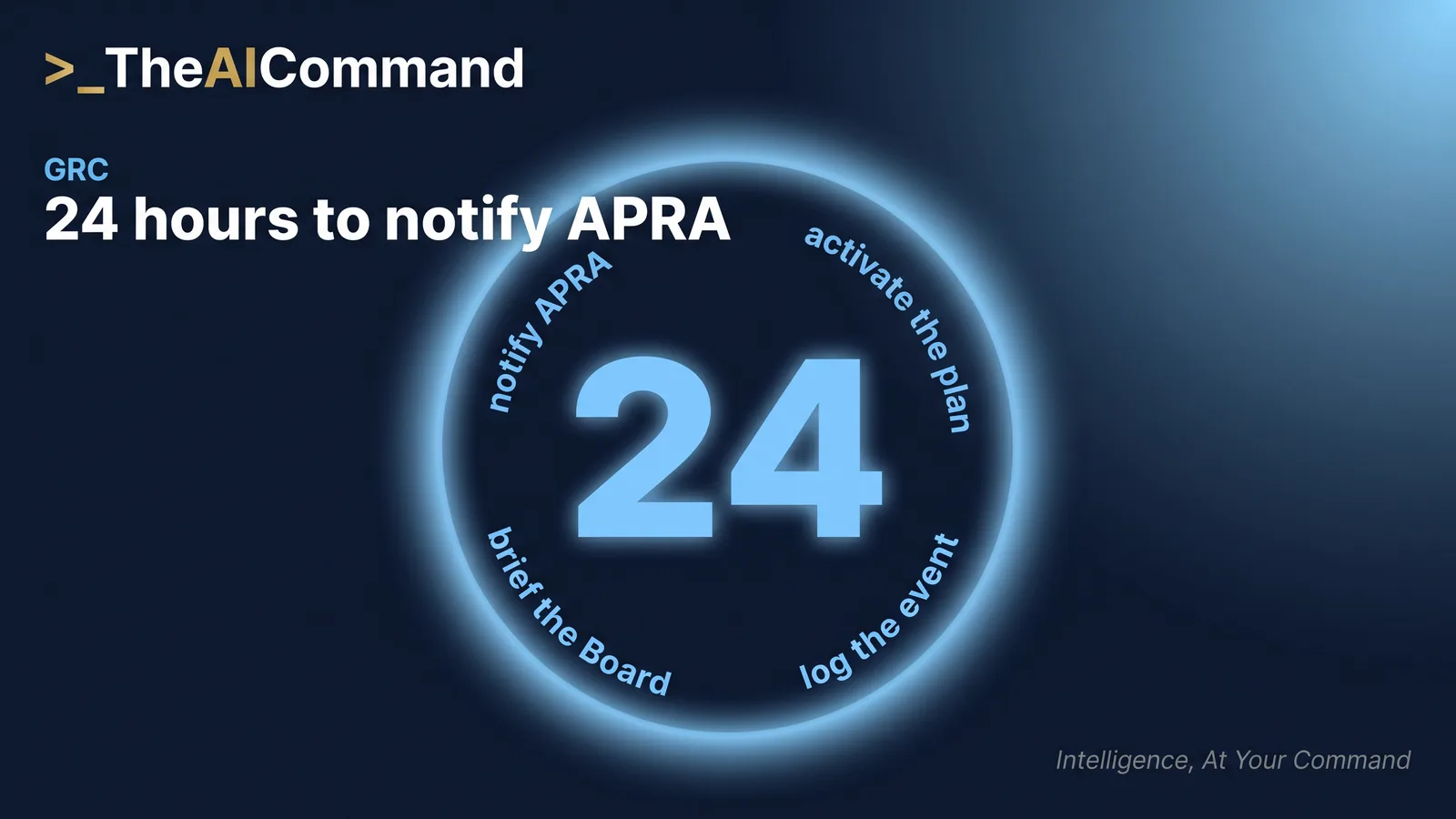
- Notification protocols cover the 24 hour tolerance breach notification and the 72 hour material incident notification, with named owners and tested contact trees.
- The Board attestation rests on a traceable evidence pack with documented second and third line assurance, not management assertion alone.
- Every AI workflow touching CPS 230 artefacts has a privacy impact assessment, de-identification rules, human-in-the-loop approval and audit logging.
- Post incident actions each carry a named owner, a target date and an assurance check on closure.
Your prompt library
This module now carries a working prompt set: the six prompts in the section 5.3 library, plus the scenario designer, the register gap sweep, the AI use case screen and the pitfall self-audit placed through the body. Adapt each one to your entity vocabulary, keep the de-identification constraints intact, and store the versions you settle on in a controlled prompt register. Here is one more for the moment you least want to write from a blank page.
Test your knowledge
LM-G05 assessment. 30 questions
25-30 minutes. One question per screen. Your progress is saved locally for 30 days, so you can pick up where you left off. Submit anytime to see your score, tier, and per-question rationale.
Read next

Corporations Act 2001 (Cth)
The Corporations Act 2001 (Cth) is the consolidated statute governing companies, financial product issuers and distributors, and the directors who oversee them. The Act sits at the apex of the Australian financial services regulatory hierarchy. The Australian Securities and Investments Commission (ASIC) is the lead reg
Read article
Privacy Act 1988 (Cth) and the Australian Privacy Principles
The Privacy Act 1988 (Cth) is the principal Commonwealth statute governing personal information handling in Australia. It binds APP entities, including all Australian financial services providers because of the financial services carve-out from the small business exemption. The 13 Australian Privacy Principles (APPs) s
Read article
Anti-Money Laundering and Counter-Terrorism Financing Act 2006 (Cth)
The Anti-Money Laundering and Counter-Terrorism Financing Act 2006 (Cth) (the AML/CTF Act) is the Commonwealth statute that obliges Australian reporting entities to detect, deter, and disrupt the movement of illicit funds and the financing of terrorism. The Act is administered by the Australian Transaction Reports and
Read articleGeneral information and education only. Not legal, compliance, financial, or professional advice. Verify any time-sensitive obligation against the primary source.
TheAICommand. Intelligence, At Your Command.