
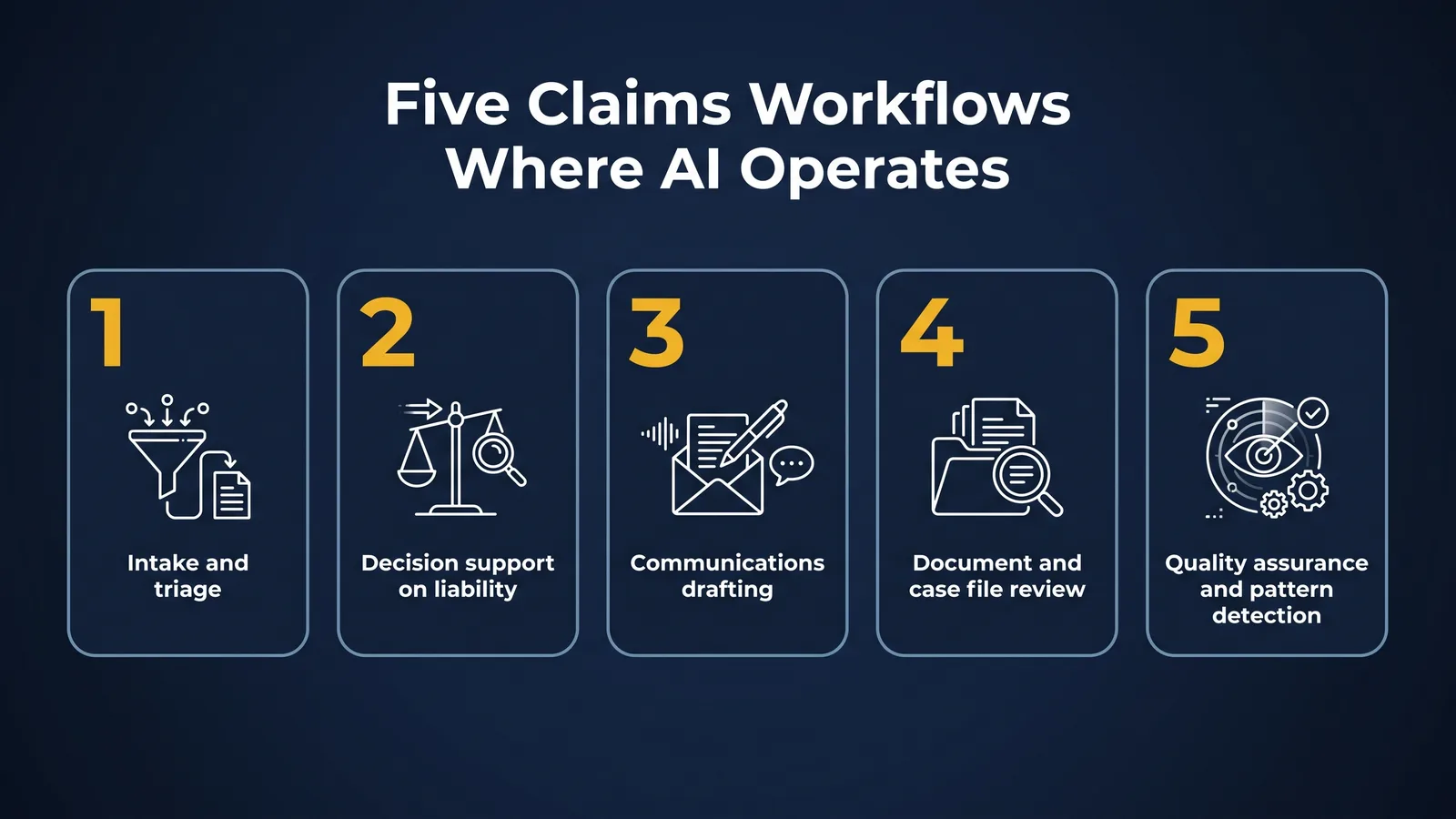
AI now operates across five workflows in workers compensation claims: intake and triage, decision support on liability, communications drafting, document analysis, and quality assurance, and each needs its own governance baseline. AI is in the claims workflow already. The work now is governing it well.
Context for general readers: Workers compensation claims under the Safety, Rehabilitation and Compensation Act 1988 (SRC Act) move through a sequence of decisions that affect a claimant's entitlements, treatment, and return to work. Case managers, claims officers, treating practitioners, rehabilitation providers, and reconsideration officers all make decisions that the SRC Act binds. AI tools are now a working part of that sequence in many schemes - used in intake, triage, decision support, communications, and documentation. The supervisory question is no longer whether AI is in the workflow. It is whether AI's role is governed in a way that holds up to scrutiny.
This article is a practitioner's map of the five workflows where AI tools are currently operating in production across Australian workers compensation schemes. For each, it sets out where the value sits, where the risk sits, and the minimum governance baseline. It closes with a numbered AI-leverage workflow that case managers and governance leads can apply directly.
Workflow 1: Intake and initial triage
What AI is doing here. Natural language processing of incoming claim documents (initial reports, treating practitioner letters, employer notifications) to extract structured fields and assign a complexity band. Some schemes also use AI to flag claims that may need urgent intervention.
Where value sits. Faster routing of claims to the right team. Earlier identification of complex claims that benefit from senior case management from day one. Lower data-entry burden on intake officers.
Where risk sits. Misclassification on intake can shape the subsequent handling in ways that are hard to undo. A claim incorrectly tagged as low-complexity can sit in standard handling for weeks before someone notices it should have been escalated. Where the triage band influences case manager attention, the risk is procedural fairness drift across the cohort, not a single bad decision, which is why predictive triage warrants its own risk analysis for scheme operators.
Governance baseline. A sample-audit of triage band assignments on a monthly cadence, looking specifically at amber-to-red and red-to-amber misclassifications. A documented threshold for human override of the AI band on intake. Capture of the AI's role in the file note from the first determination forward.
Workflow 2: Decision support on liability
What AI is doing here. Case managers using large language models to summarise medical reports, draft analyses of complex evidence, identify the elements of a section 14 determination, and surface the questions that need answering before the determination is made. Some schemes have purpose-built decision support tools layered on top of general LLMs.
Where value sits. Real time saved on the analytical work. A second pair of eyes on complex evidence. Faster identification of the right question to ask the treating practitioner. Reduced cognitive load on the case manager, freeing attention for the harder elements of the determination.
Where risk sits. Hallucinated content in the summary. Misquoted medical opinion. Confident-but-wrong identification of which SRC Act test applies. Case manager over-reliance on AI output as a substitute for direct engagement with the source documents. Most importantly, the determination must be made by the case manager on the evidence, within a practitioner framework for AI-assisted determinations. The AI's analysis is decision support, not the decision.
Governance baseline. The case manager reads the source documents in addition to the AI summary. The file note records the AI's role in the analysis. Where the AI summary is used as the basis for an external communication (treating practitioner query, employer letter), the case manager verifies it against source. A monthly sample audit of liability decisions checks for AI-introduced errors.
De-identification callout. Every claim handled in a worked example in this article uses placeholders. [CLAIMANT_NAME], [CLAIM_NUMBER], [CONDITION], [EMPLOYER]. In production, claim data must be de-identified before being sent to any AI tool that sits outside the scheme's perimeter, with a documented re-identification process for the case manager to attach the AI output back to the claim. This is the single highest-leverage control across the entire workflow.
Workflow 3: Communications drafting
What AI is doing here. Drafting determination letters, treating practitioner queries, employer communications, and rehabilitation referrals. Draft outputs are typically reviewed and edited by the case manager before sending.
Where value sits. Significant time saved on routine drafting. More consistent letter quality across case managers. Better adherence to plain-language standards where the AI has been prompted on those standards.
Where risk sits. Generic letters that miss the specific facts of the claim. Tone errors that are subtle but consequential (a determination letter that reads as adversarial when the case is finely balanced). Confident assertions of fact that the case manager has not verified. Inadvertent disclosure of de-identified information that was supposed to be redacted.
Governance baseline. A templated AI prompt set that includes the appropriate tone, content requirements, and structural elements for each letter type. For determination drafting specifically, a step-by-step recipe with de-identification controls built in is the safer starting point than an ad hoc prompt. Case manager review of every AI-drafted communication before sending, with explicit attention to the specific facts of the claim. A bar on AI-drafted determination letters that have not been read in full by the determining case manager.
Workflow 4: Document analysis and case file review
What AI is doing here. Reviewing accumulated case files (sometimes thousands of pages) to identify inconsistencies, surface missed evidence, summarise the procedural history, or check whether all required steps have been taken. Particularly common in long-running and complex cases.
Where value sits. Genuine insight from data that is otherwise too voluminous to read end-to-end. Earlier detection of evidence gaps. Better-prepared case managers when a matter heads to reconsideration or to the Administrative Review Tribunal.
Where risk sits. AI summaries that miss critical detail. Confidence cues that overstate the certainty of factual claims. Reasoning trails that can't be reconstructed by an external reviewer (the AI saw the file, the case manager read the summary, the reasoning sits inside both layers and is hard to audit).
Governance baseline. Direct case manager engagement with any document the AI flags as load-bearing. A documented reasoning trail that captures the AI's contribution. For cases heading to ART, an independent file review by a senior case manager that does not rely solely on the AI summary.
Workflow 5: Quality assurance and pattern detection
What AI is doing here. Portfolio-level analysis of claim outcomes, decision consistency, processing times, and procedural fairness signals. Surfaces patterns that case-by-case review cannot.
Where value sits. Genuine portfolio insight. Earlier detection of process gaps. Evidence-based input to scheme operator continuous improvement. The pattern view often surfaces things that no individual case manager could see.
Where risk sits. Pattern detection that drives intervention without first verifying the pattern is real. Statistical artefacts that look like systematic issues but are noise. Models that are calibrated to past data but no longer reflect current scheme operation.
Governance baseline. Any pattern that triggers operational change is verified by a senior case manager looking at a sample of underlying claims. A documented refresh cadence for the pattern-detection model. Output reports that include confidence intervals, not just point estimates.
How do you use AI well in workers compensation claims?
The five workflows above translate into a single practitioner-facing workflow that case managers and governance leads can apply directly. This is the simplest path to using AI well in claims.
Step 1: Inventory every AI tool currently in use
This includes tools formally deployed by the scheme operator AND tools that individual case managers have brought in via personal subscriptions. The shadow inventory is often larger than the official one, and is the larger compliance risk.
Step 2: De-identify before the perimeter
For every workflow where claim data leaves the scheme's controlled environment to interact with an AI tool, de-identification is the default. No full names, no claim numbers, no specific addresses, no employer identifiers, no diagnoses linked to identifiers. Use stable internal identifiers the case manager can re-attach, following the de-identification toolkit for case managers.
Step 3: Make the human accountable for the regulated act
The determination under the SRC Act is made by the determining authority through an authorised delegate, in practice usually the case manager. A reconsideration under section 62 must be conducted by a person who was not involved in making the original determination. AI output supports those decisions; it does not make them. Document the human accountability in the workflow design, not just in policy.
Step 4: Capture the AI's role in the file note at decision time
When the AI output is part of the analysis, the file note records that. Specifically: which tool was used, what data was sent to it, what the output was, and how the case manager engaged with it. Retrospective reconstruction of the AI's role is significantly harder than capture at the time of decision.
Step 5: Sample-audit monthly
A monthly sample of AI-influenced decisions, reviewed by a senior case manager or quality assurance officer, looking for procedural fairness consistency, file note completeness, and instances where AI output was treated as decision rather than input. The audit produces a written record that builds an evidence base for the scheme's governance posture.
Step 6: Refresh tools and prompts on a documented cadence
AI tools update. The behaviour of the same prompt against the same model can change between versions. The scheme operator's tool inventory and prompt library should be reviewed at least quarterly, with documented decisions about which tools to keep, swap, or retire. Teams standardising on a single platform can start from a governed workers compensation configuration rather than building instructions from scratch.
What to never do
Do not: Send unredacted claim data to an AI tool whose data residency, retention, and training-use posture has not been documented and accepted. Treat an AI summary as a substitute for engaging with the source documents in a load-bearing decision. Allow an AI-drafted determination letter to leave the scheme without case manager review. Use AI-flagged patterns as the basis for operational change without first verifying the pattern against a sample of underlying claims. Run AI-influenced decisions without a documented file note record of the AI's role.
Governance checklist
- A scheme-wide AI tool inventory exists, dated, and is reviewed at least quarterly
- De-identification is the default for every workflow that crosses the scheme's perimeter
- Every AI-influenced decision has a file note record of the AI's role, captured at the time of decision
- Monthly sample-audit of AI-influenced decisions is run and reported
- Tool inventory and prompt library are refreshed on a documented quarterly cadence
- A Privacy Impact Assessment covers every tool that ingests claim data
- The scheme can produce, on request, evidence that AI output was input to the decision and not the decision itself
How does the SRC Act regulatory frame apply to AI in claims?
The SRC Act does not contain AI-specific provisions. The framework that applies is the same framework that has always applied: case managers must make determinations on the evidence, with attention to the requirements of natural justice, and within the scheme's procedural and governance settings. The Comcare best-practice decision making guidance sets the baseline.
What AI changes is where the case manager needs to look to evidence that the decision was made on the evidence. Where AI tools influence the analysis, the documentation must reach the AI's role. Where AI tools draft communications, the case manager's review of those drafts must be substantive, not procedural. Where AI tools surface portfolio-level patterns, the operational response must be grounded in verified facts, not just signal.
The Voluntary AI Safety Standard (September 2024) set the Commonwealth's baseline for governance practices, and its ten voluntary guardrails remain published. It has since been evolved: in October 2025 the Department of Industry, Science and Resources published the Guidance for AI adoption, which the department describes as updated and simplified guidance built around six essential practices for safe and responsible AI governance. As at 15 August 2026, the Guidance for AI adoption is the current Commonwealth benchmark that regulators and oversight bodies are likely to look to when assessing whether a scheme operator is using AI responsibly. Neither instrument is binding, but scheme operators that have not aligned their AI governance to the six essential practices can expect that gap to surface in oversight conversations.
For privacy specifically, the OAIC's guidance on privacy and the use of commercially available AI products (October 2024) states that the Privacy Act applies to all uses of AI involving personal information. APP 1 (open and transparent management), APP 6 (use and disclosure), and APP 11 (security) are the most commonly engaged, and the OAIC's guidance adds that generating or inferring personal information with AI is itself a collection that must comply with APP 3. Cross-border transfers under APP 8 are particularly important where the AI tool is hosted outside Australia. The OAIC also recommends, as a matter of best practice, that organisations do not enter personal information, and particularly sensitive information, into publicly available generative AI tools. For claims teams, that recommendation lands exactly where this article's de-identification baseline already sits.
Direction of travel
AI tools in claims are no longer experimental. The supervisory question has shifted from "should we let case managers use AI" to "can we evidence that AI is being used well." Scheme operators that have built clear governance - inventory, de-identification, file note conventions, audit cadence, prompt library - are in a defensible position, and the workers compensation AI self-assessment can help a team gauge where it currently sits. Scheme operators that have allowed AI use to grow informally are accumulating a governance debt that will surface, eventually, either through an oversight process or through an adverse outcome on a specific claim.
The work this quarter is the inventory. Once the scheme knows what tools are in use, where, and by whom, the rest of the governance framework follows. The work cannot be done in reverse. For case managers building the underlying skills, the AI for SRC Act claims practice learning module works through de-identification, determination drafting, and the rehabilitation loop end to end.
Bottom line
AI is already operating across five claims workflows, so the supervisory question is no longer whether it is present but whether its role is governed and can be evidenced. The single highest-leverage control is de-identification before claim data leaves the scheme's perimeter, and the human stays accountable for the regulated act. Governance that is built after the fact is much harder to evidence than governance captured at the time of decision.
Do this Monday:
- Inventory every AI tool in use, including the shadow tools individual case managers brought in via personal subscriptions.
- Make de-identification the default before any claim data leaves the scheme's controlled environment.
- Record the AI's role in the file note at the time of decision, not retrospectively.
- Keep the case manager accountable for the determination, treating AI output as an input, never the decision.
- Run a monthly sample-audit of AI-influenced decisions for procedural fairness consistency and file note completeness.
Content disclaimer: This article is for general educational and informational purposes only. It does not constitute legal, compliance, or professional advice. The SRC Act 1988 should always be consulted directly. Practitioners should refer to current Comcare scheme guidance and seek legal advice where required. Nothing in this article constitutes a formal determination or interpretation of law.
TheAICommand. Intelligence, At Your Command.