Large language models are now used across AML/CTF programs, drafting suspicious matter narratives, summarising KYC documents, triaging alerts, and generating training content, and each use stays inside the regulated program under AUSTRAC oversight. LLMs touch every part of the AML/CTF program. Governance has to follow.
Context for general readers: AML/CTF is the regime that requires banks, casinos, money transfer services, and a growing list of other businesses to identify their customers, monitor for unusual activity, and report suspicious matters to AUSTRAC, the Australian financial intelligence agency. The framework runs on the AML/CTF Act 2006 and the supporting AML/CTF Rules 2025, which replaced the 2007 Rules when the reformed regime commenced for existing reporting entities on 31 March 2026. The Tranche 2 reforms expanded coverage to lawyers, accountants, real estate professionals and dealers in precious metals and stones, whose obligations commenced on 1 July 2026 (position as at 15 August 2026). The compliance burden is substantial, and the temptation to use AI tools to manage it is high.
This article covers the four highest-volume uses of large language models inside AML/CTF programs in Australian reporting entities, the supervisory considerations attached to each, and the governance posture that practitioners should be adopting now.
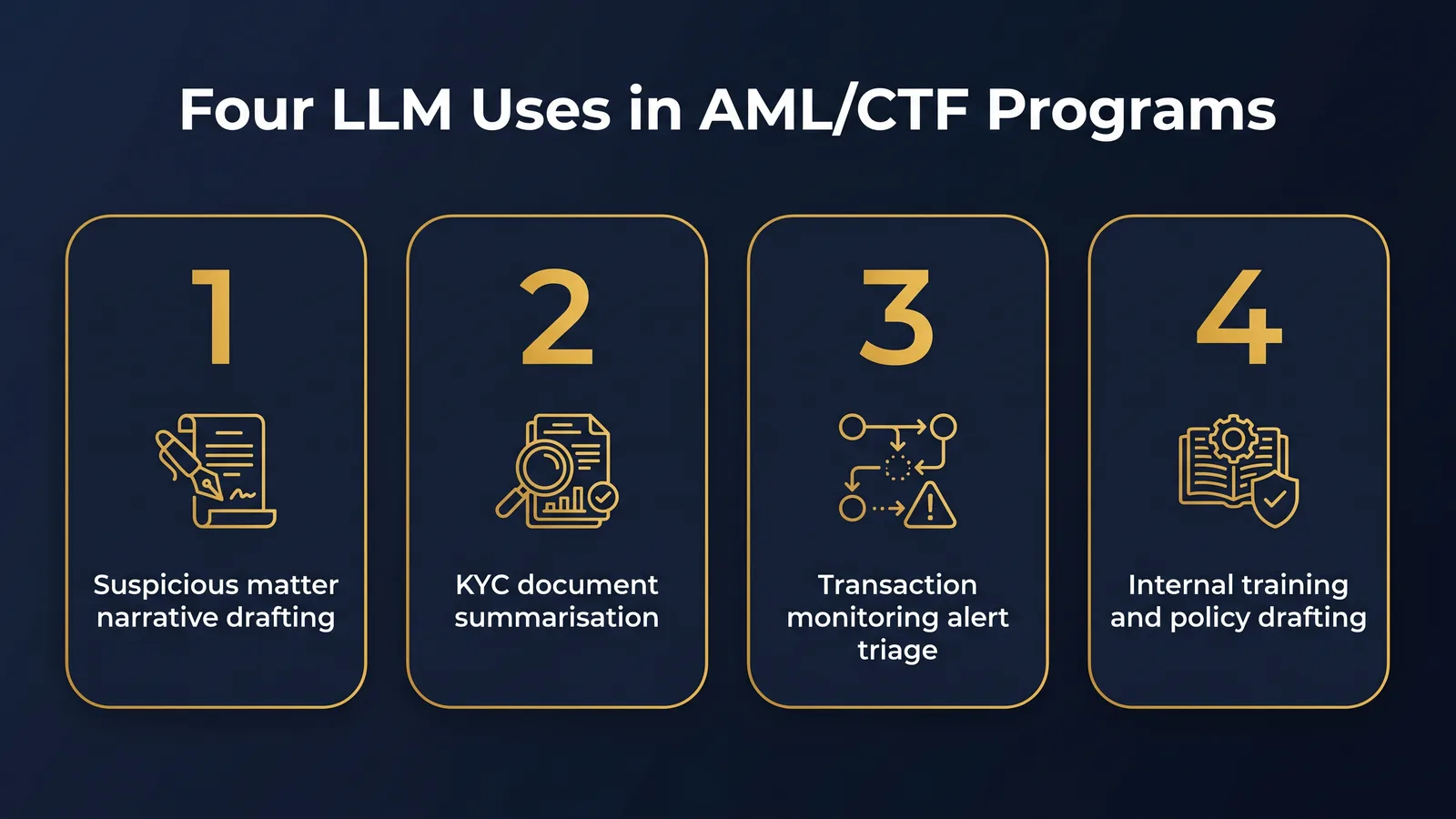
Where are LLMs operating in AML/CTF programs?
1. Suspicious matter narrative drafting
When an analyst triages a transaction monitoring alert and decides to escalate, the suspicious matter report (SMR) submitted to AUSTRAC includes a narrative section. Large language models are now widely used to draft these narratives from structured alert data.
The supervisory consideration: the SMR is a regulatory submission. The Reporting Entity (not the AI tool) is responsible for its accuracy and completeness. Where the LLM output is treated as the final narrative without substantive review, several risks emerge. Hallucinated detail is the most obvious; less obvious is the systematic omission of contextual information that the structured alert data does not capture but that the analyst would have included by hand.
The governance posture: human-in-the-loop is not optional. The analyst must read the LLM output critically, verify it against source data, and add or correct narrative content. Documentation should evidence this review, not just the existence of the LLM workflow.
2. KYC document summarisation
Customer onboarding under enhanced customer due diligence requirements often involves reviewing complex source-of-wealth and source-of-funds documentation. Multi-page tax returns, corporate ownership structures, trust deeds. LLMs can summarise these efficiently.
The supervisory consideration: section 28 of the reformed AML/CTF Act requires the reporting entity to establish, on reasonable grounds, matters including the customer's identity and beneficial ownership before providing a designated service. A summarisation that omits or misrepresents key information undermines this. The analyst's certification of customer due diligence completion must be defensible against the source documents, not against the LLM summary.
The governance posture: LLM summaries should be a starting point for analyst review, not a substitute for source-document examination on high-risk customers. The materiality threshold matters; for low-risk standard customers, LLM-assisted review may be appropriate. For politically exposed persons, sanctioned-jurisdiction nexus, or unusually complex ownership structures, the LLM is an aid, not an answer.
3. Transaction monitoring alert triage
Transaction monitoring systems generate large volumes of alerts. The vast majority are false positives. LLMs are increasingly used to triage these alerts, providing a recommended disposition (close, escalate, request further information) with a supporting narrative.
The supervisory consideration: AUSTRAC expects the Reporting Entity to operate a program that produces an appropriate volume of suspicious matter reports relative to its risk profile. An LLM-driven triage system that systematically biases toward closure can cause under-reporting; one that biases toward escalation can drown the financial intelligence system in low-quality reports.
The governance posture: LLM-driven triage requires periodic back-testing. A sample of LLM-recommended dispositions should be re-reviewed by a senior analyst, with metrics on agreement rates, false negatives (alerts the LLM closed that should have escalated), and false positives. Without this back-testing, the institution is operating its AML/CTF program partly blind.
4. Internal AML/CTF training and policy drafting
Many institutions use LLMs to generate AML/CTF training content, draft policy updates, and answer staff queries about AML/CTF obligations. This is generally lower-risk than the customer-facing uses, but it has a specific failure mode worth flagging: hallucinated regulatory citations.
LLMs are confident and articulate. They are also capable of generating plausible-sounding but inaccurate references to AML/CTF Rules, AUSTRAC guidance, and case law. Training content and policy updates that include such references can mislead staff and create unnecessary compliance risk.
The governance posture: LLM-generated content used in AML/CTF training or policy must have every regulatory citation verified against the primary source. This is straightforward but easy to overlook.
Cross-cutting governance considerations
Three principles apply across all four use cases.
Data residency and confidentiality
Most large language models are operated by US-based providers, with inference infrastructure that may not be located in Australia. The customer information passing through these systems is subject to Privacy Act obligations and, where the entity has banking secrecy obligations or specific contractual confidentiality, those as well.
The pattern emerging in major Australian institutions is to use LLM deployments with documented data residency commitments, audit logs, and contractual restrictions on use of customer data for model training. The vendor relationship also carries incident consequences: if the LLM provider suffers a data breach involving your customer data, the notification clock starts with your entity, not the vendor. Reporting entities operating outside this pattern have a governance gap that AUSTRAC and the privacy regulator may both reach for.
Explainability and audit trail
AUSTRAC's risk-based supervision tests whether the Reporting Entity can explain why it took particular AML/CTF actions. An LLM-driven triage decision needs an audit trail that allows a supervisor (or an internal investigator following an external incident) to reconstruct what the LLM saw, what it recommended, what the human reviewer did, and why.
The technical capability for this audit trail varies considerably across LLM deployments. Reporting entities should test whether their current configuration produces an audit trail that would survive supervisory scrutiny.
Tranche 2 entities are now in the regime
The Tranche 2 reforms brought legal, accounting, real estate and precious-metals professionals into the regime, with obligations commencing on 1 July 2026 and enrolment open since 31 March 2026 (transitional rules defer some obligations); as at 15 August 2026, AUSTRAC has said it expects newly regulated entities to be enrolled with an AML/CTF program in place, and that it will prioritise enforcement against entities that wilfully ignore the obligation to enrol. Our companion piece on what AI can and cannot do for a new Tranche 2 program walks through the program-design implications. Many of these new reporting entities are small or mid-sized firms reaching for LLMs as a default compliance tool. The supervisory expectation is forming now, not later. Practitioners advising new reporting entities should build governance around LLM use into the AML/CTF program design from day one, not retrofit it after the program is live.
Privacy Act intersection
LLM use in AML/CTF programs intersects with the Privacy Act in several places. Customer data flowing through prompts is in scope of the Australian Privacy Principles. The use of inference logs containing customer data is a use and disclosure question. The cross-border transfer of customer data to an overseas-hosted LLM engages APP 8.
The OAIC's emerging position on AI is that the Privacy Act applies to AI processing in the same way it applies to other data processing, and the same posture is now surfacing in the expectation that automated decisions belong in your privacy policy. For AML/CTF programs, this means LLM deployment decisions need to satisfy both the AUSTRAC and OAIC frameworks. The two frameworks are aligned on the key points (transparency, control, accountability) but not always on the operational details. Where the LLM deployment cannot satisfy both frameworks, the entity has a compliance choice to make.
Sanctioned-jurisdiction LLM exposure
A specific risk category that has emerged: the use of LLM tools whose operating chain includes sanctioned-jurisdiction nexus. This is rare for the major enterprise LLM providers but worth a deliberate check. Australia's targeted financial sanctions are imposed under separate sanctions legislation administered by the Department of Foreign Affairs and Trade, and the reformed AML/CTF Act makes sanctions status part of initial customer due diligence: section 28 requires the entity to establish whether a customer, beneficial owner, or person acting on the customer's behalf is a person designated for targeted financial sanctions. Introducing an LLM tool with a sanctioned-jurisdiction nexus into the AML/CTF program would be self-defeating.
The practical action: the third-party assessment of any LLM tool used in the AML/CTF program should include an explicit sanctioned-jurisdiction nexus check, not only on the contracting entity but on the model provider, infrastructure provider, and any sub-processors.
Where are LLMs not yet appropriate in AML/CTF?
A balanced view requires acknowledging the use cases where LLMs are not yet appropriate, regardless of governance maturity.
The first is the final certification of customer due diligence. The certification that the entity has met its CDD obligations is a regulated act. It must be made by a person with authority and accountability, not by an LLM. LLMs can support the underlying review; the certification itself sits with the analyst.
The second is the decision to file or not file a suspicious matter report. The decision to escalate (or not) is a judgement that the regulated entity makes, with the consequences sitting with the entity. LLM-driven triage can support the analyst's decision; the decision itself should sit with a human.
The third is high-risk customer relationship sign-off. Politically exposed persons, customers in sanctioned-jurisdiction nexus territory, and customers with complex beneficial ownership structures should have human-led customer due diligence, with LLM tools playing a supporting summarisation role at most. The risk of LLM error in these cases creates an asymmetric exposure that is rarely worth the efficiency gain.
These boundaries are not legally codified, but they reflect emerging practice in major Australian reporting entities. Practitioners building LLM governance frameworks for AML/CTF programs should articulate these boundaries explicitly rather than leaving them implicit.
Practical implications this quarter
For AML/CTF compliance teams, the four actions to prioritise:
- Map every LLM-assisted AML/CTF workflow against the AML/CTF Act, the Rules, and your program documentation. Each workflow needs a documented risk assessment and a documented control framework.
- Implement back-testing on LLM-driven triage and dispositioning. A monthly sample-based review is a sensible starting point.
- Verify the data residency and confidentiality posture of every LLM in use. Where the posture is inadequate, the use case should be paused or restructured.
- Build a citation-verification step into any LLM-generated training, policy, or guidance content. This is cheap to do and meaningfully reduces a common error mode.
Practical AI leverage under AML/CTF
LLMs can do real work inside an AML/CTF program. The work has to be designed so the program is still defensible against AUSTRAC's risk-based supervision. The workflow below is the simplest path to a governed deployment.
Step 1: Map every LLM touchpoint to an Act or Rules obligation
For each LLM use case (SMR drafting, KYC summarisation, alert triage, training, policy), identify the provision of the AML/CTF Act or the AML/CTF Rules 2025 the use case sits inside, and the obligation the entity must continue to meet. Use cases that don't map to an obligation are either premature or inappropriate. Recording the mapping in a use case register gives the board and the independent evaluator the same evidence base, an approach we cover in AI use case registers as board evidence.
Step 2: Strip customer identifiers from prompts before they leave the perimeter
For every workflow, the default prompt should be de-identified. No full names, no account numbers, no addresses, no tax file numbers. Use stable internal identifiers the analyst can re-attach to the response, a discipline set out in more depth in our guide to privacy-safe AI for regulated work. This is the single highest-leverage control in the entire deployment.
Step 3: Keep the human accountable for the regulated act
LLM output supports the analyst's decision. The decision (escalate, close, certify CDD, file SMR) sits with the human. Document this in the workflow design, not just in policy.
Step 4: Back-test triage and disposition decisions monthly
Pick a sample of LLM-recommended dispositions and have a senior analyst re-review. Track agreement rates, false negatives, and false positives over time. Without this evidence, AUSTRAC supervision has nothing to test against.
Step 5: Verify every regulatory citation in LLM-generated training and policy content
LLMs hallucinate citations. Every reference to an AML/CTF Rules paragraph, AUSTRAC guidance, or case in LLM-generated training, policy, or response content must be checked against the primary source before publication.
Step 6: Track which model version made which decision
When the underlying model is updated, the entity needs an audit trail showing which version was in use for each disposition. Where the LLM provider does not expose this, restructure the workflow so the version is captured at decision time.
What to never do
Do not: Submit an SMR narrative drafted by an LLM without analyst review against source data. Use LLM-summarised KYC documentation as the certification basis for a politically exposed person or sanctioned-jurisdiction nexus customer. Send unredacted customer data to an LLM whose data residency, retention, or training-use posture has not been documented and accepted. Treat the LLM provider's logs as your audit trail without verifying you can access and produce them on AUSTRAC request.
Governance checklist
- Every LLM use case is mapped to a specific AML/CTF Act or Rules obligation
- Prompt-level de-identification is the default, not the exception
- The human-in-the-loop accountability for each regulated act is documented in the workflow
- Monthly back-testing of LLM-driven triage decisions is documented
- LLM-generated training, policy, and guidance content has its regulatory citations verified
- Model version is captured for each AML/CTF decision
- The independent evaluation of the AML/CTF program explicitly covers LLM use cases with full audit trail
Auditability and the independent evaluation
The reformed AML/CTF Act requires a reporting entity's AML/CTF policies to provide for independent evaluations of the AML/CTF program, at a frequency appropriate to the nature, size and complexity of the business and at least once every three years. For programs with significant LLM components, the independent evaluation should explicitly cover the LLM use cases, reflecting the wider shift toward recording AI risk directly in AML program documents. The evaluator needs sufficient access to the workflows, prompts, outputs, and human review evidence to form a view on whether the program is operating as documented.
A practical pattern: the evaluator should be able to walk a sample of suspicious matters from initial alert through LLM-assisted triage and human review to disposition, with full audit trail. Where the audit trail is fragmented or relies on the LLM provider's logs (which the entity may not control), the evaluator should flag the gap.
This is consistent with broader good practice for AML/CTF programs, but the LLM dimension makes it materially harder to execute. The institutions that have built unified audit logging across human and LLM components of the workflow will pass the evaluation more comfortably than those relying on the LLM provider's separate log infrastructure.
Direction of travel
As at 15 August 2026, AUSTRAC has not published guidance dedicated to reporting entities' use of AI; its AI transparency statement covers the agency's own use of AI. What it has published is an outcomes-focused statement of regulatory expectations for implementing the reforms, announced on 4 July 2025 and updated for the 2026-27 financial year on 21 May 2026, prioritising effective management of money laundering, terrorism financing and proliferation financing risks and quality reporting. AUSTRAC's obligations and guidance material makes clear that the obligation is on the reporting entity to design a program proportionate to its risk profile and to operate it consistently with the AML/CTF Act and Rules. The use of LLMs sits inside that obligation, not outside it.
The practical reality for AML/CTF teams is that LLMs are now operating at sufficient scale across reporting entities that AUSTRAC supervisory engagement on AI is increasingly likely. The institutions that will fare best are those that have documented governance, can show back-testing evidence, and can articulate a clear position on data residency and audit trail. None of that is technically difficult; it does require attention now, while the supervisory expectation is still forming. A standing Monday regulatory sweep covering AUSTRAC releases is the cheapest way to catch that expectation as it lands.
Bottom line
LLMs now operate across four high-volume AML/CTF uses, and each one sits inside the regulated program under AUSTRAC's risk-based supervision, not outside it. The regulated acts stay human: certifying customer due diligence, deciding whether to file a suspicious matter report, and signing off high-risk relationships. What will survive supervisory scrutiny is documented governance, back-testing evidence, and a clear position on data residency and audit trail.
Do this Monday:
- Map every LLM-assisted AML/CTF workflow to a specific AML/CTF Act or Rules obligation.
- Default every prompt to de-identification before it leaves the perimeter.
- Keep a named human accountable for each regulated act, documented in the workflow design.
- Start a monthly, sample-based back-test of LLM-driven triage and dispositioning.
- Verify every regulatory citation in LLM-generated training and policy content against the primary source.
Content disclaimer: This article is for general educational and informational purposes only. It does not constitute legal advice, regulatory guidance, or a substitute for professional compliance judgement. Regulatory obligations vary by entity type, licence, and circumstance. Always refer to primary source guidance from APRA, ASIC, or the relevant regulatory authority.
TheAICommand. Intelligence, At Your Command.