1. The month in AI
GRC: APRA demands a step change in AI governance
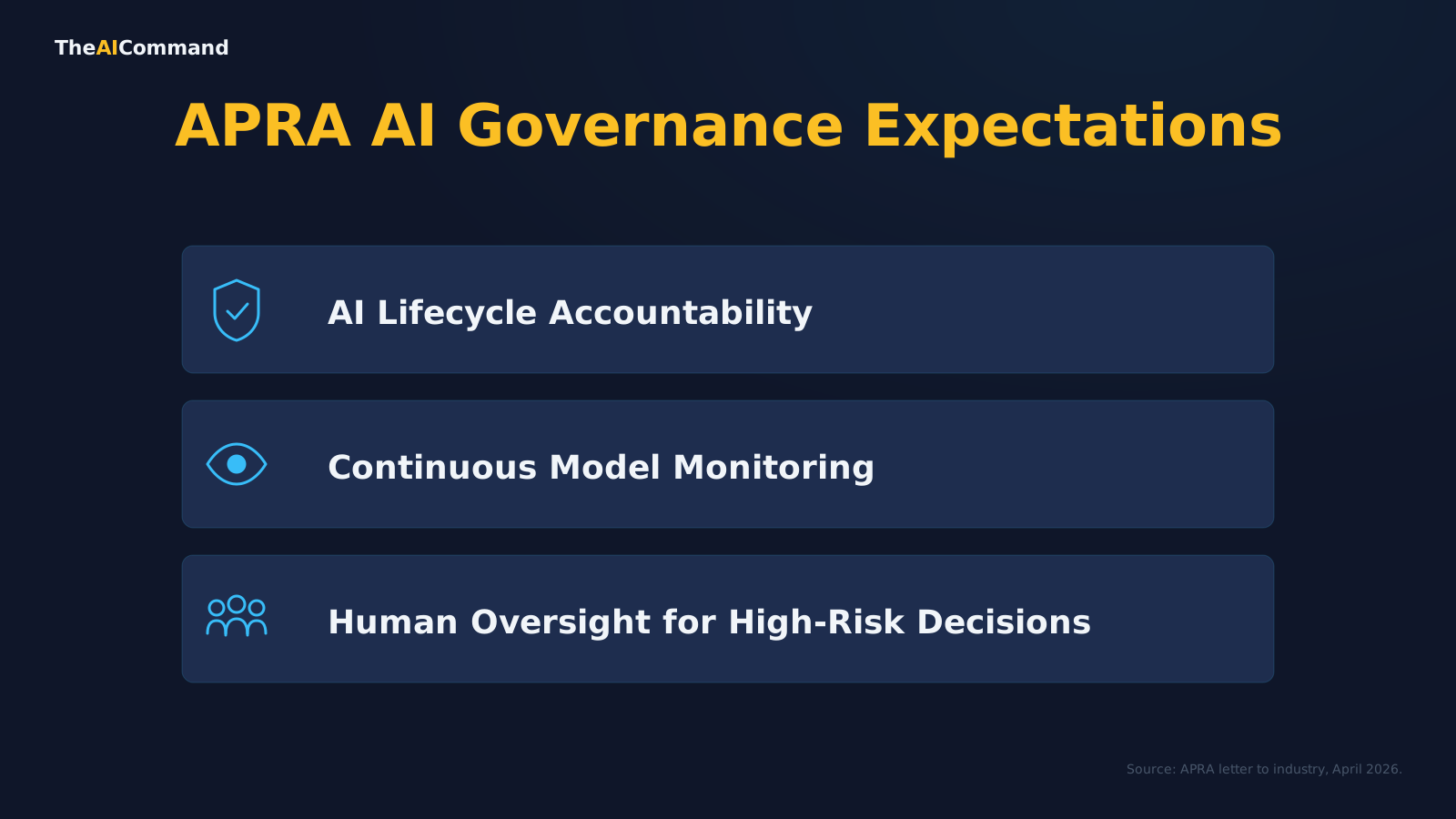
The Australian Prudential Regulation Authority (APRA) has issued a clear warning to regulated entities: artificial intelligence governance is failing to keep pace with rapid adoption. Following a targeted review of large banks, insurers, and superannuation trustees, APRA found that while entities are eager to harness productivity gains, many treat AI risk as "just another technology." This approach misses the distinct characteristics of predictive systems, adaptive behaviour, and inherent bias. APRA now expects boards to maintain sufficient technical literacy to provide effective challenge, and demands that entities establish consistent governance across the AI lifecycle, including human involvement for high-risk decisions and robust third-party oversight.
Source: apra.gov.au
HR: The surge of AI-generated workplace claims
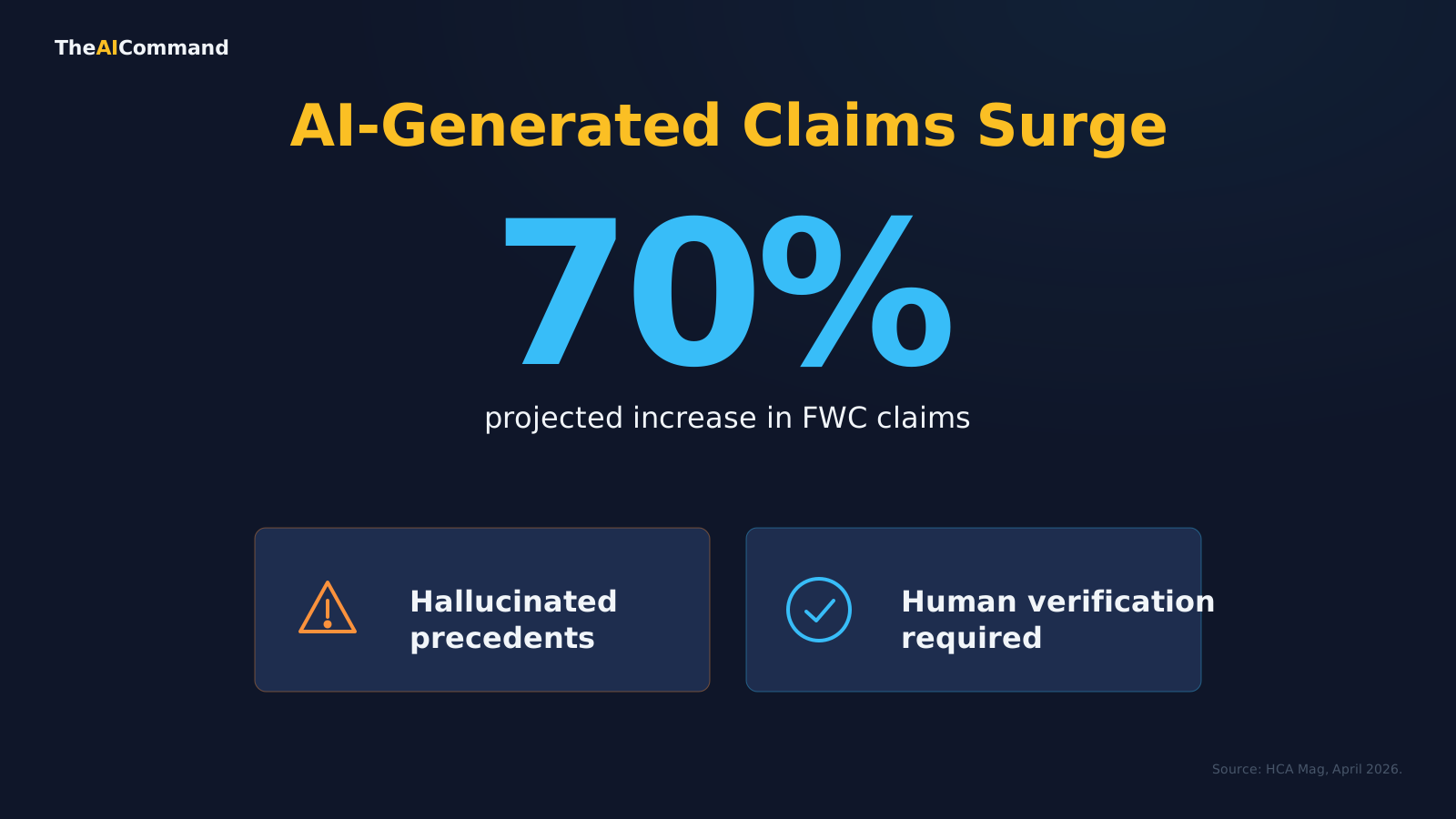
The Fair Work Commission is bracing for a 70 per cent increase in claims, driven largely by generative AI. Employees are increasingly using chatbots to draft unfair dismissal and general protections applications, often resulting in baseless allegations and hallucinated legal precedents that overwhelm human resources teams. In response, the Commission is moving toward mandatory "human verification" declarations, warning that applicants who blindly rely on AI-generated content may face cost consequences. Concurrently, the Federal Government has launched a tripartite AI Employment and Workplaces Forum to establish guardrails, while explicitly ruling out union veto powers over workplace AI deployment.
Source: hcamag.com
WC: AI exclusions and the rise of agentic triage
The workers' compensation sector is witnessing a rapid deployment of AI for First Notice of Loss (FNOL) triage, with tools like Gradient AI's ClaimVoyant assessing claim complexity the moment it is filed. However, this operational efficiency is colliding with a hardening insurance market. Major global insurers are beginning to introduce broad AI exclusions into liability policies to control their exposure to autonomous decision-making errors. This tension highlights a critical challenge for claims leaders: balancing the clear benefits of AI-driven triage against the emerging gaps in coverage when algorithms fail or produce biased outcomes.
Source: pymnts.com
2. Three actions GRC practitioners can take this month.
This month, we focus on Governance, Risk, and Compliance (GRC) practitioners navigating APRA's new expectations for AI risk management.
Transition from point-in-time assurance to continuous monitoring. Traditional sample-based audit methods are ill-suited for probabilistic models that learn, adapt, and degrade over time. GRC teams must implement continuous validation frameworks to detect model drift, bias, and control breakdowns before they impact critical operations or customer outcomes.
Audit your AI supply chain for concentration risk. APRA highlighted that many entities rely heavily on a single provider for multiple AI use cases, often without robust contingency planning. You must map your material third-party and fourth-party dependencies, ensuring that contractual arrangements provide sufficient transparency, audit rights, and clear exit strategies for critical AI providers.
Enforce technical controls over "shadow AI." Relying solely on policy direction to manage staff experimentation is no longer sufficient. GRC teams need to partner with IT security to implement enforceable technical restrictions, such as strong privileged access management and automated vulnerability discovery, ensuring that all AI usage operates within the board's approved risk appetite.
3. The governance gap in agentic AI procurement.
4. Prompt of the month.
This prompt produces a vendor risk assessment against APRA's new AI expectations. Use it when reviewing a new AI vendor proposal or pitch deck. The model returns a structured gap analysis and three contractual clauses you can take into negotiation.
You are a Senior Technology Risk Assessor at an Australian financial institution preparing a vendor risk assessment for senior management.

Vendor and service:
- Vendor name: [insert]
- Service description: [insert, for example generative AI customer service]
- Sector: [insert, for example general insurance, banking, superannuation]
- Internal sponsor: [insert role]

Reference frameworks:
- APRA letter to industry on AI (April 2026).
- CPS 230 operational risk management.
- Existing model risk management policy and third-party risk management policy of my organisation. I will paste extracts as needed.

Produce:
1. A structured risk assessment that scores the vendor against four domains: visibility over fourth-party dependencies, continuous model monitoring capabilities, contractual audit rights, and exit and substitution feasibility. Use a five-point scale per domain with a one-sentence justification.
2. A gap summary identifying where the existing procurement framework cannot adequately assess this vendor.
3. Three contractual clauses we should negotiate before approval. For each clause, include the rationale, suggested wording, and the risk if the vendor refuses.

Constraints:
- Do not invent obligations the inputs do not mention.
- Where evidence is insufficient, score amber and state what would be needed to score green.
- Flag any item that appears to create an APRA, ASIC, or Privacy Act exposure.
- Do not include vendor pricing or proprietary technical specifications.
How to use it. Paste this prompt into your approved enterprise AI tool. Replace the bracketed inputs with the specific vendor and service. Run. Compare the output against your existing TPRM policy. Use the three contractual clauses as the starting point for legal review and negotiation.
What to watch for. The output may include suggested clauses that are commercially unrealistic or legally unenforceable in Australia. Have your legal team review every clause before sending to the vendor. The risk assessment is a draft for discussion. Do not table it as a board-ready artefact without sign-off from your risk and compliance functions.
5. Glossary
- APRA
- Australian Prudential Regulation Authority. The statutory authority that regulates the Australian financial services industry.
- FNOL
- First Notice of Loss. The initial report made to an insurance provider following a loss, theft, or damage of an insured asset.
- FWC
- Fair Work Commission. Australia's national workplace relations tribunal.
- Gen AI
- Generative Artificial Intelligence. AI systems capable of generating text, images, or other media in response to prompts.
- GRC
- Governance, Risk, and Compliance. An integrated strategy for managing an organisation's overall governance, enterprise risk management, and compliance with regulations.
- Shadow AI
- The unsanctioned or unmanaged use of artificial intelligence tools by employees outside of IT or security oversight.
- TPRM
- Third-Party Risk Management. The process of analysing and controlling risks presented to an organisation by its third-party vendors or service providers.
- WC
- Workers' Compensation. A form of insurance providing wage replacement and medical benefits to employees injured in the course of employment.
6. References
- Australian Prudential Regulation Authority, APRA letter to industry on artificial intelligence (AI), 30 April 2026
- Grant Thornton Australia, Artificial intelligence, risk and governance: closing the gap between capability and control, 1 May 2026
- Human Resources Director, AI is flooding Australia's employment system, forcing a rethink of how law is practiced, April 2026
- Human Resources Director, Government moves to rein in workplace AI, April 2026
- Five Sigma, Fast Cover Deploys Five Sigma's AI-Native Claims Platform in Australia, April 2026
- PYMNTS, Big insurance backs away from AI risk and startups rush in, May 2026
- The Connector, Agentic AI Governance in Banking: Closing the Gap in 2026, May 2026